(This article originally appeared in the TAU-USA Spring 2024 Issue #111)
by Kathleen Molaro, OFS National FY/YA Animator
 100vw, 251px” data-recalc-dims=”1″>Young adults are often at a crossroads, not only regarding school, work, relationships, and family, but also in their faith life. They may be questioning or have even left the faith in which they were raised. Maybe for the first time they are experiencing a draw toward God. In some cases, a young person discovers a renewed faith-life, but doesn’t know how to nourish this new reality. Finding time and energy to give thought, let alone action, to their spiritual lives is often not a “luxury” they feel they can afford. We, as more “seasoned” Catholics, can offer simple ways to revitalize this important area of their lives.</p>
<p>Reflecting on the story of St. Francis and his experience of renewal and transformation, we know he was close to the same age as many of the young people we hope to serve. He too sought answers when he felt confused, and later when his heart was moved toward conversion. He too experienced tension between contemporary social mores and the role of faith.</p>
<p>Our world is bombarded with racial issues, drug and sex trafficking, terrorism, war and violence…and the list goes on. It’s no wonder we may feel overwhelmed, depressed, and hopeless. Like Francis, many of our youth are ready to explore new options and are open to refreshing and transforming opportunities. Our Rule calls us to “adopt appropriate means for growth in Franciscan and ecclesial life…” (art. 24) One way individuals and fraternities can respond is to provide encouragement, support, and times of respite to our young adult brothers and sisters. Here are some ideas that have proved successful:</p>
<ul>
<li>Evenings of Young people are thirsty for a relationship with God. Offer an evening of Taizé, a para-liturgical prayer service, adoration, or an experience in visio or lectio divina.</li>
<li>Encouraging Social media platforms are a great way to send thoughtful messages to the younger generations. Or, surprise them with heartfelt written cards or notes.</li>
<li>Ventures into Gather for a hike after Mass. Camping or backpacking takes more prep than a walk but is well worth the effort. Or meet for a picnic at a beach to mingle and build relationships.</li>
<li>Home-cooked Young people appreciate a good meal and perhaps even time to study together with “tutors” on hand.</li>
<li>Movie Gather to watch a thought provoking or simply fun movie. Our Rule states that “A sense of community will make them (us) joyful,” (art. 13) which is an important aspect of renewal.</li>
<li>Providing a half day, whole day, or even a weekend retreat is a dynamic means of rejuvenation and growth in holiness.</li>
<li>Plan a Justice, Peace, and Integrity of Creation Invite young adults to join you. Taking action when we feel powerless about the world’s ills rejuvenates our spirits.</li>
<li>Take a Even a short road trip to a local holy place can be a way to escape stress, pray together, and build community with fellow pilgrims. (See Previous Article)</li>
</ul>
<p>We can help our younger generation learn “Where there is rest and meditation, there is neither anxiety nor restlessness.” (Admonition XXVII, FA:ED, pg. 137) Of course, we are on our journey together, and as these are all multi-generational activities, we can be renewed right along with them!</p>
<p>https://www.secularfranciscansusa.org/2024/04/29/spiritual-renewal-for-young-catholics/</p>
</div><!-- .entry-content -->
</article><!-- #post-## -->
<article id=)
The Gospel Through a Franciscan Lens – 5th Sunday in Easter – Fr. Christopher
Fr. Christopher Panagoplos, TOR, explores the implications of Jesus’ identity as life-giving vine,
“The true vine of God—true life—is Jesus who with His sacrifice of love gives us salvation, opens to us the way to be part of this vine. And as Jesus remains in the love of God the Father, we too, wisely pruned by the word of the Master, if we remain profoundly united in Him, we become fruitful branches that bear an abundant harvest.”
the full text of this Sunday’s homily here: 5th Sunday in Easter – Fr. Christopher (text)
View his homily here: 5th Sunday in Easter – Fr. Christopher (video)

https://www.secularfranciscansusa.org/2024/04/27/the-gospel-through-a-franciscan-lens-5th-sunday-in-easter-fr-christopher/
FORMATION FRIDAY – JPIC #3 – April 26, 2024
(En español abajo) THE KOREAN TRANSLATION IS ALSO ATTACHED IN A SEPARATE PDF
Justice, Peace, and the Integrity of Creation #3 (Our series on the Rule will continue next month.)
Thank you to Joe Makely, OFS, National JPIC Animator for contributing this piece.
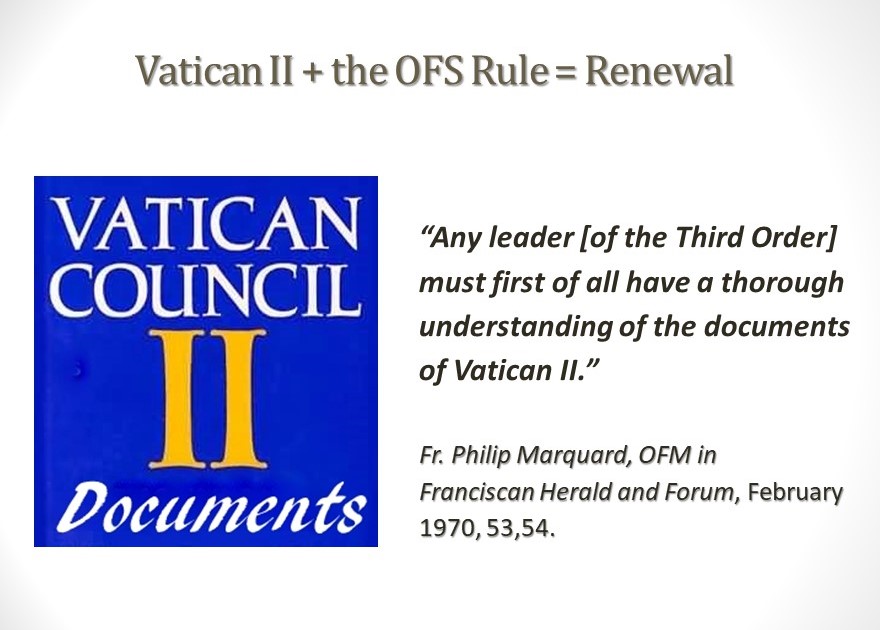
What does it mean that our Rule is influenced by Vatican II? It means we experienced a renewal.
At the close of Vatican II, the friars led the tertiaries to follow long sought after reforms. Their guidelines included the major documents of Vatican II about the laity. It was a very exciting time for the Third Order, when we finally gained our autonomy and an affirmation of the lay charism. One of the luminaries was Fr. Philip Marquard, OFM, who wrote in 1970: “Any leader [of the Third Order] must first of all have a thorough understanding of the documents of Vatican II. They must be read and reread so that one understands their true direction. The Church is not looking for mere adaptation, but renewal. There was nothing Pope John stressed more strongly than this point.” (See note 1)
The process of renewal included a very serious study of the early penitents, as described by Mrs. Pamona Pefanis, a Third Order participant from Canada who attended the gatherings in Assisi: “The strongest impression I received from the entire historians’ congress was that the 13th Century Penitenti were deeply involved in the social and political problems of their period, and that we must emerge from our cocoon of pious devotions and embroil ourselves in the problems of our day, bringing to them the same evangelical fervor that motivated the 13th Century members of our order.” (See note 2)
So that’s a partial picture of how we got those lively apostolic phrases in our Rule, like “promoting justice [with] courageous initiatives” and how we eventually got the Apostolic Commissions, which became (in accord with the 1st Order) Justice, Peace and the Integrity of Creation. The “how” of JPIC, our emphasis on loving dialogue and obedience, is central to what we do and that goes back to Francis himself, who said of his friars: “… they should be gentle, peaceful, and unassuming, courteous and humble, speaking respectfully to everyone, as is expected of them.” (See note 3) It did not mean departure from the vision of the founder, but was a call to restudy, reembrace that vision and adapt it to the needs of the current generation.
For discussion or to answer in your journal:
Question 1. In what ways is my fraternity bringing evangelical fervor to the problems of society?
Question 2. Have I read the documents of Vatican II myself, more than once? After reading them again, write down any questions you have and see if your group (or an outside source) will answer them for you.
Question 3. Does my region/fraternity have a JPIC animator? Discuss with the group who might be gifted in this area.
Challenge: Consider initiating a fraternity formation or workshop based on Article 14.1 of the General Constitutions: “They should commit themselves to a faith-inspired reflection on the Church, its mission in today’s world and the role of the Franciscan laity within it. They should take up the challenges and accept the responsibilities that this reflection will lead them to discover.” (See note 4)
Notes
1-Franciscan Herald and Forum, February 1970, 53,54.
2-A History of the Secular Franciscan Order in the United States, Volume IIA, p 409
3-ST. Francis of Assisi, Rule of 1223, Chapter 3, Omnibus of Sources, P.60
4-OFS General Constitutions, Article 14.1
Formación (Por favor, comparta con su fraternidad local)
La justicia, la paz y la integridad de la creación #3 (Nuestra serie sobre la Regla continuará el mes próximo.)
Le agradecemos a Joe Makely, OFS, Animador nacional de JPIC por contribuir esta materia.
¿Qué significa que nuestra Regla está influenciada por el Vaticano II? Significa que experimentamos una renovación.
Al final del Concilio Vaticano II, los frailes condujeron a los terciarios a seguir las reformas largamente buscadas. Sus directrices incluían los principales documentos del Vaticano II sobre los laicos. Fue un tiempo muy emocionante para la Tercera Orden, cuando finalmente obtuvimos nuestra autonomía y una afirmación del carisma laical. Una de las luminarias fue el P. Philip Marquard, OFM, quien escribió en 1970: “Cualquier líder [de la Tercera Orden] debe, en primer lugar, tener un conocimiento profundo de los documentos del Vaticano II. Hay que leerlos y releerlos para que uno entienda su verdadera dirección. La Iglesia no busca una mera adaptación, sino una renovación. No había nada que el Papa Juan enfatizara con más fuerza que este punto. (Vea la nota 1)
El proceso de renovación incluyó un estudio muy serio de los primeros penitentes, como lo describe la Sra. Pamona Pefanis, una participante de la Tercera Orden de Canadá que asistió a las reuniones en Asís: “La impresión más fuerte que recibí de todo el congreso de historiadores fue que los penitenti del siglo XIII estaban profundamente involucrados en los problemas sociales y políticos de su época, y que debíamos salir de nuestro capullo de devociones piadosas y enredarnos en los problemas de nuestro tiempo, llevándoles el mismo fervor evangélico que motivó a los 13ésimo Centenarias miembros de nuestra orden”. (Vea la nota 2)
Así que esa es una imagen parcial de cómo obtuvimos esas frases apostólicas vivas en nuestra Regla, como “promover la justicia [con] iniciativas valientes” y cómo finalmente obtuvimos las Comisiones Apostólicas, que se convirtieron (de acuerdo con la 1ª Orden) la justicia, la paz y la integridad de la creación. El “cómo” de JPIC, nuestro énfasis en Diálogo amoroso y obediencia, es central en lo que hacemos y que se remonta al mismo Francisco, que dijo de sus frailes: “… Deben ser gentiles, pacíficos y modestos, corteses y humildes, hablando con respeto a todos, como se espera de ellos. (Vea la nota 3) El Concilio Vaticano II no significó apartarse de la visión del fundador, sino que fue un llamado a reestudiar, retomar esa visión y adaptarla a las necesidades de la generación actual.
Para platicar o contestar en su diario:
Pregunta 1. ¿Cómo está mi fraternidad llevando fervor evangélico a los problemas de la sociedad?
Pregunta 2. ¿He leído yo mismo los documentos del Vaticano II, más de una vez? Después de leerlos otra vez, apunte las preguntas que tenga y vea si alguien en su grupo (o un “experto” de afuera) tenga las respuestas.
Pregunta 3. ¿Mi región/fraternidad tiene un animador de JPIC? (Hablen con su grupo para ver si pueden pensar en quién tiene talento en esta área.)
Desafío: Considerar la posibilidad de iniciar una formación o taller de fraternidad basado en el artículo 14, p1 de las Constituciones Generales: “Deben comprometerse a una reflexión inspirada en la fe sobre la Iglesia, su misión en el mundo de hoy y el papel de los laicos franciscanos dentro de ella. Deben asumir los desafíos y aceptar las responsabilidades que esta reflexión les llevará a descubrir”. (Vea la nota 4)
Notas
1-Heraldo y Foro Franciscano, febrero de 1970, 53,54.
2-Una historia de la Orden Franciscana Seglar en los Estados Unidos, Volumen IIA, p 409
3-San Francisco de Asís, Regla de 1223, Capítulo 3, Ómnibus de Fuentes, p.60
4-Constituciones Generales de la OFS, artículo 14, p 1
Diane F. Menditto, OFSVice Minister, National Fraternity, Secular Franciscan Order USAListen – Discern – Go Forth National Theme 2022-2025
The Gospel Through a Franciscan Lens – Good Shepherd Sunday – Fr. Christopher
Fr. Christopher Panagoplos, TOR, describes how well Jesus knows his sheep, knows our stories, and how, in spite of that intimate knowledge, He still chooses to save us and be with us on our journey.
“Jesus, the Good Shepherd is our model shepherd. The one who calls us is the one we follow. ‘Lord,
You lead, I’ll imitate, because I place my trust in You.’ Shepherd me, lead me, guide me.”
the full text of this Sunday’s homily here: Good Shepherd Sunday – Fr. Christopher (text)
View his homily here: Good Shepherd Sunday – Fr. Christopher (video)

https://www.secularfranciscansusa.org/2024/04/24/the-gospel-through-a-franciscan-lens-good-shepherd-sunday-fr-christopher/
Praying in Holy Places
(This article originally appeared in the TAU-USA Spring Issue #111)
by Fr. Jerome Wolbert, OFM
National Spiritual Assistant
 viewed from the Place of<br />
the Resurrection.</p>
<p> ” data-medium-file=”https://i0.wp.com/www.secularfranciscansusa.org/wp-content/uploads/Franciscan-Holy-Land-Monastery-015.jpg?fit=240%2C300&ssl=1″ data-large-file=”https://i0.wp.com/www.secularfranciscansusa.org/wp-content/uploads/Franciscan-Holy-Land-Monastery-015.jpg?fit=800%2C1000&ssl=1″ class=” wp-image-35136″ src=”https://i0.wp.com/www.secularfranciscansusa.org/wp-content/uploads/Franciscan-Holy-Land-Monastery-015.jpg?resize=165%2C207&ssl=1″ alt=”Calvary (replica) viewed from the Place ofthe Resurrection.” width=”165″ height=”207″ srcset=”https://i0.wp.com/www.secularfranciscansusa.org/wp-content/uploads/Franciscan-Holy-Land-Monastery-015.jpg?resize=200%2C250&ssl=1 200w, https://i0.wp.com/www.secularfranciscansusa.org/wp-content/uploads/Franciscan-Holy-Land-Monastery-015.jpg?resize=240%2C300&ssl=1 240w, https://i0.wp.com/www.secularfranciscansusa.org/wp-content/uploads/Franciscan-Holy-Land-Monastery-015.jpg?resize=400%2C500&ssl=1 400w, https://i0.wp.com/www.secularfranciscansusa.org/wp-content/uploads/Franciscan-Holy-Land-Monastery-015.jpg?resize=600%2C750&ssl=1 600w, https://i0.wp.com/www.secularfranciscansusa.org/wp-content/uploads/Franciscan-Holy-Land-Monastery-015.jpg?resize=768%2C960&ssl=1 768w, https://i0.wp.com/www.secularfranciscansusa.org/wp-content/uploads/Franciscan-Holy-Land-Monastery-015.jpg?fit=800%2C1000&ssl=1 800w” sizes=”(max-width: 165px) 100vw, 165px” data-recalc-dims=”1″></p>
<p id=) Calvary (replica) viewed from the Place of
Calvary (replica) viewed from the Place ofthe Resurrection.
For many people, a pilgrimage is a time of renewal. Going to a specific, holy place, often walking more than usual, praying in a place that is made significant by who has been there and what has happened in the past, any one of these things would help us to reflect on our lives, and a pilgrimage usually has all of them.
Living at the Franciscan Monastery of the Holy Land in America, I am aware that our church and monastery were built 125 years ago when it took 45 days to cross the Atlantic and travel through Europe, across the Mediterranean, up through Egypt to the place where Jesus walked and “pitched his tent” among us (John 1).
While today it is possible to fly from DC to Tel Aviv in 11 hours, it is not advisable during this time of war to travel there. So even today there are reasons beyond cost preventing our walking where Jesus walked. That said, the Monastery where I live has many replicas of Holy Land shrines, precisely to answer this difficulty.
 100vw, 166px” data-recalc-dims=”1″></p>
<p id=) Mt. St. Sepulcher Church, Franciscan
Mt. St. Sepulcher Church, FranciscanMonastery of the Holy Land in America,
Washington, DC. Photos used with permission.
St. Jerome described the Holy Land as “the Fifth Gospel,” by which he meant that being in the Holy Land, seeing and praying and walking, helps a person to better understand the written Gospels. Many of the Christians who live or have lived in the Holy Land express such appreciation for being in this “special place.” I remember when I was there years ago, climbing Mount Tabor and praying in the Place of the Resurrection. When I was a child my pastor would describe what it was like to be on the road from Jerusalem down to Jericho.
But the nature of a pilgrimage is that we eventually return home—changed, hopefully, but still we return. And so, I bring my memory of Mount Tabor and the Empty Tomb home with me. The priest’s preaching is changed by his experience on that lonely road where the Good Samaritan found the man beaten by thieves.
The Holy Land is not the only place of pilgrimage. People journey to holy sites all over the world, and the Monastery of the Holy Land in DC is one of those places. Just today as I finish writing this, there is a group now on our grounds.
When the Church was but a few hundred years old, Egeria went on a pilgrimage to the Holy
Land. We have her recollections today, so helpful to those who study the history of the Church,
pilgrimages, or Liturgy. She describes processions and worship that with some adaptation has
persisted to this day. Some of these processions are followed not only in the Holy Land but
also replicated in our Monastery. But the big question for our keeping Lent and celebration of
the Resurrection is what do I bring home, what do I replicate in my heart and in my life?
https://www.secularfranciscansusa.org/2024/04/22/praying-in-holy-places/