Please share with your local fraternity
Documents of the Secular Franciscan Order
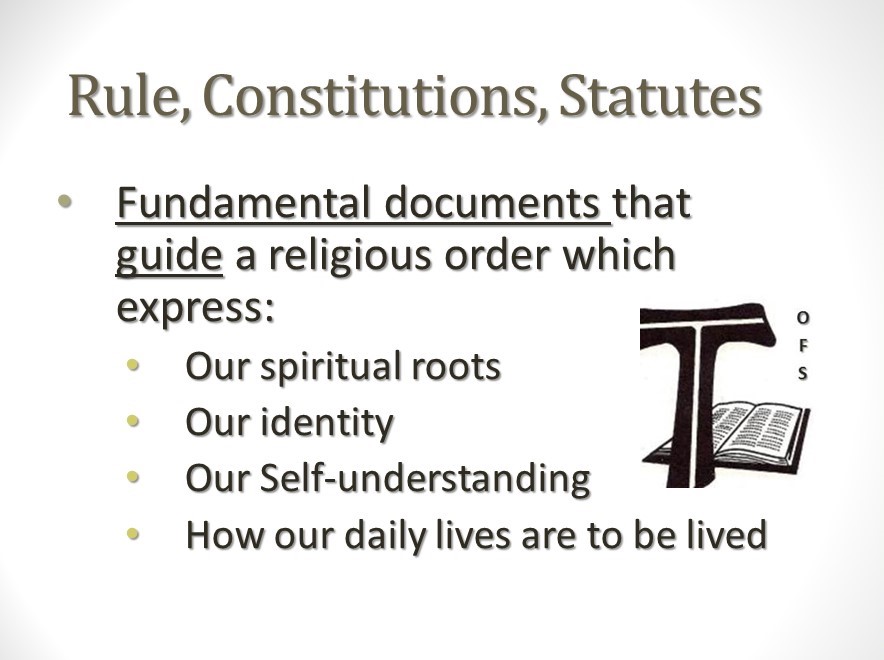
We have recently completed a series of Formation Fridays delineating each section of our Rule and providing commentary. We hope that each local fraternity has been encouraged to use those posts as a basis for ongoing formation on the Rule. It is also very important for each member (especially those serving on Councils) to become familiar with our General Constitutions and National Statutes since they help us to live out the Rule and to navigate most (or many) of the situations (both good and challenging) we encounter in fraternity life.
+ We have one Rule with a Prologue and 26 articles (Calling the articles “rules” implies a restrictive list rather than a way of life!)
Religious orders and institutes follow the charism of their founders. Generally, the founder writes or inspires the Rule of a particular community. The intention of a Rule is that the members of the order will have the inspiration of the founder to live by when he or she is no longer among them. The Rules of religious communities, although requiring approval by the Holy See, are general, most of the time without the specifics that will be necessary to govern a religious community and to live out the Rule authentically.
“The word ‘rule’ (Latin: regula, Greek: kanon) literally means a standard by which something can be tested. In the case of religious or secular institutes it establishes the spiritual foundation and identity of the community. It is the norm which all the other documentation of the institutes – constitutions, statutes, etc. – are measured. Approbation of rules for religious and secular institutes in the Church is reserved to the Holy See.” (See Michael Higgins, TOR, “Importance of Familiarization with the Documents of the Secular Franciscan Order.”)
A Rule is not a list or set of “rules” but the outline of a plan or way of life to help us live out the vision of the founder. In our case the vision for Secular Franciscans is put forth in a Prologue and 26 articles.
+We have General Constitutions which help us to carry out the Rule and govern the Order.
The Constitutions (also approved by the Holy See) are much more specific about the way the Rule should be interpreted and carried out. Here is an explanation by Fr. Lester Bach, OFM Cap., in the Franciscan Journey p. 106:
“The SFO (OFS) Constitutions contain comments on the Rule and insights for understanding the Rule. The Constitutions point out structures to help the Rule come alive in community life. The Constitutions spell out things like canonical procedures and structural developments. They deal with issues of lukewarm members and the role of the servant leaders
of fraternity life (councils). The Constitutions present ways and means to deal with issues that may arise in fraternity life.”
Ministers and Councils should take note that before difficult decisions are made about fraternity life or about individual members, the Constitutions should be consulted. Much confusion can be avoided if this suggestion is always followed.
+National Statutes are developed by the National Fraternity to aid in governing all levels of the National Fraternity.
Article 29.3 of the General Constitutions calls for each national fraternity to develop its own statutes. “National Statutes should indicate the criteria for the organization of the OFS in the nation. The application of these criteria is left to the prudent judgement of those responsible for the Fraternities concerned and of the National Council.” National Statutes are not approved by the Holy See but must be approved by the council of the higher level. (CIOFS) The statutes of a particular country take into account the culture and customs of that country and add further particulars to what is laid out in the Constitutions. Statutes may be more restrictive than the Constitutions, but not less restrictive.
Every member should have access to the Rule, Constitutions, and Statutes. You will find our documents in their latest translations on our national website and on the CIOFS website. (Links below)
OFS Governing Documents: https://www.secularfranciscansusa.org/ongoing-formation-resources/#38871d71653d8dcec Official Documents of the OFS https://ciofs.info/library/official-documents/
Questions for discussion or to answer in your journal:
+When was the last time you read our Rule and Constitutions? Please take some time to read them: Choose two or three areas to focus on in the next week. Continue this practice until you have read both documents completely.
+List some of the items that stood out to you as you were completing the above “labor of love.”
+How does your fraternity use the Rule and Constitutions for ongoing formation? Make a list of ideas for their use and submit it to your local council or fraternity formation team.
+Resolve to pray one article of the Rule each day!
+++++++++++++++++++++++++++++++++++++
Formación 14 de junio de 2024 Por favor comparta con su fraternidad local
Documentos de la Orden Franciscana Seglar
Recientemente hemos completado una serie de materiales delineando cada sección de nuestra Regla y proporcionando comentarios. Esperamos que cada fraternidad local se haya animado a utilizar esas materias como base para la formación permanente sobre la Regla. También es muy importante que cada miembro (especialmente los que forman parte de los Consejos) se familiarice con nuestras Constituciones Generales y Estatutos Nacionales, ya que nos ayudan a vivir la Regla y a navegar la mayoría (o muchas) de las situaciones (tanto buenas como desafiantes) que encontramos en la vida de fraternidad.
+ Tenemos una Regla con un Prólogo y 26 artículos (¡Llamar a los artículos “reglas” implica una lista restrictiva en lugar de una forma de vida!)
Las órdenes e institutos religiosos siguen el carisma de sus fundadores. Generalmente, el fundador escribe o inspira la Regla de una determinada comunidad. La intención de una Regla es que los miembros de la orden tengan la inspiración del fundador para vivir cuando él o ella ya no esté entre ellos. Las Reglas de las comunidades religiosas, aunque requieren la aprobación de la Santa Sede, son generales, la mayoría de las veces sin las especificidades que serán necesarias para gobernar una comunidad religiosa y vivir auténticamente la Regla.
“La palabra ‘regla’ (latín: regula , griego: kanon ) literalmente significa un estándar por el cual algo puede ser probado. En el caso de institutos religiosos o seglares establece el fundamento espiritual y la identidad de la comunidad. Es la norma por la que se mide toda la demás documentación de los institutos – constituciones, estatutos, etc. La aprobación de las normas para los institutos religiosos y seglares de la Iglesia está reservada a la Santa Sede”. (Ver Michael Higgins, TOR, “Importancia de la familiarización con los documentos de la Orden Franciscana Seglar”).
Una Regla no es una lista o un conjunto de “reglas,” sino el esquema de un plan o forma de vida para ayudarnos a vivir la visión del fundador. En nuestro caso, la visión para los franciscanos seglares se expone en un prólogo y 26 artículos.
+Tenemos Constituciones Generales que nos ayudan a llevar a cabo la Regla y a gobernar la Orden.
Las Constituciones (también aprobadas por la Santa Sede) son mucho más específicas sobre la forma en que debe interpretarse y llevarse a cabo la Regla. Aquí hay una explicación del P. Lester Bach, OFM Cap., en La jornada franciscana p. 106:
“Las Constituciones OFS (OFS) contienen comentarios sobre la Regla e ideas para comprender la Regla. Las Constituciones señalan estructuras para ayudar a que la Regla cobre vida en la vida comunitaria. Las Constituciones explican cosas como procedimientos canónicos y desarrollos estructurales. Se ocupan de cuestiones de los miembros tibios y el papel de los líderes servidores de la vida de la fraternidad (consejos). Las Constituciones presentan formas y medios para tratar los problemas que pueden surgir en la vida de la fraternidad. En cierto sentido, las Constituciones se convierten en un amplio comentario sobre la vida franciscana seglar. regla y vida.”
Los Ministros y los Consejos deben tomar nota de que antes de tomar decisiones difíciles sobre la vida de la fraternidad o sobre cada uno de los miembros, se deben consultar las Constituciones. Se puede evitar mucha confusión si siempre se sigue esta sugerencia.
+Los Estatutos Nacionales son desarrollados por la Fraternidad Nacional para ayudar a gobernar todos los niveles de la Fraternidad Nacional.
El artículo 29.3 de las Constituciones Generales llama a cada fraternidad nacional a desarrollar sus propios estatutos. “Los Estatutos nacionales deben indicar los criterios de organización de la OFS en la nación. La aplicación de estos criterios se deja al prudente juicio de los Responsables de las Fraternidades interesadas y del Consejo nacional.” Los Estatutos Nacionales no son aprobados por la Santa Sede sino que deben ser aprobados por el consejo del nivel superior. (CIOFS) Los estatutos de un país en particular tienen en cuenta la cultura y las costumbres de ese país y añaden más detalles a lo dispuesto en las Constituciones. Los Estatutos pueden ser más restrictivos que las Constituciones, pero no menos restrictivos.
Cada miembro debe tener acceso a la Regla, a las Constituciones y a los Estatutos. Encontrará nuestros documentos en sus últimas traducciones en nuestro sitio web nacional y en el sitio web del CIOFS. (Enlaces a continuación)
Documentos rectores de la OFS : https://www.secularfranciscansusa.org/ongoing-formation-resources/#38871d71653d8dcec Documentos Oficiales de la OFS: https://ciofs.info/es/library/official-documents/
Preguntas para discutir o responder en tu diario:
+ ¿Cuándo fue la última vez que leyó nuestra Regla y Constituciones? Tómese un tiempo para leerlos: elija dos o tres áreas en las que concentrarse la próxima semana. Continúe con esta práctica hasta que haya leído ambos documentos por completo.
+ Enumere algunos de los elementos que se destacaron para usted mientras completaba el “trabajo de amor” anterior.
+¿Cómo utiliza su fraternidad la Regla y las Constituciones para la formación permanente? Haga una lista de ideas para su uso y envíela a su consejo local o al equipo de formación de la fraternidad.
+ ¡Resuelva rezar un artículo de la Regla cada día!

 100vw, 261px” data-recalc-dims=”1″></p>
<p id=) Kathryn Swegart – Formation Director, Jordan Smith, and Dean Astumian – Minister of St. John the Baptist Fraternity in Winslow, Maine.
Kathryn Swegart – Formation Director, Jordan Smith, and Dean Astumian – Minister of St. John the Baptist Fraternity in Winslow, Maine.
 100vw, 214px” data-recalc-dims=”1″></p>
<p id=) The Original San Damiano Crucifix
The Original San Damiano Crucifix