Please share with your fraternities (En español abajo) Korean translation attached in separate PDF.
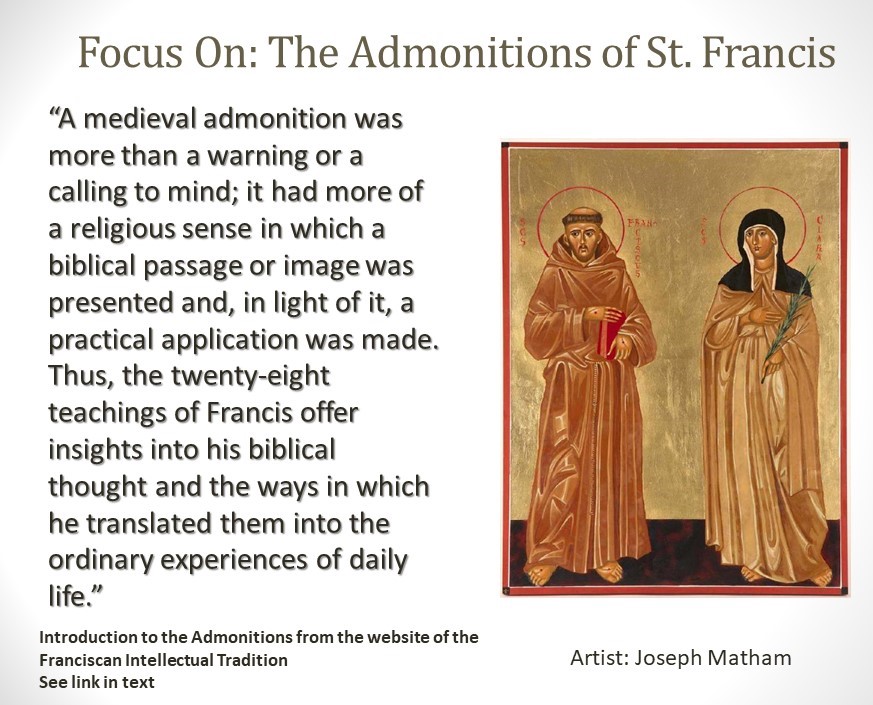
Focus on the Admonitions (#10)
[X. Castigating the Body]1There are many people who, when they sin or are injured, frequently blame the enemy or their neighbor. Gn 3:12 Gn 3:13 2But it is not so, because each one has the enemy in his power, that is his body through which he sins.
3Blessed is the servant, Mt 24:46 then, who always holds captive the enemy delivered into his power and wisely safeguards himself from him; 4because, as long as he does this, no other enemy visible or invisible will be able to harm him.
From the Prologue to our Rule
“1All those men and women who are not living in penance, 2who do not receive the Body and Blood of our Lord Jesus Christ, 3who practice vice and sin and walk after the evil concupiscence and the evil desires of their flesh, 4who do not observe what they have promised to the Lord, 5and who in their body serve the world and the cares of this life: 6They are held captive by the devil, whose children they are, and whose works they do (Jn 8:41) 7They are blind because they do not see the true light, our Lord Jesus Christ.”
“11See you blind ones, deceived by your enemies: the flesh, the world and the devil, because it is sweet for the body to sin and it is bitter to serve God, 12for every vice and sin flow and proceed from the human heart (Mt 15:19, Mk 7:21) as the Lord says in the gospel. 13And you have nothing in this world or in that to come. 14And you think you will possess this world’s vanities for a long time, but you are deceived because a day and hour will come of which you give no thought, which you do not know, and of which you are unaware when the body becomes weak, death approaches, and it dies a bitter death.”
As you read Admonition X and the two paragraphs from the Prologue to our Rule (Concerning Those Who Do Not Do Penance), please consider the following questions. Record your thoughts in your journal or share them in a small group with other fraternity members.
+Blaming others has become the answer many in today’s society use when explaining why they have done something wrong. They say, “Yes, but…” Or “That’s how I was raised.” Or “No one told me/taught me.” Or “That’s just the way I am.”
–Explain the advice that St. Francis gives us on this topic in Admonition 10.
–How does he speak to us in the Prologue to our Rule to follow up on this advice?
–How often are we tempted to blame others for the wrongs we commit? Can you think of an example?
–Which Franciscan virtues can help us to avoid the temptation to blame others?
–What do I want to change about myself when it comes to blaming others?++++++++++++++++++
Formación 13 de febrero, 2026
Enfoque en las admoniciones de San Francisco (Admonición X)
https://www.franciscanos.org/esfa/escritossf.html#adm[Cap. X: Del castigo del cuerpo]
1Hay muchos que, cuando pecan o reciben una injuria, con frecuencia acusan al enemigo o al prójimo. 2Pero no es así, porque cada uno tiene en su poder al enemigo, es decir, al cuerpo, por medio del cual peca. 3Por eso, bienaventurado aquel siervo (Mt 24,46) que tiene siempre cautivo a tal enemigo entregado en su poder, y se guarda sabiamente de él; 4porque, mientras haga esto, ningún otro enemigo, visible o invisible, podrá dañarle.
http://franciscanos.org/esfa/adm-ae.html
Del Prólogo de nuestra regla
“Por el contrario, todos aquellos y aquellas que no viven en penitencia, ni reciben el cuerpo y la sangre de nuestro Señor Jesucristo, y viven en el vicio y el pecado, y van tras la mala concupiscencia (cf. Col 3,5) y los malos deseos de su carne (cf. Gál 5,16), y no cumplen lo que prometieron al Señor, y sirven corporalmente al mundo con los deseos carnales (1Pe 2,11) y con los afanes de este mundo (cf. Mt 13,22; Lc 21,34) y las preocupaciones de esta vida, engañados por el diablo, cuyos hijos son y cuyas obras hacen (cf. Jn 8,41), son unos ciegos (cf. Mt 15,14), pues no ven al que es la luz verdadera (cf. Jn 1,9), nuestro Señor Jesucristo.”
“Mirad, ciegos, engañados por vuestros enemigos, la carne, el mundo y el diablo, que al cuerpo le es dulce pecar y amargo servir a Dios; pues todos los vicios y pecados salen y proceden del corazón del hombre, como dice el Señor en el Evangelio (cf. Mc 7,21.23; Mt 15,18-19). Y nada tenéis en este mundo ni en el futuro. Pensáis poseer por mucho tiempo las vanidades de este mundo, pero estáis engañados, porque vendrán el día y la hora que no pensáis, que desconocéis e ignoráis (cf. Mt 24,44; 25,13): enferma el cuerpo, se acerca la muerte, y se muere así con muerte amarga (1Sam 15,32).”
Mientras lee la Admonición X y los dos párrafos del Prólogo de nuestra Regla (De los que no hacen penitencia), considere las siguientes preguntas. Escriba sus pensamientos en su diario o compártalos en un grupo pequeño con otros miembros de la fraternidad.
+Culpar a los demás se ha convertido en la respuesta que muchos en la sociedad actual utilizan para explicar por qué han hecho algo mal. Dicen: “Sí, pero…” o “Así me criaron.” O “Nadie me dijo/me enseñó.” O “Así soy yo.”
–Explique el consejo que nos da San Francisco sobre este tema en la Admonición 10.
–¿Cómo nos habla en el Prólogo de nuestra Regla para dar seguimiento a este consejo?
–¿Con qué frecuencia nos sentimos tentados a culpar a otros por los errores que cometemos? ¿Puede pensar en un ejemplo?
–¿Qué virtudes franciscanas pueden ayudarnos a evitar la tentación de culpar a los demás?
–¿Qué quiero cambiar de mí mismo cuando se trata de culpar a los demás?
Diane F. Menditto, OFSVice Minister, National Fraternity, Secular Franciscan Order USA“Go into the world and proclaim the good news.”National Theme 2025-2028
A Pilgrimage into Creation and Conversion
(This article originally appeared in the TAU-USA Fall 2025 Issue #117)
By Sharon Winzeler, OFS • Communications Committee Chair
As part of their National Chapter, on Friday, September 12th, members of the Secular Franciscan Order set aside time for a half-day pilgrimage to St. Anthony Shrine in Ellicott City, MD. The site has long stood as a place of prayer, reflection, and Franciscan witness. Operated by the Conventual Franciscan Friars, the shrine rests on 236 wooded acres, offering both spiritual and natural beauty.
Founded in 1928 as a novitiate, the shrine’s architecture was inspired by the sacred convent of the Poor Clares in Assisi. Its very foundations connect it to local history, incorporating small pieces of marble left over from the construction of the U.S. Capitol and the Washington Monument.
Within its chapels are relics of St. Anthony of Padua as well as the Polish saints St. Maximilian Kolbe, St. Faustina, and St. Pope John Paul II. Winding walking trails throughout the grounds invite pilgrims to encounter creation in prayerful stillness.
The visit also highlighted the friars’ environmental ministry, Little Portion Farm, a living sign of Franciscan care for both the poor and the earth. This three-acre farm operates as an agro-ecosystem, with a diversity of plants and hab-itats that sustain the land while producing healthy food. Since the farm’s founding in 2019, more than 100,000 pounds of produce have been harvested and donated to those in need.
Little Portion Farm’s reach extends beyond its fields. The ministry supports a 13-week culinary program at the Fran-ciscan Center in Baltimore, where students learn valuable skills while preparing meals for those experiencing hunger as well as catering outside meals. During the Chapter visit, participants were treated to a dinner prepared by the Center – salmon accompanied by fresh salad, vegetables, and dessert – a taste of the Farm’s mission in action.
At the center of the day was the celebration of Mass, where Fr. Jude Winkler, OFM Conv., offered a homily that connected the pilgrimage experience to the daily rhythm of Secular Franciscan life. Fr. Jude began with a central question: “How can we convert other people?” His answer was both simple and challenging: “By our own conver-sion.” Transformation, he reminded the Secular Franciscans, is not imposed but inspired. When others see the Gospel alive in us, they are naturally drawn toward God.
On the subject of prayer, he emphasized sincerity over rigidity. “Decide which prayers work for you and pray them,” he said, even suggesting an “Early Bird Special” for evening prayer: “It’s okay to pray your evening prayer at 4:30 p.m.” What matters most, he reminded them, is faithfulness of heart.
He then turned to the delicate practice of fraternal correction, urging discernment and humility. Before offering correction, one must ask: Why am I doing this? Pointing to Mary’s visitation to Elizabeth, he explained that Mary went not to escape but to lovingly share the joy of God’s work. Correction, he said, should likewise spring from love, guided by the Holy Spirit, and offered at the right time.
Fr. Jude encouraged listeners to examine their own expectations when considering fraternal correction. “Is what they are doing really wrong, or do you have different or unrealistic expectations?” he asked. Even the uncertainty of whether to be gentle or firm can itself be turned into prayer. “It’s good to be confused. Offer the confusion as a prayer.”
Returning to his central theme, Fr. Jude underscored that holiness is not perfection but honesty before God. “You might not be perfect, but you are considering God’s call. Consider it humility and resolve. We are what we are, and we’ll be the best we can.”
The half-day away became more than an excursion. The pilgrimage deepened respect for the Franciscan vocation by calling attention to reverence for creation, solidarity with the poor, and a continuing call to personal conversion. From the witness of Little Portion Farm to the inspiration of Fr. Jude’s homily, the day wove together earth and prayer, fraternity and mission, reminding all present that God’s grace is found both in the soil beneath our feet and the conversion of our hearts.
https://www.secularfranciscansusa.org/2026/02/a-pilgrimage-into-creation-and-conversion/
Personal Experiences from the Opening of the 8th Centenary of the Transitus of St. Francis
by Kathy Vore, OFS
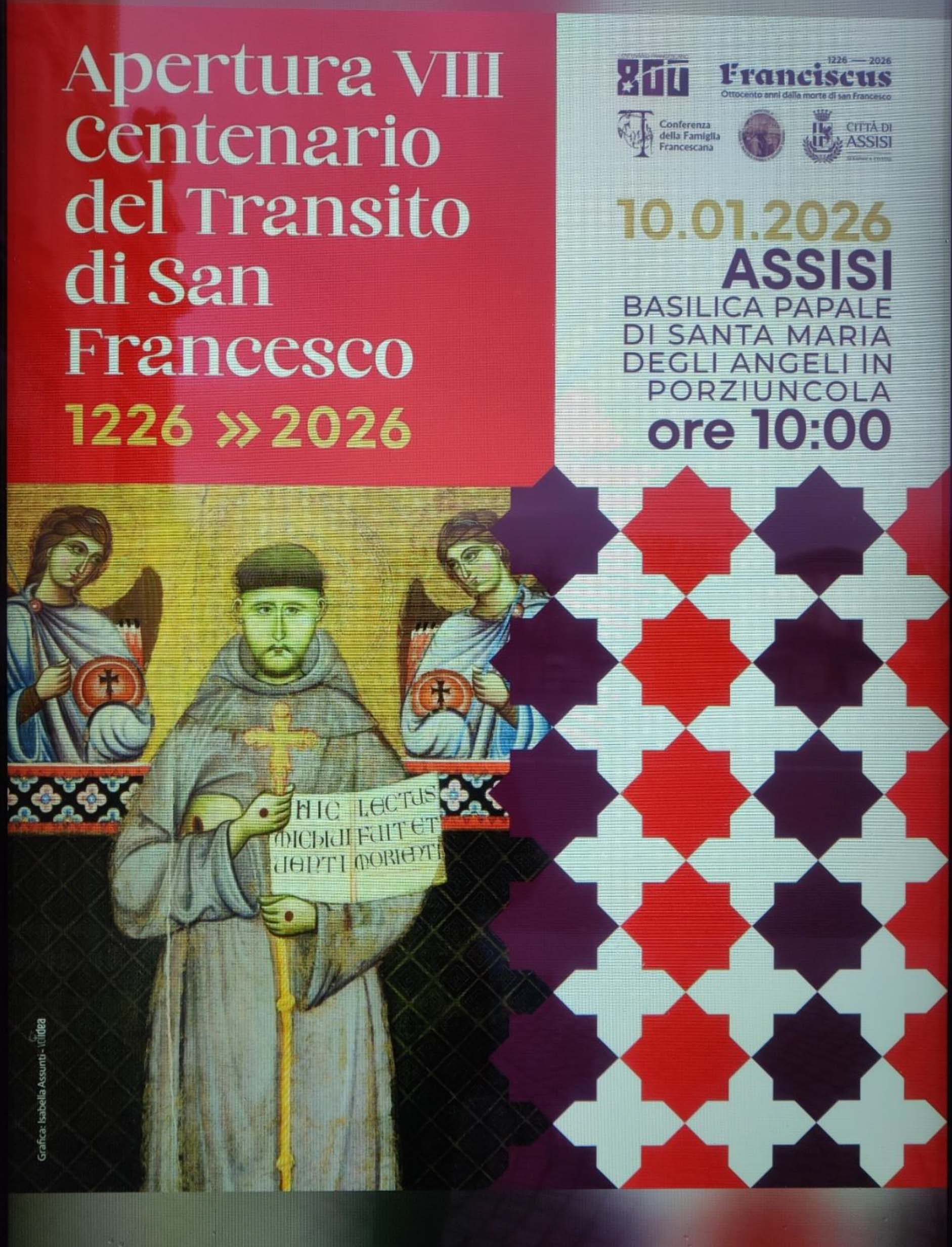
Photo by Kathy Vore, OFS
Italy joyfully celebrates every Christmas season from the first Sunday of Advent through Epiphany, January 6, unlike the American Catholic Church, which celebrates Epiphany on the nearest Sunday. Italians recognize Epiphany as a national holiday.
As American Secular Franciscans, my husband and I have been blessed to spend the Christmas season in Assisi, Italy, for the past three years. It is a time to step back from daily commitments, reflect and pray, attend daily Mass, and walk the steep, cobblestone streets of historic Assisi, where the Piazza is the only flat surface and all routes either lead up or down steep stairways or narrow, picturesque streets. Most evenings we dine out, enjoying freshly prepared foods unique to Umbria along with tasty local house wines.
Despite often large groups of day-trippers, Assisi manages to retain a sense of calm and peace unlike any other destination. This past December, an electronic billboard on the road into Assisi read, “Benvenuti ad Assisi Citta Della Pace,” or Welcome to Assisi, the City of Peace. We saw these welcoming words from the Assisi Link bus we rode up the hill from the train station and knew we had arrived at our spiritual home.
On the first Saturday following Epiphany, January 10, 2026, Assisi officially opened the 8th Centenary of the Transitus of St. Francis with a beautiful ceremony in the Basilica of Santa Maria degli Angeli, about three kilometers down the hill from historic hilltop Assisi, where we were staying. The Basilica contains the Portiuncula, and the ceremony took place in front of and inside of the tiny chapel of St. Francis.
We only learned of this event a few days earlier and took the statement that seating would be limited seriously. So, on a cold, damp Saturday morning, we rode the Assisi Link bus down the hill, arriving at the Basilica an hour before the doors were to open. We attended the 8 o’clock Mass in a side chapel of the Basilica, then returned to the main entrance, where we encountered a friend from the English-speaking community. Promptly at 9 o’clock, the Basilica doors opened, and we were soon inside and seated! We were going to experience this moment of history – the opening of the 8th Centenary of the Transitus for which Pope Leo XIV announced a special Franciscan Jubilee Year. What a blessing.
The ceremony began promptly at 10 o’clock (and was live-streamed) with a procession led by the Bishop of Assisi, H.E. Mons. Domenico Sorrentino, and the Mayor of Assisi, Walter Stoppini, who carried an unlit Easter Candle. The two processed into the Portiuncula, where together they lit the candle, signifying the light of the Risen Christ, as well as the light of peace and forgiveness, a direct reference to the verse about Light in the Canticle of the Creatures. Shortly before his death in 1226, Francis sent friars to speak to the then Bishop of Assisi, Guido II, and the mayor, who were in a dispute. As a result of Francis’s outreach, the two men reconciled and since then the two offices have maintained a special relationship. What began as reconciliation 800 years ago continues to this day.
The hour-and-a-half-long exquisite ceremony included numerous participants, each with a specific role. The Icon of the Master of St Francis (the oldest image of the Saint in the Portiuncula) could be observed near the entrance to the Portiuncula, having been moved from its usual place in the Sanctuary Museum. The Icon is a wooden panel on which Francis’ mortal remains were placed when they were moved to the town of Assisi for their first burial.
The procession then began moving around the Basilica, pausing at six locations, each for a moment of reflection and prayer, marking the six stages of Francis’ legacy: mercy, prayer, fraternity, work, peace, and blessing.
At each pause, a similar format included a short testament from St. Francis’s writings, an intervention or statement on the topic, and a personal testimony from a religious or lay person.
The fraternity stage concluded with a symbolic gesture: everyone in the basilica was invited to exchange the Sign of Peace with those around them. This was a particularly moving experience as I exchanged the sign of peace with local residents and Franciscan sisters, who responded most kindly in Italian to my American English, wishing me “Pace.” I cherish this moment of acceptance and hospitality.
As a Secular Franciscan, I found the work stage of Francis’s legacy to be the most personally impactful. Tibor Kauser, minister general of the Secular Franciscan Order, spoke of work as “a gift and a grace.” He said that work is “not a privilege of the few, but the duty of all: helping men and women to have dignified work, to be able to support their families.” This spoke to me, for we Secular Franciscans live and work in the world, bringing the Gospel to Life and Life to the Gospel while following in the footsteps of St. Francis.
He then invited Carlo Bennato Lauro to give his personal testimony on his work as a religious education teacher. Carlo is the minister of the Santa Maria degli Angeli Secular Franciscan Fraternity. His participation was especially meaningful to us as just four days previously, my husband and I had the privilege of meeting and spending time with Carlo and his wife at their home a short distance from the Basilica.
They are both kind, caring people who opened their home and hearts to two American Secular Franciscans, serving us tea and sweets. Then, only a few days later, we read Carlo’s words in English as he spoke that testimony eloquently in Italian, giving us yet another moment to cherish on our Franciscan Journey. He closed his personal testimony by giving “thanks to God, the good and provident Father, who has granted me this gift (of teaching).”
Before Bishop Sorrentino gave the final Blessing, we were all reminded that this event “is not just a commemoration, but an immersive experience that invites each participant to make the Testament of Saint Francis their own” as St. Francis was “a man of peace, brother to all.”
During our time of reflection in Assisi this past Christmas, we were able to absorb Assisi’s spiritual calm and reconnect with friends from previous visits. Our hearts felt especially warm each time we were recognized and welcomed back with hugs and genuine smiles. To then share in this historic and meaningful Saturday morning as Italy and the World began a Jubilee Year of St. Francis was truly a Gift. We are indeed Blessed.
Note: Kathy Vore, OFS, & her husband Don Vore, OFS, are members of the San Damiano Fraternity, Ruskin, FL, where Kathy currently serves as minister.
https://www.secularfranciscansusa.org/2026/02/personal-experiences-from-the-opening-of-the-8th-centenary-of-the-transitus-of-st-francis/
The Gospel Through a Franciscan Lens – 5th Week in Ordinary Time – Fr. Christopher
“And as we let our own light shine, we consciously give other people permission to do the same. As we are liberated from our own fear, our presence automatically liberates others.” Nelson Mandella’s 1994 Inaugural Address as President of South Africa

https://www.secularfranciscansusa.org/2026/02/the-gospel-through-a-franciscan-lens-5th-week-in-ordinary-time-fr-christopher/
Formation Friday – Focus on the Admonitions (VII and VIII) – February 6, 2026
(Please share with your fraternities) Korean translation attached in a separate PDF.
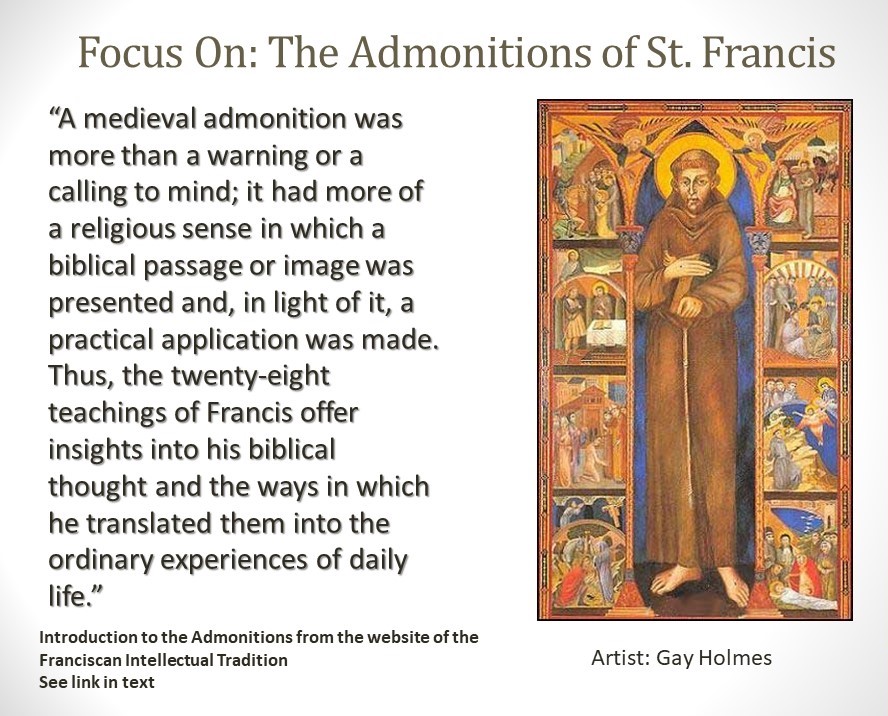
Focus on the Admonitions (VII and VIII)
[VII: Let Good Action Follow Knowledge]
1The apostle says: The letter kills, but the spirit gives life. 2 Cor 3:6
2Those people are put to death by the letter who only wish to know the words alone, that they might be esteemed wiser than others and be able to acquire great riches to give to their relatives and friends.
3And those religious are put to death by the letter who are not willing to follow the spirit of the divine letter but, instead, wish only to know the words and to interpret them for others.
4And those people are brought to life by the spirit of the divine letter who do not attribute every letter they know, or wish to know, to the body but, by word and example, return them to the most high Lord God to Whom every good belongs.
[VIII. Avoiding the Sin of Envy]
1The apostle says: No one can say: Jesus is Lord, except in the Holy Spirit; 1 Cor 12:3 2and: There is not one who does good, not even one. Rom 3:12
3Therefore, whoever envies his brother the good that the Lord says or does in him incurs a sin of blasphemy because he envies the Most High Himself Who says and does every good thing. Mt 20:15
Questions to discuss or to answer in your journal+ Come, Holy Spirit! Open my mind and heart as I contemplate Admonition VII.
- How do we get sidetracked in our lives by the “letter of the law” (the literal words) as opposed to the spirit of the law (the intent of the law)?
- What are some ways that we can come to understand the spirit of what is asked of us in Scripture?
- Try to give an example of where “the letter” and “the spirit” affect us as Secular Franciscans.
+ Admonition VIII—Holy Spirit, help us to increase our humility as we consider Admonition VIII.
- First, take a look in the Catechism to see what it says about sinful envy. (2538-2540) (2553)
https://www.vatican.va/archive/ENG0015/__P8U.HTM- When we see the gifts of others, what are some ways that we can avoid the sin of envy?
- Spend some time thinking about the gifts that the Holy Spirit has given you. How can you make the most of these gifts in your spiritual life? In your family life? In your life in fraternity?
++++++++++++++
Formación 6 de febrero, 2026
Enfoque en las Admoniciones VII y VIII
http://franciscanos.org/esfa/adm-ae.html
[Admonición VII: Que el buen obrar siga a la ciencia]
1Dice el Apóstol: La letra mata, pero el espíritu vivifica (2 Cor 3,6). 2Son matados por la letra aquellos que únicamente desean saber las palabras solas, para ser tenidos por más sabios entre los otros y poder adquirir grandes riquezas que dar a consanguíneos y amigos. 3Y son matados por la letra aquellos religiosos que no quieren seguir el espíritu de la divina letra, sino que desean más bien saber únicamente las palabras e interpretarlas para los otros. 4Y son vivificados por el espíritu de la divina letra aquellos que no atribuyen al cuerpo toda la letra que saben y desean saber, sino que, con la palabra y el ejemplo, la devuelven al altísimo Señor Dios, de quien es todo bien.
[Admonición VIII: Del pecado de envidia, que se ha de evitar]
1Dice el Apóstol: Nadie puede decir: Señor Jesús, sino en el Espíritu Santo (1 Cor 12,3); 2y: No hay quien haga el bien, no hay ni siquiera uno (Rom 3,12). 3Por consiguiente, todo el que envidia a su hermano por el bien que el Señor dice y hace en él, incurre en el pecado de blasfemia, porque envidia al mismo Altísimo (cf. Mt 20,15), que dice y hace todo bien.
Preguntas para platicar o responder en su diario
+ ¡Ven, Espíritu Santo! Abre mi mente y mi corazón mientras contemplo la Admonición VII.
• ¿Cómo nos desviamos en nuestras vidas por la “letra de la ley” (las palabras literales) en oposición al espíritu de la ley (la intención de la ley)?
• ¿Cuáles son algunas formas en que podemos llegar a comprender el espíritu de lo que se nos pide en las Escrituras?
• Trate de dar un ejemplo de dónde “la letra” y “el espíritu” nos afectan como franciscanos seglares.
+ Admonición VIII—Espíritu Santo, ayúdanos a aumentar nuestra humildad mientras consideramos la Admonición VIII.
• Primero, eche un vistazo al Catecismo para ver lo que dice acerca de la envidia pecaminosa. (2538-2540) (2553) https://www.vatican.va/archive/catechism_sp/p3s2c2a0_sp.html
• Cuando vemos los dones de los demás, ¿cuáles son algunas formas en que podemos evitar el pecado de la envidia?
• Dedique algún tiempo a pensar en los dones que el Espíritu Santo le ha dado. ¿Cómo puede aprovechar al máximo estos dones en tu vida espiritual? ¿En su vida familiar? ¿En su vida en fraternidad?
Diane F. Menditto, OFSVice Minister, National Fraternity, Secular Franciscan Order USA“Go into the world and proclaim the good news.”National Theme 2025-2028