Open post

FORMATION FRIDAY -Living the Beatitudes – June 28, 2024

(en español abajo) Korean translation attached in a separate PDF.

Please share with your local fraternity

Living the Beatitudes: Matthew 5: 3-12: Read prayerfully each of the Beatitudes (Matthew 5: 3-12) and think about the comments. Also read the indicated pages in the Franciscan Journey and the articles of the Rule noted below.

“BLESSED are the poor in spirit, for theirs is the kingdom of heaven.”

· Do not cling to material goods or to personal opinions.

· This brings freedom to follow the path of conversion.

+Read Franciscan Journey p. 211 and Article 11 of the OFS Rule

“BLESSED are they who mourn, for they will be comforted.”

· Mourn for personal and societal sinfulness; Discover our mistakes in relationships.

· Conversion brings comfort.

+Read Franciscan Journey pp. 211-212; Read the Prologue to our Rule and Article 7


BLESSED are the meek, for they will inherit the land.”

· Those who are meek (gentle) see what needs to be done and do it without arrogance or dominance.

· This spirit shows us what good relationships can accomplish.

+Read Franciscan Journey p. 212; Read Article 13 of our Rule.

BLESSED are they who hunger and thirst for righteousness, for they will be satisfied.”

· We are faithful to building a world where all people are treated with dignity.

+Read Franciscan Journey p. 212; Refer to article 15 of our Rule.


BLESSED are the merciful, for they will be shown mercy.”

· This reflects the spirit of Francis and Clare. We offer the hand of mercy because this is what Jesus did.

· “Show mercy and seek reconciliation.”

+Read Franciscan Journey p. 212; Refer to article 12 of our Rule


BLESSED are the clean of heart, for they will see God.”

· We are willing to deal with reality in a faith-filled way—we are clear-sighted.

· We see the presence of God in all.

+Read Franciscan Journey p. 213; Refer to articles 5, 12, 13 of our Rule


BLESSED are the peacemakers, for they will be called children of God.”

· We seek “both/and” solutions rather than “either/or.” We listen to one another.

+ Read Franciscan Journey p. 213; Refer to article 19 of our Rule

BLESSED are they who are persecuted for the sake of righteousness, for theirs is the kingdom of heaven.

BLESSED are you when they insult you and persecute you and utter every kind of evil against you [falsely] because of me. “ Rejoice and be glad, for your reward will be great in heaven. Thus, they persecuted the prophets who were before you.”

· If we follow the Gospel, we may find that others will persecute us.

· We can rejoice because our reward will be great in heaven.

+ Read Franciscan Journey p. 213; Refer to the Prologue to our Rule

To discuss or to comment on in your journal.

+ Which of the Beatitudes most reflects your personal commitment as a Secular Franciscan?

+ After reading the articles of the Rule mentioned above, how do Franciscans live the Beatitudes in a special way?


++++++++++++++++++

Formación 28 de junio, 2024 Compartir con su fraternidad local.

Vivir las Bienaventuranzas: Mateo 5: 3-12: Lea con espíritu de oración cada una de las Bienaventuranzas (Mateo 5: 3-12) y piense en los comentarios a continuación. Lea también las páginas indicadas en el Camino Franciscano.

BIENAVENTURADOS los pobres de espíritu, porque de ellos es el reino de los cielos”.

• No se aferre a bienes materiales ni a opiniones personales. Esto trae libertad para seguir el camino de la conversión.

+ Leer La jornada franciscana p. 225 y el Artículo 11 de nuestra regla.


BIENAVENTURADOS los que lloran, porque ellos recibirán consolación.”

• Llorar por la pecaminosidad personal y social; Descubrir nuestros errores en las relaciones

• La conversión trae consuelo.

+ Leer Jornada franciscana págs. 225-226; Consulte el artículo 7 y el prólogo de nuestra regla.


BIENAVENTURADOS los mansos, porque ellos heredarán la tierra”.

• Aquellos que son mansos (gentiles) ven lo que hay que hacer y lo hacen sin arrogancia ni dominio.

• Este espíritu nos muestra lo que pueden lograr las buenas relaciones.

+ Leer Jornada franciscana p. 226 y el artículo 13 de nuestra regla.


BIENAVENTURADOS los que tienen hambre y sed de justicia, porque ellos serán saciados”.

• Somos fieles a la construcción de un mundo donde todas las personas sean tratadas con dignidad.

+ Leer Jornada franciscana p. 226; Consulte el artículo 15 de nuestra Regla.


BIENAVENTURADOS los misericordiosos, porque se les mostrará misericordia”.

• Esto refleja el espíritu de Francisco y Clara. Ofrecemos la mano de la misericordia porque esto es lo que hizo Jesús.

• “Muestren misericordia y busquen la reconciliación”.

+ Leer Jornada franciscana p. 226; Consulte el artículo 12 de nuestra regla.


BIENAVENTURADOS los limpios de corazón, porque ellos verán a Dios”.

• Estamos dispuestos a lidiar con la realidad de una manera llena de fe: somos lúcidos.

• Vemos la presencia de Dios en todos.

+ Leer Jornada franciscana p. 227; Consulte los artículos 5, 12, 13 de nuestra Regla.


BIENAVENTURADOS los pacificadores, porque ellos serán llamados hijos de Dios”.

• Buscamos soluciones de “ambos / y” en lugar de “uno u otro”.

• Nos escuchamos unos a otros.

+ Leer Jornada franciscana p. 226; Consulte el artículo 19 de nuestra regla.


BIENAVENTURADOS los que padecen persecución por causa de la justicia, porque de ellos es el reino de los cielos.

BIENAVENTURADO eres cuando te insultan, te persiguen y profieren todo tipo de mal contra ti [falsamente] por mi causa. “

“Alégrense y muéstrense contentos, porque su recompensa será grande en los cielos. Así persiguieron a los profetas que fueron antes de ustedes ”.

• Si seguimos el Evangelio, es posible que otros nos persigan.

• Podemos regocijarnos porque nuestra recompensa será grande en el cielo.

+ Leer Jornada franciscana p. 226; Consulte el prólogo de nuestra regla


Para discutir o comentar en su diario.

+ ¿Cuál de las Bienaventuranzas refleja más su compromiso personal como franciscano seglar?

+ Después de leer los artículos de la Regla antes mencionados, ¿cómo viven los franciscanos las Bienaventuranzas de una manera especial?


Diane F. Menditto, OFS
Vice Minister, National Fraternity, Secular Franciscan Order USA
Listen – Discern – Go Forth National Theme 2022-2025


Prayer inspired by Pope Francis’ Laudate Deum

(This article originally appeared in the TAU-USA Spring 2024 Digital Issue #111)

We praise you, O God, Creator of all things,
whose mystery unfolds in a leaf, in a mountain
trail, in a dewdrop, in a poor person’s face.

Jesus, your Son, taught us to wonder
as he made his way throughout the land,
contemplating the beauty of creation.

We pray, O God, that you may stir in us
a reverent awareness of our invisible link with the
entire created world.

We pray for humility—
to remember that we, too, are created
and are not creation’s masters.

We pray for compassion—
for open eyes and hearts
to welcome those forced to flee from their homes
due to rising sea levels and drought.

We pray for repentance—
so that our thirst for power and domination
may be transformed into service.

We pray for simplicity—
and the will to turn from our greed
which impacts vulnerable people everywhere.

We pray for cultural conversion—
that we may simplify our lifestyles,
reduce pollution and waste,
and exercise prudence in our decision making.

We pray for policy changes—
that as a nation and world we may work together
to reverse the course of climate change.

Our hearts ache as we ponder:
“The world sings of an infinite Love:
how can we fail to care for it?”

We praise you, O God, confident that you work
in our hearts and through our actions.

Prayer inspired by Pope Francis’
Laudate Deum
This prayer is inspired by Laudate Deum, Pope Francis’ apostolic exhortation
on care for creation in follow-up to Laudato Si’. Laudate Deum is available on
the Vatican website under “Apostolic Exhortations.”

Prayer inspired by Pope Francis’ Laudate Deum

The Gospel Through a Franciscan Lens – 12th Sunday in Ordinary Time – Fr. Christopher

In his homily for the 12th Sunday in Ordinary Time, Fr. Christopher reflects on how Frances’ union with God was through his union with the suffering of Christ.

“Through the Incarnation, a transcendent God becomes immanent in creation.  Francis becomes a symbol for us of our own potential unity with God.  The stigmata helps Francis realize his own participation in divinity.  Through the stigmata he received, his understanding came through, and was expressed by, his body.  If Christ is to be born in us, He must be born in our bodies as well as in our souls.”

Read the full text of Fr. Christoher’s homily here.

View and listen to Fr. Christopher’s homily here.

The Gospel Through a Franciscan Lens – 12th Sunday in Ordinary Time – Fr. Christopher

Open post

FORMATION FRIDAY – Histry of our Order: Use of the “habit” by Secular Francsicans – June 21, 2024

History of our Order: Use of the “habit” by Secular Franciscans
 
It is important for us to be aware of the history of our Order and why we do and do not do certain things. Here you can read the official document telling us that it was decided in 2011 that we are not to wear a habit. Many of us know this, some wonder about it, and new members hear about it and might not understand what we are talking about. So, here is a piece of our history.
 
For reference: Article 5.2 of the General Constitutions states, “The practical interpretation of the Constitutions, with the purpose of harmonizing its application in different areas and at the various levels of the Order, belongs to the General Chapter of the OFS.”
 
In the United States (and many other countries) the TAU cross is our distinctive sign of membership in the Order.
 
The General Chapter makes the following
DECISION
The practice of wearing a “habit” is not in conformity with the Rule and General Constitutions of the OFS, as already established.
 
As a practical interpretation (cf. Art. 5.2 GGCC) of Article 43 of the General Constitutions, the Chapter emphasizes and insists that the distinctive sign of membership in the Order is the “Tau or other Franciscan symbol”. (GGCC 43). A “Franciscan symbol” is a small and simple insignia that is worn on the person (for example, a San Damiano cross).
 
However, an OFS National Fraternity may determine in its National Statutes that the wearing a “uniform” is an acceptable sign of recognition for Secular Franciscans of their own country, providing that the following mandatory criteria is followed:
a) the uniform does not replace the TAU or the Franciscan symbol selected by the National Fraternity;
b) the nature of the uniform is to be specified in the National Statutes, including a detailed description (preferably graphical) and be of a style that respects the secularity of the members of the Order;
c) the style of the uniform should not look like the habit worn by member of a religious Order, so as to avoid bringing confusion between religious and seculars;
d) the occasions during which this uniform may be worn must be precisely indicated and specifically excludes its use during the rites of admission and/or profession.
 
The Chapter states that the decision replaces all previous documents in this regard, and becomes in effect now and for the future.
 
d) the occasions during which this uniform may be worn must be precisely indicated and specifically excludes its use during the rites of admission and/or profession.
 
The Chapter states that the decision replaces all previous documents in this regard,
and becomes in effect now and for the future.
 
São Paolo, October 29, 2011
Encarnación del Pozo, OFS, General Minister
 
+++++++++++++++++++++++++++++++++++
 
Formación 21 de junio, 2024: Por favor, compartir con su fraternidad local.
Historia de nuestra Orden: Uso del “hábito” por los franciscanos seglares
 
Es importante que seamos conscientes de la historia de nuestra Orden y de por qué hacemos y no hacemos ciertas cosas. Aquí puede leer el documento oficial que nos dice que se decidió en 2011 que no debemos usar un hábito. Muchos de nosotros sabemos esto, algunos se preguntan al respecto, y los nuevos miembros se enteran de ello y es posible que no entiendan de qué estamos hablando. Entonces, aquí hay un pedazo de nuestra historia.
 
A modo de referencia: El artículo 5.2 de las Constituciones Generales establece: “La interpretación práctica de las Constituciones, con el fin de armonizar su aplicación en los diversos ámbitos y en las diversas áreas y en los varios niveles de la Orden, corresponde al Capítulo General de la OFS”.
 
En los Estados Unidos (y en muchos otros países) la TAU es nuestro signo distintivo de pertenencia a la Orden.
 
El Capítulo general establece la siguiente
DECISIÓN
 
La práctica de usar un “hábito” no está en conformidad con la Regla y las Constituciones Generales de la OFS, como ya está establecido.
 
Como una interpretación práctica (cfr. Art. 5.2 GGCC) del Artículo 43 de las Constituciones Generales, el Capítulo reitera y confirma que el signo distintivo de pertenencia a la Orden es “la ‘Tau’ u otro símbolo franciscano” (Const. OFS 43). Un “símbolo franciscano” es una insignia pequeña y simple que lleva puesta la persona (por ejemplo, una cruz de San Damián).
 
Sin embargo, una Fraternidad nacional OFS puede determinar en sus Estatutos nacionales que el uso de un “uniforme” puede ser un signo aceptable para distinguir a los franciscanos seglares de su propio país, siempre que los siguientes criterios obligatorios se cumplan:
 
a) el uniforme no sustituye a la TAU ni al símbolo franciscano seleccionado por la Fraternidad Nacional;
b) la naturaleza del uniforme se ha de especificar en los Estatutos Nacionales, incluyendo una descripción detallada (preferiblemente gráfica) y debe ser de un estilo que respete la secularidad de los miembros de la Orden;
c) el estilo del uniforme no debe verse como el hábito usado por los miembros de una Orden religiosa, con el fin de evitar que se cree confusión entre religiosos y seglares;
d) las ocasiones en que se puede usar el uniforme deben indicarse con precisión y excluyendo de modo específico su uso durante los ritos de admisión y / o profesión.
 
El Capítulo establece que esta decisión sustituya todos los documentos anteriores sobre esta cuestión y que entre en vigor desde hoy y para el futuro.
 
São Paolo, 19 de octubre de 2011
Encarnación del Pozo, OFS
Ministra General
 
 
Diane F. Menditto, OFS
Vice Minister, National Fraternity, Secular Franciscan Order USA
Listen – Discern – Go Forth National Theme 2022-2025

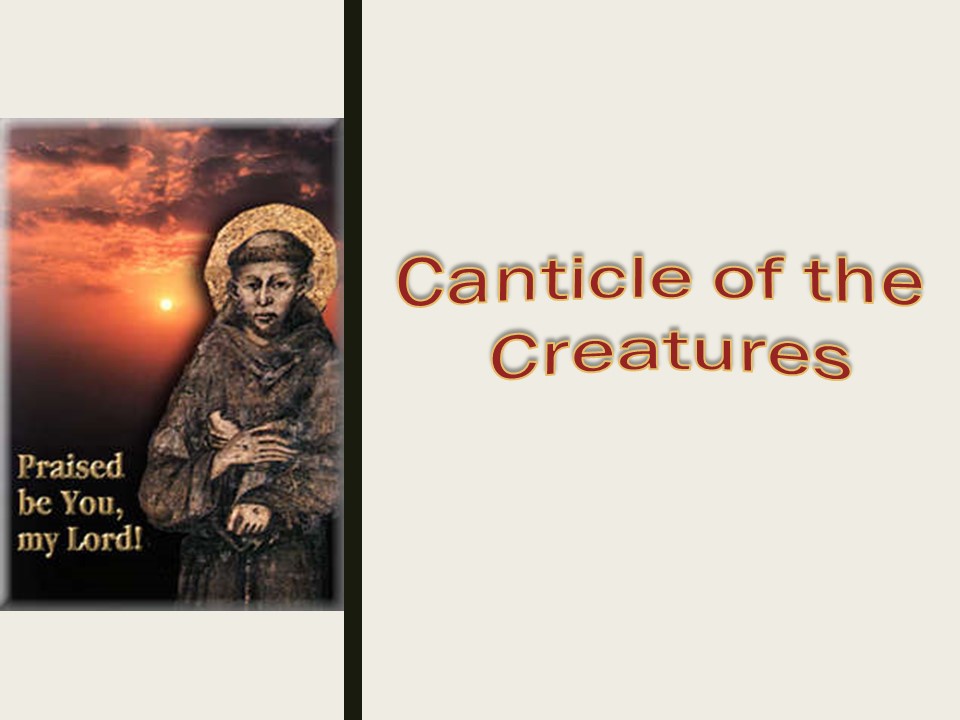
St. John the Baptist Fraternity Essay Contest Winner

(This article originally appeared in the TAU-USA Spring 2024 Digital Issue #111)

Kathryn Swegart – Formation Director, Jordan Smith, and Dean Astumian – Minister of St. John the Baptist Fraternity in Winslow, Maine.

 The St. John the Baptist fraternity in Winslow, Maine is pleased to announce the winner of its essay contest, opened to high school and college students in Maine. The winner is Jordan Smith, a student at Colby College in Waterville, Maine. He is a member of Corpus Christi Parish in Waterville and is active in Colby Catholics. Jordan is from Severna Park, Maryland.

With brilliance and insight, Jordan weaves a philosophical connection between beauty and God as proclaimed by St. Francis in the Canticle of the Sun. Jordan received a $100 prize and a Word of Fire Bible. We hope that you are inspired by the thoughtful writing of this young man. Praise be to God!

St. Francis’ Canticle of the Sun reveals his complex understanding of the relationship between God, Nature, and Man. From the outset, Francis unqualifiedly recognizes God as “Most High.” Nothing else matches the grandeur of God. However, this does not prevent Francis from proclaiming: “Praised be You, my Lord, with all your creatures.” The creation may be praised alongside God because His glory is manifest through creation. This ‘translucent’ element of creation that allows one to see through it to its Creator is the essence of beauty. The connection between translucence and beauty is emphasized in Francis’ identification of “Brother Sun” as the creature closest to God. The reason the sun “bear a likeness” to God most of all is that he is “beautiful and radiant.” Just as the sun shines its rays to not only reveal the beauty of the physical world but also to give it life and sustenance, so too God’s overflowing goodness manifests itself not only in the continual sustaining of being but in the essential beauty of all that exists. For the God Who is Beauty Itself will always produce beautiful creatures. That is to say, being and beauty are coextensive for St. Francis. Beauty is not something I merely personally will to believe or not. Beauty is constantly eliciting a response from me. It calls me out of my own being into the source of my being through the creation in which beauty inheres. Beauty raises beauty into the Beautiful Itself.

The precise connection between God, Nature, Beauty, and its implications for people on a practical basis comes to light in the second half of Francis’ canticle in which he praises “Sister Mother Earth, / who sustains us and governs us and who produces / varied fruits with colored flowers and herbs.” The title “Sister Mother” is emblematic of the dual nature of all of creation: Insofar as the Earth is mere matter and must receive her being from God, she is called “Sister,” but insofar as God has given her the ability to produce her own fruits, she is called “Mother.” These fruits are intrinsically “colored,” which is to say that, just like the sun, the sustenance that Mother Earth provides cannot be separated from the beauty that she produces. Though this may seem to make the beautiful overwhelming, perhaps even to the point that the individual cannot resist it, St. Francis is careful to avoid this conclusion. For Francis mourns: “Woe to those who die in mortal sin.” It is only those who serve God “with great humility” that shall be spared from “the second death.” Humility, as the opposite of closeminded and selfish pride, is nothing but the openness to being and beauty that leads one invariably to God. The choice, therefore, is ours: We may open ourselves to the beauty of God and His creation or close in on ourselves and experience eternal darkness.

St. John the Baptist Fraternity Essay Contest Winner

Scroll to top
Juan de Padilla