(en español abajo) Korean translation attached in a separate PDF.
Please share with your local fraternity (All three parts, this week and the next two weeks, together will work well for fraternity ongoing formation at any time of year.)Advent—Waiting and Conversion (Part 1)
During Advent we wait for the coming of our Lord Jesus Christ. We know that he walked on this earth. We know that he is always with us in the Eucharist. But now, we wait for Him to come again.
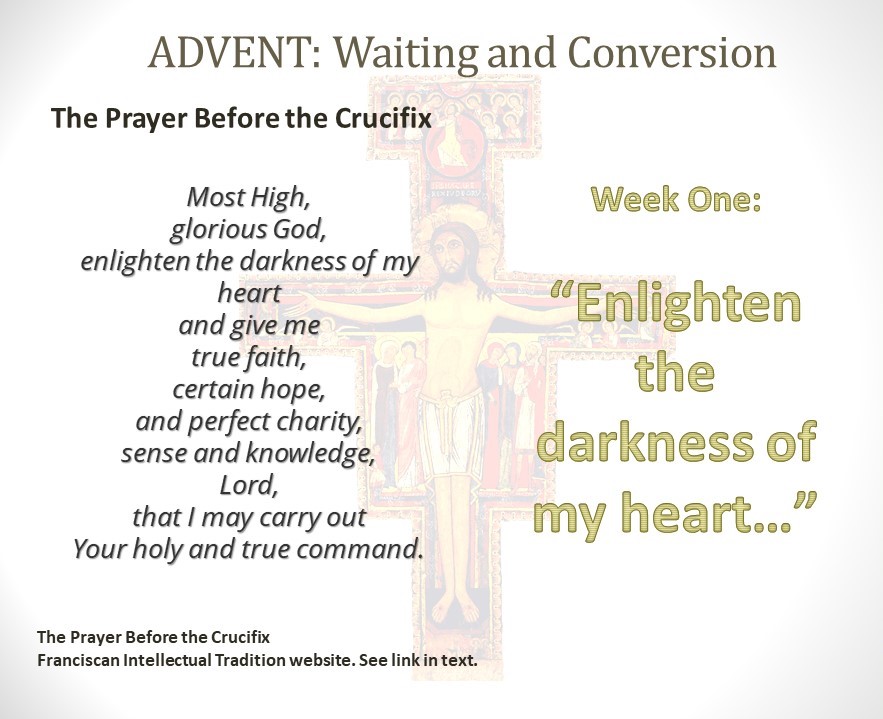
For three weeks we will focus on the prayer that St. Francis prayed as he knelt before the Crucifix of San Damiano. Each part of it has significance during this time of waiting and conversion.
Most High,
glorious God,
enlighten the darkness of my heart
and give me
true faith,
certain hope,
and perfect charity,
sense and knowledge,
Lord,
that I may carry out
Your holy and true command.Part one: Daily Conversion
“Most High, glorious God, enlighten the darkness of my heart”
CONSIDER:
+Our Rule: Article 7— “United by their vocation as “brothers and sisters of penance”11, and motivated by the dynamic power of the gospel, let them conform their thoughts and deeds to those of Christ by means of that radical interior change which the gospel itself calls “conversion.” Human frailty makes it necessary that this conversion be carried out daily12.
On this road to renewal the sacrament of reconciliation is the privileged sign of the Father’s mercy and the source of grace13.”+Admonition 22: Correction
1Blessed is the servant who endures discipline, accusation, and reprimand from another as patiently as he would from himself.
2Blessed is the servant who, after being reprimanded, agrees courteously, submits respectfully, admits humbly, and makes amends willingly.
3Blessed is the servant who is not quick to excuse himself, and endures with humility, shame, and reprimand for a sin, when he did not commit the fault.+During Advent, we examine our lives to prepare for the coming of Jesus. Now is a good time to see if we are living up to the call for daily conversion in our lives.
Questions for discussion or to answer in your journal
+ How do you live up to our call to daily conversion? During Advent, what spiritual improvements would you like to make in your life—even if they are little ones?
+ What were some of the key points of Francis’s conversion? How did he follow through? What can those moments teach us?Thank you to Anne Mulqueen, OFS, for her inspiration.
+++++++++++++++++++++
Formación 29 de noviembre, 2024
Adviento: espera y conversiónDurante el Adviento esperamos la venida de nuestro Señor Jesucristo. Sabemos que caminó sobre esta tierra. Sabemos que él está siempre con nosotros en la Eucaristía. Pero ahora, esperamos que Él regrese.
Durante tres semanas nos enfocaremos en la oración que rezó San Francisco mientras se arrodillaba ante el Crucifijo de San Damián. Cada parte tiene un significado durante este tiempo de espera y conversión.
Sumo, glorioso Dios,
ilumina las tinieblas de mi corazón
y dame fe recta,
esperanza cierta
y caridad perfecta,
sentido y conocimiento, Señor,
para que cumpla tu santo y verdadero mandamiento.http://franciscanos.org/esfa/orsd.html
Primera Parte: La conversión diaria
“Sumo, glorioso Dios, ilumina las tinieblas de mi corazón…”
CONSIDERE:
+Nuestra Regla: Artículo 7—Como “hermanos y hermanas de penitencia”11, en virtud de su vocación, impulsados por la dinámica del Evangelio, conformen su modo de pensar y de obrar al de Cristo, mediante un radical cambio interior, que el mismo Evangelio denomina con el nombre de “conversión”; la cual, debido a la fragilidad humana, debe actualizarse cada día.
En este camino de renovación, el Sacramento de la Reconciliación es signo privilegiado de la misericordia del Padre y fuente de gracia.+Admoniciones [Cap. XXII: De la corrección]
1Bienaventurado el siervo que soporta tan pacientemente la advertencia, acusación y reprensión que procede de otro, como si procediera de sí mismo. 2Bienaventurado el siervo que, reprendido, benignamente asiente, con vergüenza se somete, humildemente confiesa y gozosamente satisface. 3Bienaventurado el siervo que no es ligero para excusarse, sino que humildemente soporta la vergüenza y la reprensión de un pecado, cuando no incurrió en culpa.
http://franciscanos.org/esfa/adm-ae.html
+ Durante el Adviento, examinamos nuestras vidas para prepararnos para la venida de Jesús. Ahora es un buen momento para ver si estamos a la altura del llamado a la conversión diaria en nuestras vidas.
Preguntas para platicar o para responder en su diario
+ ¿Cómo está a la altura de nuestro llamado a la conversión diaria? Durante el Adviento, ¿qué mejoras espirituales le gustaría hacer en su vida, incluso si son pequeñas?
+ ¿Cuáles fueron algunos de los puntos clave de la conversión de Francisco? ¿Cómo cumplió? ¿Qué nos pueden enseñar esos momentos?
Gracias a Anne Mulqueen, OFS, por su inspiración.
Diane F. Menditto, OFSVice Minister, National Fraternity, Secular Franciscan Order USAListen – Discern – Go Forth National Theme 2022-2025
The Gospel Through a Franciscan Lens – The Feast of Christ the King – Fr. Christopher
If our faith means anything, it means that whatever forces control us, whatever problems attack us, whatever truth we have to face, Christ’s power is greater. When we turn to Christ as our King, we find courage to face the truth, and then take the next best step on to a full life.

https://www.secularfranciscansusa.org/2024/11/23/the-gospel-through-a-franciscan-lens-the-feast-of-christ-the-king-fr-christopher/
Formation Friday – Frequently Asked Questions #13 – November 22, 2024
Please share with your local fraternity (en español abajo) Korean translation attached in separate PDF.
Frequently Asked Questions answered by our General Constitutions (GC): This week, and for several more, we continue to spotlight the questions given in the 2010 edition of the Handbook for Servant Leadership. Becoming familiar with the Constitutions is very helpful in addressing these questions and others that arise in fraternities at all levels. For the complete, latest translation of the entire document, visit: https://ciofs.info/library/official-documents/ or https://www.secularfranciscansusa.org/the-general-constitutions-of-the-secular-franciscan-order-2000/
What is the spiritual and pastoral relationship between the First Order, TOR, and the OFS?
+Vital Reciprocity and role of the Spiritual Assistant [Articles 89-90] (For further and more complete information, please also see articles 85-88; the National Statutes, International Statutes, and the Handbook for Spiritual Assistance)
Articles 89-90 Role of the Spiritual Assistant
Article 89
1. By virtue of the vital reciprocity between the religious and the secular members of the Franciscan Family and the responsibilities of Major Superiors, spiritual assistance to the Fraternities of the OFS at all levels must be assured as a fundamental element of communion.
2. The Spiritual Assistant is the person designated by the competent Major Superior to carry out this service for a specific Fraternity of the OFS.
3. To be a witness of Franciscan spirituality and of the fraternal affection of the religious towards the Secular Franciscans, and to be a bond of communion between his Order and the OFS, the Spiritual Assistant should be a Franciscan religious, member of the First Order or the TOR.
4. When it is not possible to give such a Spiritual Assistant to the Fraternity, the competent Major Superior can entrust the service of spiritual assistance to: a) religious brothers or sisters of other Franciscan institutes;
b) diocesan clerics or other persons, specially prepared for such service who are members of the OFS;
c) other diocesan clerics or religious who are not Franciscan.
5. Prior authorization of the Superior or the local Ordinary, when needed, does not exempt the Franciscan Major Superior of the responsibility for the quality of pastoral service and of spiritual assistance given.
Article 90
1. The principal task of the Assistant is to communicate Franciscan spirituality and to co-operate in the initial and continuing formation of the brothers and sisters.
2. The Spiritual Assistant is by right, a voting member of the Council of the Fraternity to which he or she gives assistance and collaborates with it in all activities. However, the Spiritual Assistant does not exercise the right to vote in financial questions*. (also See 90.3) [*or in elections see Statutes for Spiritual and Pastoral Assistance]
After reading Articles 89 and 90, please discuss the following with a partner or in your fraternity
+Does your local fraternity have a Spiritual Assistant? Is he/she a member of a religious order, diocesan clergy, or OFS?
+What role does the Spiritual Assistant play in your fraternity?
+How does your fraternity’s Spiritual Assistant fulfill Article 90.1 above? How does this help you in your vocation as a Secular Franciscan?
Formación 22 de noviembre, 2024 Preguntas frecuentes #13 (Por favor compartir con su fraternidad local.)
Preguntas Frecuentes Respondidas por nuestras Constituciones Generales (CG): Esta semana, y por varias más, volvemos a las preguntas dadas en la edición 2010 del Manual para el Liderazgo de Servicio. Las mismas preguntas surgen a menudo en nuestros consejos y en nuestras fraternidades. Familiarizarse con las Constituciones es muy útil para abordar los problemas que surgen en las fraternidades a todos los niveles. Para obtener la traducción completa y más reciente del documento completo, visite: https://ciofs.info/wp-content/uploads/2021/01/ES-Constituciones-generales-OFS-s.pdf
¿Cuál es la relación espiritual y pastoral entre la Primera Orden, la TOR y la OFS?
+Reciprocidad vital y papel del Asistente Espiritual [Artículos 89-90] (Para una información más completa y más completa, ver también los artículos 85-88; los Estatutos Nacionales, los Estatutos Internacionales y el Manual de Asistencia Espiritual)
Artículos 89-90 Papel del Asistente Espiritual
Artículo 89
1. En virtud de la reciprocidad vital entre los religiosos y los seglares de la Familia Franciscana y de las responsabilidades de los Superiores mayores, debe garantizarse a las Fraternidades de la OFS, en todos sus niveles, la asistencia espiritual como un elemento fundamental de comunión.
2. El Asistente espiritual es la persona designada por el Superior mayor competente para prestar este servicio a una Fraternidad concreta de la OFS.
3. Para ser testigo de la espiritualidad franciscana y del afecto fraterno de los religiosos hacia los franciscanos seglares y vínculo de comunión entre su Orden y la OFS, el Asistente espiritual sea un religioso franciscano, perteneciente a la Primera Orden o a la TOR.
4. Cuando no es posible asignar a la Fraternidad tal Asistente espiritual, el Superior mayor competente puede confiar el servicio de la Asistencia espiritual a:
a) religiosos o religiosas pertenecientes a otros Institutos franciscanos;
b) clérigos diocesanos u otras personas, específicamente preparadas para este servicio, pertenecientes a la OFS;
c) otros clérigos diocesanos, o religiosos no franciscanos.
5. La autorización previa del Superior o del Ordinario del lugar, necesaria en estos casos, no exime al Superior mayor franciscano de su responsabilidad respecto a la calidad del servicio pastoral y de la asistencia espiritual.
Artículo 90
1. Es cometido principal del Asistente comunicar la espiritualidad franciscana y cooperar en la formación inicial y permanente de los hermanos.
2. El Asistente espiritual es miembro de derecho, con voto, del Consejo de la Fraternidad al que presta su asistencia y colabora con él en todas sus actividades. No ejerce el derecho de voto en las cuestiones económicas*
(Véase también 90.3) [*o en las elecciones ver Estatutos para la Asistencia Espiritual y Pastoral]
Después de leer los artículos 89 y 90, por favor discuta lo siguiente con un compañero o en su fraternidad.
+¿Su fraternidad local tiene un Asistente Espiritual? ¿Es miembro de una orden religiosa, del clero diocesano o de la OFS?
+¿Qué papel desempeña el Asistente Espiritual en su fraternidad?
+¿Cómo cumple el Asistente Espiritual de su fraternidad el Artículo 90.1 anterior? ¿Cómo le ayuda esto en su vocación de franciscano seglar?
Diane F. Menditto, OFSVice Minister, National Fraternity, Secular Franciscan Order USAListen – Discern – Go Forth National Theme 2022-2025
The Gospel Through a Franciscan Lens – 33rd Sunday in Ordinary Time – Fr. Christopher
The Gospel today gives us vivid apocalyptic imagery to portray the truth that the One who was crucified and seemingly overcome by evil, is now about to extend the triumph of His resurrection over the entire universe. Assurance and vindication emerge as vestiges of hope.

https://www.secularfranciscansusa.org/2024/11/16/the-gospel-through-a-franciscan-lens-33rd-sunday-in-ordinary-time-fr-christopher/
Formation Friday -Frequently Asked Questions #12 – November 15, 2024
Please share with your local fraternity (en español abajo) Korean translation attached in a separate PDF.
Frequently Asked Questions answered by our General Constitutions (GC): This week, and for several more, we continue to spotlight the questions given in the 2010 edition of the Handbook for Servant Leadership. Becoming familiar with the Constitutions is very helpful in addressing these questions and others that arise in fraternities at all levels. For the complete, latest translation of the entire document, visit: https://ciofs.info/library/official-documents/ or https://www.secularfranciscansusa.org/the-general-constitutions-of-the-secular-franciscan-order-2000/
Focus on the Pastoral Visit
+What is the focus of the Pastoral Visit? [Article 95]
1. The pastoral visit is a privileged moment of communion with the First Order and the TOR. It is carried out also in the name of the Church and serves to guarantee and promote the observance of the Rule and the Constitutions and fidelity to the Franciscan charism. The visit is carried out with respect to the organization and the law proper to the OFS itself.
2. Having verified that the Fraternity was canonically erected, the Visitor will give attention to the relations between the Fraternity and its Spiritual Assistant and the local Church. The Visitor will meet the pastors (Bishop or parish priest) when this is opportune for fostering communion and service for building up the Church.
3. The Visitor will promote collaboration and a sense of co-responsibility among the secular leaders and the Spiritual Assistants. The Visitor is to confirm the quality of spiritual assistance given to the visited Fraternity, encourage the Spiritual Assistants in their service and promote their continuing spiritual and pastoral formation.
4. The Visitor will give special attention to programs, methods and experiences of formation, to liturgical and prayer life, and to the apostolic activities of the Fraternity.
After reading Article 95, please discuss the following with a partner or in your fraternity
+Why would it be the role of the pastoral visitor to guarantee fidelity to the Franciscan charism?
+How does the visitor determine if the local fraternity has been “canonically erected?” Have you ever seen your fraternity’s document of establishment?
+Number 2 above mentions the relationship between the fraternity and the local Church. Describe your fraternity’s relationship with the parish(es) of the fraternity members and/or the parish or monastery where the fraternity meets.
+The pastoral visitor is tasked with giving attention to the formation programs and spiritual life of the fraternity. Discuss how a pastoral visitor from outside your local fraternity would describe/evaluate your initial and ongoing formation programs and the prayer life of your fraternity. What suggestions do you think they would make, if any?
Formación 15 de noviembre, 2024 Preguntas frecuentes #12 (Por favor compartir con su fraternidad local.)
Preguntas Frecuentes Respondidas por nuestras Constituciones Generales (CG): Esta semana, y por varias más, volvemos a las preguntas dadas en la edición 2010 del Manual para el Liderazgo de Servicio. Las mismas preguntas surgen a menudo en nuestros consejos y en nuestras fraternidades. Familiarizarse con las Constituciones es muy útil para abordar los problemas que surgen en las fraternidades a todos los niveles. Para obtener la traducción completa y más reciente del documento completo, visite: https://ciofs.info/wp-content/uploads/2021/01/ES-Constituciones-generales-OFS-s.pdf
Enfoque en la visita pastoral
+ ¿Cuál es el enfoque de la Visita Pastoral? [GGCC Artículo 95]
Artículo 95 La Visita pastoral
1. La Visita pastoral es un momento privilegiado de comunión con la Primera Orden y la TOR. Ésta se efectúa también en nombre de la Iglesia y sirve para garantizar y promover la observancia de la Regla y de las Constituciones y la fidelidad al carisma franciscano. Se desarrollará respetando la organización y el derecho propio de la OFS.
2. El Visitador, comprobada la erección canónica de la Fraternidad, se interesará por las relaciones entre la Fraternidad y su Asistente espiritual y la Iglesia particular, y se reunirá con los pastores (Obispo, Párroco), cuando sea oportuno, para favorecer la comunión y el servicio para la edificación de la Iglesia.
3. Promoverá la colaboración y el sentido de corresponsabilidad entre los Responsables seglares y los Asistentes espirituales. Comprobará la calidad de la asistencia espiritual que se da a la Fraternidad Visitada, animando a los Asistentes en su servicio, y promoverá su formación permanente espiritual y pastoral.
4. Dedicará particular atención a los programas, métodos y experiencias formativas, a la vida litúrgica y de oración y a las actividades apostólicas de la Fraternidad.
Después de leer el artículo 95, por favor discuta lo siguiente con un compañero o en su fraternidad
+¿Por qué sería el papel del visitador pastoral garantizar la fidelidad al carisma franciscano?
+¿Cómo determina el visitante si la fraternidad local ha sido “erigida canónicamente”? ¿Ha visto alguna vez el documento de constitución de su fraternidad?
+El número 2 arriba menciona la relación entre la fraternidad y la Iglesia local. Describa la relación de su fraternidad con la(s) parroquia(s) de los miembros de la fraternidad y/o la parroquia o monasterio donde se reúne la fraternidad.
+El visitador pastoral tiene la tarea de enfocarse en los programas de formación y a la vida espiritual de la fraternidad. Discuta cómo un visitante pastoral de fuera de su fraternidad local describiría/evaluaría sus programas de formación inicial y continua y la vida de oración de su fraternidad. ¿Qué sugerencias cree que harían, si es que harían alguna?
Diane F. Menditto, OFSVice Minister, National Fraternity, Secular Franciscan Order USAListen – Discern – Go Forth National Theme 2022-2025