Celebrating Sister Mother Earth

“LAUDATO SI’, mi’ Signore” – “Praise be to you, my Lord.”

In the words of this beautiful canticle, Saint Francis of Assisi reminds us that our common home is like a sister with whom we share our life and a beautiful mother who opens her arms to embrace us. “Praise be to you, my Lord, through our Sister, Mother Earth, who sustains and governs us, and who produces various fruit with coloured flowers and herbs”. ~ From the opening of Laudato Si’, 2015

This year marks the 50th anniversary of Earth Day and the 5th anniversary of Pope Francis’ much-anticipated encyclical, Laudato Si’. These important milestones have ignited a renewed energy and excitement for environmental justice issues. They have also brought back to light the tremendous damage we are doing to the earth, our common home.

Earth Day is an annual event celebrated around the world on April 22 to demonstrate support for the protection of our environment; of our Sister, Mother Earth. Earth Day is a global reminder that we have to continue to care for our common home. Unfortunately, we as a people have been negligent in that care and have done great harm to the earth. Pope Francis writes in Laudato Si’: “This sister now cries out to us because of the harm we have inflicted on her by our irresponsible use and abuse of the goods with which God has endowed her. We have come to see ourselves as her lords and masters, entitled to plunder her at will. The violence present in our hearts, wounded by sin, is also reflected in the symptoms of sickness evident in the soil, in the water, in the air and in all forms of life. This is why the earth herself, burdened and laid waste, is among the most abandoned and maltreated of our poor; she ’groans in travail.’. We have forgotten that we ourselves are dust of the earth; our very bodies are made up of her elements, we breathe her air and we receive life and refreshment from her waters.

More than 800 years ago, Saint Francis wrote that our Sister Mother Earth sustains and governs us; she gives us life. Instead of returning the favor, we have laughed in her face by the damage and the harm we have done to her. The social teaching of our Church speaks to us of caring for all of God’s creation – this includes God’s people and God’s earth. In Seven Themes of Catholic Social Teaching, the United States Conference of Catholic Bishops (USCCB) writes: “We show our respect for the Creator by our stewardship of creation. Care for the earth is not just an Earth Day slogan, it is a requirement of our faith. We are called to protect people and the planet, living our faith in relationship with all of God’s creation. This environmental challenge has fundamental moral and ethical dimensions that cannot be ignored.”

Pope Emeritus Benedict XVI wrote in his 2009 encyclical Caritas in Veritate: The environment is God’s gift to everyone, and in our use of it we have a responsibility towards the poor, towards future generations and towards humanity as a whole…. Our duties towards the environment are linked to our duties towards the human person, considered in himself and in relation to others. It would be wrong to uphold one set of duties while trampling on the other” (48, 51).

Finally, Article 18 of our Holy Rule states: “Moreover [we] should respect all creatures, animate and inanimate, which “bear the imprint of the Most High,” and [we] should strive to move from the temptation of exploiting creation to the Franciscan concept of universal kinship”. This is not just a lovely suggestion or some pie-in-the-sky platitude, this is what we promise, what we profess. As Secular Franciscans, let us continue to call to mind the words of our Holy Rule and our seraphic Father Francis who called our earth Mother and Sister. Let us always show Sister Mother Earth the reverence and respect that Saint Francis showed. May the Lord continue to grant you peace.

https://secularfranciscansusa.org/2020/06/29/celebrating-sister-mother-earth/

Open post

Formation Friday 6/26/2020

Please share with your local fraternities (abajo en español)


We are all part of a history and a story. We are part of a “tribe.” We are part of the story of our families, of our religion, of the time in which we live. As Franciscans we are also part of the Franciscan story. There are traditions, stories, devotions, prayers and sayings involved with all of these groups. Knowing about them helps us to be part of the family. Every so often, Formation Friday will highlight one of these important parts of our story.

Why was the TAU special to St. Francis? Why do Secular Franciscans wear the TAU?

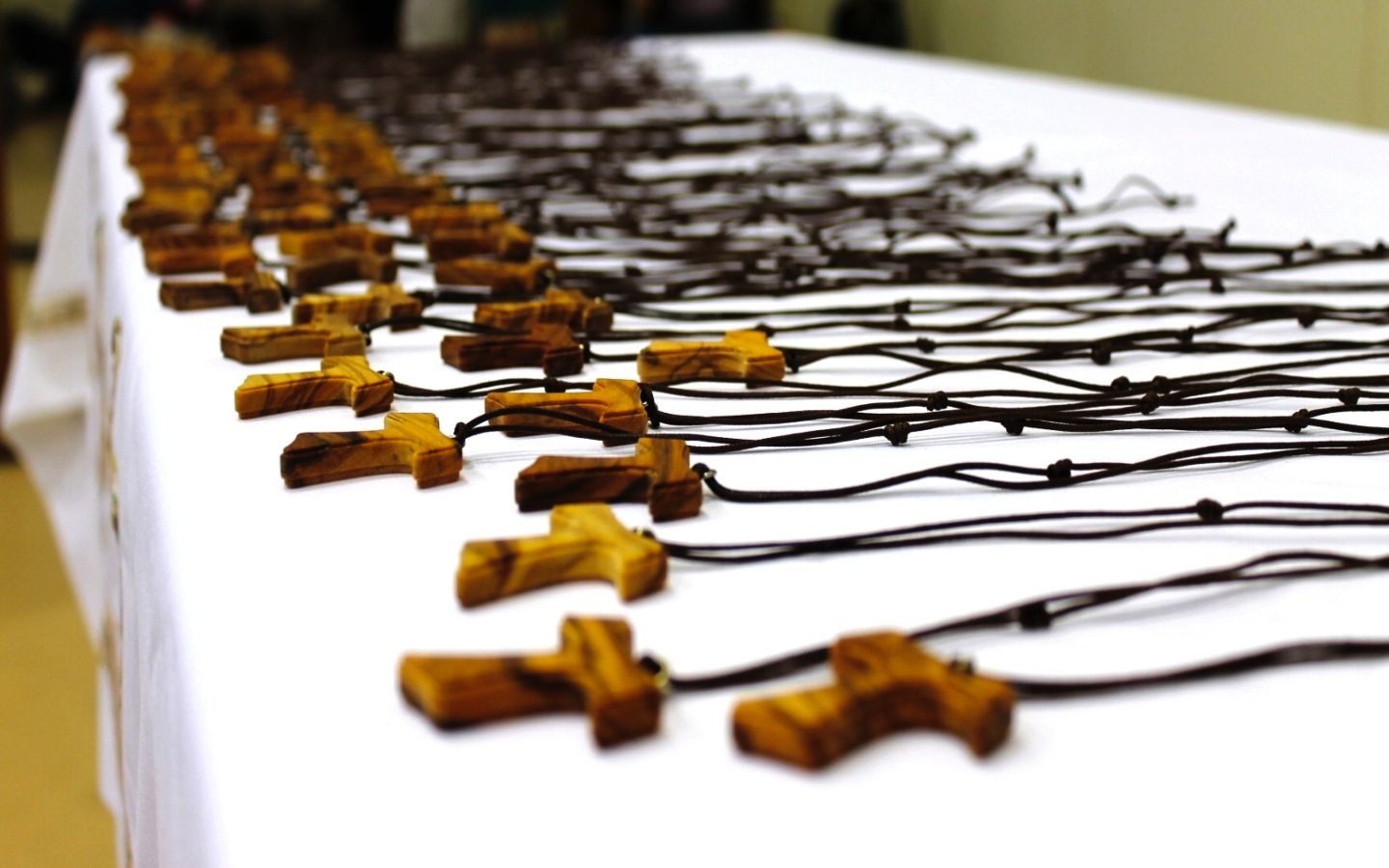
The TAU Cross

·        TAU, as a symbol of sanctity, comes from Ezekiel 9:4
“Go through the city of Jerusalem and put a TAU on the foreheads of those who grieve and lament over all the detestable things that are done in it.” It is the last letter of the Hebrew alphabet and looks very much like the letter “T”.

·        Franciscan scholarship points to St. Francis’s being present at the Lateran Council in 1215

·        He would have heard Pope Innocent III announce that every Catholic should take the TAU Cross as the symbol of their Passover

·        He would have heard that the elect, the chosen will be marked with the sign of the TAU (Ezekiel 9:4)

·        He would have heard the pope say that the TAU has the form as the Cross on which our Lord was crucified and that those who had mortified their flesh and conformed their life to that of Christ crucified will obtain mercy.


·        From then on, the TAU became Francis’s own coat of arms and he often used it in his

writings as his personal signature.

St. Bonaventure said, “This TAU symbol had all the veneration and all the devotion of the saint: he spoke of it often in order to recommend it, and he traced it on himself before beginning each of his actions.”

Thomas of Celano, another Franciscan historian and biographer of Francis, writes, “Francis preferred the Tau above all other symbols: he utilized it as his only signature for his letters, and he painted the image of it on the walls of all the places in which he stayed.”


In the famous blessing of Brother Leo, Francis wrote on parchment,

“May the Lord bless you and keep you! May the Lord show His

face to you and be merciful to you! May the Lord lift up His

countenance upon you and give you peace! God bless you Brother

Leo!” Francis sketched a head (of Brother Leo) and then drew the TAU over this portrait.


Due, no doubt, in large part to Francis’ own affection for and devotion to the TAU, it has been a well-recognized and accepted Franciscan symbol among Franciscans of various denominations and of all orders within those denominations for centuries. It remains so today. The TAU carries with it all of the symbolism of the Cross of Christ as well as Francis’ ideal of life and dream for himself and his followers.


The TAU is the designated as the distinctive sign of the Secular Franciscan Order of

the United States.


Secular Franciscans, do you wear your TAU every day? What do you think about when you put on your TAU?

(Information from the FUN Manual)


Todos somos parte de una historia y una historia. Somos parte de una “tribu”. Somos parte de la historia de nuestras familias, de nuestra religión, del tiempo en que vivimos. Como franciscanos, también somos parte de la historia franciscana. Hay tradiciones, historias, devociones, oraciones y dichos relacionados con todos estos grupos. Saber sobre ellos nos ayuda a ser parte de la familia. De vez en cuando, el Viernes de Formación destacará una de estas partes importantes de nuestra historia.

¿Por qué la TAU fue especial para San Francisco? ¿Por qué usan la TAU los franciscanos seglares?

La cruz TAU

• La TAU, como símbolo de santidad, proviene de Ezequiel 9: 4

“Pase por la ciudad de Jerusalén y ponga un TAU en la frente de aquellos que lloran y lamentan todas las cosas detestables que se hacen en él”. Es la última letra del alfabeto hebreo y se parece mucho a la letra “T”.

• La erudición franciscana apunta a la presencia de San Francisco en el Concilio de Letrán en 1215.

• Habría escuchado al Papa Inocencio III anunciar que todo católico debería tomar la Cruz TAU como símbolo de su Pascua.

• Habría escuchado que los elegidos, los escogidos serían marcados con el signo de la TAU (Ezequiel 9: 4)

• Habría escuchado al Papa decir que la TAU tiene la forma de la Cruz en la cual nuestro Señor fue crucificado y que aquellos que mortifiquen su carne y conformen su vida a la de Cristo crucificado obtendrán misericordia.

• A partir de entonces, la TAU se convirtió en el escudo de armas de Francisco y él lo usó a menudo en sus

escritos como su firma personal.


San Buenaventura dijo: “Este símbolo TAU tenía toda la veneración y la devoción del santo: hablaba de él a menudo para recomendarlo, y lo trazó sobre sí mismo antes de comenzar cada una de sus acciones.”

Tomás de Celano, otro historiador franciscano y biógrafo de Francisco, escribe: “Francisco prefería el Tau sobre todos los demás símbolos: lo utilizaba como su única firma para sus cartas, y pintaba la imagen en las paredes de todos los lugares en que se quedó “.

En la famosa bendición del hermano Leo, Francisco escribió en pergamino:

“El Señor te bendiga y te guarde;
t e muestre su faz y tenga misericordia de ti.
Vuelva a ti su rostro y te conceda la paz.
El Señor te bendiga, hermano León.”


Francisco dibujó la cabeza (del hermano León) y luego dibujó la TAU sobre este retrato.


Debido, sin duda, en gran parte al afecto y la devoción de Francisco por la TAU, ha sido un símbolo franciscano bien reconocido y aceptado entre los franciscanos de varias denominaciones y de todas las órdenes dentro de esas denominaciones durante siglos. Sigue siendo así hoy. La TAU lleva consigo todo el simbolismo de la Cruz de Cristo, así como el ideal de vida y sueño de Francisco para él mismo y sus seguidores.

La TAU es designada como el signo distintivo de la Orden Franciscana Seglar de los Estados Unidos.


Hermanos y hermanas franciscanos seglares, ¿Usas tu TAU todos los días? ¿En qué piensas cuando te pones la TAU?

Información de la Manual FUN


Diane F. Menditto, OFS
Chair, National Formation Commission


As We Look to Our Own Wellbeing, Think of Others

(This article originally appeared in the Spring 2020 Issue of the TAU-USA)

By Alexander Escalera, O.F.M. Cap.

As part of our Franciscan charism, we have the idea that not only do we need to look to our own wellbeing, but we must also consider the welfare of others who surround us, even if our own life is not going the way we want it. For this, we have the example of St. Francis and his encounter with the leper. Francis was going through a major conversion point in his life (as he would for most of his life). He was trying to find out what God wanted him to do with his life. Where was God leading him? This was not an easy task for one who had tried it and still continued to do so. Yet God answered Francis in giving him the grace to embrace the leper, to be God’s instrument in showing His mercy and love even though he still had so many questions of his own.

A modern day example: My brother, Deacon Stephen Gabriel Escalera, passed away on October 29, 2019, due to complications from a liver disease. He was a deacon at Christ the King Parish in Pueblo, Colorado, and leaves behind a wife and two children. Steve was 53, his daughter is a senior in high school, and his son is in junior high. My brother suffered greatly in his more than three-month stay in the ICU at the University of Denver Hospital. When I visited him in August 2019, he was writhing in pain on his bed, he had a tracheotomy, and his face was contorting from all his suffering.

“God is not fair,” “God works in mysterious ways,” and “Why do bad things happen to good people?” are almost clichéd phrases given how much use they get. Many will see my brother Steve’s suffering for such a long time before his final passing, dying so young and leaving behind such young children as tragic. Yet in the Introduction to his book, “God Is Not Fair And Other Reasons For Gratitude,” Daniel Horan, OFM, states that the simple premise is that God’s way is not our way; God’s lack of fairness by human standards should challenge and show us how inappropriate, inhumane, and unchristian we actually are. We would project how we see our own world view, put that on other people, and even our own religion, as if to say these things are not our way but God’s way.

In the story of my brother, several days before he passed away, our parents were with him. At some point, a cleaning lady came in to tidy up Steve’s room. She told mom and dad how much she admired Steve because he was a fighter, fighting his illness till the end. She was a bit sad, however. Her own daughter had just been taken to the hospital for trouble breathing. Upon examination, it was discovered she had a heart defect. The doctor examined further and found out she had diabetes. And upon even further examination, it was discovered she had a lump on her leg, and the doctor couldn’t figure out what it was. She was going to go visit her daughter after her shift ended. She turned to leave after she cleaned up, and Steve, who could not speak due to the tracheotomy, motioned to get her attention. He then pointed to himself, clasped his hands like praying, then pointed at her. Translation, “I’m going to pray for you.” Even as he lay there dying, my brother, God gave him the grace to think of others in their need. Surely this was not where Steve had intended his life to go, but he was always open to God’s will.

As I write this letter, the coronavirus is spreading throughout the world. I don’t know if, by the time you read this, it will be under control or not. But in this time of uncertainty, be safe and healthy, and may God give you His grace to think of and help the other.

https://secularfranciscansusa.org/2020/06/24/as-we-look-to-our-own-wellbeing-think-of-others/

A Culture of Contempt

This Prayer of the Church and the Profession of the OFS Rule direct our witness and mission to build a more fraternal and Gospel-centered world. In St Francis’ day, and in our own day, the members of the Franciscan Family are in a continuous struggle to build an alternative society. The dominant paradigm in our world is division, polarization. Herein lies the challenge: Is our world God’s world? And in my own quirkiness, why can’t people stand each other?

Attitudes are difficult to change. One attitude has come across my radar: “We know…but so what?” Charmed, no. Chilled, yes. Such an attitude infects and poisons truth. Lying voices fly 24/7, while the truth of the Gospel at Sunday Mass gets less than 20 minutes…a week!

You’ve heard these voices. They tell you to swap personal integrity for what they sell. They persuade you barter your convictions for an easy deal; to exchange your devotion for a cheap thrill. “We know…but so what.” Lies and deception eat away at the human spirit, tear at the fabric of society. They taunt and tantalize; they flirt and flatter. It’s ok; don’t worry, no one will know.

Evil breaks down the doors of our hearts. Jesus stands and taps gently. The voices of lies and deception scream for our allegiance. Jesus softly and tenderly requests it. They promise shiny new objects. Jesus invites us to dine with Him at table.

Our Rule challenges us as Franciscans to build the Kingdom of God in temporal situations and activities. We do not live in two worlds, nor do we live two lives. We may not accept everything that people develop, nor embrace ideas that oppose the Gospel. Like it or not, we live in one world. And it belongs to God. (Thank you, dear brother, Father Lester. May God be good to you as you have been to us!)

Our Constitutions reiterate the fact that we have membership “both in the Church and in society as an inseparable reality” (20.1). This world is where we implement the Gospel. Here is where we work to build the kind of society that offers light and life rather than darkness and destruction. Our political systems need to be constantly called to accountability. We will do our best to fulfill what the Gospel asks of us. We support the Church when we accept personal responsibility to be Gospel- oriented. We discard any approach that makes us two-faced.

Our Profession mandates that we be the best servants we can be. Formation in fraternity, enriched by life experiences, having intimacy with Jesus in prayer—these are key in being good and responsible Franciscans, whose primary contribution is to build a Gospel society.

St Francis experienced polarization in the Order, in the Church, and in the society of his day. It was painful indeed, but he showed us that pain can be quenched by mercy and forgiveness. Habits and temptations will always be with us. What’s needed is a change of heart, a heart filled with mercy and forgiveness.

Let us, then, pray with St Francis’ the Salutation of the Virtues, where he reminds us to take to heart and not forget the virtues—simplicity, poverty, humility, charity, and obedience, led by holy wisdom. May we stand firm in the challenge of social transformation, for a world governed not by sin and evil, but by virtues. Virtues proceed from the heart of God. We pray that we may have God in the heart.

https://secularfranciscansusa.org/2020/06/22/a-culture-of-contempt/

Open post

Formation Friday – Building a Just Society

Dear Brothers and Sisters,  May the Sacred Heart of Jesus bless you, your families, and our Nation.  This is a holy weekend celebrating the Sacred Heart of Jesus and tomorrow, the Immaculate Heart of Mary.  Please pray for our families and this country.
Please share this formation lesson with your fraternities.  You can use the questions at the end to start discussions.   Peace, Dona
 
Relationships: Building a Just Society  Part 3 June 19, 2020
 
 
Deciding how to handle social matters:
               Observe  –  Judge  –  Act
 
O- The situation is examined
J- Situation is evaluated according to Catholic Social Teaching
A- Then it is decided what can and should be done
 
 
 There are three stages that should normally be followed in the reduction of social principles into practice.
  • First, one reviews the concrete situation; 
  • Secondly, one forms a judgment on it in the light of these same principles;
  • Thirdly, one decides what in the circumstances can and should be done to implement these principles. 

These are the three stages that are usually expressed in the three terms: look, judge, act.      (Christianity and Social Progress #236  Pope St. John XXIII-1961)


Our Rule inspires us to develop the qualities we need to be successful
  1. Build relationships with others
  2. Listen without prejudice
  3. Don’t blame others
  4. Give yourself time to think before you speak
  5. Don’t assume
Respect  –  Love  –  Empathy  –  Compassion
 
When Differences Arise…
 
238. Differences of opinion in the application of principles can sometimes arise even among sincere Catholics. When this happens, they should be careful not to lose their respect and esteem for each other. Instead, they should strive to find points of agreement for effective and suitable action, and not wear themselves out in interminable arguments, and, under the pretext of the better or the best, omit to do the good that is possible and therefore obligatory.
 
239. In their economic and social activities, Catholics often come into contact with others who do not share their view of life. In such circumstances, they must, of course, bear themselves as Catholics and do nothing to compromise religion and morality. Yet at the same time, they should show themselves animated by a spirit of understanding and unselfishness, ready to cooperate loyally in achieving objects which are good in themselves or can be turned to good. Needless to say, when the Hierarchy has made a decision on any point Catholics are bound to obey their directives. The Church has the right and obligation not merely to guard ethical and religious principles, but also to declare its authoritative judgment in the matter of putting these principles into practice.
(Christianity and Social Progress #238 &239 Pope St. John XXIII-1961)
 
       How have you learned to build relationships in your family? At work? In your fraternity?
       Can you think of times when respect, love, empathy, and compassion were in short supply on your part? How could you have done better?
 
 
Las relaciones: edificando una sociedad justa
 
Decidir cómo manejar los asuntos sociales:
               Observar – Juzgar – Actuar
 
O- Examinar la situación.
J- Evaluar la situación según la enseñanza social católica.
A- Decidir lo que se puede y se debe hacer
 
 Hay tres etapas que normalmente deben seguirse en la reducción de los principios sociales a la práctica. Primero, uno revisa la situación concreta; en segundo lugar, se forma un juicio al respecto a la luz de estos mismos principios; tercero, uno decide qué circunstancias pueden y deben hacerse para implementar estos principios. Estas son las tres etapas que generalmente se expresan en los tres términos: observar, juzgar, actuar. (Cristianismo y progreso social # 236 Papa San Juan XXIII-1961)
 
Nuestra regla nos inspira a desarrollar las cualidades que necesitamos para tener éxito.
1. Construir relaciones con otros
2. Escuchar sin prejuicios
3. No culpar a los demás
4. Tomar tiempo para pensar antes de hablar
5. No asumir
 
El respeto – El amor – La empatía – La compasión
 
Cuando surgen las diferencias …
 
238. Las diferencias de opinión en la aplicación de principios a veces pueden surgir incluso entre católicos sinceros. Cuando esto sucede, deben tener cuidado de no perder el respeto y la estima entre ellos. En cambio, deben esforzarse por encontrar puntos de acuerdo para una acción efectiva y adecuada, y no agotarse en argumentos interminables y, con el pretexto de lo mejor o lo mejor, omitir hacer el bien que es posible y por lo tanto obligatorio.
 
239. En sus actividades económicas y sociales, los católicos a menudo entran en contacto con otros que no comparten su visión de la vida. En tales circunstancias, deben, por supuesto, comportarse como católicos y no hacer nada para comprometer la religión y la moral. Sin embargo, al mismo tiempo, deberían mostrarse animados por un espíritu de comprensión y desinterés, dispuestos a cooperar fielmente para lograr objetos que sean buenos en sí mismos o que puedan convertirse en buenos. Huelga decir que cuando la Jerarquía ha tomado una decisión sobre cualquier punto, los católicos están obligados a obedecer sus directivas. La Iglesia tiene el derecho y la obligación no solo de proteger los principios éticos y religiosos, sino también de declarar su juicio autoritario en la cuestión de poner en práctica estos principios.
(El Cristianismo y el progreso social # 238 & 239 Papa San Juan XXIII-1961)
 
• ¿Cómo has aprendido a construir una relación en tu familia? ¿En el trabajo? En tu fraternidad?
 
• ¿Puedes pensar en momentos en que el respeto, el amor, la empatía y la compasión eran escasos por tu parte? ¿Cómo pudiste haberlo hecho mejor?


Diane F. Menditto, OFS

Chair, National Formation Commission


Scroll to top
Juan de Padilla