“Jesus Never Invites Us To Failure!” Servant Leadership in the Secular Franciscan Order

This past August offered me the joyful opportunity to make a Visitation to the Divine Mercy Region with our National Spiritual Assistant Friar Stephen Gross, OFM Conventual. It was the 19th Sunday in Ordinary Time, and the Sunday Gospel included, in part, the famous story of Peter’s walking on the water, found only in St. Matthew:

When the disciples saw him walking on the sea they were terrified.
“It is a ghost,” they said, and they cried out in fear.
At once Jesus spoke to them, “Take courage, it is I; do not be afraid.”
Peter said to him in reply,
“Lord, if it is you, command me to come to you on the water.”
He said, “Come.”
Peter got out of the boat and began to walk on the water toward Jesus.
But when he saw how strong the wind was he became frightened;
and, beginning to sink, he cried out, “Lord, save me!”
Immediately Jesus stretched out his hand and caught Peter,
and said to him, “O you of little faith, why did you doubt?”

Matthew 14:26-31

It is a Gospel we all know well, and I have been blessed to preach on this Gospel on occasion. However, I have never explained or heard the Gospel explained as did Friar Stephen. With apologies that I do not have enough of his exact words, here is what I remember:

“Jesus never invites us to failure!” When Jesus called Matthew from being a tax-collector, He did not invite him to failure. When Jesus called Andrew and Peter, James and John to “Follow me!” He did not invite them to follow Him to failure. So, when Jesus said to Peter, “Come.” He did not invite him to come and sink.

It always surprises me when I attend a fraternity election, and someone whom everybody else says will be the right person for the job, the right fit for the position, and that person tells me, “I’m not ready.” Or “I’m not worthy.” Or, my favorite, “But I’m a sinner.”

Where’s our faith? Don’t we all know by now that Jesus really does have the love and the mercy to help and to save one more sinner like me or you? Doesn’t He? What have we not understood about “Immediately Jesus stretched out His hand” or the very last words of the same Gospel: “And behold, I am with you always, until the end of the age” (Matthew 28:20).

Brothers and Sisters who say No! to Servant Leadership at fraternity elections do not give the rest of the fraternity, with the inspiration of the Holy Spirit, a chance to choose for themselves if they would like a FELLOW SINNER to serve them. We do not give God Himself the chance, as the saying goes, not so much to call the qualified as to qualify those whom He is calling. Sisters and Brothers, please give the Holy Spirit, and your own fraternity family a chance to say No! Who knows? They may say Yes!

Now, I readily admit there are legitimate reasons why one may decline Servant Leadership, and we all have to answer to our own consciences; but as Friar Stephen went on to explain, all service to the Lord and to His people will be successful if only we can trust and love the Lord more. One of the great deceits of the devil, the flesh and world is to trick us into convincing ourselves, for whatever reason, of our obvious sinfulness and unworthiness.

Of course, we are all sinners and unworthy! But our hearts lack sufficient faith, hope and love of God and neighbor to keep out the self-doubts, fears and distrust. It’s not really about us. We don’t trust God enough. We think God doesn’t love us enough, and thus we cannot trust Him or ourselves to step out into an admittedly new service to Him and neighbor. We will fail, we are sure, so we never try. We never accept Christ’s invitation. We never say Yes!

Shame on us!

“Jesus never invites us to failure!” Let us hold Friar Stephen’s words in our minds and examine our lives. It can be our Secular Franciscan life, our married and family life, our work life, whatever. What should we do when we feel called out of our comfort zone by the Lord?

I pray that we can say Yes! That’s the answer Mary and all the saints gave sooner or later. We should surrender our wills to Christ and stay focused on Christ, never minding the storms and rough seas around us or the weaknesses and fears within us.

That’s why I usually say at all elections, “If you have been nominated for Servant Leadership in the Secular Franciscan Order, the default position is Yes!” We have to trust that Jesus is not inviting us to failure.

Well, then, why do we fail? Why did Peter start by walking on water, and then begin sinking like a rock?

Again, I think Friar Stephen is correct. From my own personal experience and observation, our hearts are, my heart is, not full enough of the love of God and neighbor, and we, I, get easily distracted. Why shouldn’t we be distracted? Like Peter on the sea, the storms do rage, water is always fluid, and the correct way seems often uncertain and even dangerous. Internally, who wouldn’t feel self-distrust? In fact, we are all sinners, we are all weak and we have all failed.

Will we fail again? Only when we don’t trust the Lord enough, don’t pray enough, and start focusing on ourselves or on the difficulties enough to take our eyes off of our Lord and Savior Jesus Christ.

Well, what about if the Lord really isn’t calling us to service, what about if it’s our own ego alone? Okay, if it’s only about our egos, that’s usually a sure indication of failure, but honestly, after over 30 years in the Secular Franciscan Order, I haven’t seen many Servant Leaders invited to service by their own egos! I mean, have you been misinformed? Being an officer in a Secular Franciscan Fraternity at any level is not about fame, power or fortune. If you are currently an officer at any level, how many people in the greater world know or care what you do? How many people in your own family know or care? How many people in your own fraternity kowtow to your every word and gesture? How much are you paid? Please!

Of the hundreds of elected and appointed officers that I have met in Local, Regional and National Fraternities and in the International Fraternity, the vast, vast majority of the people are holding office not out of ego, but out of service, out of love of the Order and out of accountability to their brothers and sisters, to God and to themselves.

That service is from the Lord, and that invitation is not one to failure. Now, yes, will there be suffering? Indeed. Will that suffering give us pain on occasion? Hello? What have we not understood about the Cross? We are all called to follow Christ to the Cross. Do we have a Feast Day entitled “The Failure of the Cross”? No, every September 14, even if it falls, as happened this year, on a Sunday, we have the Feast Day entitled “The Triumph or Exaltation of the Holy Cross.”

We do not fail when we suffer in doing the Lord’s work. We do not fail when we carry our crosses yoked to the Lord. Deep down in our Christian faith, we must know that without the Cross, there can be no Resurrection. Don’t be afraid of suffering in service to God and neighbor. Don’t be afraid of the Cross.

Be afraid of not doing what the Lord wants us to do. Be afraid of walking away from what only we can do if we surrender to the Lord and fill our hearts with trust of Him, hope in Him, love with Him. How many times have we all missed opportunities to step out and serve our brothers and sisters, and in doing so, missed serving the Lord Himself (see Matthew 25:45)?

Let us pray. God, why are we so afraid at times of Servant Leadership in the Secular Franciscan Order? Why do we say No! and turn our backs? Help us to trust more, to hope more and to love more. May we keep our eyes and minds and hearts always on You. May we not focus on the stormy waves outside or the raging fears inside. And even if we begin to sink, may we always remember and believe that You never invite us to failure, and we need only pray three simple words, “Lord, save me!” And immediately You will stretch out Your hand and catch us. We pray in Jesus’ name.

Reflection Questions

  1. What was the Lord’s reply when Peter asked to walk on the water?
  2. Was it necessary that Peter sink? Why did he sink?
  3. When our sisters and brothers solicit us for Servant Leadership in the fraternity, what might be some good reasons to decline?
  4. What might be less good reasons to decline this request for service?
  5. After prayer and seeking advice concerning a request to run for office in the fraternity, and we simply don’t have a sure answer to give, what might be the best answer? Why?
  6. Could election to Servant Leadership in your fraternity bring you possible suffering? How should you respond?
  7. If your service to your fraternity makes you feel that you are truly sinking, what should you do?

This is an excerpt from a series of articles by the late Deacon Tom Bello, OFS, former Minister of the National Secular Franciscan Order – USA.  “Many of these essays were originally published in TAU-USA, our national newsletter,” said Jan Parker, OFS, current National Minister. “They are excellent for reflection and ongoing formation.”  Jan helped Tom publish these essays in book form.  It is called  For All The Saints:  St. Francis’s Five-Point Plan for Salvation and is available from Tau Publishing. These excerpts will appear several times a week on the Secular Franciscans website.

https://secularfranciscansusa.org/2020/08/17/jesus-never-invites-us-to-failure-servant-leadership-in-the-secular-franciscan-order/

Open post

Formation Friday August 14, 2020 (graphics attached)

Dear Brothers and Sisters, Today’s Formation Friday emphasize the importance of initial and ongoing formation.   It is not only the formation team that is responsible for your formation, but you have a part in this as well.   It might be a good time to survey candidates and professed members about formation.  Hope you enjoy this information from our National Formation Commission.   Peace, Dona

_______________________________________________________________

Please share with your local fraternities (en español abajo)

The Importance of Formation (Initial and Ongoing)

·        The formation of candidates and members of the Secular Franciscan Order
            is a continuous process of conversion.

·        It should be regarded as a personalized procedure that takes into account
           the totality of the human person, the charism, the needs and the
           the spiritual growth of the person

·        In the process of formation, there is a necessary interaction
           between those forming and those who are being formed.

·        All are continually being formed and are forming one another.

Questions to ponder, discuss or answer in your journal:

·        Think about your experience in initial formation. What did you love about it?
           How could it have been better for you?

·        How does formation (initial or ongoing) help you to achieve daily conversion?

·        Why do you think relationships and interaction are important for good formation?


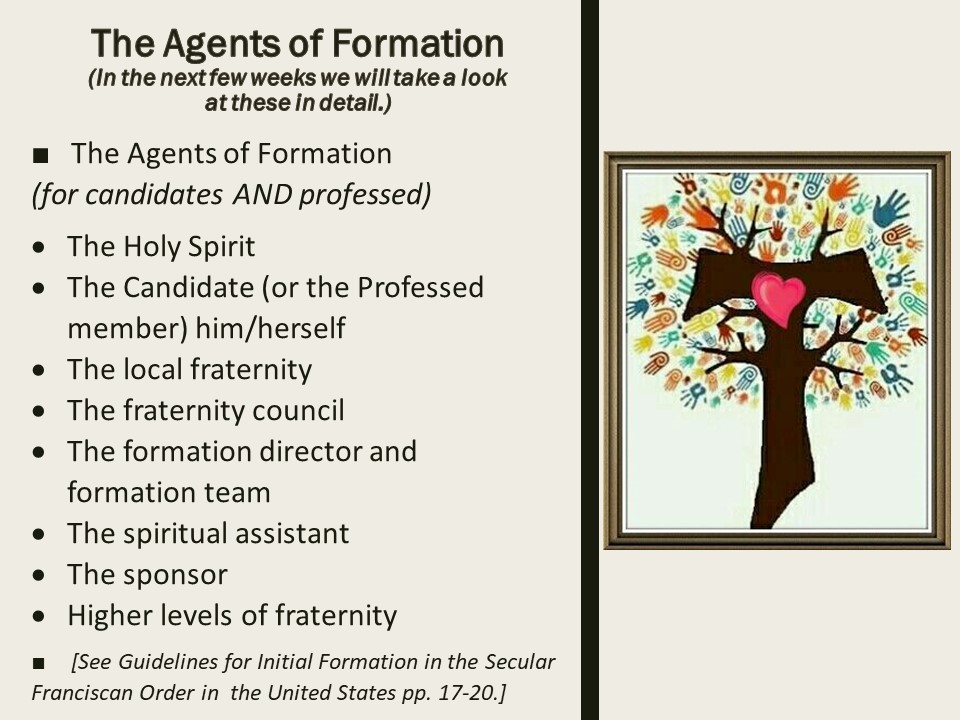
Who is responsible for formation? (In the next few weeks, we will take a look at these in detail.)

The Agents of Formation (for candidates AND professed)

·        The Holy Spirit

·        The Candidate (or the Professed member) him/herself

·        The local fraternity

·        The fraternity council

·        The formation director and formation team

·        The spiritual assistant

·        The sponsor

·        Higher levels of fraternity

[See Guidelines for Initial Formation in the Secular Franciscan Order in  the United States pp. 17-20.]


+++++++++++++++++


La importancia de la formación (inicial y continua)

• La formación de candidatos y miembros de la

La Orden Franciscana Seglar es un proceso continuo de conversión.

• Debe considerarse como un procedimiento personalizado que tiene en cuenta

la totalidad de la persona humana, el carisma, las necesidades y la

crecimiento espiritual de la persona

• En el proceso de formación, hay una interacción necesaria

entre los que se forman y los que se están formando.

• Todos se forman continuamente y se forman unos a otros.

Preguntas para reflexionar, discutir o responder en su diario:

• Piense en su experiencia en la formación inicial. ¿Qué te gustó de él? ¿Cómo podría haber sido mejor para ti?

• ¿Cómo le ayuda la formación (inicial o permanente) a lograr la conversión diaria?

• ¿Por qué cree que la relación y la interacción son importantes para una buena formación?


¿Quién es el responsable de la formación? (En las próximas semanas, los analizaremos en detalle).

Los Agentes de la Formación (para candidatos Y profesos)

•El espíritu santo

• El Candidato (o el miembro Profeso) él mismo

• La fraternidad local

• El consejo de la fraternidad

• El director de formación y el equipo de formación

• El asistente espiritual

•El patrocinador

• Mayores niveles de fraternidad


[Ver Pautas para la formación inicial en la Orden Franciscana Seglar en los Estados Unidos, págs. 17-20.]


Diane F. Menditto, OFS

Chair, National Formation Commission

Minister, Our Lady of the Angels Region


COME AND MARCH FOR LIFE IN PRAYER

(From Winter 2010)

On January 22, (2010), I invite you to come and join me if not physically, then please, spiritually in the annual March for Life down Constitution Avenue in Washington, DC, past the United States Supreme Court.

If physically and if you know the National Gallery of Art on the National Mall in front of the U.S. Capitol, we will meet on the steps of the National Gallery of Art West Building on 7th Street between Madison Drive and Constitution Avenue just opposite the skating rink.

I will be wearing the same green parka with the same banner that you see in the picture above. I am on the far left.

We have been having a bitterly cold and windy January so far, so please dress warmly in layers. We will not stay outside any longer than we need, and we will march.

If you cannot join us physically, and you are reading this on or before January 22, I would ask you to pray the following prayer from the National Basilica:

“Our Lady of Guadalupe, we turn to you who are the protectress of unborn children and ask that you intercede for us, so that we may more firmly resolve to join you in protecting all human life.

Let our prayers be united to your perpetual motherly intercession on behalf of those whose lives are threatened, be they in the womb of their mother, on the bed of infirmity, or in the latter years of their life.

May our prayers also be coupled with peaceful action which witnesses to the goodness and dignity of all human life, so that our firmness of purpose may give courage to those who are fearful and bring light to those who are blinded by sin.

Encourage those who will be involved in the March for Life; help them to walk closely with God and to give voice to the cry of the oppressed, in order to remind our nation of its commitment to life, liberty, and the pursuit of happiness for all people.

O Virgin Mother of God, present our petitions to your Son and ask Him to bless us with abundant life. Amen.”

If you are reading this message after January 22, please pray:

“O God, our Loving Creator, all life is in Your hands from the moment of conception until death. Help us to cherish our children and to be grateful for the privilege of sharing in Your work of creation. Bless all those who defend the rights of the unborn, the poor, the handicapped and the aged. Enlighten and be merciful toward those who do not value the gift of life. Help them to seek and find you. Grant that by our care and respect for all people and all life, we might be a sign of Your Love in our world today. We pray as always in Jesus’ name. Amen.”

Permit me to close by repeating those marvelous words of Saint John Paul II in his 1988 apostolic exhortation, The Vocation and the Mission of the Lay Faithful in the Church and in the World (Christifideles Laici):

“The inviolability of the person, which is a reflection of the absolute inviolability of God, finds its primary and fundamental expression in the inviolability of human life. Above all, the common outcry, which is justly made on behalf of human rights — for example, the right to health, to home, to work, to family, to culture — is false and illusory if the right to life, the most basic and fundamental right and the condition of all other personal rights, is not defended with maximum determination (38).”

We Seculars have felt that need to march, to pray, to witness to Life: Secular Franciscans For Life (Pro Vita)! Please come and march with us in prayer!

Peace and Life,

Tom

 Reflection Questions

  1. On what day do I ask you to march with us?
  2. Where will we meet?
  3. Where will we march?
  4. Why will we march?
  5. If you cannot march, what do I ask you to do?
  6. According to Saint John Paul II, what is a “reflection of the absolute inviolability of God”?
  7. Again, according to Saint John Paul II, what is the most basic and fundamental human right, the one without which the other human rights do not make much sense?

This is an excerpt from a series of articles by the late Deacon Tom Bello, OFS, former Minister of the National Secular Franciscan Order – USA.  “Many of these essays were originally published in TAU-USA, our national newsletter,” said Jan Parker, OFS, current National Minister. “They are excellent for reflection and ongoing formation.”  Jan helped Tom publish these  essays in book form.  It is called  For All The Saints:  St. Francis’s Five-Point Plan for Salvation and is available from Tau Publishing. These excerpts will appear several times a week on the Secular Franciscans website.

https://secularfranciscansusa.org/2020/08/12/come-and-march-for-life-in-prayer/

NAFRA Guidelines Concerning Secular Franciscan Prison Ministry

“I was . . . in prison and you visited me” Matthew 25:35-36.

It is good to consider how we might maintain the good things we are already doing, do some things in a different or better way, or even consider doing some new things.

One ministry that I would like to encourage in your Regions, local fraternities or even individually is greater outreach to our sisters and brothers in prison.

I have been active at the Alexandria Detention Center in Alexandria, Virginia since 1987. Because of its proximity to Washington, DC and the federal court system, this facility has housed, among many others, the reputed “20th 9/11 terrorist” Zacarias Moussaoui, the alleged “American Taliban” John Walker Lindh and Judith Miller, the New York Times reporter who chose to go to jail rather than reveal her sources.

I have had many blessed memories at the jail: many prisoners who have shared their stories, their prayers; one man whom we baptized and brought into the church; prison personnel who have received Holy Communion with us.

One favorite moment was the time Bishop Paul Loverde came to celebrate Christmas Mass with the prisoners, and it was my honor to assist him.

When the Bishop started his homily, he said, “I came to see Jesus. Where is Jesus?”

The prisoners looked shocked. What is he talking about?

The Bishop explained that in the Gospel of Matthew, Chapter 25, Jesus said “I was . . . in prison and you visited Me” (verse 35-36). He went on to make them feel that they were like Jesus and that they should be Jesus to one another. He gave them both greater dignity and a sense of mission.

This is exactly where the National Executive Council (NEC) began its Guidelines for Secular Franciscan Prison Ministry, which were unanimously approved by the entire National Fraternity (NAFRA) at our National Chapter on October 19, 2013, and which are included below and attached.

I believe that a careful reading of these Guidelines is self-explanatory. Permit me to stress again the value the National Fraternity sees in prison ministry for Secular Franciscans who feel so called. We do find Jesus in our prisons, but by the very reality of the situation, prisoners do not have control of their lives. They may be moved at any time; they cannot gather within the facility on a consistent basis; they cannot go outside the facility; nor is it easy for others to come in and observe or be with them.

For all these reasons and more, the time for formation and formal admission into our Secular Franciscan Order must come after release from prison, when both former prisoners and the local fraternity will have greater freedom to journey together in vital fraternity as permanently committed Brothers and Sisters of Penance.

Please note that these Guidelines do not address prisoners who have already been permanently professed; nor do we address permanent members of other institutions such as nursing homes or assisted living facilities. These Guidelines specifically address a problem that had arisen in several Regions and are not intended at this time as a legislative norm that will cover all situations in all institutions. The NEC feels that common sense, guided by prayer and the Holy Spirit, with knowledge of the Rule, the General Constitutions and the National Statues will usually be sufficient to address other concerns. If not, recourse can always be made to the National Fraternity and its Executive Council.

Nor do we say that prison ministry is for everybody. I still get a little nervous every time those big metal prison doors clang behind me, and I have been “panhandled” by one or two “hustlers” even when vested as a deacon within the walls of the facility! Still, Pope Francis has called us to ministry at the margins by his words and example. St. Francis certainly did likewise. And prayer itself is a positive ministry. Do your fraternities, do you, regularly pray for prisoners? Has anyone in your local fraternity (including you) ever participated in prison ministry either by consistent prayer or physical presence? Is the Lord calling you and your fraternity in some way to this ministry?

NAFRA GUIDELINES CONCERNING

SECULAR FRANCISCAN PRISON MINISTRY

Adopted October 19, 2013

  1. “I was . . . in prison and you visited me” (Matthew 25:35-6). Ministry to people in prison is a good gospel-based ministry for OFS members. We encourage such a ministry for those who are called to it. “As the Father sees in every person the features of his Son, the firstborn of many brothers and sisters, so the Secular Franciscans with a gentle and courteous spirit accept all people as a gift of the Lord and an image of Christ” (Secular Franciscan Rule 13).
  2. Individuals who are in prison can be encouraged to learn about the Franciscan charism. People in prison can read and learn about St. Francis and begin to live his spirit in prison. Prayer groups, Christian education and Bible study can be established to offer prisoners hope and a sense of belonging to a faith community.
  3. It benefits neither prisoners nor Secular Franciscans to invite prisoners to enter formation to become permanently professed members of the OFS while still in prison. Prisoners lack control of their own lives. They may be moved at any time and therefore lack a sense of permanence in a set place. They cannot congregate consistently to participate in a common formation program with approved spiritual assistance. Nor can they work together in fraternity performing apostolic ministries. In addition, by very definition, it is impossible for prisoners to participate directly in the life of a local fraternity outside the prison (cf. National Statutes Article 18.5a). Similarly, the local fraternity cannot witness formation and profession of a prisoner.
  4. Therefore, the time for formation and formal admission into the OFS must come after release from prison. These individuals would then be able to begin formation in a fraternity of their choice. They and the members of that local fraternity would both be free and able to discern a Secular Franciscan vocation in the same way as any applicant.

These guidelines were approved and adopted by the OFS National Fraternity Council gathered in Chapter on October 19, 2013

Reflection Questions

  1. What is the corporal work of mercy discussed in this article?
  2. Is this ministry for every Secular Franciscan? Why or why not?
  3. In the article, what did the Bishop mean when he asked, “I came to see Jesus. Where is Jesus?”
  4. What are, say, five problems with serious formation of permanently professed Secular Franciscans within a prison facility?
  5. Besides serious formation of permanently professed Secular Franciscans within a prison facility, what are, say, three other “Franciscan” activities that might be done by Secular Franciscans with prisoners?
  6. What do the NAFRA Guidelines urge as the best time for local fraternities and prisoners to think seriously about permanent formation in the Secular Franciscan Order? Why?
  7. Do the NAFRA Guidelines suggest that perhaps it might be best for Secular Franciscans to have nothing to do with prison ministry? Why or why not?

This is an excerpt from a series of articles by the late Deacon Tom Bello, OFS, former Minister of the National Secular Franciscan Order – USA.  “Many of these essays were originally published in TAU-USA, our national newsletter,” said Jan Parker, OFS, current National Minister. “They are excellent for reflection and ongoing formation.”  Jan helped Tom publish these  essays in book form.  It is called  For All The Saints:  St. Francis’s Five-Point Plan for Salvation and is available from Tau Publishing. These excerpts will appear several times a week on the Secular Franciscans website.

https://secularfranciscansusa.org/2020/08/10/nafra-guidelines-concerning-secular-franciscan-prison-ministry/

Open post

Formation Friday – Commitment & the Value of Profession

Dear Brothers and Sisters, 
Some of us are having new professions this month.  Whether your fraternity is doing this or not – it is always good to reflect upon our own profession and how we have lived that profession.  
Please share with your local fraternities  (en español abajo), Peace Dona
_______________________________________________________________________
Commitment and Value of Profession  (See For Up to Now Manual, “Profession.”)
The Value of Profession
       Profession contains an obligation contracted before God
       Profession contains a commitment to observe a form of life (Rule)

       By Profession there is definitive incorporation into the Order


Commitment
In the Footsteps of Francis–What does this mean?

       We follow Francis as Franciscans not to BECOME Francis, but to journey toward Christ and eternal life.


       We follow
       His relationship to God
       His calling to follow the Gospel
       His dependence on God

       His desire to do God’s will in all things

Following Christ Means Following the Gospel
       Some of the ways Francis lived the Gospel*:
       He followed Christ’s poverty;  Christ’s humility;
       The life of Christ; the precepts of Christ; the doctrine of Christ
       Following the way of Christ; the goodness of Christ

       The spirit of the Scriptures


*Fr. Felice Cangelosi, OFM Cap. – refer to For Up to Now Manual, “Profession.”
 
To ponder or to answer in your journal
 
·        At present, how do you proclaim Christ by your life and words?
·        If you are professed, did you think that this was what you were promising?
·        If you are not professed, are your initial formation classes helping you to see the importance of profession and what it signifies?
 
++++++++++++++++++++
Compromiso y valor de la profesión (Ver el Manual FUN, “Profesión”)
El valor de la profesión
• La profesión contiene una obligación contraída ante Dios.
• La profesión contiene el compromiso de observar una forma de vida (Regla)

• Por profesión hay incorporación definitiva a la Orden


Compromiso:
Tras las huellas de Francisco: ¿qué significa esto?

• Seguimos a Francisco como franciscanos, no para SER Francisco, sino para viajar hacia Cristo y la vida eterna.


•   Seguimos
• Su relación con Dios.
• Su llamado a seguir el Evangelio.
• Su dependencia de Dios.

• Su deseo de hacer la voluntad de Dios en todas las cosas.


Seguir a Cristo significa seguir el Evangelio


• Algunas de las formas en que Francisco vivió el Evangelio *:
• Siguió la pobreza de Cristo; La humildad de Cristo;
• La vida de Cristo; los preceptos de Cristo; la doctrina de cristo
• Seguir el camino de Cristo; la bondad de cristo

• El espíritu de las Escrituras.


* P. Felice Cangelosi, OFM Cap. – consulte el manual de hasta ahora, “Profesión”.
Para reflexionar o responder en su diario
• En la actualidad, ¿cómo proclama Ud. a Cristo con su vida y sus palabras?
• Si usted es profeso, ¿pensó que esto era lo que prometía?
• Si no es profeso, ¿sus clases de formación inicial le ayudan a ver la importancia de la profesión y lo que significa?


Diane F. Menditto, OFS

Chair, National Formation Commission

Minister, Our Lady of the Angels Region


Scroll to top
Juan de Padilla