Open post

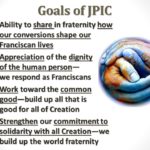
Formation Friday September 4, 2020 (Graphic attached)

Dear Brothers and Sisters,  This is a great time for us to reflect on our hearts and souls as Franciscans.  We might not have thought that JPIC was an area where we could do just that.  However, when you read the goals of JPIC below, JPIC goals focus upon our communication, respect for one another and how well we practice Franciscan virtues.  Hope that you find this section interesting and good material for your own personal reflection.  Peace, Dona
 
Please share with your local fraternities. (En español abajo)
 

 Goals of JPIC  (The National Commission on Justice, Peace and Integrity of Creation)

1-To foster an atmosphere in fraternity where we can share how our personal conversions are shaping our Franciscan lives.

2-To reinforce the appreciation of the dignity of the human person in the choices made in our professed lives by responding in charity and patience to all we meet and to respond as Franciscans to anything which would denigrate the dignity of the human person, beginning with our own personal communications with one another;


3-. To assist in the living out of obedience to the common good as intended by God so that the professed Secular Franciscan builds up all that is good for all of Creation and does nothing which would damage the fabric of communal interdependence;

4-To strengthen the professed Secular Franciscans’ commitment to solidarity with all of Creation enabling them to make those choices in life which would bring about a more fraternal and evangelical world. (Build up the world fraternity)


See For Up to Now (FUN) Manual: JPIC pp 15 & 16

·        What is the Church asking of me as my part in her mission?

·        How does my daily conversion reflect upon this?

·        What one new way can I find to energize my life in the Church?

  • What one new way can I find, as a Candidate, to energize my life in Fraternity?

If you are interested in more resources on Justice, Peace and Integrity of Creation, please visit our National website at this link: https://secularfranciscansusa.org/jpic/

 ++++ ++++++++++++++++++++++++++++++++++++++++++++++++++++++++++++++++++++

Objetivos de JPIC  (La comisión de Justicia, paz e integridad de la creación)

1-Fomentar un clima de fraternidad donde podamos compartir cómo nuestras conversiones personales están moldeando nuestra vida franciscana.

2-Reforzar la apreciación de la dignidad de la persona humana en las elecciones realizadas en nuestra vida profesa, respondiendo con caridad y paciencia a todos los que nos encontremos y respondiendo como franciscanos a cualquier cosa que denigre la dignidad de la persona humana, comenzando por nuestras propias comunicaciones personales entre nosotros;

3-. Ayudar a vivir la obediencia al bien común como lo pretendía Dios para que el profeso franciscano seglar construya todo lo que es bueno para toda la Creación y no haga nada que dañe el tejido de la interdependencia comunitaria;

4-Reforzar el compromiso de los profesos seglares franciscanos de solidaridad con toda la Creación, capacitándolos para tomar aquellas decisiones en la vida que traigan un mundo más fraterno y evangélico. (Construye la fraternidad mundial.)


Consulte el manual FUN: JPIC págs.15 y 16

• ¿Qué me pide la Iglesia como parte de su misión?

• ¿Cómo se refleja mi conversión diaria sobre esto?

• ¿Qué nueva forma puedo encontrar para energizar mi vida en la Iglesia?

• ¿Qué nueva forma puedo encontrar, como Candidato, para dinamizar mi vida en Fraternidad?


Si está interesado en más recursos sobre Justicia, Paz e Integridad de la Creación, visite nuestro sitio web Nacional en este enlace: https://secularfranciscansusa.org/jpic/


Diane F. Menditto, OFS

Chair, National Formation Commission

Minister, Our Lady of the Angels Region


Season of Caring for Creation September 1 – October 4

Most High, all powerful, good Lord, Yours are the praises, the glory, the honor, and all blessing.

To You alone, Most High, do they belong, and no man is worthy to mention Your name.

Be praised, my Lord, through all your creatures, especially through my lord Brother Sun, who brings the day; and you give light through him.

And he is beautiful and radiant in all his splendor! Of you, Most High, he bears the likeness.

Call to Prayer:  All-powerful God, you are present in the whole universe and in the smallest of your creatures. You embrace with your tenderness all that exists. Pour out upon us the power of your love, that we may protect life and beauty. Encourage us in our struggle for justice, love and peace. We thank you for being with us each day. In Jesus’ name we pray. Amen.

Reading:  The human environment and the natural environment deteriorate together; we cannot adequately combat environmental degradation unless we attend to causes related to human and social degradation. In fact, the deterioration of the environment and of society affects the most vulnerable people on the planet: “Both everyday experience and scientific research show that the gravest effects of all attacks on the environment are suffered by the poorest”. (Laudato Si #48)

https://secularfranciscansusa.org/2020/08/31/season-of-caring-for-creation-september-1-october-4/

Open post

FORMATION FRIDAY – The Seven Crosses of St. Francis – Formation Friday August 28, 2020

Dear Brothers and Sisters, 

The National Formation Commission continues to provide excellent resources for us during this unique time in history.  Today we will learn about the 7 Crosses of St. Francis.  The Youtube video on this topic helps to enrich our understanding.  I found several videos on Youtube about this topic; some were retreats on the 7 Crosses of St. Francis.  Hope you enjoy them and discuss this with your local fraternity via phone, Zoom, or even better – in person.  (there are two attachments for download)  Peace, Dona

++++++++++++++++++++++++++++++++++++++++++++++++++++++++++++++++


We are all part of history and a story.  We are part of the story of our families, of our religion, of the time in which we live. As Franciscans, we are also part of the Franciscan story. There are traditions, stories, devotions, prayers, and sayings involved with all of these groups. Knowing about them helps us to be part of the family. Every so often, Formation Friday will highlight one of these important parts of our story.

Have you ever heard of the Seven Crosses of St. Francis? They appear in the Major Legend of St. Francis by St. Bonaventure. You can find some interesting talks on this topic on YouTube  https://www.youtube.com/results?search_query=seven+crosses+of+St.+Francis

Meanwhile, here is a summary. Thank you to Chris Leone, OFS, Our Lady of the Angels Regional Fraternity.

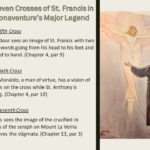
The First Cross

Francis has a dream in which he sees a room filled with armor. He hears the question, “Who is it better to follow, the master or the servant?” (Chapter 1, par 3)

The Second Cross

St. Francis sees a vision of Christ crucified which pierces the depth of his soul. (Chapter 1, Par 5)

The Third Cross

Francis hears a voice from the cross in the chapel of San Damiano, “Francis, go and repair my house which, as you see, is all being destroyed.” (Chapter 2, par 1)

The Fourth Cross

Sylvester, a man of an upright way of life, has a vision of St. Francis with a golden cross issuing from his mouth. (Chapter 3, par 5)

The Fifth Cross

A troubadour sees an image of St. Francis with two crossed swords going from his head to his feet and from hand to hand. (Chapter 4, par 9)

The Sixth Cross

Brother Monaldo, a man of virtue, has a vision of St. Francis on the cross while St. Anthony is preaching. (Chapter 4, par 10)

The Seventh Cross

St. Francis sees the image of the crucified in the wings of the seraph on Mount La Verna and receives the stigmata. (Chapter 13, par 3)

______________________________________________________________________________________________________________________

Questions to ponder, discuss, or answer in my journal. Think about St. Francis’s life as you answer.

·        How does St. Francis’s discernment process help you to discern your vocation?

·        St. Francis often meditated on the Cross of Christ and finally received the stigmata. How is meditating on the Cross important to your prayer life? How could it help you deepen your prayer?


Diane F. Menditto, OFS

Chair, National Formation Commission

Minister, Our Lady of the Angels Region


Open post

Formation Friday – What does Formation do for us?

 Dear Brothers and Sisters, 

This is a great time to talk with your Fraternity about the importance of Formation.  Journaling and discussing formation lessons will help us all internalized our Franciscan vocation.  Please share thiswith your local fraternities.  Peace, Dona


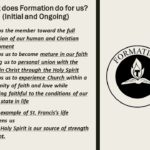
(Initial and Ongoing)


       Helps the member toward the full realization of our human and Christian development

       Helps us to become mature in our faith bringing us to personal union with the Father in Christ through the Holy Spirit

       Helps us to experience Church within a community of faith and love while remaining faithful to the conditions of our secular state in life

       The example of St. Francis’s life enlightens us

The Holy Spirit is our source of strength and light.


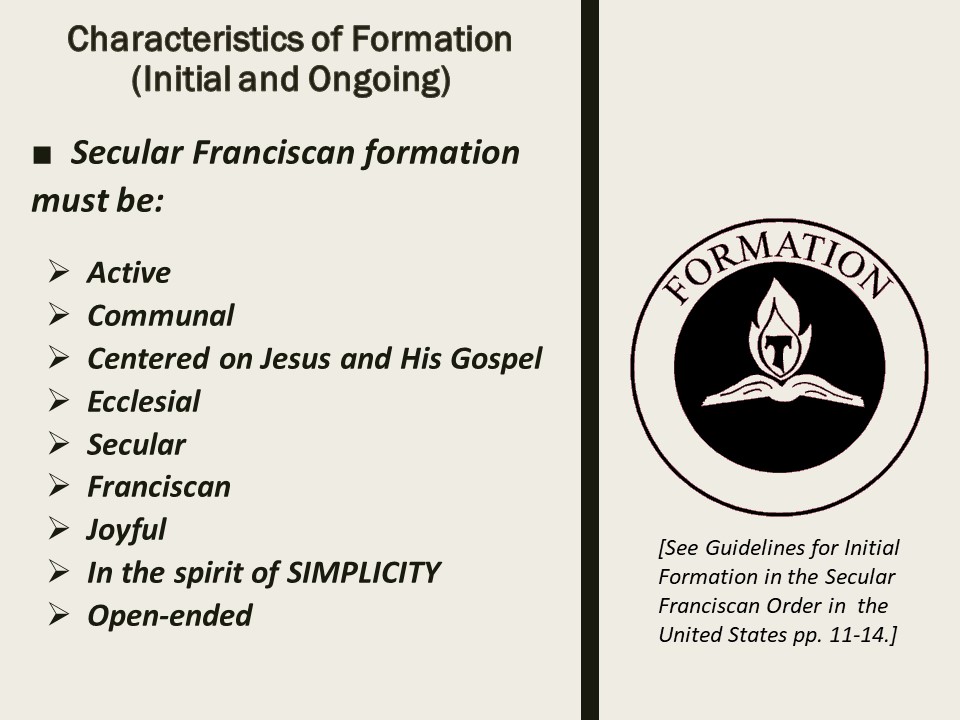
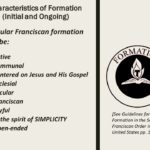
Characteristics of Formation (Initial and Ongoing)

       Secular Franciscan formation must be:

Ø  Active

Ø  Communal

Ø  Centered on Jesus and His Gospel

Ø  Ecclesial

Ø  Secular

Ø  Franciscan

Ø  Joyful

Ø  In the spirit of Simplicity

Ø  Open-ended


+++++++++++++++++++++++++++++++++++++++++++++++++++++++++++++++++++++++++++++++++++


¿Qué hace la formación por nosotros?

(Inicial y en curso)


 Ayuda al miembro a la plena realización de nuestro desarrollo humano y cristiano.

 Nos ayuda a madurar en nuestra fe llevándonos a la unión personal con el Padre en Cristo a través del Espíritu Santo.

 Nos ayuda a experimentar la Iglesia dentro de una comunidad de fe y amor mientras permanecemos fieles a las condiciones de nuestro estado secular en la vida.

 El ejemplo de la vida de San Francisco nos ilumina

El Espíritu Santo es nuestra fuente de fuerza y luz.


Características de la formación (inicial y permanente)

 La formación franciscana seglar debe ser:

·        Activo

·        Comunitario

·        Centrado en Jesús y Su Evangelio

·        Eclesial

·        Secular

·        Franciscano

·        Alegre

·        En el espíritu de la simplicidad

·        Abierto

Preguntas para reflexionar, discutir o responder en su diario:

·        • ¿Su experiencia de formación inicial se ajusta a las características anteriores?

·         Piense en la experiencia de formación permanente en su fraternidad.

           o ¿Cómo pueden estas características ayudar a que las experiencias de formación  

               permanente sean más beneficiosas e interesantes?

           o Piense en lo que usted sugeriría a su equipo de formación de fraternidad y ¡hágales

               saber!


Diane F. Menditto, OFS

Chair, National Formation Commission

Minister, Our Lady of the Angels Region


The Final Test of Servant Leadership in the Secular Franciscan Order is Love

In the final extended exchange between our first “Minister,” St. Peter, and our Lord and Savior Jesus Christ, we read:

When they had finished breakfast,
Jesus said to Simon Peter,
“Simon, son of John, do you love me more than these?”
He said to him, “Yes, Lord, you know that I love you.”
He said to him, “Feed my lambs.”
He then said to him a second time, “Simon, son of John, do you love me?”
He said to him, “Yes, Lord, you know that I love you.”
He said to him, “Tend my sheep.”
He said to him the third time, “Simon, son of John, do you love me?”
Peter was distressed that he had said to him a third time, “Do you love me?”
And he said to him, “Lord, you know everything; you know that I love you.”[Jesus] said to him, “Feed my sheep”
(John 21:15-17).

Most Biblical scholars agree that John is the last written of the four major Gospels, and this exchange is the final test that the Lord gives Peter before His Ascension. I say “final” because it is clearly not the first test.

Perhaps the first test of Servant Leadership is one not very popular in American culture. Most Biblical scholars agree that Mark is the first written of the four major Gospels. Spoken directly to Simon (Peter) and his brother Andrew in this first Gospel, our Lord’s first word is “Come.” “Come after me” (Mark 1:17).

Well, how can we respond to “Come”? To me, I either say, “Yes, I’m coming,” or “No, I’m not coming.” “Come” does not really sound like a call to dialogue or discussion.

Thus, the first test the Lord gives his first “Minister” is obedience. Either Simon Peter follows the Lord’s summons or he doesn’t; either he obeys or he doesn’t. Simon comes, obediently, as do Andrew and the other disciples; note, please, not knowing what to expect in following the Lord. How could they?

How many of us would accept this “blind” test of obedience? I guess all of us who are permanently professed have accepted this test. I can honestly say that I did not know what lay ahead of me on June 12, 1983, when I made my permanent profession. Perhaps obedience is not a bad test to start with!

What might be the second test? Well, early on in most of the Gospels, Peter and the other disciples face some serious challenges: for Peter, the sickness of his mother-in-law at a time of no professional doctors or emergency rooms (Mark 1:30), a storm at sea (Mark 4:37-40), and the inability to drive out demons (Mark 5:1-20), to name just three. And as the Lord allows Peter and the others to experience these challenges or tests, He will often counsel to the effect, “Do not be afraid; just have faith” (Mark 5:36).

Thus, the second test brings us to faith, the first of the theological virtues, faith that is a gift of God and the practice of which helps lead us to God. According to Hebrews 11:1, “faith is the realization of what is hoped for and evidence* of things not seen.” To me, this is not the same as obedience, and every Minister will be tested on her or his faith, I promise, as were Peter and the disciples. Let us pray that our tests as Servant Leaders will strengthen our faith, and with God’s grace, we can strengthen each other’s faith. As the Lord says to Peter: “I have prayed that your own faith may not fail; and once you have turned back, you must strengthen your brothers” (Luke 22:32).

This article cannot explore all the tests or challenges that the Lord gives in the Gospels, but since we started with and will finish with Peter, let’s stay with Peter, as the Lord’s first “Fraternity Minister” a bit longer. What other tests did Peter need to face? How did the Lord prepare Peter for Servant Leadership?

Well, although I have written about it before, I continue to be attracted Peter’s effort to walk on the water (Matthew 14:28-31). The Lord again says to Peter that one word: “Come.” Yet to me the test here is not one of obedience or even faith, but rather a test of focus. Peter obeys, and he trusts in the Lord, but he cannot keep his focus exclusively on the Lord. As long as he keeps his eyes focused on Jesus, he’s fine. When he thinks about the power of the storm or his own sinfulness, he sinks like a stone.

Although I have not seen any Secular Franciscan Ministers trying to walk on water, I have seen some of us attempting more than we can really do with our own obviously limited human abilities. In every case, when we have allowed our attention and concentration to turn from the Lord to the circumstances and personalities involved, we, or at least I, have sunk.

Then there is that test of recognition (Matthew 16:13-20). Who do people say that I am? Who do you say that I am? Peter has to know. It is impossible to be Secular Franciscan leaders if we cannot recognize our Lord and Savior, if we cannot proclaim that Jesus Christ is truly God and truly man.

Another great test of leadership in the Lord’s service is the test of forgiveness. Who else but Peter will ask how often he should forgive his brother who sins against him. Seven times? The test here is on the limits of forgiveness, and I have talked to Ministers who just cannot forgive. We say we are Christian leaders, but we can be vengeful or passive/aggressive.

We just don’t like people for what they have done, or what we imagine they have done, and we fail this test of forgiveness since our Lord tells Peter in essence, there are no limits on forgiveness.
We don’t just forgive our brother (or sister) who sins against us seven times, but seventy-seven times (or in some translations, seventy times seven times) (Matthew 18:21-22).

Then during the Passion, when Jesus has been taken captive, Peter is challenged to stand with the Lord, and of course, he denies the Lord three times (Matthew 26:69-75). The test here may be that test of martyrdom. As a Servant Leader, could I remain faithful to the Lord even in the face of possible death?

I have never met this test, nor have I met anyone in the United States who has faced this test, but at the meeting of the International Fraternity in Assisi last November (and please forgive me for not publicly divulging names), I met good sisters from China, the Ukraine and Russia and good brothers from Bethlehem and Nigeria, for example, who gave me the sense that they could face this test sooner than later. Let us pray for all who have faced or will face this test!

Yet, even this test of possible martyrdom is not the final test the Lord gives to Peter and to us. Again, that final test is the test of love.

Why does the Lord ask Peter three times if he loves Him? Of course, neither the Lord nor Peter has forgotten Peter’s three-fold denial, but note that nowhere does the Lord blame or remonstrate with Peter for this denial. Rather, he wants Peter to practice from henceforth perhaps the greatest lesson that the Lord could teach him: Love.

Love is the answer to almost all of our problems and failures as Servant Leaders; not our own limited, imperfect human love, but God’s love for us, which never stops and is always there. If we are open to the Lord’s love, that love will flow from the Lord through us to our sisters and brothers before returning to the Lord.

Without that love, all our Secular Franciscan Servant Leadership is more or less hypocritical. Without that love, even great faith and the willingness to die mean nothing. As wrote St. Paul: “If I have all faith so as to move mountains but do not have love, I am nothing. If I give away everything I own, and if I hand my body over so that I may boast but do not have love, I gain nothing” (1 Corinthians 13:2b-3).

Let us pray. Heavenly Father, Servant Leadership in the Secular Franciscan Order is not about us. It is never about us. Servant Leadership, finally, is about love. Love and service. If we are seeking anything else, fame, attention, escape from boredom, revenge on someone in the fraternity, whatever, we are wasting our time; and worse, the fraternity’s time; and the worst, Your graces and gifts. You test us in many different ways with different people and circumstances as we journey on this Franciscan Way to salvation. When we fail, lift us up. Help us to learn from our mistakes to trust Your love and mercy more and more by showing that love and mercy to all our sisters and brothers. We pray in Jesus’ name.

Reflection Questions

1. What might have been our Lord’s first test of Servant Leadership with Simon Peter?
2. What might have been our Lord’s second test of Servant Leadership with Simon Peter? How are the first two tests different?
3. What might Peter have learned from trying to walk on the water?
4. What might Peter have learned from the Lord’s question, “Who do you say that I am?”
5. What might all Servant Leaders learn from Peter’s question on how often he should forgive his brother who sins against him?
6. What might have been our Lord’s final test of Servant Leadership with Simon Peter?
7. Why is this final test perhaps the most important of all?

This is an excerpt from a series of articles by the late Deacon Tom Bello, OFS, former Minister of the National Secular Franciscan Order – USA.  “Many of these essays were originally published in TAU-USA, our national newsletter,” said Jan Parker, OFS, current National Minister. “They are excellent for reflection and ongoing formation.”  Jan helped Tom publish these  essays in book form.  It is called  For All The Saints:  St. Francis’s Five-Point Plan for Salvation and is available from Tau Publishing. These excerpts will appear several times a week on the Secular Franciscans website.

https://secularfranciscansusa.org/2020/08/19/the-final-test-of-servant-leadership-in-the-secular-franciscan-order-is-love/

Scroll to top
Juan de Padilla