Sharing the Vision

(This article originally appeared in the TAU-USA Fall 2020 #101)

NEWS FROM THE NATIONAL EXECUTIVE COUNCIL

COVID-19 changes the National Executive Council’s Plans too.

The National Executive Council (NEC) typically meets 2-4 times per year to conduct the business of the Secular Franciscan Order in the United States with a few phone calls in between meetings. Due to the pandemic the NEC began to meet only virtually. Most of those meetings were two hours or less once or twice a month. In March, the scheduled four-day meeting at the Chiara Center in Springfield, Illinois was replaced by virtual meeting sessions over the same period of time. As of July 2020, the NEC virtually met 15 times in 2020. See chart of meetings for the NEC:

Some specific actions taken during the spring and summer include:

1. Guidelines for Fraternal Gatherings in Times of Social Distancing were issued in May  2020. https://secularfranciscansusa.org/2020/05/13/guidelines-for-fraternal-life-during-socialdistancing/

The guidelines address what types of events can happen virtually (fraternity gatherings, council meetings, and initial formation sessions). Other events will need to be postponed until it is safe to gather together (visitations, elections, and Rites of Admission and Profession).

2.The International Council of the OFS (CIOFS) sent out a draft of new International Statutes this past spring. The NEC reviewed the statutes and drafted comments with recommendations and questions. The draft will be shared with the Regional Ministers for review and comment prior to returning it to the CIOFS this September.

3.The CIOFS elective chapter has been postponed until 2021. Please continue to pray that the Holy Spirit will guide all as CIOFS prepares for the chapter.

4. A new CIOFS website, www.ciofs.info, was launched in early July.

5. Our three National Commissions – Formation, Justice Peace and Integrity of Creation (JPIC) and Franciscan Youth and Young Adults (FY/YA) – were undaunted by the Covid-19 limitations and over this past summer enthusiastically hosted virtual workshops. Hundreds of OFS from across the country benefitted from these gatherings, enjoying both formation and fellowship in large and small groups. At the JPIC Visioning II Workshop, held virtually May 8-9, 2020, 36 national leaders came together to continue the conversation that was begun in August 2019. During this workshop, the idea of JPIC Focus Groups came up as a way to educate and communicate about certain social justice issues: Immigration, Care for Creation, and the Spirituality of JPIC. Less than three weeks later, the world was shocked at the brutal killing of another unarmed black man by police. People were able to see the killing unfold on TV and on social media. Seculars all over the country were crying out, “What is ours to do?” As a result, an additional JPIC Focus Group was formed to address the issue of racism and practice mindful dialogue. This past August, the Formation Commission two-day workshop drew nearly 100 attendees. (See related article in this issue.) The FY/YA Commission hosted weekly gatherings over an 11-week period. All these virtual gatherings have received rave reviews.

6. Guidelines for Regional Archives were approved in May 2020 and have been posted on our webiste. For a copy of the guideline, please contact Jane DeRose-Bamman, OFS (ofsusasecretary@gmail.com)

7. Regional Visitations and Elections have been postponed due to the pandemic. NEC members are working closely with the Regional Ministers to see when the events can be rescheduled.

8. The Spanish translation of the OFS Ritual is nearly complete. Many people were involved with this effort. It will be sent for final formatting and printing in the near future. The NEC is looking forward to having this resource become available.

https://secularfranciscansusa.org/2020/11/09/sharing-the-vision/
Open post

Formation Friday – November 6 – OFS Prayer Life

Dear Brothers and Sisters,  Today, more than ever we need to seek the Holy Spirit through prayer.  Prayer is our ‘Bridge Over Troubled Water”. Padre Pio said, ” Pray, Hope, and don’t worry.  Worry is useless.  God is merciful and He will hear our prayers.”    Peace, Dona

++++++++++++++++++++++++++++++++++++++++++++++++++++++++++++++++++

(Please share with your local fraternity.) (En español abajo)

The Prayer Journey of the Secular Franciscan

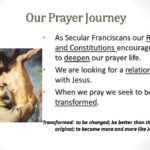
       As Secular Franciscans our Rule and Constitutions encourage us to deepen our prayer life.

       We are looking for a relationship with Jesus.

       When we pray we seek to be transformed.

Transformed:  to be changed; be better than the original; to become more and more like Jesus.


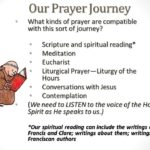
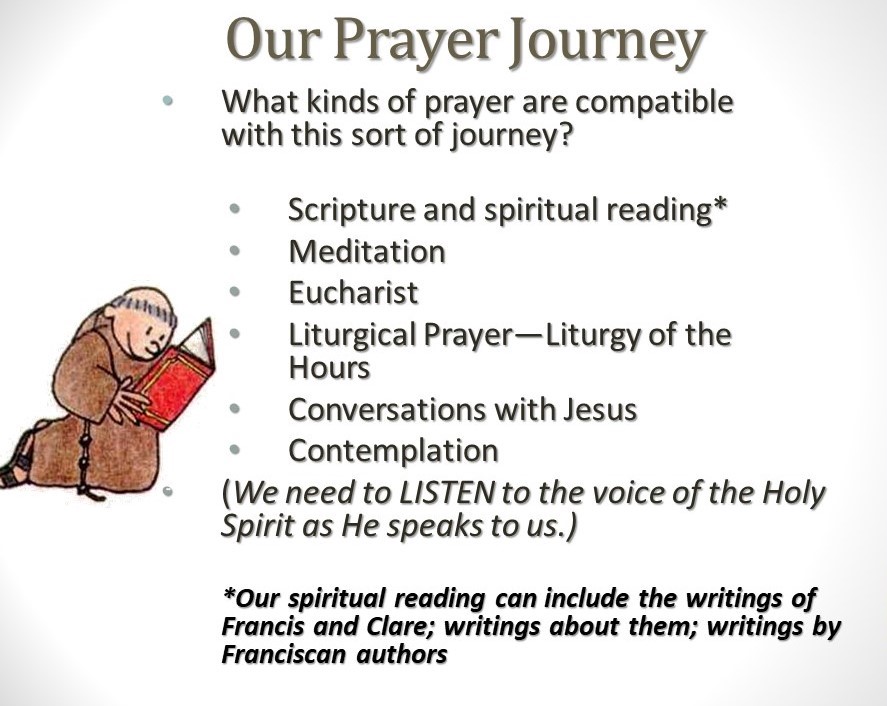
       What kinds of prayer are compatible with this sort of journey?

       Scripture and spiritual reading*

       Meditation

       Eucharist

       Liturgical Prayer—Liturgy of the Hours

       Conversations with Jesus

       Contemplation

       (We need to LISTEN to the voice of the Holy Spirit as He speaks to us.)

*Our spiritual reading can include the writings of  Francis and Clare; writings about them; writings by
Franciscan authors


       Contemplation is a normal prayerful stance of Franciscans” (See GC 14.5)

       “The Trinity calls us to unity through our prayer.” (See GC 14.3)

       “The Eucharist is the center of the life of the Church.” (See GC 14.)

       “The Liturgy of the Hours unites us to the praying Church.” (See GC 14.4)


(From the FUN Manual)


To discuss or answer in your journal

+How has your prayer life changed over the last few years? 

+Are you feeling closer to Jesus or further away?

+What might you do to improve the quality of your prayer?


General Constitutions Article 14

2. (Rule 8) The Eucharist is the center of the life of the Church. Christ unites us to himself and to one another as a single body in it. Therefore, the Eucharist should be the center of the life of the fraternity. The brothers and sisters should participate in the Eucharist as frequently as possible, being mindful of the respect and love shown by Francis, who, in the Eucharist, lived all the mysteries of the life of Christ.


3. They should participate in the sacraments of the Church, attentive not only to personal sanctification but also to fostering the growth of the Church and the spreading of the Kingdom. They should collaborate in achieving living and conscious celebrations in their own parishes, particularly in the celebrations of baptism, confirmation, marriage, and the anointing of the sick.


4. The brothers and sisters, as well as the fraternities, should adhere to the indications of the Ritual with respect to the different forms of participating in the liturgical prayer of the Church, giving priority to the celebration of the Liturgy of the Hours. (See Ritual pp. 103-104)


5. In all places and at all times, it is possible for true Worshippers of the Father to give him adoration and to pray to him. Nevertheless, the brothers and sisters should try to find times of silence and recollection dedicated exclusively to prayer. (See Ritual pp. 103-104)


++++++++++++++++++++++++++++++++++++++++


La jornada de oración del franciscano seglar


• Como Franciscanos Seglares, nuestra Regla y Constituciones nos animan a profundizar nuestra vida de oración.

• Buscamos una relación con Jesús.

• Cuando oramos buscamos ser transformados.

Transformado: ser cambiado; ser mejor que el original; para ser cada vez más como Jesús.


• ¿Qué tipos de oración son compatibles con este tipo de jornada?

• La Escritura y lectura espiritual *

• La meditación

• La Eucaristía

• La oración litúrgica: la liturgia de las horas

• Conversaciones con Jesús

• La contemplación

• (Necesitamos ESCUCHAR la voz del Espíritu Santo cuando nos habla).


* Nuestra lectura espiritual puede incluir los escritos de Francisco y Clara; escritos sobre ellos; escritos de

autores franciscanos


• “La contemplación es una actitud de oración normal de los franciscanos” (Ver CCGG 14.5)

• “La Trinidad nos llama a la unidad a través de nuestra oración”. (Ver CCGG 14.3)

• “La Eucaristía es el centro de la vida de la Iglesia”. (Ver CCGG 14.)

• “La Liturgia de las Horas nos une a la Iglesia orante”. (Ver CCGG 14.4)


(Del manual FUN)


Para platicar o responder en su diario 

+¿Cómo ha cambiado su vida de oración en los últimos años? 

+¿Se siente más cerca o más lejos de Jesús? 

+¿Qué podría hacer para mejorar la calidad de su oración?


Constituciones generales Artículo 14


2. (Regla 8) La Eucaristía es el centro de la vida de la Iglesia. Cristo nos une a él y a los demás como un solo cuerpo en él. Por tanto, la Eucaristía debe ser el centro de la vida de la fraternidad. Los hermanos y hermanas deben participar en la Eucaristía con la mayor frecuencia posible, teniendo en cuenta el respeto y el amor mostrado por Francisco, quien, en la Eucaristía, vivió todos los misterios de la vida de Cristo.


3. Participen en los sacramentos de la Iglesia, atentos no sólo a la santificación personal, sino también a favorecer el crecimiento de la Iglesia y la difusión del Reino. Deben colaborar en la realización de celebraciones vivas y conscientes en sus propias parroquias, particularmente en las celebraciones del bautismo, la confirmación, el matrimonio y la unción de los enfermos.


4. Los hermanos y hermanas, así como las fraternidades, deben adherirse a las indicaciones del Ritual con respecto a las diferentes formas de participación en la oración litúrgica de la Iglesia, dando prioridad a la celebración de la Liturgia de las Horas. (Ver Ritual págs. 103-104)


5. En todo lugar y en todo momento, es posible que los verdaderos adoradores del Padre le adoren y le recen. Sin embargo, los hermanos y hermanas deben tratar de encontrar momentos de silencio y recogimiento dedicados exclusivamente a la oración. 


Diane F. Menditto, OFS

Chair, National Formation Commission

Minister, Our Lady of the Angels Region
__._,_.___


Did You Know – Copying Calendars into MS Word

Sometime we don’t have time to get on the internet and sometime it is down!!!

You can put any of the Calendars from this website into a MS Word document and save it to a folder in your Documents on your computer.

If you have Microsoft Word, you can copy the whole calendar and paste it into Word.

Before or after you paste it into the Word Document, change the Orientation from Portrait to Landscape.

 Then you can Insert a Heading — if you want — for the Month & Year.


You can change it into a PDF format by the Save As to PDF.


And you have it.   

The links are carried into both the Word and the PDF documents. 

If your internet is available, you can pull up the info for the event on the calendar right from the document.

By placing your cursor over the entry of the day in your document, the link pops up and tells you to hit the  “ctrl”  key at the same time you press the right click on the mouse…  (most times I have to try it a time or 2 to get the sequence right) 

https://secularfranciscansusa.org/2020/11/02/did-you-know-copying-calendars-into-ms-word/

Open post

FORMATION FRIDAY – What are the Admonitions of Francis?

Dear Brothers and Sisters,  

Ever wonder how to begin a good formation lesson about the Admonitions of Francis?  Well, today, the NFC gives us a great start on Admonitions 15- 18.    The first link takes us to the Franciscan Tradition website – full of free resources – All of the Sources, (Francis the Saint/Prophet/Founder, and much more).  And it also shows the translation of all in Latin (the language the devil hates according to exorcist!)   The simple lesson below is an easy way to get into a big topic and several big books.  The National Formation Commission breaks it down into small enough parts so that you can really discuss the admonitions and what they means to you.  Hope that you will share this within your fraternities.  Peace, Dona

++++++++++++++++++++++++++++++++++++++++++++++++++++++++++++++++++++++++++++

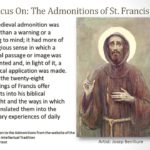
Focus on the Admonitions  (XV, XVII, XVIII) 

https://www.franciscantradition.org/francis-of-assisi-early-documents/the-saint/writings-of-francis/the-undated-writings/the-admonitions/144-fa-ed-1-page-128


[XV: Peace]

1Blessed are the peacemakers, for they will be called children of God. Mt 5:9

2Those people are truly peacemakers who, regardless of what they suffer in this world, preserve peace of spirit and body out of love of our Lord Jesus Christ.


[XVII: The Humble Servant of God]

1Blessed is that servant Mt 24:46 who no more exalts himself over the good the Lord says or does through him than over what He says or does through another.

2A person sins who wishes to receive more from his neighbor than what he wishes to give of himself to the Lord God.


[XVIII: Compassion for a Neighbor]a

1Blessed is the person who supports his neighbor in his weakness as he would want to be supported were he in a similar situation. Gal 6:2  Mt 7:12

2Blessed is the servant who returns every good to the Lord God because whoever holds onto something for himself hides the money of his Lord Mt 25:18 God within himself, and what he thinks he has will be taken away from him.


To discuss or answer in your journal:

  • How does Admonition XV inspire me in my dealings with others? (Family; friends; on social media; in political discussions)
  • How does Admonition XVII speak to those of us who are servant leaders or those who aspire to offer service to the Order? What are the qualities of a servant leader who gives him/herself to God?
  • How does Admonition XVIII  encourage us in our outreach to those who are less fortunate than we are? Which Franciscan qualities do we need to fulfill this Admonition?                                   


 ++++++++++++++++++++++++++++++++++


Enfoque en las admoniciones de San Francisco  (XV, XVII, XVIII)

http://www.franciscanos.org/esfa/adm-ae.html

[Cap.. XV: De la paz]

1Bienaventurados los pacíficos, porque serán llamados hijos de Dios (Mt 5,9). 2Son verdaderamente pacíficos aquellos que, con todo lo que padecen en este siglo, por el amor de nuestro Señor Jesucristo, conservan la paz en el alma y en el cuerpo.

[Cap.. XVII: Del humilde siervo de Dios]

1Bienaventurado aquel siervo (Mt 24,46) que no se exalta más del bien que el Señor dice y obra por medio de él, que del que dice y obra por medio de otro. 2Peca el hombre que quiere recibir de su prójimo más de lo que él no quiere dar de sí al Señor Dios.

[Cap.. XVIII: De la compasión del prójimo]

1Bienaventurado el hombre que soporta a su prójimo según su fragilidad en aquello en que querría ser soportado por él, si estuviera en un caso semejante (Gál 6,2; Mt 7,12). 2Bienaventurado el siervo que devuelve todos los bienes al Señor Dios, porque quien retiene algo para sí, esconde en sí el dinero de su Señor Dios (Mt 25,18), y lo que creía tener se le quitará (Lc 8,18).


Para platicar o contestar en su diario:

• ¿Cómo me inspira la Admonición XV en mi trato con los demás? (Familia; amigos; en las redes sociales; en discusiones políticas)

• ¿Cómo nos habla la Admonición XVII a quienes somos líderes servidores o quienes aspiramos a ofrecer servicio a la Orden? ¿Cuáles son las cualidades de un líder servidor que se entrega a Dios?

• ¿Cómo nos anima la Admonición XVIII en nuestro alcance a aquellos que son menos afortunados que nosotros? ¿Qué cualidades franciscanas necesitamos para cumplir esta Admonición?


Diane F. Menditto, OFS

Chair, National Formation Commission

Minister, Our Lady of the Angels Region


Conversion and Action on the Anniversary of Laudato Si’

by Joe Makley OFS Vice-Chair, National JPIC Commission

It was Pope Francis, in Laudato Si, who said of Saint Francis: “[He showed us the] inseparable bond between concern for nature, justice for the poor, commitment to society and interior peace.” He was talking about Francis’ whole life and ministry, and he wanted us to understand that these things are connected. To put it in the terms of the moment, it is difficult to stop a pandemic when large segments of the society do not have proper health insurance or clean drinking water. The spirit of Laudato Si is a spirit of justice and peace, integral to life in a clean and healthy Earth.

I was to attend the Ecumenical Advocacy Days in Washington at the end of April. The theme was environmental justice (on the anniversary of Laudato Si). After it was cancelled, I caught one of the guest speakers online, Joan Brown, Sister of Francis, who directs New Mexico Interfaith Power and Light, a group that works on environmental issues with native American and vulnerable populations. Her presentation called for that change of heart described in our Rule, from the temptation to exploit nature, to one of universal kinship. Sister spoke directly to how the pandemic provides an opportunity for a conversion to realize essential elements of the Laudato Si vision, through direct changes to our own lifestyles, and working to correct societal injustices brought to light by its stresses on our institutions. “What is our call now,” she asked, “in this mysterious moment of death and birth?”

I’ve been thinking and praying about that, as I’m sure you have. During these weeks we’ve had a close visit from Sister Death, a unique physical separation from our human families, and a pause in the bustle, under skies clearer and bluer than I can remember seeing in decades. Whole fleets of commercial jets are parked. Even trains and buses have stopped rolling. The human costs of perpetual war, weak institutions and social inequities are placed under a bright light. Surely now we can hear the cries of those who are not in the protective bubble of the “developed” world, or its dominant groups. Surely now we can see how our own habits of consumption are connected to the problem. Surely now, we will hear God speaking to us, and our hearts will be made ready for a truer, deeper, and more complete conversion to Christ, and with our Seraphic Father St. Francis, to see all creatures, animate and inanimate, praising the Most High, to renew our gratitude for them, and to raise our voices in the same chorus.

All our popes since Pope St. John XXIII have called us to this, most recently Pope Francis, but also Pope St John Paul II in his articulate description of “human ecology” in Centesimus Annus. Our Rule (p. 18) calls us to ecological 2 conversion, universal kinship. Over the past few weeks, we have also been shown (in a new way) that we can’t do it all. So what action will we choose? How will a renewed love, a new, less stony, more natural heart for everyone and all creation, be made manifest in each one of us?

I know we are all helping to reduce suffering, through volunteer work, donations, etc., so we are already taking visible action out of love. We have been asked to work more on “root causes and structures,” so I’ll mention a few practical steps, trying to stick to things that I have done or someone that I know has.

✤ Monitor legislation at the state, local, or national level. See what is being proposed in each session and follow the OFS Rule to support just laws and oppose unjust laws, to seek the common good, to demonstrate solidarity with the marginalized. This includes contacting the diocesan public policy office and writing to or calling legislators, offering comments to legislative committees. As Kent Ferris, of the Davenport, Iowa, diocese, said at the 2019 JPIC: “If a person prefers to work directly with the poor and doesn’t like politics, that person’s voice may be the most important one the legislators hear on that day.” Like many of us, I am reluctant to trust an email alert; I need to know myself what is going on, so it takes time. In Maine, we do have a diocesan office of Public Policy, and its director, Suzanne Lafrenier, lets us know about things coming up at the state legislature if we get on her email list. Some dioceses have an office of Pro-Life or other title.

✤ Send thank you messages to legislators and others who work on behalf of the marginalized, the poor, and the vulnerable.

✤ Look for authentic dialogue opportunities. Specifically, have a respectful online discussion with, for instance, a vocal Catholic who disagrees with the Church’s activity of refugee placement. Practice that loving dialogue. Ask questions. Seek to understand. “How did you come to be at such odds with Church teaching on this?” Develop a relationship, rather than trying to “win.”

✤ Continue to work to get St Francis’ Canticle of the Creatures out there among Catholics, in print, but especially in recital to music. The Canticle is a picture and an inspiration of ecological conversion. The Transitus service is a great way to feature it at a Parish. Holy Family Fraternity has a service that does this, and we’d be glad to share.

✤ Reduce consumption: It’s a key Franciscan lesson from the pandemic: buying stuff can cause harm. Buying less can be transformational. Look at what we just achieved by not buying air travel! Buying intentionally (avoiding sweatshops and child labor, choosing Fair Trade, avoiding petrochemicals, supporting worker-owned companies and coops, etc.) can make a real difference, too.

✤ Use less food: More rice and beans. More soup. Make things rather than buy. Fewer onetime purchases “for supper,” better planning. Food takes a lot of energy to produce and transport. David Seitz, a board member of the Franciscan Action Network, said recently of the pandemic: “I am eating healthy and spending way less money. I’m going to keep doing this.

✤ Drive less. I am amazed at the lack of movement of our car’s odometer. I’m partial to a road trip, but I can get used to the savings, and the substantial contribution to Mother Earth.

✤ Hold onto that deepened sense of gratitude for what I already have. I think all of us have felt we would come out of this transformed. I pray that our conversion will also be a collective one, where the voice of the OFS is more unified and gains volume and is heard by those who in Pope Francis’ words “are still waiting.”

(This article originally appeared in the TAU-USA Fall Issue 2020.)

https://secularfranciscansusa.org/2020/10/26/conversion-and-action-on-the-anniversary-of-laudato-si/

Scroll to top
Juan de Padilla