
Open post

Formation Friday December 11, 2020

Dear Brothers and Sisters,  Let us reflect upon Francis’ Early Documents to find our way as servants in the Order.  The lesson today is a help to bring our mission to light.  Please discuss the Admonitions below with your fraternities.   Peace, Dona

++++++++++++++++++++++++++++++++++++++++++++++++++++ 

Focus on the Admonitions  (IV, VI, and IX) 

https://www.franciscantradition.org/francis-of-assisi-early-documents/the-saint/writings-of-francis/the-undated-writings/the-admonitions/144-fa-ed-1-page-128


[IV: Let No One Make Being Over Others His Own]

1I did not come to be served, but to serve, says the Lord. Mt 20:28

2Let those who are placed over others boast about that position as much as they would if they were assigned the duty of washing the feet of their brothers. 3And if they are more upset at having their place over others taken away from them than at losing their position at their feet, the more they store up a money bag Jn 12:6 to the peril of their soul.c


[VI: Imitation of Christ]

1Let all of us, brothers, consider the Good Shepherd Who bore the suffering of the cross to save His sheep.

2The Lord’s sheep followed Him in tribulation and persecution, in shame and hunger, in weakness and temptation, and in other ways; and for these things they received eternal life from the Lord.

3Therefore, it is a great shame for us, the servants of God, that the saints have accomplished great things and we want only to receive glory and honor by recounting them.


[IX: Love]

1The Lord says: Love your enemies [do good to those who hate you and pray for those who persecute and slander you]. Mt 5:44

2For that person truly loves his enemy who is not hurt by an injury done to him, 3but, because of the love of God, is stung by the sin of his soul. 4Let him show him love by his deeds.


To discuss or answer in your journal:

  • How does Admonition IV inspire me in my role as a servant leader in my fraternity? What does it say to me as a parent or as a leader in my community?
  • How does Admonition VI encourage me to be strong in my following of Christ? How do I handle suffering for Christ? How do I explain my commitment to Christ to others?
  • When you think about Admonition IX, what is your reaction?  


+++++++++++++++++++++++


Enfoque en las admoniciones de San Francisco  (IV, VI y IX)

http://www.franciscanos.org/esfa/adm-ae.html

[Cap. IV: Que nadie se apropie la prelacía]

1No he venido a ser servido, sino a servir, dice el Señor (cf. Mt 20,28). 2Aquellos que han sido constituidos sobre los otros, gloríense de esa prelacía tanto, cuanto si hubiesen sido destinados al oficio de lavar los pies a los hermanos. 3Y cuanto más se turban por la pérdida de la prelacía que por la pérdida del oficio de lavar los pies, tanto más acumulan en la bolsa para peligro de su alma (cf. Jn 12,6).

[Cap. VI: De la imitación del Señor]

1Consideremos todos los hermanos al buen pastor, que por salvar a sus ovejas sufrió la pasión de la cruz. 2Las ovejas del Señor le siguieron en la tribulación y la persecución, en la vergüenza y el hambre, en la enfermedad y la tentación, y en las demás cosas; y por esto recibieron del Señor la vida sempiterna. 3De donde es una gran vergüenza para nosotros, siervos de Dios, que los santos hicieron las obras y nosotros, recitándolas, queremos recibir gloria y honor.

[Cap. IX: Del amor]

1Dice el Señor: Amad a vuestros enemigos, [haced el bien a los que os odian, y orad por los que os persiguen y calumnian] (Mt 5,44). 2En efecto, ama de verdad a su enemigo aquel que no se duele de la injuria que le hace, 3sino que, por amor de Dios, se consume por el pecado del alma de su enemigo. 4Y muéstrele su amor con obras.

Para platicar o contestar en su diario:

• ¿Cómo me inspira la Admonición IV en mi papel de líder servidor en mi fraternidad? ¿Qué me dice como padre o líder en mi comunidad?

• ¿Cómo me anima la Admonición VI a ser fuerte en mi seguimiento de Cristo? ¿Cómo manejo el sufrimiento por Cristo? ¿Cómo explico mi compromiso con Cristo a los demás?

• Cuando piensa en la Admonición IX, ¿cuál es su reacción?


Diane F. Menditto, OFS

Chair, National Formation Commission

Minister, Our Lady of the Angels Region


You received this message because you are subscribed to the Google Groups “NAFRA-FORM” group.
To unsubscribe from this group and stop receiving emails from it, send an email to nafra-form+unsubscribe@googlegroups.com.
To view this discussion on the web visit https://groups.google.com/d/msgid/nafra-form/CAOsaYJnN6%2BRq7HbYP-ppEgLXcynXUDVBOQ7G3nNXn%2BL8xLnTDA%40mail.gmail.com.
For more options, visit https://groups.google.com/d/optout.  


Celebrating Our Lady of Guadalupe

Dear Sisters and Brothers of the National Fraternity,

I truly hope you are experiencing the beauty of this Advent season, and that you are doing well.

In this Advent season, in this time of pandemic, in this time of so much uncertainty for so many, and in this time of such unrest in our society, we turn to our Blessed Mother for her help.  Let us turn to her joyfully and in confidence as we celebrate the feast of Our Lady of Guadalupe today.

Here is a very festive video that makes me so happy!   I invite you to take 3 minutes, and maybe even dance as you watch it… or at least tap your feet!

Our Lady is with us in all that is going on in our lives, and in our world.  Like her, let us believe that what has been spoken to us will be fulfilled!  Because it will be! 

By the way, I have some history with these Capuchin Poor Clares, and it touched my heart to see them. They reside at the Monastery of Our Lady of Light in Denver.  Check out their website and order some of their cookies!  They are great….so yummy!

Their website is http://capuchinpoorclaresdenver.org/

I will also take this opportunity to again thank you for your prayers and support.  I continue, with God’s help, to manage the little side effects of chemo with only minor bumps along the way, and I am so happy to be able to continue many of the things I need, and want, to do.  In other words, I’m rolling with it, and blessedly I find joy in this interesting, though unexpected, new part of my journey.

May you find joy in your journey today as well. God is with us!

Our Lady of Guadalupe, Patroness of the Americas, pray for us!

Peace and love,
Jan

P.S. Feel free to share this message…  and share the joy!

Jan Parker OFS

https://secularfranciscansusa.org/2020/12/12/celebrating-our-lady-of-guadalupe/

Race Relations and the Secular Franciscan Order

A Historical View

By William Wicks, OFS, NAFRA Historian 2005 – 2012

 I believe strongly that as Secular Franciscans, we are called to accept all people as equal under God; our Rule testifies to this by stating “in the divine seed in everyone.” (Rule 2:19) And who can prejudge the divine seed? As Franciscans, we are called to be sensitive to the diversity of culture. In 2007, the Quinquennial Congress in Pittsburgh, Pennsylvania was dedicated to Multiculturalism.

The following is a brief chronology of events related to the Secular Franciscan Order during the early period of race relations in the United State of America. This information can be found in A History of the Secular Franciscan Order, Volumes I and IIB.

1938 National Executive Board Meeting

“The Color Question” was a topic addressed at the National Executive Board Meeting held in Cleveland, Ohio, in August 1938. The dialogue related to how to respond to the situation in which white members complained about the presence of “Negroes” at their fraternity meetings, and how the question of Negroes” at a convention should be addressed; some hotels did not allow them room accommodations. Here are excerpts of the meeting dialogue. Board Chairman Fr. Thomas Grassman, OF. Conv., stated, “We must more aggressively come out for the equality of all in the sight of God and because of the immortal soul.” When the topic of a separate convention was proposed, Secretary Maximus Poppy, OFM, argued, “That amounts to Jim Crow.…” Fr. Max ended the discussion with “…any members who feel that they cannot s u b s c r i b e  t o  t h i s  p o l i c y [ o f  e q u a l accommodations] are free to remain from the convention. Thus, liberty is safeguarded, and the principle, even though we lose their good will.”[1]

1947 Quinquennial Congress

This “Color” dilemma resurfaced in the planning of the 1947 Quinquennial Congress held at the Netherland Plaza Hotel in Cincinnati, Ohio. “The question relative to our Colored delegates was then raised, since the Netherland Plaza Hotel refused to house them. A Friar [not named] said that he had made arrangements with the Manse Hotel, a colored businessmen’s hotel…. Arrangements were also to be made to reserve a special dining room in the Netherland Plaza Hotel and to designate it as the Convention dining room. The Colored delegates could eat freely here with our white delegates. This was necessitated by the fact that the hotel management declared that the Colored could not eat in the public dining room of the hotel, nor perhaps in any of the adjacent White restaurants.” That is “the way it was.”[2]

1961 Action for Interracial Understanding Apostolate

The Action for Interracial Understanding (AIU) began as an apostolate for the Third Order in 1963, a year before the passing of the 1964 Civil Rights Act. It was a program designed to educate members on race relations and to encourage them to participate in non-violent demonstrations in support of Civil Rights. “Our apostolate, ‘Action for Interracial Understanding,’ certainly needs paramount attention in all fraternities. Good race relations must be a concern of every tertiary. No tertiary can close his eyes and ears to the tremendous problem. Love of God and love of neighbor demands that you involve yourself in helping Negroes, Puerto Ricans, Mexicans and other minority groups in obtaining a true recognition of their dignity as sons of God and your brothers in Christ. This is no time to wring your hands. It is a time of action.”[3]  It should be noted that many Tertiaries participated in the famous 1963 Washington march.

1968 1971 Waldeman (Wally) Roebuck,

National Federation Prefect (Nation Minister of the Order on left)

Although the apostolate was motivated by the “African American” Civil Rights movement, all minority groups were included. Robert Fenton was the first Executive Director. Waldemar Roebuck, who later became president of the North American Federation (the national OSF organization at the time), was very much involved in the AIU apostolate.

Five years after Wally presented the St. Francis Peace Award to Dr. Martin Luther King, Jr., Dr. King, 39, was assassinated. When race riots broke out in Harlem, Wally, now a Secular Franciscan for 40 years, hit the streets with a copy of the “peace prayer of St. Francis.” He was a longtime civil rights activist and recipient of the Pierre Toussaint Award from the Archdiocese of New York. He passed away in 1999 on All Saints Day.

2007 Quinquennial Congress

More 400 members of the Order participated in the 17th Quinquennial Congress in Pittsburgh, Penn. The theme of the congress was Many CulturesThrough FrancisIn Christ. This multicultural theme was intended to raise the level of awareness of cultural diversity within the Order.

A Letter to the Secular Franciscan Order from 1963
In 1963 Dr. Martin Luther King, Jr., was awarded the St. Francis Peace Medal. The following is a letter of gratitude addressed to the Executive Secretary of the Third Order. These words were written 57 years ago and still resonate today. Our world has changed greatly over the years, yet the insights and aspiration of Dr. King are as important today as they were when this letter was written.

This is a rather belated note again to thank you and the Third Order of St. Francis for honoring me in such a significant way with your St. Francis Peace Medal. It is an honor that I will cherish as long as the cords of memory shall lengthen. In a real sense, your desire to bestow upon me this distinguished award was expressive of two important points. On the one hand, it expressed the new and vital willingness of the Christian church to take a concrete step in the direction of identifying with the struggle for racial justice in our nation. Since I happen to be a Protestant, the awarding of the St. Francis Peace Medal expresses the new ecumenical concern that is now greatly alive in both Protestant and Catholic circles. So, I am convinced that your generous gesture toward me will go a long, long way toward bringing about new levels of fellowship for all Christians, a move so nobly initiated by Pope John, and it will give those of us engaged in this difficult yet challenging struggle for freedom and justice, the consoling awareness of the support of the church.

[1] Wicks, William H., A History of the Secular Franciscan Order in the United States, Volume I (1917-1942), Barbo Carlson Printing, Lindsborg, KS, 2007, 247- 249

[2] Minutes of Special Executive Board Meeting, January 1947

[3] Franciscan Herald and Forum, August 1963, 226

https://secularfranciscansusa.org/2020/12/07/race-relations-and-the-secular-franciscan-order/

Open post

FORMATION FRIDAY – December 4, 2020

Dear Brothers and Sisters,  Advent is a time of waiting for the Messiah.  And a time to meditate on the Incarnation of Jesus Christ and a time of HOPE.  Below are some activities you can do with your fraternities to help us reflect upon this liturgical season.   Peace, Dona

++++++++++++++++++++++++++++++++++++++++++++++++++++++++++++++++++++++++++++

Please share with your fraternity. (En español abajo)


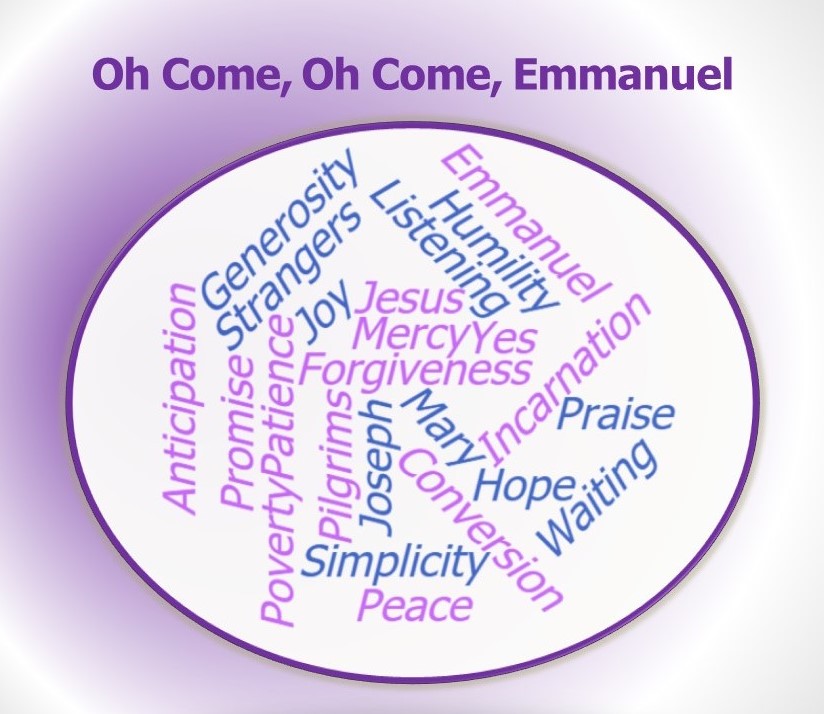
Advent is a time of waiting and meditation. We think about the coming of our Lord and Savior in the Incarnation and the part that Mary and Joseph played in his life. During this month we can use the words in the graphic in our prayer and meditation to focus on the meaning of this season. St. Francis was devoted to the Incarnation. This devotion came out in his prayer, his writings and in his actions.

Here are some ideas to put a Franciscan flavor in your Advent meditations:

·        Choose a word or two from the word cloud each day and see where those words or ideas
come up in our Rule.


·        Choose a word or two and see where they come up in Scripture—perhaps in the readings of the day or in the psalms as you pray the Liturgy of the Hours.


·        Think of stories in Scripture and in the writings by and about Francis and Clare that typify hope and patience.


·        Read online or in books that you have at home:


1 Celano chapter 30 (The story of the first Nativity scene at Greccio)  (FA:ED, vol. 1, 254)
 https://franciscantradition.org/francis-of-assisi-early-documents/the-saint/the-life-of-saint-francis-by-thomas-of-celano/695-fa-ed-1-page-254


A Salutation of the Blessed Virgin Mary (FA:ED, vol. 1, 163)

https://franciscantradition.org/francis-of-assisi-early-documents/the-saint/writings-of-francis/the-undated-writings/a-salutation-of-the-blessed-virgin-mary/179-fa-ed-1-page-163#ges:searchword%3Dsalutation%26searchphrase%3Dall%26page%3D1


The Praises of God (FA:ED, vol. 1, 109)

https://franciscantradition.org/francis-of-assisi-early-documents/the-saint/writings-of-francis/the-praises-of-god-and-the-blessing/125-fa-ed-1-page-109


St. Clare’s Fourth Letter to Agnes of Prague  (CA:ED, 56)

https://franciscantradition.org/clare-of-assisi-early-documents/the-fourth-letter-to-agnes-of-prague/232-ca-ed-1-page-56

The references above (FA:ED and CA:ED) refer to Francis of Assisi: Early Documents and Clare of Assisi: Early Documents. These and many more writings of and about Francis and Clare can be found on the Franciscan Intellectual Tradition website:

https://franciscantradition.org/


+++++++++++++++++++++

Comparta con su fraternidad.

El Adviento es una temporada de espera y meditación. Pensamos en la venida de nuestro Señor y Salvador en la Encarnación y el papel que María y José desarrollaron en su vida. Durante este mes podemos usar las palabras del gráfico en nuestra oración y meditación para enfocarnos en el significado de esta temporada. San Francisco se dedicó a la Encarnación. Esta devoción se manifestó en su oración, sus escritos y sus acciones.

Aquí hay algunas ideas para darle un toque franciscano a sus meditaciones de Adviento:

• Elija una palabra o dos de la nube de palabras cada día y vea dónde esas palabras o ideas
aparecen en nuestra Regla.

• Elija una palabra o dos y vea dónde aparecen en las Escrituras, tal vez en las lecturas del día o en los salmos mientras reza la Liturgia de las Horas.

• Piense en historias en las Escrituras y en los escritos de Francisco y Clara y sobre ellos que tipifican la esperanza y la paciencia.

• Lea en Internet o en libros que tenga en casa:

1 Celano capítulo 30 (La historia del primer pesebre de Greccio) (FA: ED, vol. 1, 254)

 https://franciscantradition.org/francis-of-assisi-early-documents/the-saint/the-life-of-saint-francis-by-thomas-of-celano/695-fa-ed-1-page- 254  (en inglés)

http://www.franciscanos.org/fuentes/1Cel03.html (en español)

Un saludo de la Santísima Virgen María (FA: ED, vol. 1, 163)

https://www.franciscanos.org/esfa/salvm.html

Las alabanzas del Dios altísimo (FA: ED, vol. 1, 109)

 http://www.franciscanos.org/esfa/ald.html

Cuarta carta de Santa Clara a Agnes de Praga (CA: ED, 56)

http://www.franciscanos.org/esscl/ctacla4.html

Las referencias anteriores en inglés (FA: ED y CA: ED) se refieren a Francisco de Asís: Primeros documentos y Clara de Asís: Primeros documentos. Estos y muchos más escritos de Francisco y Clara se pueden encontrar en el sitio web de la Tradición Intelectual Franciscana:  (en inglés)

https://franciscantradition.org/

Excelente sitio en español: http://www.franciscanos.org/frandp/menup.html

 
Diane F. Menditto, OFS

Chair, National Formation Commission

Minister, Our Lady of the Angels Region


Racism – What’s A Secular Franciscan To Do?

(This article originally appeared in the Fall 2020 TAU-USA Magazine Issue #101)

RACISM–WHATS A SECULAR FRANCISCAN TO DO?

Mother Cabrini OFS Region Newsletter Submission, August 2020

Justice, Peace, and Integrity of Creation (JPIC)

The national OFS fraternity has asked us:

  • to identify and eradicate the structures that perpetuate racism…
  • to pray for an end to racism…
  • to identify and confront our own unconscious racial biases.

I hope this article provides some resources for each of these actions that you can use individually or as a fraternity for on-going formation. It is not comprehensive, but rather offers a menu of ideas.

Warning: Expect to be uneasy when you ponder and grapple with issues of race. Racism in the U.S. is an uncomfortable truth, experienced differently by us all. For some, it is a passing thought, brought to mind by occasional news events. For others, it is real each time they walk out the door. Some are blind to how they silently participate or reap its benefits, while others see their role with crystal clarity. When we discuss racism, our very image of ourselves and our participation comes into question, which is not easy. Have hope! As penitents, Secular Franciscans are used to on-going conversion and the discomfort it brings as the Spirit leads us to new places!

First, a Prayer to Overcome Racism

On August 2, 2020, we celebrated the Feast of Our Lady of the Angels of the Portiuncula, so it is fitting that we ask the Blessed Mother’s assistance in our journey of confronting racism.[1]

  • “Mary, friend and mother to all, through your Son, God has found a way to unite himself to every human being, called to be one people, sisters and brothers to each other.
  • We ask for your help in calling on your Son, seeking forgiveness for the times when we have failed to love and respect one another.
  • We ask for your help in obtaining from your Son the grace we need to overcome the evil of racism and to build a just society.
  • We ask for your help in following your Son, so that prejudice and animosity will no longer infect our minds or hearts but will be replaced with a love that respects the dignity of each person.
  • Mother of the Church, the Spirit of your Son Jesus warms our hearts: pray for us.”

Second – The Rule: A Starting Point for Secular Franciscans

There are many instances of Scripture and Catholic Social Teaching that confront racism, but a shortcut is to look at The Rule. Taking a stand is not only the realm of politics – it is in the realm of faith, too.

  • Rule Article 13b. As the Father sees in every person the features of his Son, the firstborn of many brothers and sisters, so the Secular Franciscans with a gentle and courteous spirit accept all people as a gift of the Lord and an image of Christ.
  • Rule Article 15. Let them individually and collectively be in the forefront in promoting justice by the testimony of their human lives and their courageous initiatives. Especially in the field of public life, they should make definite choices in harmony with their faith.

Third – Identifying Systemic Racism Through Definitions and Videos

Each of us can work on our own attitudes and actions to not be racist, but to make real change “in the field of public life” we need to work on the structures of racism and how we unconsciously contribute to or benefit from them.

Definitions: The OFS-USA JPIC Animator Notes – Special Edition – Carolyn Townes, OFS from June 2020 offers some useful definitions. Suggestion: walk with the Spirt a bit if any of these terms make you feel uncomfortable.

  • “Racism is defined as prejudice, discrimination, or antagonism directed against someone of a different race based on the belief that one’s own race is superior.
  • Institutional racism (also known as systemic racism) is a form of racism expressed in the practice of social and political institutions. It is reflected in disparities regarding wealth, income, criminal justice, employment, housing, health care, political power and education, among other factors.
  • White privilege or white-skinned privilege are the inherent advantages possessed by a white person on the basis of their race in a society characterized by racial inequality and injustice. It also refers to societal privilege that benefits white people over non-white people in some societies, particularly if they are otherwise under the same social, political, or economic circumstances.
  • The phrase “Black Lives Matter” (BLM) can refer to the social movement, the organization, or the message. When someone refers to BLM, make sure you know which one they are referring to. Note: Many people agree with the message without belonging to the organization or supporting the movement.
  • The social movement was founded in 2013 after the acquittal of George Zimmerman in the shooting death of African-American teen Trayvon Martin in February 2012. The movement became nationally recognized for street demonstrations following the 2014 deaths of two African Americans: Eric Garner in New York City and Michael Brown in Ferguson, Missouri.
  • Black Lives Matter Foundation, Inc. is a global organization in the US, UK, and Canada, whose mission is to eradicate white supremacy and build local power to intervene in violence inflicted on Black communities by the state and vigilantes.
  • The message, represented by the hashtag (#blacklivesmatter), is used at demonstrations, rallies and on social media to reaffirm that Black lives are just as sacred, valued and loved by God.
  • And yes, all lives matter. However, all lives do not matter when Black lives do not matter.

Video: “Let’s Get to the Root of Racial Injustice,” Prof. Megan Ming Francis, TEDx Rainier, (19.5 minutes) https://www.youtube.com/watch?v=-aCn72iXO9s (Note: if you can’t access the video links directly, you can search YouTube for the titles.)

Description: This personable explanation from an African American professor uses the Ted Talk format and her own stories to reframe how we think of racism. It moves from thinking of racism as a few “bad apples” to the knowledge of how the “whole tree” is infected and calls for a new approach that goes beyond focusing only on education or policing. Note: I think her language and style will appeal to Franciscans!

Video: Systemic Racism Explained (4.5 minutes) https://www.youtube.com/watch?v=YrHIQIO_bdQ

 Description: This short education cartoon explains what is meant by systemic racism, using the example of a white and a black student. It touches on schools, universities, housing, banking, incarceration, jobs, and implicit bias.

Video: “The Unequal Opportunity Race” (4 minutes) https://www.youtube.com/watch?v=vX_Vzl-r8NY

 Description: This brief cartoon uses the analogy of a footrace, with some contestants held back by systemic racism while other run more easily and accumulate wealth and prosperity.

Finally – Confronting Our Own Unconscious Racial Bias

I have not met a Franciscan who thinks they are a racist. The very thought of it is threatening. Yet we all carry unconscious biases based on our upbringing, where we get our news, personal experiences, gut-feelings, etc. The graphic below of concentric circles fits nicely with our approach of on-going conversion. What behaviors match our Franciscan approach to life? What circles do you sit in right now? Is your vocation calling you to move to another circle or act on one or more items?

Note: The original of this graphic can be found at: h6ps://www.surgeryredesign.com/ It is by Andrew M. Ibrahim, MD, MSc based on the work of Dr. Ibram Kendi. Permission has been given to use, copy and share.

[1] Source: © 2020 OFS-USA JPIC Animator Notes – Special Edition – Carolyn Townes, OFS

https://secularfranciscansusa.org/2020/11/30/racism-whats-a-secular-franciscan-to-do/

Scroll to top
Juan de Padilla