A Little Bit of Love Goes a Long Way

(This article originally appeared in the TAU-USA Spring/Summer 2021 Issue #103)

By Kathleen Molaro, OFS

National Franciscan Youth and Young Adult Commission Chair

When I served as a youth director, each summer we participated in a week-long service program called “Young Neighbors in Action.” One year, our week was spent in an orphanage in Mexico. Among other chores, we were each asked to choose one child and befriend them, rather than spread ourselves among the large group. We were told it would be better for that one child to benefit from extra love and attention, even if only for a week. “A little bit of love goes a long way. The love settles in their hearts and can be drawn on later,” the director explained.

I believe the same philosophy applies when reaching out to youth and young adults. Young people are often in flux at this point in their lives, so we may only have them for a short time. Every moment counts in building a loving relationship that might “settle in their hearts.” Are we genuine? Do we truly live what we preach about gospel life? Are we willing to hear their story and share their successes, fears, and struggles?

Many fraternities have shared that a young adult will call or drop into a gathering to check out the Secular Franciscans. They often have but a few months to join us, considering they may be on a break from school, looking for a job elsewhere, moving away from family to start their own, or any number of reasons. They may or may not stay, depending on their need and intention— but also on what they find when they arrive. The FY/YA Commission has encouraged all fraternities to be ready for the possibility of younger members by taking a close look at their fraternity dynamics.

I found myself reflecting on the Instrumentum Laboris in light of this challenge. On pages 5 and 6 there is a list of ways to animate and guide our fraternities. Simply rephrasing them a bit helps us see why they are important to consider if you are serious about offering the gift of fraternity and Franciscan spirituality to young people.

✦ Do we understand the importance of a Christcentered life, and are we able to inspire young people to adopt that goal?

✦ Do we encourage one another to accept and respect the young person simply because they are a brother or sister of Christ?

✦ Do we witness a life of prayer and intimacy with the Lord, both as individuals and as fraternity?

✦ Do we work for justice and invite young people to join us, and do we join young people in their work toward a more just world?

✦ Do we share concrete experiences and truthful stories of our own spiritual journey and allow young people to do the same, without judgment?

✦ Do they see us in fidelity with the Church, our Order, and each other? Are we obviously growing in our faith and in our charism?

✦ Do we model lives of vital and reciprocal communion, and are we an active presence in the world?

✦ Do our young people see us as a family, working together and sharing responsibilities?

Jan Parker wrote in the Winter 2021 TAU-USA about the term “prophetic creativity” used in the Instrumentum Laboris. She describes prophetic creativity, saying “It is innovative action we take in response to the Holy Spirit working within us.” The Holy Spirit is moving across our country, inspiring us to journey together with our younger Catholic brothers and sisters. The apostle Paul says, “the fruit of the Spirit is love, joy, peace, patience, kindness, generosity, faithfulness, gentleness, and self-control.” (Gal. 5:22-23) Practicing these virtues and modelling a way of life led by the Holy Spirit and our beloved Saints Francis and Clare is what we are called to do as Secular Franciscans. A little love goes a long way. Just think what a lot of love can do!

The commission gathers via Zoom monthly with FY/YA Regional Animators for ongoing training, prayer, networking, and formation. Our meeting right before Pentecost included a “Prayer for Perfect Charity,” and ritual for strengthening the gifts of the Holy Spirit. The prayer can be found on the National Website on the FY/YA page, in the young adult faith development document, Living a Gospel Life: Walking in the Steps of Saints Francis and Clare of Assisi—Session 10.

https://secularfranciscansusa.org/2021/09/27/a-little-bit-of-love-goes-a-long-way/
Open post

FORMATION FRIDAY – Preparing for the feast of St. Francis – His Prayers & Novena – September 24, 2021

 
Dear Brothers and Sisters, 
Today’s lesson is a great resource for Franciscan Prayers.  Though you may be familiar with most of his prayers, have you ever thought about themes in Francis’ prayers? Do you say some of these prayers each day or could you find a way to fit one or more in?  Think about what was important to Francis when you review his prayers.  Novena to St. Francis starts 9/25 – Tomorrow!  Don’t let this prayer opportunity past you by.  Peace, Dona
++++++++++++++++++++++++++++++++++++++++++++++++++++++++++++++++++++++++++++++++++++++++++++++++++++++++++++++++++++++++++++++++++++


PDF document with the full links is attached to this email. Because Gmail will not deliver emails with numerous links to big groups, the links can be accessed by clicking on the titles. In the PDF the links are visible.

As the feast day of St. Francis approaches, we share a link to the Novena to St. Francis which starts on September 25th. Also, this week we provide links to the special prayers of St. Francis with some general questions for meditation.

Novena on the St. Anthony Shrine website starting tomorrow

Links to some of the prayers of St. Francis with which we should all be familiar: (Read the complete prayer and some background material on the Franciscan Intellectual Tradition website.)

THE TESTAMENT PRAYER
“We adore you, Lord Jesus Christ, in all your churches throughout the whole world, and we bless you because by your holy cross you have redeemed the world.”

PRAYER BEFORE THE CRUCIFIX
“Most high, glorious God, enlighten the darkness of my heart. And give me true faith, certain hope, and perfect charity…” 

PRAYER FROM THE LETTER TO THE ENTIRE ORDER

A PRAYER INSPIRED BY THE OUR FATHER

THE PRAISES TO BE SAID AT ALL THE HOURS
“Holy, holy, holy Lord God Almighty, Who is, and Who was, and Who is to come:  And let us praise and glorify Him forever…”

THE PRAISES OF GOD AND THE BLESSING
“You are the holy Lord God Who does wonderful things. You are strong. You are great. You are the most high….”

THE CANTICLE OF BROTHER SUN
“Most High, all-powerful, good Lord, Yours are the praises, the glory, the honor, and all blessing,”

PRAYER AND THANKSGIVING (Chapter XXIII of the EarlierRule—Regula non-Bullata)
“All-powerful, most holy, Almighty and supreme God,…”

 SALUTATION OF THE BLESSED VIRGIN MARY

“Hail, O Lady, Holy Queen, Mary, holy Mother of God, Who are the Virgin made Church, chosen by the most Holy Father in heaven whom he consecrated with His most holy beloved Son and with the Holy Spirit the Paraclete, 3in whom there was and is all fullness of grace and every good….”

Some questions to think about, discuss, or answer in your journal.

If you cannot read all of the prayers listed above in one sitting, choose 2 or 3 at a time. As you read and then pray, please think about the following:


  • What are the common themes in all of Francis’s prayers?
  • Where can these prayers fit into our prayer lives as Franciscans?
  • As you consider the words of these prayers, what stands out as being important to St. Francis? How are these ideas and feelings affect us as Franciscans?


+++++++++++++++++++++++++++++++++++++++++++++++++++++++++++++++++++++++++++++++++

Comparta con su fraternidad local.

Preparándose para la fiesta de San Francisco: sus oraciones y una novena

Se adjunta a este correo electrónico un documento PDF con los enlaces completos. Debido al hecho de que Gmail no entregará correos electrónicos con numerosos enlaces a grupos grandes, se puede acceder a los enlaces haciendo clic en los títulos. En el PDF los enlaces son visibles.

A medida que se acerca el día de la fiesta de San Francisco, compartimos un enlace a la Novena a San Francisco que comienza el 25 de septiembre. Además, esta semana proporcionamos enlaces a las oraciones especiales de San Francisco con algunas preguntas generales para la meditación.

NOVENA A SAN FRANCISCO en español(Comienza mañana, 25 de septiembre.)

Enlaces a algunas de las oraciones de San Francisco con las que todos deberíamos estar familiarizados: (Lea la oración completa en http://franciscanos.org/ ).

LA ORACIÓN DEL TESTAMENTO
5”Te adoramos, Señor Jesucristo, también en todas tus iglesias que hay en el mundo entero, y te bendecimos, porque por tu santa cruz redimiste al mundo.”

LA ORACIÓN ANTE EL CRUCIFIJO DE SAN DAMIÁN
Sumo, glorioso Dios, ilumina las tinieblas de mi corazón y dame fe recta, esperanza cierta y caridad perfecta,
sentido y conocimiento, Señor, para que cumpla tu santo y verdadero mandamiento.”

ORACIÓN DE LA CARTA A TODA LA ORDEN

EXPOSICIÓN DEL PADRE NUESTRO

ALABANZAS QUE SE HAN DE DECIR EN TODAS LAS HORAS
1”Santo, santo, santo Señor Dios omnipotente, el que es y el que era y el que ha de venir (cf. Ap 4,8):
Y alabémoslo y ensalcémoslo por los siglos.”

ALABANZAS DEL DIOS ALTÍSIMO
“1Tú eres santo, Señor Dios único, que haces maravillas (Sal 76,15). 2Tú eres fuerte, tú eres grande (cf. Sal 85,10), tú eres altísimo, …”

CÁNTICO DEL HERMANO SOL   o   ALABANZAS DE LAS CRIATURAS        
“Altísimo, omnipotente, buen Señor, tuyas son las alabanzas, la gloria y el honor y toda bendición.”

REGLA NO BULADA Cap. XXIII: Oración y acción de gracias
“Omnipotente, santísimo, altísimo y sumo Dios,…”

SALUDO A LA BIENAVENTURADA VIRGEN MARÍA
“Salve, Señora, santa Reina, santa Madre de Dios, María, que eres virgen hecha iglesia 2y elegida por el santísimo Padre del cielo, a la cual consagró Él con su santísimo amado Hijo y el Espíritu Santo Paráclito, 3en la cual estuvo y está toda la plenitud de la gracia y todo bien….”

Algunas preguntas para pensar, platicar o responder en su diario.

Si no puede leer todas las oraciones enumeradas anteriormente de una sola vez, elija 2 o 3 a la vez. Mientras lee y luego ora, piense en lo siguiente:

+ ¿Cuáles son los temas comunes en todas las oraciones de Francisco?

+ ¿Dónde pueden encajar estas oraciones en nuestra vida de oración como franciscanos?

+ Al considerar las palabras de estas oraciones, ¿qué se destaca como importante para San Francisco? ¿Cómo nos afectan estas ideas y sentimientos como franciscanos?


Diane F. Menditto, OFS
Chair, National Formation Commission
Minister, Our Lady of the Angels Region
 

NEW BEGINNINGS WITH A HOPEFUL VISION OF UNITY AMONG ALL PEOPLE

(This Article originally appeared in the Spring/Summer Issue of TAU-USA #103)

Ecumenical Interfaith Committee Joint Committee on Franciscan Unity

by Donna Hollis, OFS, National Councilor

We are called to rebuild. We must dare to dream! We must dare to Hope!

(Reflection from the book “Let us Dream” by Pope Francis)

Pope Francis has been transforming the tone and approach of the Catholic Church towards Ecumenism by reaching out to non-Catholic denominations to reconcile past differences, opening the doors to dialogue and understanding, focusing on what we have in common and not differences, celebrating and reconciling “That they may all be one.”
Pope Francis inspires us to dream of a future that seeks to restore the dignity of every person and creation in order to foster healthy relationships. As Franciscans we ask, “How do we work to heal the Body of Christ, to speak as Franciscans to the world based on ‘one Lord, one Faith, one Baptism?’” Certainly, our vocation is meant to be one of healing and witness to the urging of the Spirit. Doesn’t our vocation to “live the gospel in fraternal communion” call us to create a sisterhood and brotherhood beyond borders of our beliefs? Fraternity itself is our challenging new frontier.

How might these ideals look in practice? Scripture asks us to feed the hungry, clothe the naked and give hope to those in most need. Doing these works of mercy tears down the walls of differences, and we find ourselves working together for the common good for all people.

Members of a number of Christian denominations are working together to assist refugees coming across our Southwest Borders seeking asylum due to threats, and a way out of violence and poverty. They have their own stories to tell. One family arrived with their oldest son, having left the younger behind, only to find out that he was killed while they were on their journey. They faced a difficult choice. Going back would mean not being able to return; moving forward in search of a better life would require leaving the heartache to heal in time.

We listen to their stories and our hearts are broken; compassion is released as we serve together in helping those whose hearts are already broken. We recognize that we are all children of God, men and women of every race, of every faith. If we really see someone in their fullness, recognizing the Divine seed in everyone, we cannot help but treat treating them with kindness and compassion.

Where do we go from here? Working with the refugees reminds us that God Himself chooses to go to the margins; they are places full of possibilities. We need to become those “saints”’ who have an awakened heart to seek those in the marginal places where possibilities are waiting. We let those stories told of the journey of desperation change our hearts. We need to rethink our priorities and dare to take risks. Enkindle the fire of the Spirit that we experienced when we were first Professed, and that in itself will be a witness to others and catch on like wildfire! So, keep living it out!

“Live a life worthy of your calling”

Prayer for Franciscan Unity

O gracious and loving God,

Having brought us into the Body of Christ

And Called to follow Francis and Clare:

Let your Holy Spirit inspire all

In the Franciscan Family to be of

One heart and mind in love with

You and one another.

Grant, we pray, that our common Charism and Vocation,

Shared by Franciscan Orders, from every

Christian tradition, help build up

The Body of Christ

And heal the Franciscan Family,

Through Jesus Christ our Lord.

https://secularfranciscansusa.org/2021/09/20/new-beginnings-with-a-hopeful-vision-of-unity-among-all-people/

Open post

FORMATION FRIDAY – The Stigmata of St. Francis – Sept. 17, 2021


Dear Brothers and Sisters, September is a month we meditate on the Passion of Christ and of Our Lady of Sorrows with special feast days and devotions.  No wonder holy St. Francis received the stigmata in this month.  Be sure to review this formation lesson at least on your own because it contains basic information about St. Francis, our Seraphic Father.

Peace, Dona

image.png
__________________________________________________________________________________________________________________________


The Stigmata of St. Francis

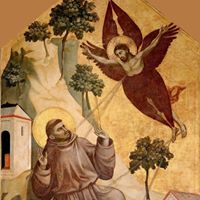
+ St. Francis received the Stigmata around the feast of the Triumph of the Holy Cross in September of 1224–two years before his death.
+He was praying on Mt. La Verna preparing for the feast of St. Michael the Archangel. Brother Leo was nearby.
+While praying He asked God for two things. 


  • One, to let him experience the suffering Christ endured on the Holy Cross 
  • and two, for him to experience the love in which He did it.
+ Shortly thereafter, Francis saw a Seraph with six wings. (Seraphs are angels of the highest order who are closest to God and most passionate in praising Him.) Between the wings was the image of a crucified man. When the vision disappeared, Francis was marked with the wounds of Christ. (St. Francis’s encounter with the Seraph and his passion in praising the Father has caused the Franciscan Order to be called the Seraphic Order and Francis our Seraphic Father.
+ We celebrate the Feast of the Stigmata on September 17th
+ St. Francis is the first person in recorded Christian history to receive the Stigmata.


The Stigmata: Inspiration for our spiritual lives as Franciscans

The marks in our lives:
–What does it mean to be marked?
–What marks us in our lives?
–As Catholics, how are we marked?
–How do the things that mark us, help us to move forward in our spiritual lives?

Now, Gaze at the Cross:
–As we gaze at the wounds of Christ, what comes to mind?
–As we consider what Jesus suffered for us, how do we respond?
–As we contemplate Jesus’s willingness to die for us, what are we willing to do for our brothers and sisters?
–As we imitate Jesus in our lives, how are we willing to use our lives in the service of others?

Prayer to the Five Wounds of the Lord prayed by St. Clare of Assisi
https://www.franciscantradition.org/clare-of-assisi-early-documents/related-documents/franciscan-documents/the-prayer-to-the-five-wounds-of-the-lord/599-ca-ed-1-page-422

Prayer of Pope St. John Paul II (On a visit to Mt. La Verna in 1983)


O St Francis, stigmatized on La Verna, the world longs for you, that icon of the crucified Jesus.


It has need of your heart, open to God and to others; of your bare, wounded feet, of your pierced hands raised in supplication.
It longs for your voice so frail yet forceful with the power of the Gospel.
Francis, help the people of this age to recognize the evil of sin and to seek purification from it in penance.
Help them to become free from the very structures of sin that oppress today’s society.
Rekindle in the consciousness of those in government an urgent need for peace between nations and peoples.
Instil in young people your freshness of life that is capable of withstanding the snares of the many cultures of death.
To those injured by every type of evil teach, O Francis, the joy of being able to forgive.
To all those crucified by suffering, hunger and war, reopen the doors of hope. Amen.


++++++++++++++++++++++++++++++++++++++++++++++++++++++++++++++++++++++++++++++++++++++++++++++++++++++++++++++++++++++++++++++++


Los estigmas de San Francisco

+ San Francisco recibió los estigmas en torno a la fiesta del Triunfo de la Santa Cruz en septiembre de 1224, dos años antes de su muerte.
+ Estaba orando en el monte La Verna preparándose para la fiesta de San Miguel Arcángel. El hermano Leo estaba cerca.
+ Mientras oraba, le pidió a Dios dos cosas. Una, dejarle experimentar el sufrimiento que Cristo soportó en la Santa Cruz y dos, que experimentara el amor en el que lo hizo.
+ Poco después, Francisco vio un Serafín con seis alas. (Los serafines son ángeles del orden más alto que están más cerca de Dios y más apasionados en alabarlo.) Entre las alas estaba la imagen de un hombre crucificado. Cuando la visión desapareció, Francisco quedó marcado con las llagas de Cristo. (El encuentro de San Francisco con el Serafín y su pasión por alabar al Padre ha hecho que la Orden Franciscana sea llamada Orden Seráfica y Francisco nuestro Seráfico Padre.
+ Celebramos la Fiesta de los Estigmas el 17 de septiembre
+ San Francisco es la primera persona en la historia cristiana registrada en recibir los estigmas.

Los estigmas: inspiración para nuestra vida espiritual como franciscanos

Las marcas en nuestras vidas:
-¿Qué significa estar marcado?
-¿Qué nos marca en nuestra vida?
-Como católicos, ¿cómo estamos marcados?
– ¿Cómo nos ayudan las cosas que nos marcan a avanzar en nuestra vida espiritual?

Ahora, mirar la cruz:
– Al contemplar las heridas de Cristo, ¿qué nos viene a la mente?
-Al considerar lo que Jesús sufrió por nosotros, ¿cómo respondemos?
Al contemplar la disposición de Jesús a morir por nosotros, ¿qué estamos dispuestos a hacer por nuestros hermanos y hermanas?
Al imitar a Jesús en nuestra vida, ¿cómo estamos dispuestos a usar nuestra vida al servicio de los demás?

Oración a las cinco llagas del Señor–oración de santa Clara de Asís (en inglés)
https://www.franciscantradition.org/clare-of-assisi-early-documents/related-documents/franciscan-documents/the-prayer-to-the-five-wounds-of-the-lord/599-ca-ed-1-page-422

Oración del Papa San Juan Pablo II (En una visita al Monte La Verna en 1983)
Oh, San Francisco, estigmatizado en La Verna, el mundo te anhela, ese icono de Jesús crucificado.
Necesita tu corazón, abierto a Dios ya los demás; de tus pies descalzos y heridos, de tus manos traspasadas alzadas en súplica.
Anhela tu voz tan frágil pero contundente con el poder del Evangelio.
Francisco, ayuda a la gente de esta época a reconocer la maldad del pecado y a buscar la purificación de él en la penitencia.
Ayúdalos a liberarse de las mismas estructuras del pecado que oprimen a la sociedad actual.
Reavivar en la conciencia de los gobernantes una urgente necesidad de paz entre naciones y pueblos.
Inculca en los jóvenes tu frescura de vida que es capaz de resistir las trampas de las muchas culturas de la muerte.
A los heridos por todo tipo de mal, enséñales, oh Francisco, la alegría de poder perdonar.
A todos los crucificados por el sufrimiento, el hambre y la guerra, reabre las puertas de la esperanza. Amén.


Diane F. Menditto, OFS
Chair, National Formation Commission
Minister, Our Lady of the Angels Region
 

Francis of Assisi: Saint and Writer

(This article originally appeared in the Spring/Summer TAU-USA Issue #103)

Formation Commission

Francis of Assisi: Saint and Writer

Justin Carisio, OFS

National Formation Commission

Thomas of Celano tells us that two years before St. Francis’s death:

While the saint was secluded in a cell on Mount La Verna, one of his companions was yearning with great desire to have something encouraging from the words of our Lord, commented on briefly by Saint Francis and written with his own hand.… One day Saint Francis called this brother and said: “Bring me paper and ink, because I want to write down the words of the Lord and his praises upon which I have meditated in my heart.” What he had asked for was quickly brought to him. He then wrote down with his own hand the Praises of God and the words he wanted and, at the end, a blessing for that brother, saying: “Take this paper for yourself and keep it carefully to your dying day.”[1]

That small parchment from 1224 is now in the Basilica of St. Francis in Assisi. Francis wrote “The Praises of God” on one side and “A Blessing for Brother Leo” on the other. It is one of only two surviving documents actually written in Francis’s own hand. The other is “A Letter to Brother Leo” preserved in the Cathedral of Spoleto. They are among the 30 or so writings composed by Francis. They range from prayers and letters to longer documents. They include Francis’s great poem, The Canticle of the Creatures, the value of which extends beyond the Franciscan family and which has an important place in the canon of Italian literature.

The number of Francis’s writings may, at first glance, appear limited. However, consider the era in which he lived, the radical poverty of the life he chose, and the uncertain conditions under which anything he wrote would have been preserved. It quickly becomes apparent that we are blessed to have as much as we do in the voice of our founder. By comparison, only four writings by Francis’s contemporary, St. Dominic, who founded the Order of Preachers, survive.[2]

Regis Armstrong, OFM Cap., suggests that Francis’s writings reflect his deep humility, his “determination to hide the gifts the Lord has bestowed on him.”[3] Even so the gifts of a writer’s temperament and a poet’s impulse invariably shine through. Francis had a natural inclination to use words to communicate his beliefs, to record his thoughts, to create beauty, and to offer praise. Murray Bodo, OFM writes, “Although St. Francis’s whole being was that of a poet, he was not a poet in the modern sense of someone whose vocation or avocation is the writing of poetry.” Rather, “he walked and praised as a poet would as he followed Jesus.”[4]

Familiarity with Francis’s writings should be part of the initial and ongoing formation of every Secular Franciscan, especially considering that one of his writings, The Earlier Exhortation, forms the “Prologue” to the Secular Franciscan Rule. His writings let the saint speak for himself. They permit us to encounter him on his own terms.

What are some ways to enhance this encounter?

First, fundamental to understanding Francis as a writer is to understand that Scripture always informs his documents. His writings are replete with quotations from the Gospels and Psalms as well as other scriptural references and allusions.[5] Our encounter with Francis’s writings is a reminder that even for us, Scripture comes before the documents. Knowing and following Jesus and what the gospel life entails is our life’s work just as it was Francis’s.

Another consideration to keep in mind is that biographies over the centuries, as well as film and video over the past hundred years or so, have filled our imaginations with convincing representations of Francis’s life and times. It becomes difficult to see through these cultural, religious, and media filters and confront Francis as he was: a medieval, urban, Italian man.[6] The time in which we live separates us in profound ways from the world in which Francis’s ideas and experiences were shaped, defined, and expressed. The Francis we meet in his writings is fascinating, ardent, and devout, but also frank, determined, and assertive. The places where he lived and travelled appear intriguing and exotic, but also remote and dangerous. The reader of Francis’s writings who takes time to learn about late 12th and early 13th century history or to study the art and objects from that era will find it time well-spent.

Also, for most of us, our encounter with what Francis wrote will be through translations. All but two of his writings were in Latin. (The Canticle of the Creatures and The Canticle of Exhortation for the Ladies of San Damiano were written in his Umbrian dialect of Italian.[7]) Fortunately for English readers, there are outstanding modern translations in printed book form (Francis of Assisi, Early Documents, vol 1, New City Press) or on the web at the Commission on the Franciscan Intellectual- Spiritual Tradition (CFIT).[8] We may not hear Francis’s voice in the most immediate way, but the translators’ scholarship and skill help to reveal for us the saint’s spirit and personality. These translations are also accompanied by valuable introductions and footnotes that aid in opening up the documents by providing context and explanations.

Finally, although Francis was not a writer by profession or avocation, he was yet a serious writer. He considered what he wrote to be important. He insisted when his words were being copied for sharing with others that they be reproduced exactly as he had written—nothing added or subtracted.[9] Thaddée Matura, OFM, underscores this: “He was able and loved to write or have others write for him. He insisted on the preservation of what he wrote…. He was convinced of the power of the Word of God, which he had received in faith and to which he had oriented his life. The necessity of transmitting this belief into writing for everyone of every generation was a mission for him.”[10] We are the most recent generation to receive what Francis wrote. Let us take the time to read, measure, and heed his words.

[1] The Remembrance of the Desire of a Soul by Thomas of Celano, in Francis of Assisi: Early Documents, vol 2, The Founder, ed. Regis J. Armstrong, OFM Cap, J. A. Wayne Hellman, OFM Conv., and William J. Short, OFM (Hyde Park, N.Y.: New City Press, 2000), 282.

[2] “Dominican Documents: Letters of St. Dominic,” www.domcentral.org/trad/domdocs/0002.htm, accessed May 3, 2021

[3] Regis J. Armstrong, OFM Cap., St. Francis of Assisi Writings for a Gospel Life, (New York: Crossroad Publishing Company, 1994), 25

[4] Murray Bodo, OFM, Poetry as Prayer St. Francis of Assisi, (Boston: Pauline Books and Media, 2003), 56.

[5] Thaddée Matura, OFM. Francis Of Assisi The Message in His Writings (St. Bonaventure, N.Y.: Franciscan Institute Publications, 1996, 2004), 16

[6] Augustine Thompson, O.P., Francis of Assisi, A New Biography, (Ithaca and London: Cornell University Press, 2012), 3

[7] Matura, 9.

[8] See: https://franciscantradition.org/early-sources

[9] Regis J. Armstrong, OFM Cap. and Ignatius C. Brady, OFM, Francis and Clare The Complete Works (New York: Paulist Press, 1982), 7.

[10] Thaddée Matura, OFM. Francis Of Assisi Writer and Spiritual Master (Cincinnati: Franciscan Media, 2005), 1

https://secularfranciscansusa.org/2021/09/13/formation-commission-2/

Scroll to top
Juan de Padilla