Open post

SHAPING THE FRANCISCAN FOOTPRINT – September 28 – October 5 2022

(a pdf copy of this article is attached for printing)

Five Important Spiritual Thoughts from the Liturgy of the Word

…and follow up for the Secular Franciscan

September 28 – October 5


1 — “Here is a true
child of Israel.
There
is no duplicity in him.”
(Jn 1:47)**

…No
duplicity means that Nathanael was “real” and not “fake.” Is my commitment to Jesus as strong as it
should be?


2 – ”I have dealt
with great things that I do not understand; things too wonderful for me, which
I cannot know.”
(Job
42:3)

…When
I don’t understand the Lord’s way…


3 – “When
you have done all you have been commanded, say, ‘We are unprofitable servants;
we have done what we were obliged to do.’”
(LK 17:10)**

…Am I conducting my
life as if I were a servant to others?


4 — “And who is my
neighbor?” (The Good Samaritan)
(Lk 10:29)**

…Go
and do likewise, Jesus says


Extended meditation:

Jesus cared about people.
The fact is documented throughout the Gospels. One time in Matthew’s Gospel, he
had retreated a while to mourn the loss of a friend. But when he saw how the
crowds seemed to be searching for something, he left his meditation in order to
help them.

Jesus’s
care is often translated as “pity” or “compassion.” The derivation of the word “compassion”
presents a learning possibility. It
comes from the Latin cum patio, meaning
a feeling with the pain of someone else.
The person who possesses such a virtue, as Jesus certainly did, studies
the painful situation of another and desires to do something about it.

In
real life, compassion is expressed in various ways. One notable way was exemplified by a football
coach and his words of “Maybe I can help.”
Coach Jack Lengyel was enjoying a good career as head football coach at
the College of Wooster in Northeast Ohio, and he heard about a disaster of
monumental proportions in nearby Huntington, West Virginia. The complete football team and coaches of
Marshall University in that city were killed in a tragic air accident as they
were returning from an away football game.

When
Coach Lengyel read of the tragedy, he thought of the pain of the people left
behind and the pain of the University personnel in particular. Knowing that he could accomplish something,
he wrote to the University president volunteering his services, saying “Maybe I
can help.” He probably had some idea of
what it would take to carry out his words, but he was to discover great
personal cost, great resistance from the city and University, and the pains of
beginning with absolutely nothing and building a complete football
program. But he cared; he had
compassion.
(Movie: “We Are
Marshall”)

A
Christian generally speaking will not have the opportunity to show such care or
compassion, to be sure. But if she or he
truly understands Jesus’s words, then Coach Lengyel’s words will ring true in
their minds, “Maybe I can help.”

It
is interesting to note that Jack Lengyel about 40 years later, lent his
expertise to a school in Bathurst, New Brunswick, Canada who suffered a similar
tragedy.

Indeed,
the Christian may not know what to do, may have no idea of the amount of work
it will take, not even know where to begin.
But a true Christian will have the attitude of wanting to help
others.

Wanting
to help or simply trying to care can accomplish great things.


5 — Mary has chosen
the better part
and
it will not be taken from her.”
(Lk 10:42)**

…Have
I established a good prayer pattern in my daily life?


**
denotes one of the most important passages of the Gospel


Fr.
Mike’s website:
www.frmikescully.com
 

12 Weeks of Franciscan Peace 2022

A weekly program of peace-giving themes, reflections, and prayers leading up to Christmas is available on the website.
Developed by Carolyn Townes, OFS, National JPIC animator, the readings and reflections focus on peace from Oct. 3-Dec. 25.

A beautiful way to prepare for the coming of the Prince of Peace, the program includes thoughts or themes for each week, a reflection, a Psalm fragment, a reflection question, resolution, and prayer.

At our August 2022 Quinquennial, Marion Clorey, OFS, mentioned “12 Weeks of Franciscan Peace” in her keynote address.  Marion said this about the program:

“In the program 12 weeks of Franciscan Peace by our sister Carolyn Townes, she quotes Claude Thomas as saying “Imagine, if everyone stopped the war in themselves – there would be no seeds from which war could grow.” In our prayers of the faithful at Eucharist, we often pray for an end to war and conflict in various parts of our world. We need to pray for the seeds of war that grow in the recesses of our own hearts. When I am critical of my neighbor when I want more recognition for my service – all of these things are the beginnings of anger and resentment which can take root in my heart. We need to uproot those thoughts with the power of God’s grace and forgiveness. And, of course, our commitment to daily conversion and prayer is the place where this can happen. We trust in the presence of the divine seed in
everyone, including ourselves!”

You can find 12 Weeks of Franciscan Peace here:   [English] [Spanish] [Korean]

https://www.secularfranciscansusa.org/2022/10/03/12-weeks-of-franciscan-peace-2022/

Blessed Feast of St. Francis from Markus Heinz, OFM

Dear Sisters and Brothers, dear friends,

Happy Feast of Saint Francis of Assisi!

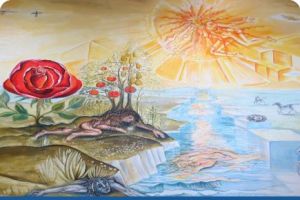
This painting by Brother Laurentius Englisch OFM shows the beauty of creation as expressed in the canticle. This painting by Brother Laurentius Englisch OFM shows the beauty of creation as expressed in the canticle.
Looking into our actual world we can get an impression that humanity is in process of destroying all this beauty; not respecting the inherent dignity given by God our Creator, which we as humans share with all creatures.

As Pope Francis reminds us in his encyclicals: care for creation and for those who are excluded and discriminated against, goes hand in hand.

Encouraged by Saint Francis’ life and his fraternal relation with all creatures, we are called to follow his path to bring the good news to all world.

Therefore, we Franciscans engage at the United Nations to ensure the protection of everyone’s dignity and our common home.

Together with many other ‘people of good will’ we worked hard so that the United Nations recognized the human right to a clean, healthy, and sustainable environment. We thank you for all your continued support of our common mission.

On behalf of our International Board of Directors and all our team members, I wish you a blessed and happy Feast of Saint Francis

Fraternally,

Markus Heinze OFM
Executive Director

https://www.secularfranciscansusa.org/2022/10/03/blessed-feast-of-st-francis-from-markus-heinz-ofm/

Open post

FORMATION FRIDAY – Canticle & the Transitus – September 30, 2022

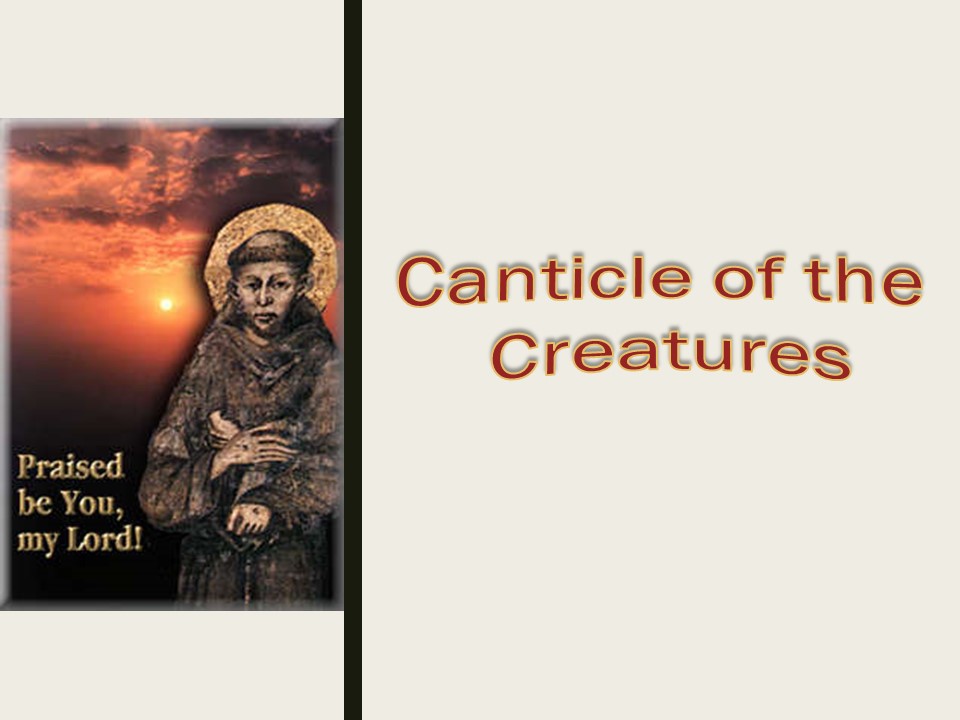
The Canticle of the Creatures

As we approach the Transitus and Feast Day of our Seraphic Father, we offer his own words as they appear in the Canticle of the Creatures. Composed in 1225 during his last illness, St. Francis gives glory to God through all of creation in the first portion of the canticle. Ever the peacemaker, he added verses 10 and 11 at a time when the political and religious authorities of Assisi were in conflict. Then, right before his death, he added two verses praising God for “Sister Bodily Death,” and, as always, calling us to penance and conversion.

The Canticle of the Creatures

1Most High, all-powerful, good Lord,
Yours are the praises, the glory, and the honor, and all blessing, Rv 4:9 Rv 4:11

2To You alone, Most High, do they belong,
and no human is worthy to mention Your name.d

3Praised be You, my Lord, with all Your creatures, Tb 8:7
especially Sir Brother Sun,
Who is the day and through whom You give us light.e

4And he is beautiful and radiant with great splendor;
and bears a likeness of You, Most High One.

5Praised be You, my Lord, through Sister Moon and the stars, Ps 148:3
in heaven You formed them clear and precious and beautiful.a

6Praised be You, my Lord, through Brother Wind,
and through the air, cloudy and serene, and every kind of weather,
through whom You give sustenance to Your creatures.

7Praised be You, my Lord, through Sister Water, Ps 148:4 Ps 148:5
who is very useful and humble and precious and chaste.

8Praised be You, my Lord, through Brother Fire, Dn 3:66
through whom You light the night, Ps 78:14 [Vulgate, Ps 77:14]
and he is beautiful and playful and robust and strong.

9Praised be You, my Lord, through our Sister Mother Earth, Dn 3:74
who sustains and governs us,
and who produces various fruit with colored flowers and herbs. Ps 104:13 [Vulgate, Ps 103:13] Ps 104:14 [Vulgate, Ps 103:14]

10Praised be You, my Lord, through those who give pardon for Your
love, Mt 6:12
and bear infirmity and tribulation.b

11Blessed are those who endure in peace
for by You, Most High, shall they be crowned.

12Praised be You, my Lord, through our Sister Bodily Death,
from whom no one living can escape.c

13Woe to those who die in mortal sin.
Blessed are those whom death will find in Your most holy will,
for the second death Rv 2:11 Rv 20:6 shall do them no harm.d

14Praise and bless my Lord Dn 3:85 and give Him thanks
and serve Him with great humility.

https://franciscantradition.org/francis-of-assisi-early-documents/the-saint/writings-of-francis/the-canticle-of-the-creatures/129-fa-ed-1-page-113

After reading the Canticle, go back and look at the Scripture sources indicated—read the passages—see how Francis was influenced by his intimate knowledge of Scripture.

+What part does Scripture play in your daily life? What does “going from Gospel to life and life to the Gospel” (Article 4 of our Rule) mean to you?

Reread verses 10 and 11 of the Canticle.

+How do you serve as a peacemaker in your family, job, or community?
+In what ways is it difficult for you to “forgive” those who don’t agree with you?
+Verse 10 calls to mind the story of Perfect Joy. What is Francis telling us in that story and in this canticle?

Verses 12 and 13 talk about the end of life and how we are to prepare.

+Give some thought to the qualities it takes to accept our eventual death or the death of someone we love.
+Reread the Prologue to the Rule of 1978, especially “Concerning Those Who Do Not Do Penance.” Why are penance and conversion so important to us?

Here is a short video about the Transitus of St. Francis celebrated on October 3rd.
https://www.youtube.com/watch?v=lTRzZz0Rmdg

+++++++++++++

Por favor compartir con sus fraternidades locales

Cántico de las Criaturas

A medida que nos acercamos al Tránsito y la Fiesta de nuestro Seráfico Padre, ofrecemos sus propias palabras tal como aparecen en el Cántico de las Criaturas. Compuesto en 1225 durante su última enfermedad, San Francisco da gloria a Dios a través de toda la creación en la primera parte del cántico. Siempre pacificador, agregó los versículos 10 y 11 en un momento en que las autoridades políticas y religiosas de Asís estaban en conflicto. Luego, justo antes de su muerte, añadió dos versos alabando a Dios por la “Hermana Muerte Corporal” y, como siempre, llamándonos a la penitencia y la conversión.

ALABANZAS DE LAS CRIATURAS

1Altísimo, omnipotente, buen Señor,

tuyas son las alabanzas, la gloria y el honor y toda bendición.


2A ti solo, Altísimo, corresponden,

y ningún hombre es digno de hacer de ti mención.


3Loado seas, mi Señor, con todas tus criaturas,

especialmente el señor hermano sol,

el cual es día, y por el cual nos alumbras.


4Y él es bello y radiante con gran esplendor,

de ti, Altísimo, lleva significación.


5Loado seas, mi Señor, por la hermana luna y las estrellas,

en el cielo las has formado luminosas y preciosas y bellas.


6Loado seas, mi Señor, por el hermano viento,

y por el aire y el nublado y el sereno y todo tiempo,

por el cual a tus criaturas das sustento.


7Loado seas, mi Señor, por la hermana agua,

la cual es muy útil y humilde y preciosa y casta.


8Loado seas, mi Señor, por el hermano fuego,

por el cual alumbras la noche,

y él es bello y alegre y robusto y fuerte.


9Loado seas, mi Señor, por nuestra hermana la madre tierra,

la cual nos sustenta y gobierna,

y produce diversos frutos con coloridas flores y hierba.


10Loado seas, mi Señor, por aquellos que perdonan por tu amor,

y soportan enfermedad y tribulación.


11Bienaventurados aquellos que las soporten en paz,

porque por ti, Altísimo, coronados serán.


12Loado seas, mi Señor, por nuestra hermana la muerte corporal,

de la cual ningún hombre viviente puede escapar.


13¡Ay de aquellos que mueran en pecado mortal!:

bienaventurados aquellos a quienes encuentre en tu santísima voluntad,

porque la muerte segunda no les hará mal.


14Load y bendecid a mi Señor,

y dadle gracias y servidle con gran humildad.

http://franciscanos.org/esfa/cant.html


+ ¿Qué papel juegan las Escrituras en su vida diaria? ¿Qué significa para usted “ir del Evangelio a la vida y de la vida al Evangelio” (artículo 4 de nuestra Regla)?


Releer los versículos 10 y 11 del Cántico.

+ ¿Cómo se desempeña como pacificador en su familia, trabajo o comunidad?

+ ¿De qué manera te resulta difícil “perdonar” a los que no están de acuerdo contigo?

+ El versículo 10 recuerda la historia de Perfect Joy. ¿Qué nos dice Francisco en esa historia y en este cántico?


Los versículos 12 y 13 hablan sobre el final de la vida y cómo debemos prepararnos.

+ Piense un poco en las cualidades que se necesitan para aceptar nuestra eventual muerte o la muerte de alguien a quien amamos.

+ Releer el Prólogo de la Regla de 1978, en especial “Sobre los que no hacen penitencia”. ¿Por qué son tan importantes para nosotros la penitencia y la conversión?


Un breve video sobre la vida de San Francisco en español
https://www.youtube.com/watch?v=RTNq9pGF4C0


Diane F. Menditto, OFS

Chair, National Formation Commission

Formation Director, Our Lady of the Angels Region
Formation Director, St. Francis Fraternity, Hackensack, NJ


Open post

SHAPING THE FRANCISCAN FOOTPRINT – September 22 – September 28 2022

(pdf attachment for printing)

Five Important Spiritual Thoughts from the Liturgy of the Word

…and follow up for the Secular Franciscan

September 22 – September 28


1 — He kept trying to see him. (Lk 9:9)**

…Do I keep “how
Jesus would think, act and say” as the guide to my life?


2 — “But
who do you say that I am?”
(Lk 9:20)**

Extended meditation:

This question of the Gospel is among
the five or so most important questions that we must ask ourselves as we
develop our own spirituality:

Who
do you say that I am?
that is,

Who
do we say Jesus Christ is?

It is among the
most important spiritual questions because depending on our answer, we develop
our approach to Jesus, and we direct our spiritual lives—rightly or wrongly. The truth of faith, as Peter says in this
portion of the Gospel, is that Jesus is the Lord of our lives, the living and
true God, the person that we must pattern ourselves after, the way, the truth
and the life…and measure how we are doing by studying what we are doing in
comparison to Jesus’s life.

In answer to the
question of who Jesus is for us, many have said for example that Jesus for them
is someone who punishes evil and punishes evil people. And in that case, Jesus becomes a God who
condemns—and these people form their religion in that light. When they do, there is anger and hatred and
what they might call “justifiable” revenge.
That is not a very good picture of who Jesus Christ is, and therefore
religion is not a pleasant thing at all for them, or for the others they meet.

Still others have answered that Jesus
is someone who is not real because they see so many people who are hypocritical
in the Church or in religion. Or because
they have had things go wrong for them in one way or another. Every Christian and certainly every Franciscan
in our world is called to answer this question in light of our Christian
faith. The truth is that Jesus is Lord,
the way, the truth and the life, the Lord contained in the Scriptures that we
read, God who gives real hope to our world.

Jesus is the pattern. That is, we accept as our guideline of
living, the Gospels of Sacred Scripture, that is, the actions and words of
Jesus, and as best we can, His thinking in individual cases. Jesus is the measure. We look at our actions and words over a
significant amount of time, say our past lives, and we study, say on a scale of
1-10, how close we came to the pattern that Jesus gave us.

Catholic Christians, and those of us
who follow Francis of Assisi, in the past have made the Institution of the
Eucharist as one of the most important actions that the Lord performed. In exactly the same way, and for the same
reason—making the Lord present—are the words, actions and thoughts of Jesus
throughout the Gospels.

We must begin to see that the Gospels
are not a “proof” that the Christian religion is the true religion or the like. The Gospels are just as much the real
presence as Jesus in the Eucharist.

And so, we must take the time to study
the person of Jesus and how he acted with regard to love, anger, prayer, mental
and physical pain, being a disciple, and so forth, and accept how Jesus
behaved. That is, we ask WWJS, what
would Jesus say, WWJD, what would Jesus do, and as far as possible WWJT, what
would Jesus think—and apply it to our lives.


3 – “But you, man of God, pursue
righteousness, devotion, faith, love, patience, and gentleness.”
(1 Tim 6:11)

…Go through each of
these virtues, asking myself about how I am keeping them.


4 – “An argument arose among the disciples about which of them was
the greatest. Jesus
realized the intention of their hearts.”
(Lk 9:46-47)**

…Is jealousy of
others a problem in my life?


5 – “I will follow you wherever you go.” (Lk 9:57)

…Such is my
profession as a Franciscan. Do I mean
it?


** one of the most important quotes in the Gospels


Scroll to top
Juan de Padilla