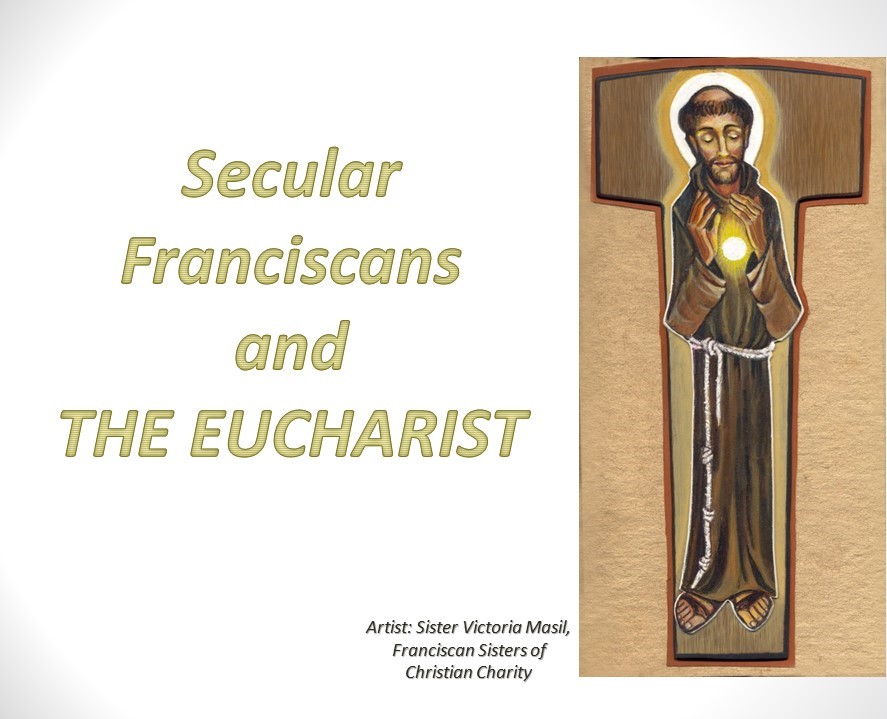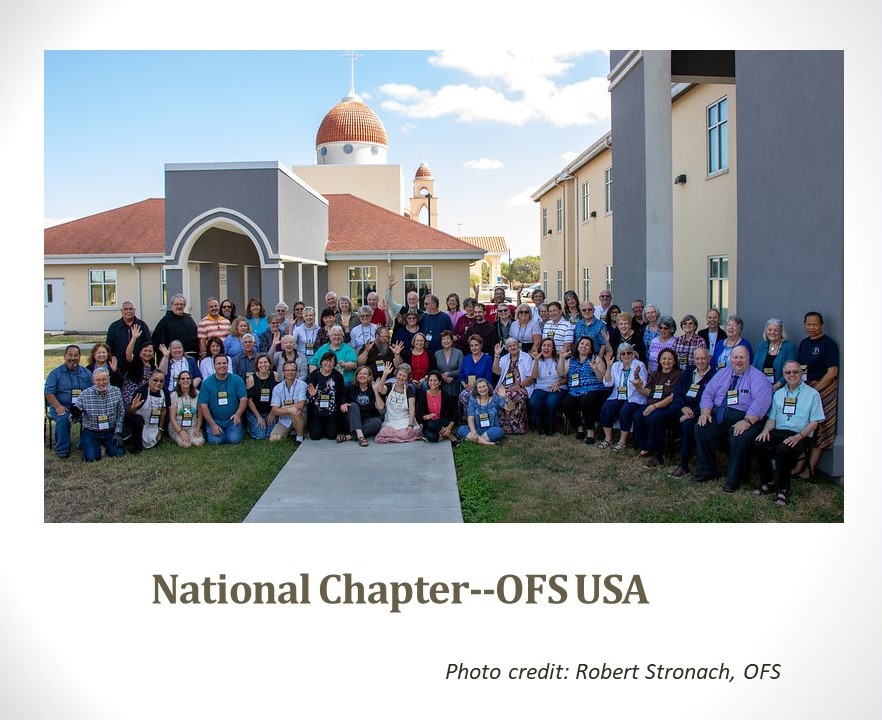
Please share with your local fraternity
+ The sixteenth century Basilica of St. Mary of the Angels envelops the tiny chapel known as the Porziuncola.
+ This chapel was one of the churches restored by St. Francis.
+ This is the spot where, while listening to the Gospel, Francis understood what he was called by God to do.
+ Here he founded the Order in 1209.
+ St. Clare received her religious habit from the hands of Francis here in 1211.
+ In 1216 as Francis prayed that everyone could be brought to heaven, he obtained from Jesus in a vision the PARDON OF ASSISI—a plenary indulgence, which was later ratified by Pope Honorius III.
+ This is where the friars’ early general chapters were held—the Chapter of Mats of 1221 was attended by 5,000 friars.
+ Here, on October 3, 1226, St. Francis welcomed Sister Death lying naked on the ground just outside the chapel.
“See to it, my sons, that you never abandon this place. If you are driven out from one side, go back in at the other. For this place is truly holy and is the dwelling place of God. Here, when we were but a few, the Most High gave us increase; here he enlightened the hearts of his poor ones by the light of his wisdom; here he set our wills on afire with the flame of his love. Here he who prays with a devout heart will obtain what he prays for and he who offends will be punished more severely. Wherefore, my sons, consider this dwelling place of God to be worthy of all honor, and with all your, with the voice of joy, and praise, give glory to the Lord in this place.” (Words of the dying St. Francis, Celano 1, n. 106)
The Conditions for Receiving the Pardon
+ Each year from vespers on August 1 through August 2 (Feast of Our Lady of the Angels) you should visit either a Franciscan church or your own church. (At first the indulgence was only given for the Porziuncola, but it has been widened over the years.)
+ You may obtain the indulgence any day of the year upon visiting the Porziuncola itself.
CONDITIONS TO OBTAIN THE PARDON OF ASSISI
Plenary Indulgence–(for oneself or for a departed soul)
- Sacramental Confession to be in God’s sanctifying grace *(to be received within eight days before or after initiate “appeal” for the Plenary Indulgence);
- *Participation in the Holy Mass with reception of the Holy Eucharist.
- Visit to a Catholic Church, followed by the Profession of FAITH (Nicene Creed or Apostles Creed),
- Recite the OUR FATHER, in order to reaffirm and give witness to one’s Christian dignity, as a child of God, that one received in Baptism;
- Pray for the Pope’s intentions: as Vicar of Christ, Shepherd of the Universal Church, and visible sign of unity among the Faithful
Excellent reference on this topic: http://www.shrinesf.org/pardon-of-assisi.html
Also, if you are able to read Spanish, the link below has a very interesting article about the Porziuncola.
For discussion and reflection
+ Read Matthew 10: 9-15. This is the gospel that Francis heard read at the Porziuncola. Reflect on its meaning to all Franciscans and to us as Secular Franciscans.
+ On August 1-2, visit a Franciscan or other church and follow the conditions to receive the indulgence.
+ While you are there, spend time with the Blessed Sacrament. Consider your vocation and what God is asking of you.
+++++++++++++++++++++++++
Formation Friday – 29 de julio, 2022
El perdón de Asís – La indulgencia de la porciúncula 2 de agosto
Comparta con su fraternidad local.
+ La Basílica de Santa María de los Ángeles del siglo XVI envuelve la pequeña capilla conocida como la Porciúncula.
+ Esta capilla fue una de las iglesias restauradas por San Francisco.
+ Este es el lugar donde, mientras escuchaba el Evangelio, Francisco comprendió lo que Dios le había llamado a hacer.
+ Aquí fundó la Orden en 1209.
+ Santa Clara recibió su hábito religioso de manos de Francisco aquí en 1211.
+ En 1216, mientras Francisco oraba para que todos pudieran ser llevados al cielo, obtuvo de Jesús en una visión el PERDÓN DE ASÍS, una indulgencia plenaria, que luego fue ratificada por el Papa Honorio III.
+ Aquí es donde se llevaron a cabo los primeros capítulos generales de los frailes; al Capítulo de las Esteras de 1221 asistieron 5.000 frailes.
+ Aquí, el 3 de octubre de 1226, San Francisco recibió desnudo a la Hermana Muerte en el suelo a las afueras de la capilla.
“Ocúpense, hijos míos, de que nunca abandonen este lugar. Si son expulsados de un lado, regresen por el otro. Porque este lugar es verdaderamente santo y es la morada de Dios. Aquí, cuando éramos sólo unos pocos, el Altísimo nos dio crecimiento; aquí iluminó el corazón de sus pobres con la luz de su sabiduría; aquí prendió nuestras voluntades con la llama de su amor. Aquí el que ora con corazón devoto obtenga lo que pide y el que ofende será castigado más severamente. Por tanto, hijos míos, consideren esta morada de Dios digna de toda honra, y con toda su voz, con voz de gozo y alabanza, den gloria al Señor en este luga .” (Palabras de San Francisco agonizante, Celano 1, n. 106)
Las condiciones para recibir la indulgencia
+ Cada año, desde las vísperas del 10 de agosto al 20 de agosto (Fiesta de Nuestra Señora de los Ángeles), debe visitar una iglesia franciscana o su propia iglesia. (Al principio, la indulgencia solo se otorgó a la Porciúncula, pero se ha ampliado con los años).
+ Puede obtener la indulgencia cualquier día del año al visitar la propia Porziuncola.
CONDICIONES PARA OBTENER EL PERDÓN DE ASÍS
Indulgencia plenaria – (para uno mismo o para un alma difunta)
• Confesión sacramental para estar en la gracia santificante de Dios * (para ser recibida dentro de los ocho días antes o después de iniciada la “apelación” para la Indulgencia Plenaria);
• * Participación en la Santa Misa con recepción de la Sagrada Eucaristía.
• Visita a una Iglesia Católica, seguida de la Profesión de FE (Credo de Nicea o Credo de los Apóstoles),
• Recitar el PADRE NUESTRO, para reafirmar y dar testimonio de la propia dignidad cristiana, como hijo de Dios, que se recibió en el Bautismo;
• Ore por las intenciones del Papa: como Vicario de Cristo, Pastor de la Iglesia Universal y signo visible de unidad entre los Fieles.
Excelente recurso en español http://franciscanos.org/santuarios/bellucci.htm
Para platicar y reflexionar
+ Lea Mateo 10: 9-15. Este es el evangelio que Francisco escuchó en la Porciúncula. Reflexione sobre su significado para todos los franciscanos y para nosotros como franciscanos seglares.
+ El 10 o el 20 de agosto, visite una iglesia franciscana u otra iglesia; siga las condiciones para recibir la indulgencia.
+ Mientras esté allí, pase tiempo con el Santísimo Sacramento. Considere su vocación y lo que Dios le está pidiendo.
Diane F. Menditto, OFSChair, National Formation Commission
Formation Director, Our Lady of the Angels Region
Formation Director, St. Francis Fraternity, Hackensack, NJ
Category: Formation Friday
FORMATION FRIDAY – The TAU – Why so Important to St. Francis? – July 22, 2022
Why was the TAU Cross so important to St. Francis? Why do we OFS wear the TAU?
- The TAU, as a symbol of sanctity, comes from Ezekiel 9:4
“Go through the city of Jerusalem and put a TAU on the foreheads of those who
grieve and lament over all the detestable things that are done in it.” It is the last
letter of the Hebrew alphabet and looks very much like the letter “T”. - Franciscan scholarship points to St. Francis’s being present at the Lateran Council in 1215
While attending he would have heard Pope Innocent III announce that every Catholic should take the TAU Cross as the symbol of their Passover. “The Pope set forth the Tau as a sign of penance and renewal in Christ. Francis embraced this sign as an expression of Christ’s cross. In hearing the story, Francis experienced confirmation of the LIFE and MISSION of his new order. The Tau became for him a symbol of exodus and pilgrimage with which he wanted his companions signed as ‘the new and humble people of God.’”
- He would have heard that the elect, the chosen will be marked with the sign of the TAU (Ezekiel 9:4)
- He would have heard the pope say that the TAU has the form of the Cross on which our Lord was crucified and that those who had mortified their flesh and conformed their life to that of Christ crucified will obtain mercy.
- From then on, the TAU became Francis’s own coat of arms and he often used it in his writings as his personal signature.
Why do many Secular Franciscans wear the TAU cross?
· Article 43 of the General Constitutions establishes that: “The distinctive sign of belonging to the Order (the “TAU” or other Franciscan symbol).
· Article 16.4 of the National Statutes of the United States states: “The external sign of the OFS in the United States is the TAU.
“The Tau Cross [adapted from Catch Me A Rainbow Too by Fr. Lester Bach, O.F.M. Cap.] Franciscans use the Tau as a symbol of commitment to Jesus through the O.F.S. Way of Life. The Tau cross is the sign of the O.F.S. in this country, not the San Damiano crucifix, not a medal of St. Francis, not a scapular and cord (such as were mandated under the Rule of 1883), and not a modified religious habit such as the friars wear! The Tau is worn with pride and joy. Francis saw the Tau as a symbol of the cross of Christ. It was the sign of salvation. It was a sign of belonging to God, being chosen and saved. Francis embraced it with love. It was pregnant with meaning for him. Franciscans wear it as a sign of their commitment to Jesus and the Gospel way of life.”
Direct quotes from: Tau Cross Statements by Deacon Dave and Thérèse Ream, OFS
The following questions are for discussion in fraternity, with a prayer partner, or to answer in your journal.
+Do you always wear your TAU cross? Why or why not?
+When you received your TAU at the Rite of Admission, what did it symbolize to you?
+If someone asks you what the TAU is and why you wear it, what is your answer to them?
++++++++++++++++++++++++
Formation Friday 22 de julio de 2022
Comparta con su fraternidad local
¿Por qué la Cruz TAU fue tan importante para San Francisco? ¿Por qué los Seglares franciscanos llevamos la TAU?
- La TAU, como símbolo de santidad, proviene de Ezequiel 9,4
“Pasen por la ciudad de Jerusalén y poned una TAU en la frente de los que
se entristecen y lamentan por todas las cosas detestables que en ella se hacen.” Es la última letra del alfabeto hebreo y se parece mucho a la letra “T.” - La erudición franciscana apunta a la presencia de San Francisco en el Concilio de Letrán en 1215.
Mientras asistía, habría escuchado al Papa Inocencio III anunciar que todos los católicos deberían llevar la Cruz TAU como símbolo de su Pascua. “El Papa planteó la Tau como signo de penitencia y renovación en Cristo. Francisco abrazó este signo como expresión de la cruz de Cristo. Al escuchar la historia, Francisco experimentó una confirmación de la VIDA y MISIÓN de su nueva orden. La Tau se convirtió para él en un símbolo de éxodo y peregrinaje con el que quería que sus compañeros se firmaran como ‘el nuevo y humilde pueblo de Dios.’”
- él hubiera escuchado que los elegidos, los escogidos serán marcados con la señal de la TAU (Ezequiel 9,4)
- él hubiera escuchado al Papa cuando dijo que la TAU tiene la forma de la Cruz en la que nuestro Señor fue crucificado y que aquellos que mortificaran su carne y conformaran su vida a la de Cristo crucificado obtendrían misericordia.
- A partir de entonces, la TAU se convirtió en el escudo de armas de Francisco y a menudo lo utilizó en sus escritos como su firma personal.
¿Por qué muchos franciscanos seglares llevan la cruz TAU?
· El artículo 43 de las Constituciones Generales establece que: “el signo distintivo de pertenencia a la Orden es (la “TAU” u otro símbolo franciscano).
· El artículo 16.4 de los Estatutos Nacionales de los Estados Unidos establece: “El signo externo de la OFS en los Estados Unidos es la TAU.”
“La Cruz Tau [adaptado de Catch Me A Rainbow Too por el Padre Lester Bach, OFM Cap.] Los franciscanos usan la Tau como símbolo de compromiso con Jesús a través del Modo de Vida de la OFS. La cruz Tau es el signo de la OFS en este país, no el crucifijo de San Damián, no es una medalla de San Francisco, no es un escapulario y un cordón (como se ordenó bajo la Regla de 1883), y ¡no es un hábito religioso modificado como los que usan los frailes! La Tau se lleva con orgullo y alegría. Francisco vio la Tau como un símbolo de la cruz de Cristo. Era la señal de la salvación. Era un signo de pertenencia a Dios, de ser elegido y salvado. Francisco lo abrazó con amor. Estaba preñado de significado para él. Los franciscanos lo usan como un signo de su compromiso con Jesús y el estilo de vida del Evangelio.”
Citas directas de: “Tau Cross Statements” del diácono Dave y Thérèse Ream, OFS
Las siguientes preguntas son para discutir en fraternidad, con un compañero de oración, o para responder en su diario.
+¿Siempre lleva su cruz TAU? ¿Por qué sí o por qué no?
+Cuando recibió su TAU en el Rito de Admisión, ¿qué simbolizó para usted?
+Si alguien le pregunta qué es el TAU y por qué lo lleva, ¿cuál es su respuesta?
Chair, National Formation Commission
Formation Director, St. Francis Fraternity, Hackensack, NJ
FORMATION FRIDAY – Secular Franciscans are Stealth Evangelizers (Part 2) – July 15, 2022
When we are professed, Secular Franciscans deepen our baptismal commitment. We are called to be at the forefront of evangelization. We may not be knocking on doors or preaching sermons, but if we live our Rule authentically, we are evangelizing, nonetheless. We are STEALTH EVANGELIZERS.
The questions following each article can be used for discussion with a small group, with a prayer partner, or answered in your journal
Article 12 “…set themselves free to love God and their brothers and sisters…”
+What attachments prevent us from keeping our relationship with God and others strong and healthy?
Article 13 “…so the Secular Franciscans with a gentle and courteous spirit accept all people as a gift of the Lord and an image of Christ.” 23
+Think about how our relationships…family, fraternity, colleagues, friends, and those who encounter us online…affect our mission as evangelizers. Give examples of helpful/unhelpful
Article 14 “…are called to build a more fraternal and evangelical world….”
” …let them exercise their responsibilities competently in Christian spirit of service.” 2
+What are your particular responsibilities?
+ How do they affect the message you bring to others?
Article 15 ” Let them individually and collectively be in the forefront in promoting justice by the testimony of their human lives and their courageous initiatives.”
+What are the ways we can promote justice individually and with our fraternities?”
Article 16. “Let them esteem work both as a gift and as a sharing in the creation, redemption, and service of the human community.27
+How do you witness through your work?
+How does this witness evangelize others?
Article 17 “In their family they should cultivate the Franciscan spirit of peace, fidelity, and respect for life, striving to make of it a sign of a world already renewed in Christ.” 28” By living the grace of matrimony, husbands and wives, in particular, should bear witness in the world to the love of Christ for his Church.”
As lay people, we have the opportunity to evangelize in the family.
+Give some examples of how our Rule helps you in your family relationship.
+How do you set the example for your spouse and children or your parents and siblings?
Article 18 “Moreover they should respect all creatures, animate and inanimate, which “bear the imprint of the Most High…”
+What contribution do you make to keeping our world safe for future generations?
+How do you see the “imprint of the most high” in nature?
Article 19 “Mindful that they are bearers of peace which must be built up unceasingly, they should seek out ways of unity and fraternal harmony through dialogue, trusting in the presence of the divine seed in everyone and in the transforming power of love and pardon.31 Messengers of perfect joy in every circumstance, they should strive to bring joy and hope to others.” 32
+How do you evangelize in your workplace or your volunteer activities?
+How do you help to promote peace and harmony in groups where you encounter division?
+Give some examples of how you bring joy and hope to others.
Tip (perhaps for a fraternity ongoing formation project): Read “The Joy of the Gospel” by Pope Francis and compare it to our Rule. It’s quite a formational experience!
+++++++++++++
Formation Friday 15 julio 2022
Comparta con su fraternidad local
Los franciscanos seglares son evangelizadores “sigilosos” (Parte 2)Cuando profesamos, los franciscanos seglares profundizamos nuestro compromiso bautismal. Estamos llamados a estar en la vanguardia de la evangelización. Puede que no estemos tocando puertas o predicando sermones, pero si vivimos nuestra Regla auténticamente, estamos evangelizando, no obstante. Somos EVANGELIZADORES STEALTH (“sigilosos”).
Las preguntas que siguen a cada artículo se pueden usar para la discusión con un grupo pequeño, con un compañero de oración o se pueden responder en su diario.
Artículo 12 “…se harán libres para el amor de Dios y de los hermanos.21
+¿Qué apegos nos impiden mantener nuestra relación con Dios y con los demás fuerte y saludable?
Artículo 13 “…los Franciscanos seglares acojan a todos los hombres con ánimo humilde y cortés, como don del Señor23 e imagen de Cristo. “
+Piense en cómo nuestras relaciones… familiares, de fraternidad, de colegas, de amigos, de quienes nos encuentran en la red… afectan nuestra misión como evangelizadores. Dar ejemplos útiles/no útiles.
Artículo 14 “Llamados, juntamente con todos los hombres de buena voluntad, a construir un mundo más fraterno y evangélico para la edificación del reino de Dios, … cumplan con competencia las propias responsabilidades con espíritu cristiano de servicio.”25
+¿Cuáles son sus responsabilidades particulares ?
+ ¿Cómo afecta a los demás el mensaje que usted les lleva?
Artículo 15 “Estén presentes con el testimonio de su vida y también con iniciativas eficaces, tanto individuales como comunitarias, en la promoción de la justicia, particularmente en el ámbito de la vida pública, empeñándose en opciones concretas y coherentes con su fe.”26
+¿Cuáles son las formas en que podemos promover la justicia individualmente y con nuestras fraternidades?
Artículo 16. “Consideren el trabajo como don de Dios y como participación en la creación, redención y servicio de la comunidad humana.27
+¿Cómo da testimonio a través de su trabajo?
+¿Cómo evangeliza a otros este testimonio?
Artículo 17 “Vivan en la propia familia el espíritu franciscano de paz, fidelidad y respeto a la vida, esforzándose en convertirlo en el signo de un mundo ya renovado en Cristo.28
Los casados, particularmente, viviendo la gracia del matrimonio, den testimonio en el mundo del amor de Cristo a su Iglesia. …”
Como laicos, tenemos la oportunidad de evangelizar en la familia.+Dé algunos ejemplos de cómo nuestra Regla le ayuda en su relación familiar.
+¿Cómo da el ejemplo a su cónyuge e hijos o a sus padres y hermanos?
Artículo 18 “Sientan, además, respeto por las otras criaturas, animadas e inanimadas, que “de ti, Altísimo, llevan significación…”
+¿Qué contribución hace para mantener nuestro mundo seguro para las generaciones futuras?
+¿Cómo ve la “huella del altísimo ” en la naturaleza?
Artículo 19 “Como portadores de paz y conscientes de que ésta ha de construirse incesantemente, indaguen los caminos de la unidad y del entendimiento fraterno, mediante el diálogo, confiando en la presencia del germen divino que hay en el hombre y en la fuerza transformadora del amor y del perdón.31 Mensajeros de la perfecta alegría, esfuércense permanentemente en llevar a los demás el gozo y la esperanza.”32
+¿Cómo evangeliza en su lugar de trabajo o en sus actividades de voluntariado?
+¿Cómo ayuda a promover la paz y la armonía en grupos donde encuentra división?
+Da algunos ejemplos de cómo trae alegría y esperanza a los demás.
Consejo (quizás para un proyecto de formación permanente de una fraternidad): Lea “La alegría del Evangelio” del Papa Francisco y compárelo con nuestra Regla. ¡Es toda una experiencia formativa!
Diane F. Menditto, OFSChair, National Formation Commission
Formation Director, Our Lady of the Angels Region
Formation Director, St. Francis Fraternity, Hackensack, NJ
FORMATION FRIDAY – Secular Franciscans are Stealth Evangelizers (Part 1) – July 8, 2022
Please share with your local fraternity
Through our baptism, all Christians are called to be “priests, prophets, and kings.” We are called to proclaim the gospel every day of our lives. In a recent homily, a local pastor spoke about prophets as being the “mouthpieces” of God. As prophets we are to hear God’s word and spread the Gospel.
When we are professed, Secular Franciscans deepen our baptismal commitment. We are called to be in the forefront of evangelization. We may not be knocking on doors or preaching sermons, but if we live our Rule authentically, we are evangelizing, nonetheless. We are STEALTH EVANGELIZERS.
After reading the call to conversion in the Prologue to our Rule, take a good look at the snippets of key articles of our Rule below. The Rule helps us to reorder our lives so that we become effective evangelizers.
The questions following each article can be used for discussion with a small group, with a prayer partner, or answered in your journal.
Article 2 ” By their profession they pledge themselves to live the gospel in the manner of St. Francis by means of this rule approved by the Church.”5
+How often do you read our Rule?
+Give an example of how you can make the Rule part of your prayer life.Article 4 Secular Franciscans should devote themselves especially to careful reading of the gospel, going from gospel to life and life to the gospel8.”
+How often do you read Scripture besides what you hear at Mass?
+Give some examples of how you go from gospel to life and life to the gospels.
Article 5 “…should seek to encounter the living and active person of Christ in their brothers and sisters, in Sacred Scripture, in the Church, and in liturgical activity.”
+How do you find the “living and active person of Christ in someone you do not like?”
+How do you treat those who are “difficult?” How are you evangelizing this person?
Article 6 ” Therefore, they should go forth as witnesses and instruments of her [the Church’s] mission among all people, proclaiming Christ by their life and words.”
+What are some ways your life makes you an instrument of the Church’s mission?
+How can our actions and words turn people away from the mission of the Church?
Article 10 …”let them faithfully fulfill the duties proper to their various circumstances of life.17 Let them also follow the poor and crucified Christ, witness to him even in difficulties and persecutions…”
+What duties are “proper” to your life? (Not the same for everyone)
+How do you fulfill your duties and responsibilities in a way that gives good witness?
Article 11 “Let them be mindful that according to the gospel they are stewards of the goods received for the benefit of God’s children.”
+What are our responsibilities in being good stewards of the goods we have received from God?
+How does our relationship with material things help to evangelize others?”
Part 2 next week
Formation Friday 8 de julio de 2022
Los franciscanos seglares son evangelizadores “sigilosos” (Parte 1)
Comparta con su fraternidad localA través de nuestro bautismo, todos los cristianos estamos llamados a ser “sacerdotes, profetas y reyes.” Estamos llamados a proclamar el evangelio todos los días de nuestras vidas. En una homilía reciente, un pastor local habló de los profetas como los “portavoces” de Dios. Como profetas, debemos escuchar la palabra de Dios y difundir el Evangelio.
Cuando profesamos, los franciscanos seglares profundizamos nuestro compromiso bautismal. Estamos llamados a estar en la vanguardia de la evangelización. Puede que no estemos tocando puertas o predicando sermones, pero si vivimos nuestra Regla auténticamente, estamos evangelizando, no obstante. Somos EVANGELIZADORES STEALTH (“sigilosos”).
Después de leer el llamado a la conversión en el Prólogo de nuestra Regla, eche un vistazo a los fragmentos de artículos clave de nuestra Regla a continuación. La Regla nos ayuda a reordenar nuestra vida para convertirnos en evangelizadores eficaces.
Las preguntas que siguen a cada artículo se pueden usar para la discusión con un grupo pequeño, con un compañero de oración o se pueden responder en su diario.
Artículo 2 “se comprometen con la Profesión a vivir el Evangelio a la manera de San Francisco con la ayuda de la presente Regla confirmada por la Iglesia.” 5
+ ¿Con qué frecuencia lee nuestra Regla?
+Dé un ejemplo de cómo puede hacer que la Regla sea parte de su vida de oración.Artículo 4 “Los Franciscanos seglares dedíquense asiduamente a la lectura del Evangelio, pasando del Evangelio a la vida y de la vida al Evangelio8.”
+ ¿Con qué frecuencia lees las Escrituras además de lo que escuchas en la Misa?
+ Da algunos ejemplos de cómo pasas del evangelio a la vida y de la vida a los evangelios.
Artículo 5 “Los Franciscanos seglares, pues, busquen la persona viviente y operante de Cristo en los hermanos, en la Sagrada Escritura, en la Iglesia y en las acciones litúrgicas.”
+ ¿Cómo encuentra usted a la “persona viviente y operante de Cristo” en alguien que no le gusta?
+ ¿Cómo trata a los que son “difíciles?” ¿Cómo evangeliza usted a esta persona?
Artículo 6 “…háganse testigos e instrumentos de su misión entre los hombres, anunciando a Cristo con la vida y con la palabra.”
+ ¿Cuáles son algunas formas en que su vida le convierte en un instrumento de la misión de la Iglesia?
+¿Cómo pueden nuestras acciones y palabras alejar a la gente de la misión de la Iglesia?
Artículo 10 “…cumplan fielmente las obligaciones propias de la condición de cada uno en las diversas circunstancias de la vida17, y sigan a Cristo, pobre y crucificado, testimoniándolo aún en las dificultades y persecuciones18.
+ ¿Qué obligaciones son “propias ” a su vida? (No son iguales para todos)
+ ¿Cómo cumple con sus obligaciones y responsabilidades de una manera que da buen testimonio?
Artículo 11 “…sean conscientes, en conformidad con el Evangelio, de ser administradores de los bienes recibidos, en favor de los hijos de Dios.”
+ ¿Cuáles son nuestras responsabilidades para ser buenos administradores de los bienes que hemos recibido de Dios?
+ ¿Cómo nuestra relación con las cosas materiales ayuda a evangelizar a los demás?”
Segunda parte la semana próxima
Diane F. Menditto, OFSChair, National Formation Commission
Formation Director, Our Lady of the Angels Region
Formation Director, St. Francis Fraternity, Hackensack, NJ
FORMATION FRIDAY – Rites of Admission & Profession – July 1, 2022
Please share with your local fraternity (En español abajo)Although formation is a life-long process, those who are inquirers and candidates are in a period of discernment called initial formation. During this time their formators guide them in their initial journey of discernment toward a permanent commitment in the Secular Franciscan Order.This period is marked by certain milestones:1- The Ceremony of Introduction and Welcoming (before Inquiry)2- The Rite of Admission (before Candidacy)3- The Rite of Profession—permanent commitment to the Secular Franciscan OrderThis week we focus on the Rites of Admission and ProfessionThe rites celebrated in the formation of a Secular Franciscan signify the desire to become a member of the order and to make a permanent commitment to the Gospel life.• The Rite of Admission is the moment when we become members of the Order—We are attached to the Order although we have not yet made a permanent commitment. We wear the TAU and may write OFS after our name.After about nine months of orientation and the period of Inquiry, the Inquirer writes to the Council of the local fraternity requesting admission to Candidacy. The members of the Council should have come to know this person quite well. After reading the letter and interviewing the Inquirer, the Council votes on acceptance to Candidacy.During the Rite of Admission the Inquirers ask to enter the Secular Franciscan Order so that they may live more intensely and faithfully the grace of their Baptism. The Minister receives the new Candidate into the OFS so that they may begin their period of initial formation and continue to prepare for their permanent commitment.After about eighteen months of Candidacy, the candidates again approach the Council in writing to request profession of the rule of the Secular Franciscan Order and to make a permanent commitment to the gospel life.• With the Rite of Profession, we make our perpetual (life-long) commitment to live the Gospel life according to our Rule. Profession does not make us Secular Franciscans—it celebrates the commitment we make to live the Gospel life.The celebration of Profession is God’s action and a saving event: it is a moment when salvation reaches the faithful. It enables them to make a promise to live the Franciscan gospel life and produces in them particular effects of grace, by which they are called to specific tasks within the People of God. The liturgical act of Profession makes the connection with Baptism clear—it connects us with the Church. The Rite of Profession is a “confession of faith.” Our words and actions show that we are true followers of Christ and His Gospel.The Rites do not transform us into Franciscans. They celebrate the change that has already taken place in us throughout our discernment. We celebrate the fact that God has called us from the time of our Baptism to live out our lives as Catholics and as Franciscans. God delights in our acts of love for him. He calls us first. The Holy Spirit has planted the seed of our vocation in us from the very beginning.Please read the Rites of Admission and Profession in the Ritual. The following questions can be answered in fraternity groups, with a prayer partner, or in your journal.+ For you, what are the four most outstanding parts of the Rites of Admission and Profession?+ In the promises we make at Admission and Profession, what might present a challenge to you?+The Holy Spirit speaks to each of us in a very personal way. As you read the Rites of Admission and Profession, how did they touch and change you and bring you closer to God? Give examples.++++++++++++++++++++Los ritos de admisión y profesión 10 de julio de 2022Comparta con su fraternidad localAunque la formación es un proceso de toda la vida, quienes son indagadores y candidatos se encuentran en un período de discernimiento llamado la formación inicial. Durante este tiempo sus formadores los guían en su camino inicial de discernimiento hacia un compromiso permanente en la Orden Franciscana Seglar. Este período está marcado por ciertos hitos:1- La ceremonia de presentación y bienvenida (antes de “Inquiry”)2- El Rito de Admisión (antes de la Candidatura)3- El Rito de la Profesión—compromiso permanente en la Orden Franciscana SeglarEsta semana nos enfocamos en los Ritos de Admisión y ProfesiónLos ritos que se celebran en la formación de un franciscano seglar significan el deseo de hacerse miembro de la orden y de comprometerse permanentemente con la vida evangélica.• El Rito de Admisión, es el momento en que nos convertimos en miembros de la Orden. Estamos adscritos a la Orden aunque todavía no hemos hecho un compromiso permanente. Usamos la TAU y podemos escribir OFS después de nuestro nombre.Después de unos nueve meses de orientación y el período de Pre-candidatura, el pre-candidato escribe al Consejo de la fraternidad local solicitando la admisión a la Candidatura. Los miembros del Consejo deberían haber llegado a conocer bastante bien a esta persona. Después de leer la carta y entrevistar al Pre-candidato, el Consejo vota sobre la aceptación a la Candidatura.Durante el Rito de Admisión los Pre-candidatos piden ingresar en la Orden Franciscana Seglar para vivir más intensa y fielmente la gracia de su Bautismo. El Ministro recibe al nuevo Candidato en la OFS para que inicie su período de formación inicial y continúe preparándose para su compromiso permanente.Después de unos dieciocho meses de Candidatura, los Candidatos se dirigen de nuevo al Consejo por escrito para solicitar la profesión de la regla de la Orden Franciscana Seglar y hacer un compromiso permanente con la vida evangélica.• Con el Rito de Profesión, hacemos nuestro compromiso perpetuo (de por vida) de vivir la vida del Evangelio según nuestra Regla. La profesión no nos convierte en franciscanos seglares, sino que celebra el compromiso que hacemos de vivir la vida del Evangelio.La celebración de la Profesión es acción de Dios y acontecimiento salvífico: es un momento en que la salvación alcanza a los fieles. Les permite hacer la promesa de vivir la vida evangélica franciscana y produce en ellos efectos particulares de gracia, por los cuales son llamados a tareas específicas dentro del Pueblo de Dios. El acto litúrgico de la Profesión deja clara la conexión con el Bautismo, nos conecta con la Iglesia. El Rito de Profesión es una “confesión de fe.” Nuestras palabras y acciones muestran que somos verdaderos seguidores de Cristo y Su Evangelio.Los Ritos no nos transforman en franciscanos. Celebran el cambio que ya se ha producido en nosotros a lo largo de nuestro discernimiento. Celebramos el hecho de que Dios nos ha llamado desde el momento de nuestro Bautismo a vivir nuestra vida como católicos y franciscanos. Dios se deleita en nuestros actos de amor por él. Él nos llama primero. El Espíritu Santo ha plantado en nosotros la semilla de nuestra vocación desde el principio .Por favor lea los Ritos de Admisión y Profesión en el Ritual. Las siguientes preguntas pueden responderse en grupos de fraternidad, con un compañero de oración o en su diario.+ Para usted, ¿cuáles son las cuatro partes más destacadas de los Ritos de Admisión y Profesión?+ En las promesas que hacemos en Admisión y Profesión, ¿qué podría representar un desafío para usted?+El Espíritu Santo nos habla a cada uno de nosotros de una manera muy personal. Al leer los Ritos de Admisión y Profesión, ¿cómo le tocaron y cambiaron y lo acercaron a Dios? Dar ejemplos.Diane F. Menditto, OFSChair, National Formation Commission
Formation Director, Our Lady of the Angels Region
Formation Director, St. Francis Fraternity, Hackensack, NJ