Open post

Formation Friday – Vocations, Communications, Relationships: What is Vocation? January 20, 2023


Vocations, Communications, Relationships: What is Vocation? (Part 1)

At our National Chapter in October 2022, the National Fraternity Council decided that the priorities for 2022-2025 will be Vocations, Communications, and Relationships. For the next several weeks, Formation Friday will take a look at each of the priorities.

Before we can discover and attract vocations, we need to have a good idea of what a vocation is. Part 1 looks at what our formation materials stress about the nature of vocation in general. (Material for this portion is taken from the FUN Manual, The Franciscan Journey, and materials being developed for the OFS USA formation program.)

“I have called you by your name. You are mine because you are precious in my eyes, you are honored, and I love you.” (Isaiah 43: 1b, 4)

— Vocation is an invitation to all people to share in the life of the Trinity.

— We all receive three “calls” from God

Primary call—to all people

Personal call—personal vocation

Specific call—vocation to the Secular Franciscan Order


The Primary Call is a call to all people to love—God loves us and we, in turn, are called to love God. Because of love God the Father created us, made a covenant with us and sent the prophets to communicate with us. God loves each one of us personally and un­conditionally. Vati­can II tells us that we are not called because of our good works but by God’s design and grace. (Documents of Vatican II. The Laity, p. 58)

The Personal Call is initiated by God (or by God through another person). He never forces us to respond. God deals with each of us in a unique, per­sonal way. For example, the Apostles were called to be the first witnesses to Christ’s divinity. They were called to preach and act in Jesus’s name. This was their PERSONAL VOCATION.

We are called to PERFECTION (See the story of the Rich Young Man in Matthew 19:16-30—“Sell what you have…Come, follow me.”); WITNESS (See the story of the Gerasene Demoniac in Mark 5: 1-20; Luke 8:26-29—“Tell what God has done for you.”); TOTAL AVAILABILITY (See the story of Zacchaeus in Luke 19: 5-7—“I must come to your house today.”)
Of course, there are many other examples that we can cite from Scripture.

The Specific Call—As professed Secular Franciscans, many of us have answered this call. However, for those who are searching to find what their Specific Call is, it takes many hours, days, and sometimes years to discern in what specific way the Lord is calling us to serve him and spread the good news of his life, death, and resurrection. Here are some general tips for discernment.

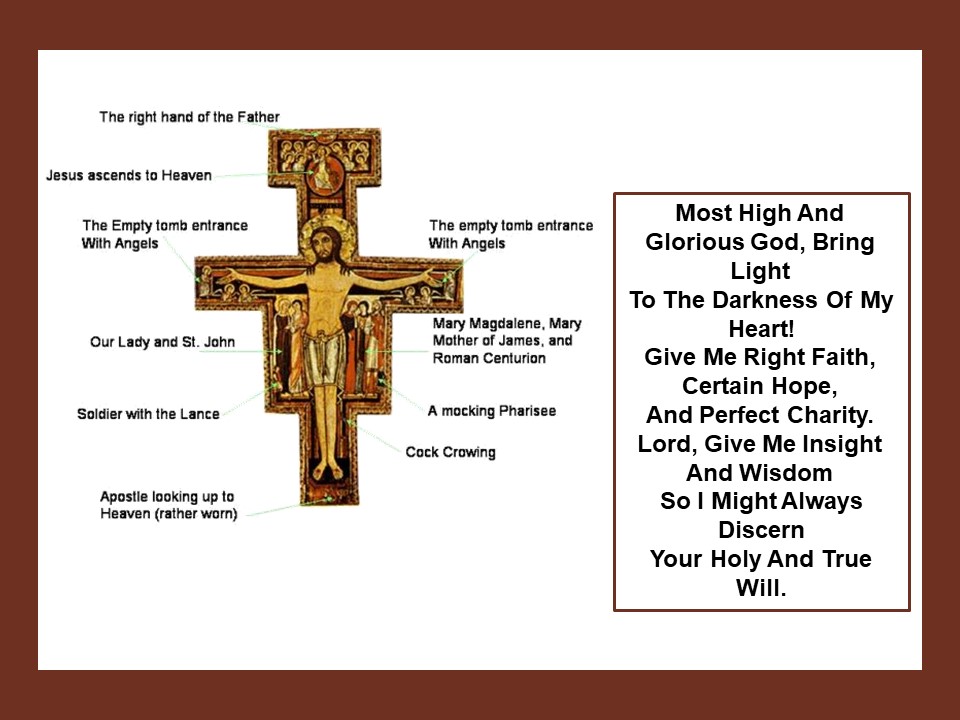
Discernment is a decision-making process that honors the place of God’s will in our lives. To discern well in the context of religion, start with prayer to know God’s will. (Perhaps the Prayer Before the Crucifix FA:ED, vol. 1, p. 40, “Most High glorious God, enlighten the darkness of my heart,…). Trust that God has a plan for your life. Find quiet time; tell God what you desire and what you fear; allow God to speak to you; talk to a mentor or someone you respect. Continue to pray and be open to the Holy Spirit, but do not be afraid to explore the options open to you.

Questions for discussion or to answer in your journal:

+ Have you discovered your specific call? If yes, how have you answered it?
+ What gifts and talents given to by God have helped you to make that decision?
+ How do you think you can help others to recognize and answer their call?

Next week we will have more on the Specific Franciscan Vocation: How to recognize it and how to call it forth in others.

+++++++++++++++++++++++++++

Por favor comparta con su fraternidad local

Las vocaciones, las comunicaciones, las relaciones personales: ¿Qué es la vocación? (Parte 1)

En nuestro Capítulo Nacional de octubre de 2022, el Consejo Nacional decidió que las prioridades para 2022-2025 serán las vocaciones, las comunicaciones y las relaciones personales. Durante las próximas semanas, Formation Friday analizará cada una de las prioridades.

Antes de que podamos descubrir y atraer vocaciones, necesitamos tener una buena idea de lo que es una vocación. La Parte 1 analiza lo que nuestros materiales de formación enfatizan sobre la naturaleza de la vocación en general. (El material para esta parte se tomó del Manual FUN, La jornada franciscana y los materiales que se están desarrollando para el programa de formación OFS USA).

“Te he llamado por tu nombre. Eres mía porque eres preciosa a mis ojos, eres honrada y te amo”. (Isaías 43: 1b, 4)

La vocación es una invitación a todas las personas a compartir la vida de la Trinidad.

Todos recibimos tres “llamados” de Dios

El llamado principal: a todas las personas

El llamada personal: vocación personal

El llamado específico: vocación a la Orden Franciscana Seglar


El llamado principal es un llamado a todas las personas a amar: Dios nos ama y nosotros, a nuestra vez, estamos llamados a amar a Dios. Por amor Dios Padre nos creó, hizo alianza con nosotros y envió a los profetas a comunicarse con nosotros. Dios nos ama a cada uno de nosotros personalmente e ­incondicionalmente . El Concilio Vaticano II nos dice que no somos llamados por nuestras buenas obras sino por el diseño y la gracia de Dios. (Documentos del Vaticano II. Los Laicos, p. 58)

El Llamado personal es iniciado por Dios (o por Dios a través de otra persona). Él nunca nos obliga a responder. Dios trata con cada uno de nosotros de una manera única y ­personal. Por ejemplo, los Apóstoles fueron llamados a ser los primeros testigos de la divinidad de Cristo. Fueron llamados a predicar y actuar en el nombre de Jesús. Esta fue su VOCACIÓN PERSONAL .

Estamos llamados a la PERFECCIÓN (Ver la historia del Joven Rico en Mateo 19:16-30—“Vende lo que tienes…Ven, sígueme.”); A ser TESTIGOS (Vea la historia del Endemoniado Gerasene en Marcos 5: 1-20; Lucas 8: 26-29—“Cuéntenme lo que Dios ha hecho por ustedes.”); DISPONIBILIDAD TOTAL (Vea la historia de Zaqueo en Lucas 19: 5-7—“Es necesario que vaya a tu casa hoy”).
Por supuesto, hay muchos otros ejemplos que podemos citar de las Escrituras.

El llamado específico— Como franciscanos seglares profesos, muchos de nosotros hemos respondido a este llamado. Sin embargo, para aquellos que están buscando cuál es su llamado específico, se necesitan muchas horas, días y, a veces, años para discernir de qué manera específica el Señor nos está llamando a servirlo y difundir la buena noticia de su vida, muerte, y resurrección. Aquí hay algunos consejos generales para el discernimiento.

El discernimiento es un proceso de toma de decisiones que honra el lugar de la voluntad de Dios en nuestras vidas. Para discernir bien en el contexto de la religión, comience con la oración para conocer la voluntad de Dios. (Quizás la Oración ante el Crucifijo http://franciscanos.org/esfa/orsd.html “Sumo glorioso Dios, ilumina las tinieblas de mi corazón,…). Confía en que Dios tiene un plan para su vida. Encuentre tiempo de tranquilidad; dígale a Dios lo que usted desea y lo que teme; deje que Dios le hable; hable con un mentor o con alguien a quien respete. Continúe orando y esté abierto al Espíritu Santo, pero no tenga miedo de explorar las opciones abiertas para usted.


Preguntas para discutir o responder en tu diario:

+ ¿Ha descubierto su llamado específico? En caso afirmativo, ¿cómo lo ha respondido?
+ ¿Qué dones y talentos dados por Dios le han ayudado a tomar esa decisión?
+ ¿Cómo cree que puede ayudar a otros a reconocer y responder a su llamado?

La próxima semana tendremos más información sobre la Vocación Franciscana Específica: cómo reconocerla y cómo invocarla en los demás.


Diane F. Menditto, OFS
Vice Minister, National Fraternity, Secular Franciscan Order USA
Listen – Discern – Go Forth National Theme 2022-2025
Open post

Formation Friday – Careful Reading of the Gospel – January 13, 2023

Careful Reading of the Gospel

Prepared by Justin Carisio, OFS, member, National Formation Commission

Secular Franciscan life is grounded in the gospel. This is underscored at Profession when the minister gives the newly professed a copy of the Holy Gospels as a symbolic reminder that profession is a lifelong commitment to “go from gospel to life and life to the gospel.” Article 4 of the Rule further emphasizes the continuing importance of Sacred Scripture by enjoining the brothers and sisters to “devote themselves especially to careful reading of the gospel.”

There are many ways to read, study, and pray with Scripture. I have long been a student of literature and also a writer. Here is a simple approach to “careful reading” of the four Gospels that I developed based on my experience. I’ve used it reading alone and in a group. It may be helpful to you.

Character. The Gospels tell the story of Jesus Christ, “true God and true man” (CCC 480), who walked the earth and interacted with people. They are full of memorable characters. When reading one of the Gospels, either in whole or in part, select a character. Try to picture him or her. Reflect on the drama and the experiences of that person.

Story. Each Gospel is replete with “stories.” Mary visiting Elizabeth. The marriage at Cana. Jesus calming the storm. When carefully reading a Gospel, choose a story that speaks to you and dwell on its significance and meaning.

Setting. Imagine you are a painter, photographer, or filmmaker. The Gospels present many “scenes.” Feeding the five thousand. The Transfiguration. Jesus before Pilate. In your reading, which scene would you capture? What makes it particularly vivid for you?

Beauty. The Word of God is beautiful! Consider the prologue of the Gospel of St. John. The centurion acknowledging his unworthiness. The Beatitudes. Focus on a passage simply for the inspiration and beauty of its words. Speak the passage aloud.

Franciscan spirit. Select a passage in your reading that specifically resonates with Franciscan heritage, spirituality, or way of life. What makes it Franciscan? How will it help you live the Rule this day as you go from gospel to life and life to the gospel?

The Rule says Secular Franciscans “should seek to encounter the living and active person of Christ…in Sacred Scripture” (Article 5) and go forth “proclaiming Christ by their life and words.” (Article 6) Careful reading of the Gospels will strengthen and prepare us to do both.

******************

From the OFS Rule: “The rule and life of the Secular Franciscans is this: to observe the gospel of our Lord Jesus Christ by following the example of Saint Francis of Assisi, who made Christ the inspiration and the center of his life with God and people. Christ, the gift of the Father’s love, is the way to him, the truth into which the Holy Spirit leads us, and the life which he has come to give abundantly. Secular Franciscans should devote themselves especially to careful reading of the gospel, going from gospel to life and life to the gospel.” (Article 4)

For discussion with your fraternity or a prayer partner:

· From your reading of the Gospels, you may already have a favorite character, story, or inspirational passage. Share (with a partner or in your journal) how that has helped you go “from gospel to life.”

· For ongoing formation:

o Gospel readings may be pre-chosen and read ahead of time at home.

o Follow the steps above to prepare for a fraternity discussion

o At the gathering, divide up into groups or partners (depending on the size of your fraternity.)

o Follow the steps again for the discussion. Share your ideas.

+++++++++++++++++++++++++++++++++++++

Lectura cuidadosa del Evangelio
Preparado por Justin Carisio , OFS, miembro, Comisión Nacional de Formación
(Por favor, comparta con su fraternidad)


La vida franciscana seglar se basa en el evangelio. Esto se subraya en la Profesión cuando el ministro entrega al recién profeso una copia de los Santos Evangelios como un recordatorio simbólico de que la profesión es un compromiso de por vida de “ir del evangelio a la vida y de la vida al evangelio”. El artículo 4 de la Regla enfatiza aún más la importancia continua de la Sagrada Escritura al ordenar a los hermanos y hermanas que “se dediquen especialmente a la lectura cuidadosa del evangelio”.

Hay muchas maneras de leer, estudiar y orar con las Escrituras. Durante mucho tiempo he sido estudiante de literatura y también escritor. Aquí hay un enfoque simple para la “lectura cuidadosa” de los cuatro Evangelios que desarrollé en base a mi experiencia. Lo he usado leyendo solo y en grupo. Puede ser útil para usted.

Personaje-Los Evangelios cuentan la historia de Jesucristo, “verdadero Dios y verdadero hombre” (CCC 480), que caminó sobre la tierra e interactuó con la gente. Están llenos de personajes memorables. Cuando lea uno de los Evangelios, ya sea en su totalidad o en parte, seleccione un personaje. Trate de imaginarlo. Reflexione sobre el drama y las vivencias de esa persona.

Historia-Cada Evangelio está repleto de “historias”. María visitando a Isabel. Las bodas de Caná. Jesús calmando la tormenta. Cuando lea cuidadosamente un Evangelio, elija una historia que le hable y reflexione sobre su importancia y significado.

Escenario-Imagine que es pintor, fotógrafo o cineasta. Los Evangelios presentan muchas “escenas”. Alimentando a los cinco mil. La Transfiguración. Jesús ante Pilato. En su lectura, ¿qué escena capturaría? ¿Qué lo hace particularmente vívida para usted?

Belleza-¡La Palabra de Dios es hermosa! Considere el prólogo del Evangelio de San Juan. El centurión reconociendo su indignidad. Las Bienaventuranzas. Concéntrese en un pasaje simplemente por la inspiración y la belleza de sus palabras. Lea el pasaje en voz alta.

Espíritu franciscano-Seleccione un pasaje en su lectura que resuene específicamente con la herencia, espiritualidad o forma de vida franciscana. ¿Qué lo hace franciscano? ¿Cómo le ayudará a vivir la Regla hoy al pasar del evangelio a la vida y de la vida al evangelio?

La Regla dice que los franciscanos seglares “deben buscar el encuentro con la persona viva y activa de Cristo… en la Sagrada Escritura” (artículo 5) y salir “proclamando a Cristo con su vida y sus palabras”. (Artículo 6) La lectura cuidadosa de los Evangelios nos fortalecerá y preparará para hacer ambas cosas.

******************

De la Regla OFS: “La Regla y la vida de los Franciscanos seglares es ésta: guardar el santo Evangelio de nuestro Señor Jesucristo siguiendo el ejemplo de San Francisco de Asís, que hizo de Cristo el inspirador y centro de su vida con Dios y con los hombres. Cristo, don del amor del Padre, es el camino hacia Él, es la verdad en la cual nos introduce el Espíritu Santo, es la vida que Él ha venido a dar abundantemente. Los Franciscanos seglares dedíquense asiduamente a la lectura del Evangelio, pasando del Evangelio a la vida y de la vida al Evangelio.“ (Artículo 4)

Para platicar en la su fraternidad o con un compañero de oración:

  • De su lectura de los Evangelios, es posible que ya tenga un personaje, una historia o un pasaje inspirador favorito. Comparta (con un compañero o en su diario) cómo eso le ha ayudado a ir “del evangelio a la vida”.
  • Para la formación permanente:
    • Las lecturas del Evangelio pueden elegirse previamente y leerse con anticipación en casa.
    • Siga los pasos anteriores para prepararse para la discusión de fraternidad
    • En la reunión, divídanse en grupos o parejas (dependiendo del tamaño de su fraternidad).
    • Siga los pasos nuevamente para la discusión. Comparta sus ideas.

Diane F. Menditto, OFS

Vice Minister, National Fraternity, Secular Franciscan Order USA
Listen – Discern – Go Forth National Theme 2022-2025
Open post

FORMATION FRIDAY – Exam 2022-23 (continued from Dec. 30) – January 6, 2023

Examen 2022-23 [Continued from December 30, 2022] Please share with your local fraternity


Past and present Formation Fridays can be found here: https://www.dmf-ofs.org/

A Litany and Examination of Conscience based on the Rule of the Secular Franciscan Order


Thank you to Judith W. Tyrrell, OFS, for giving us permission to use her work

St. Margaret of Cortona Region

Response: Lord, have mercy.

21. For the times I did not simplify my own material needs after Christ’s example of poverty…R:

22. For the times I failed to be a good steward of God’s gifts…R:

23. For the times I did not believe that living the Beatitudes would make me happy…R:

24. For the times I have not embraced my vocation with purity of heart…R:

25.For the times I have not gently and courteously welcomed every person as a gift from the Lord and as an image of Christ…R:

26. For the times I have not wanted to place myself on an equal basis with all people…R:

27. For the times I have lacked a sense of community and chosen isolation…R:

28. For the times I have not strived to create better conditions of life for the lowly and needy…R:

29. For the times I have lacked a spirit of selfless service…R:

30. For the times I have not used my talents to build the Kingdom of God…R:

31. For the ways I failed to promote justice both privately and publicly…R:

32. For the times when I have failed to make choices in harmony with my faith…R:

33. For the times I have not esteemed work both as a gift and as a sharing in the creation, redemption, and service of the human community by bringing the love of Christ to the marketplace…R:

34. For the times I have not cultivated a spirit of peace, fidelity, and respect for life in my family…R:

35. For the times as husband and wife we have not borne witness to the love of Christ for His Church to our children…R:

36. For the times I have not shown respect for all God’s creatures …R:

37. For the times I have not encouraged the proper use and protection of natural resources- . .R:

38. For the times I have not been a peacemaker, seeking ways of unity and harmony through dialogue…R:

39. For the times I have not been a messenger of perfect joy, striving to bring joy and hope to others…R:

40. For the ways I have failed to approach Sister Death with peace…R:

+Which articles of the Rule correspond to each line of the litany?

+Choose two or three of the items above each day and make them the center of your prayer.

+How does our Rule inspire us to daily conversion?

+Come back to this litany throughout 2023. How are you changing in your life as a Catholic and as a Franciscan?

+++++++++++++++++++++++++++++++++++

Letanía y examen de conciencia basados en la Regla de la Orden Franciscana Seglar

[Continuación del 30 de diciembre 2022]


Gracias a Judith W. Tyrrell, OFS, por darnos permiso para usar su trabajo.

Región de Santa Margarita de Cortona


Respuesta: Señor, ten piedad.


21. Por las veces en que no simplifiqué mis propias necesidades materiales siguiendo el ejemplo de pobreza de Cristo .R:


22. Por las veces que fallé en ser un buen administrador de los dones de Dios … R:


23. Por las veces que no creía que vivir las Bienaventuranzas me haría feliz … R:


24. Por las veces que no he abrazado mi vocación con pureza de corazón … R:


25. Por las ocasiones cuando no he acogido gentil y cortésmente a cada persona como un don del Señor y como una imagen de Cristo … R:


26. Por las veces no he querido colocarme en igualdad de condiciones con todas las personas … R:


27. Por las veces que me ha faltado un sentido de comunidad y he elegido el aislamiento … R:


28. Por las veces que no me he esforzado por crear mejores condiciones de vida para los humildes y necesitados … R:


29. Por las veces que me ha faltado un espíritu de servicio desinteresado … R:


30. Por las veces que no he usado mis talentos para construir el Reino de Dios … R:


31. Por las formas en que fracasé en promover la justicia tanto en privado como en público … R:


32. Por los momentos en que no he podido tomar decisiones en armonía con mi fe … R:


33. Por las veces que no he estimado el trabajo como un don y como una participación en la creación, redención y servicio de la comunidad humana llevando el amor de Cristo al mercado … R:


34. Por las veces que no he cultivado un espíritu de paz, fidelidad y respeto por la vida en mi familia … R:


35. Porque las veces que como esposo y esposa no hemos dado testimonio del amor de Cristo por Su Iglesia a nuestros hijos … R:


36. Por las veces que no he mostrado respeto por todas las criaturas de Dios … R:


37. Por las veces que no he fomentado el buen uso y protección de los recursos naturales-. .R:


38. Por las veces que no he sido un pacificador, buscando caminos de unidad y armonía a través del diálogo … R:


39. Por las veces que no he sido un mensajero de la alegría perfecta, esforzándome por llevar la alegría y esperanza a los demás … R:


40. Por las formas en que no he podido acercarme a la Hermana Muerte con paz … R:


Preguntas para platicar o comentar en su diario.


+ ¿Qué artículos de la Regla corresponden a cada línea de la letanía?

+ Elija dos o tres de los elementos anteriores cada día y conviértalos en el centro de su oración.

+ ¿Cómo nos inspira nuestra Regla a la conversión diaria?

+ Regrese a esta letanía a lo largo de 2023. ¿Cómo está cambiando en su vida como católico y como franciscano?


Diane F. Menditto, OFS
Vice Minister, National Fraternity, Secular Franciscan Order USA
Listen – Discern – Go Forth National Theme 2022-2025


Open post

FORMATION FRIDAY – Examen 2022-23 – Dec 30, 2022

A Litany and Examination of Conscience based on the Rule of the Secular Franciscan Order

Thank you to Judith W. Tyrrell, OFS, for giving us permission to use her work

St. Margaret of Cortona Region

Response: Lord, have mercy.

1. For all the ways I have brought division to my family, my community, my parish, or my fraternity…R:

2. For all the ways I haye not been life-giving, making present the charism of St. Francis to my family, friends, and fraternity brothers and sisters…R:

3. For all the ways I have not appreciated the unique gifts of each individual…R:

4. For all the ways I have failed to strive for holiness…R:

5. For the times I have not looked to St. Francis as a model and source of inspiration…R:

6. For the times I did not strive for perfect charity…R:

7. For the ways I did not live the Gospel in the manner of St. Francis, from Gospel to life and life to the Gospel…R:

8. For the times that Christ-the Way, the Truth and the Life-has not been the center of my life…R:

9. For the times I have not been alive with the Spirit of St. francis …R:

10. For the times the Eucharist has not been my key encounter with the living Chdst, after the example of St. Francis…R:

I l. For the times I have not looked for Christ in the Scriptures, in the Eucharist, in the Sacrament of Reconciliation and other Sacraments and in my brothers and sisters…R:

12. For the times I have not proclaimed Christ by my life and my words…R:

13. For the times I have not responded to the call to ..rebuild the Church”…R:

14. For the ways I have not lived in fuIl communion with the pope, bishops, and priests…R:

I5. For the times I have stifled the interior call to conversion…R:

16. For the times I have neglected the source ofgrace and mercv in the Sacrament of Reconciliation…R:

17. For the times I have failed to worship the Father in prayer…R:

18. For the times I have not showed my love for Mary by imitating her self-giving and confident prayer…R:

19. For the times I have not faithfully fulfilled the duties of my state of life…R:

20. For the times I did not witness like the poor and crucified Christ in difficulties and persecution…R:

To be continued on January 6, 2023


Questions for discussion or to comment on in your journal.

+Which articles of the Rule correspond to each line of the litany?

+Choose two or three of the items above each day and make them the center of your prayer.

+How does our Rule inspire us to daily conversion?

+Come back to this litany throughout 2023. How are you changing in your life as a Catholic and as a Franciscan?

+++++++++++++++++++++++++++++++++++++++++


Letanía y examen de conciencia basados en la Regla de la Orden Franciscana Seglar


Gracias a Judith W. Tyrrell, OFS, por darnos permiso para usar su trabajo.

Región de Santa Margarita de Cortona


Responder: Señor, ten piedad.


1. Por todas las formas en que he traído división a mi familia, mi comunidad, mi parroquia o mi fraternidad … R:


2. Por todas las formas en que no he sido vivificante, haciendo presente el carisma de San Francisco a mi familia, amigos y hermanos y hermanas de la fraternidad … R:


3. Por todas las formas en que no he apreciado los dones únicos de cada individuo … R:


4. Por todas las formas en que he fallado en esforzarme por la santidad … R:


5. Por los tiempos cuando no he visto a San Francisco como modelo y fuente de inspiración … R:


6. Por los tiempos en que no luché por la caridad perfecta … R:


7. Por las formas en que no viví el Evangelio a la manera de San Francisco, pasando del Evangelio a la vida y de la vida al Evangelio… R:


8. Por las veces que Cristo—“Camino, Verdad y Vida”–no ha sido el centro de mi vida … R:


9. Por los tiempos que no he estado vivo con el Espíritu de San Francisco … R:


10. Por las veces que la Eucaristía no ha sido mi encuentro clave con el Cristo vivo, a ejemplo de San Francisco … R:


11. Por las veces que no he buscado a Cristo en las Escrituras, en la Eucaristía, en el Sacramento de la Reconciliación y otros Sacramentos y en mis hermanos y hermanas … R:


12. Por las veces que no he proclamado a Cristo con mi vida y mis palabras … R:


13. Por las veces que no he respondido al llamado de .. reconstruir la Iglesia “… R:


14. Por las formas en que no he vivido en plena comunión con el Papa, los obispos y los sacerdotes … R:


I5. Para las veces que he reprimido la llamada interior a la conversión … R:


16. Por las veces que he descuidado la fuente de la gracia y la misericordia en el Sacramento de la Reconciliación … R:


17. Por las veces que no he adorado al Padre en la oración … R:


18. Por las veces que no he mostrado mi amor a María imitando su oración de entrega y confianza … R:


19. Por las veces que no he cumplido fielmente los deberes de mi estado de vida … R:


20. Por las veces no presencié como el Cristo pobre y reconciliado en las dificultades y persecuciones … R:


Continuará el 6 de enero de 2023


Preguntas para platicar o comentar en su diario.


+ ¿Qué artículos de la Regla corresponden a cada línea de la letanía?

+ Elija dos o tres de los elementos anteriores cada día y conviértalos en el centro de su oración.

+ ¿Cómo nos inspira nuestra Regla a la conversión diaria?

+ Regrese a esta letanía a lo largo de 2023. ¿Cómo está cambiando en su vida como católico y como franciscano?


Diane F. Menditto, OFS
Vice Minister, National Fraternity, Secular Franciscan Order USA
Listen – Discern – Go Forth National Theme 2022-2025
Open post

Formation Friday December 23, 2022

Thank you to Anne Mulqueen, OFS, Spiritual Assistant to the National Formation Commission


It is said that Christmas is a time for children, but I say Christmas is a time for all who have not lost the wonder, joy and delight in celebrating the gift of the birth of a baby, human and divine, who came to earth to be one of us. On Christmas eve, 1223, our Father Francis made his ardent love for the Incarnation of God tangible through the reenactment of Bethlehem in a cave in Greccio.


In the First Life of St. Francis, Thomas of Celano writes that Francis wanted the birth of Christ to come alive, presenting anew the birth of the baby Jesus in a cave in Greccio. Francis wanted this event to be, noted and recalled with reverent memory. It is almost eight hundred years later, and we continue to display the Christmas creche in our homes and in our churches. And so during this Christmastide, let us set aside time to recall with reverent memory the wonder of the Incarnation as we gaze on the crib that holds Mary’s baby.


What prompted St. Francis to create this scene? St. Bonaventure would say he wanted to rouse the hearts of those weak in the faith. Thomas of Celano would say the child had been forgotten in the hearts of many; but by grace he was brought to life again through St. Francis.


St. Francis was a man of action. So what did he do? He invited his brothers and the people in the village to a cave, filled with animals, straw and a feeding trough, that served as a crib for the infant savior. Francis wanted everyone to experience the humility and poverty of a tender God who was born into the world as a poor and helpless baby. He wanted everyone to experience the love of God poured out in the Incarnation. At the appointed time the people arrived, carrying torches and candles. And their hearts were no longer cold, but filled with love. Everyone gathered in joy around this divine baby, lying in a manger.

While gazing at the crib of the infant Jesus, ponder this quote from Pope Francis. “When, at Christmas, we place the statue of the Infant Jesus in the manger, the nativity scene suddenly comes alive. God appears as a child, for us to take into our arms. Beneath weakness and frailty, he conceals his power that creates and transforms all things. It seems impossible, yet it is true: in Jesus, God was a child, and in this way he wished to reveal the greatness of his love: by smiling and opening his arms to all.” [Admirabile Signum 8]

It is always best to read the original sources on a subject in addition to a reflection or commentary. Therefore, please go to https://www.franciscantradition.org., pray first, then read and meditate on the following accounts of Francis’ reenactment of the nativity at Greccio.

· The Life of Saint Francis by Thomas of Celano, Chapter XXX, [FA:ED, vol. 1, 254-257]

https://www.franciscantradition.org/francis-of-assisi-early-documents/the-saint/the-life-of-saint-francis-by-thomas-of-celano/695-fa-ed-1-page-254


· The Life of Blessed Francis, Legenda Maior, by St. Bonaventure, Chapter 10, [FA:ED, vol. 2, 610-611]

https://www.franciscantradition.org/francis-of-assisi-early-documents/the-founder/the-legends-and-sermons-about-saint-francis-by-bonaventure-of-bagnoregio/the-major-legend-of-saint-francis/the-life-of-blessed-francis/1699-fa-ed-2-page-610


Just one question to discuss or to comment on in your journal:
Has anything you read or meditated upon reawakened your imagination about the WORD made flesh—the invisible God made visible in a baby and has it changed your understanding of the nature of God?


“Candles and Carols: A Celebration of the Birth of Christ with St. Francis of Assisi” (Download PDF here)

Thank you to Layna Maher, Chair, National Formation Commission

+++++++++++++++++++++++++++

Por favor comparta con su fraternidad local


Gracias a Anne Mulqueen, OFS, Asistente Espiritual de la Comisión Nacional de Formación


Se dice que la Navidad es una época de niños, pero yo digo que la Navidad es una época de todos los que no han perdido el asombro, la alegría y el deleite de celebrar el don del nacimiento de un bebé, humano y divino, que vino a la tierra para ser uno de nosotros. En la víspera de Navidad de 1223, nuestro Padre Francisco hizo tangible su ardiente amor por la Encarnación de Dios a través de la recreación de Belén en una cueva en Greccio.


En la Primera Vida de San Francisco, Tomás de Celano escribe que Francisco quiso que el nacimiento de Cristo cobrara vida, presentando de nuevo el nacimiento del niño Jesús en una cueva de Greccio. Francisco quiso que se tomara nota de este evento y que fuera recordado con memoria reverente. Han pasado casi ochocientos años y seguimos exhibiendo el pesebre navideño en nuestros hogares y en nuestras iglesias. Así que durante esta Navidad, dediquemos tiempo para recordar con reverencia la maravilla de la Encarnación mientras contemplamos el pesebre que sostiene al bebé de María.


¿Qué impulsó a San Francisco a crear esta escena? San Buenaventura dijo que quiso despertar los corazones de los débiles en la fe. Tomás de Celano dijo que el niño había quedado olvidado en el corazón de muchos; pero por gracia fue devuelto a la vida a través de San Francisco.


San Francisco fue un hombre de acción. Entonces, ¿qué hizo? Invitó a sus hermanos y a la gente del pueblo a una cueva llena de animales, paja y un comedero, que serviría de cuna al niño salvador. Francisco quería que todos experimentaran la humildad y la pobreza de un Dios tierno que nació en el mundo como un bebé pobre e indefenso. Quería que todos experimentaran el amor de Dios derramado en la Encarnación. A la hora señalada llegó el pueblo portando antorchas y velas. Y sus corazones ya no estaban fríos, sino llenos de amor. Todos se reunieron en alegría alrededor de este divino bebé, acostado en un pesebre.


Mientras contempla el pesebre del niño Jesús, reflexione sobre esta cita del Papa Francisco. “Cuando, en Navidad, colocamos la estatua del Niño Jesús en el pesebre, el pesebre de repente cobra vida. Dios se nos aparece como un niño, para que lo tomemos en nuestros brazos. Debajo de la debilidad y la fragilidad, esconde su poder que crea y transforma todas las cosas. Parece imposible, pero es verdad: en Jesús, Dios era niño, y así quiso revelar la grandeza de su amor: sonriendo y abriendo sus brazos a todos.” [Admirable Signum 8]


Siempre es mejor leer las fuentes originales sobre un tema además de una reflexión o comentario. Por lo tanto, visite http://franciscanos.org/frandp/menup.html , ore primero, luego lea y medite en los siguientes relatos de la recreación de la natividad de Francisco en Greccio.


  • La Vida de San Francisco de Tomás de Celano , Capítulo XXX

http://franciscanos.org/fuentes/1Cel03.html


  • La vida del Beato Francisco, Legenda Maior, de San Buenaventura, Capítulo 10

http://franciscanos.org/fuentes/lma04.html


Solo una pregunta para discutir o comentar en su diario :
¿Algo que leyó o meditó ha vuelto a despertar su imaginación acerca de la PALABRA hecha carne, el Dios invisible hecho visible en un bebé y ha cambiado su comprensión de la naturaleza de Dios?


Diane F. Menditto, OFS
Vice Minister, National Fraternity, Secular Franciscan Order USA
Listen – Discern – Go Forth National Theme 2022-2025
Scroll to top
Juan de Padilla