Please share with your fraternities (En español abajo) Korean translation attached in separate PDF.
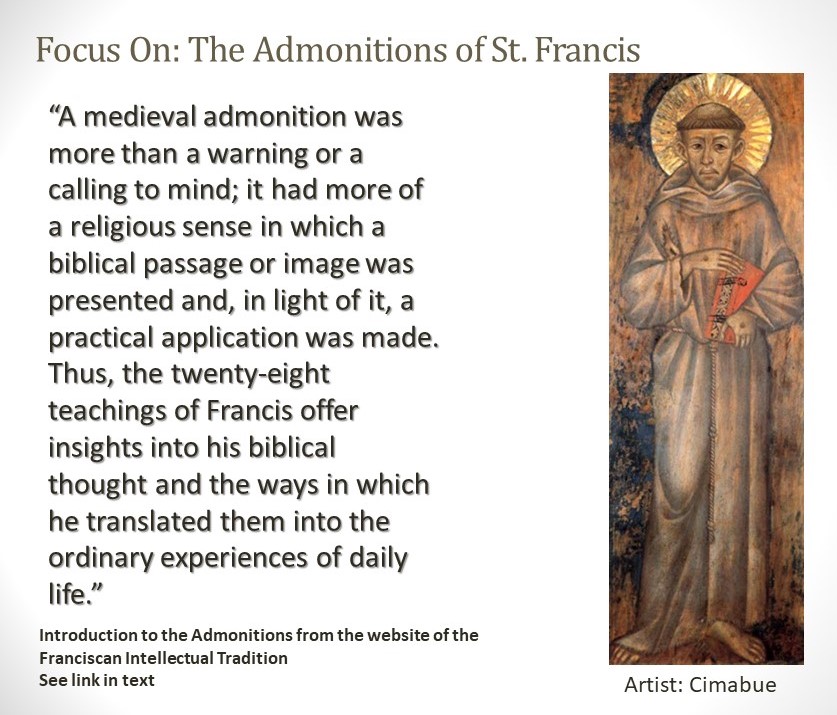
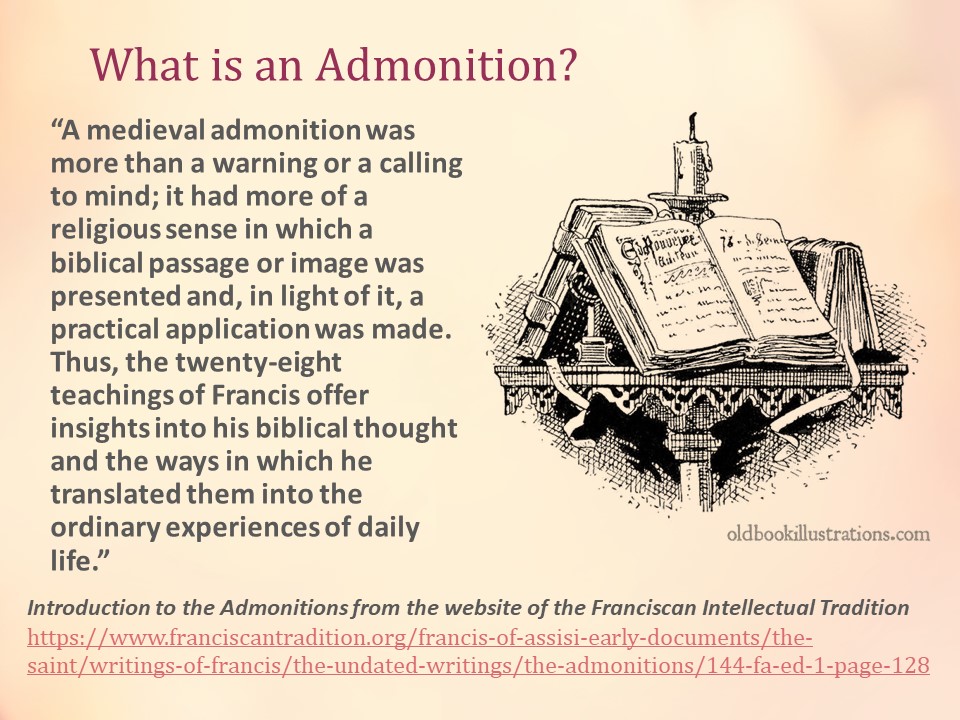
Focus on the Admonitions (#2 and #3)
https://franciscantradition.org/francis-of-assisi-early-documents/the-saint/writings-of-francis/the-undated-writings/the-admonitions/145-fa-ed-1-page-129[II. The Evil of Self-Will]b
1The Lord said to Adam: Eat of every tree; you may not eat, however, of the tree of the knowledge of good and evil. Gn 2:16 Gn 2:17
2He was able to eat of every tree of paradise, because he did not sin as long as he did not go against obedience. 3For that person eats of the tree of the knowledge of good who makes his will his own and, in this way, exalts himself over the good things the Lord says and does in him. 4And so, through the suggestion of the devil and the transgression of the command, it became the apple of the knowledge of evil. 5Therefore it is fitting that he suffer the punishment.
[III. Perfect Obedience]
1The Lord says in the Gospel: Whoever does not renounce all that he possesses cannot be my disciple; Lk 14:33 2and: Whoever wishes to save his life must lose it. Lk 9:24
3That person who offers himself totally to obedience in the hands of his prelate leaves all that he possesses and loses his body.a 4And whatever he does and says which he knows is not contrary to his will is true obedience, provided that what he does is good.
5And should a subject see that some things might be better and more useful for his soul than what a prelate commands, let him willingly offer such things to God as a sacrifice; and, instead, let him earnestly strive to fulfill the prelate’s wishes. 6For this is loving obedience because it pleases God and neighbor. 1 Pt 1:22
7If the prelate, however, commands something contrary to his conscience, even though he may not obey him, let him not, however, abandon him. 8And if he then suffers persecution from others, let him love them all the more for the sake of God. 1 Jn 3:15 1 Jn 3:16 9For whoever chooses to suffer persecution rather than wish to be separated from his brothers truly remains in perfect obedience because he lays down his life for his brothers. Jn 15:13 10In fact, there are many religious who, under the pretext of seeing things better than those which the prelate commands, look back, Lk 9:62 and return to the vomit Prv 26:11 of their own will. 11These people are murderers 2 Pt 2:22 and, because of their bad example, cause many to lose their souls
Questions to discuss or to comment on in your journal.
+ Come, Holy Spirit! Open my mind and heart as I contemplate Admonition II.
–As Secular Franciscans, we do not promise “obedience” as such. However, how does sacrificing our own will help us to live out our Rule?
–When do I have the most difficulty following the directives of my lawful superiors?+ Come, Holy Spirit! Open my mind and heart as I contemplate Admonition III.
–How is obedience related to simplicity and humility?
–What are some ways that I can seek to have a well-informed conscience?
–How does having trust in the Lord help me to let go of my own will?
Formación: 16 de enero de 2026
Enfoque en las admoniciones de San Francisco (Admoniciones II y III)
Cap. II: Del mal de la propia voluntad
1Dijo el Señor a Adán: Come de todo árbol, pero del árbol de la ciencia del bien y del mal no comas (cf. Gén 2,16.17). 2Podía comer de todo árbol del paraíso, porque, mientras no contravino a la obediencia, no pecó. 3Come, en efecto, del árbol de la ciencia del bien, aquel que se apropia su voluntad y se enaltece del bien que el Señor dice y obra en él; 4y así, por la sugestión del diablo y la transgresión del mandamiento, vino a ser la manzana de la ciencia del mal. 5De donde es necesario que sufra la pena.
Cap. III: De la perfecta obediencia
1Dice el Señor en el Evangelio: El que no renuncie a todo lo que posee, no puede ser discípulo mío (Lc 14,33); 2y: El que quiera salvar su vida, la perderá (Lc 9,24). 3Deja todo lo que posee y pierde su cuerpo el hombre que se ofrece a sí mismo todo entero a la obediencia en manos de su prelado. 4Y todo lo que hace y dice que él sepa que no es contra la voluntad del prelado, mientras sea bueno lo que hace, es verdadera obediencia. 5Y si alguna vez el súbdito ve cosas mejores y más útiles para su alma que aquellas que le ordena el prelado, sacrifique voluntariamente sus cosas a Dios, y aplíquese en cambio a cumplir con obras las cosas que son del prelado. 6Pues ésta es la obediencia caritativa (cf. 1 Pe 1,22), porque satisface a Dios y al prójimo.
7Pero si el prelado le ordena algo que sea contra su alma, aunque no le obedezca, sin embargo no lo abandone. 8Y si a causa de eso sufriera la persecución de algunos, ámelos más por Dios. 9Pues quien sufre la persecución antes que querer separarse de sus hermanos, verdaderamente permanece en la perfecta obediencia, porque da su vida (cf. Jn 15,13) por sus hermanos. 10Pues hay muchos religiosos que, so pretexto de que ven cosas mejores que las que les ordenan sus prelados, miran atrás (cf. Lc 9,62) y vuelven al vómito de la propia voluntad (cf. Prov 26,11; 2 Pe 2,22); 11éstos son homicidas y, a causa de sus malos ejemplos, hacen que se pierdan muchas almas.
https://www.franciscanos.org/esfa/escritossf.html#adm
Preguntas para platicar o responder en su diario
+ ¡Ven, Espíritu Santo! Abre mi mente y corazón mientras contemplo la Admonición II.
— Como franciscanos seglares, no prometemos “obediencia” como tal. Sin embargo, ¿cómo el sacrificio de nuestra propia voluntad nos ayudará a vivir nuestra Regla?
–¿Cuándo tengo más dificultades para seguir las directivas de mis superiores legales?+ ¡Ven, Espíritu Santo! Abre mi mente y mi corazón mientras contemplo la Admonición III.
— ¿Cómo se relaciona la obediencia con la sencillez y la humildad?
–¿Cuáles son algunas de las formas en las que puedo buscar para tener una conciencia bien informada?
— ¿Cómo me ayuda el tener confianza en el Señor a dejar ir mi propia voluntad?Diane F. Menditto, OFSVice Minister, National Fraternity, Secular Franciscan Order USA“Go into the world and proclaim the good news.”National Theme 2025-2028
Category: Formation Friday
FORMATION FRIDAY – Focus on the Admonitions (#I) – January 9, 2025
Please share with your fraternities (En español abajo) Korean translation attached in a separate PDF.
Focus on the Admonitions (#I)
https://www.franciscantradition.org/francis-of-assisi-early-documents/the-saint/writings-of-francis/the-undated-writings/the-admonitions/144-fa-ed-1-page-128
[I. The Body of Christ]1The Lord Jesus says to his disciples: I am the way, the truth and the life; no one comes to the Father except through me. 2If you knew me, you would also know my Father; and from now on, you do know him and have seen him. 3Philip says to him: Lord, show us the Father and it will be enough for us. 4Jesus says to him: Have I been with you for so long a time and you have not known me? Philip, whoever sees me sees my Father as well. Jn 14:6-9
5The Father dwells in inaccessible light, 1 Tm 6:16 and God is spirit, Jn 4:24 and no one has ever seen God. Jn 1:186Therefore He cannot be seen except in the Spirit because it is the Spirit that gives life; the flesh has nothing to offer. Jn 6:637But because He is equal to the Father, the Son is not seen by anyone other than the Father or other than the Holy Spirit.
8All those who saw the Lord Jesus according to the humanity, therefore, and did not see and believe according to the Spirit and the Divinity that He is the true Son of God were condemned. 9Now in the same way, all those who see the sacrament sanctified by the words of the Lord upon the altar at the hands of the priest in the form of bread and wine, and who do not see and believe according to the Spirit and the Divinity that it is truly the Body and Blood of our Lord Jesus Christ, are condemned.10[This] is affirmed by the Most High Himself Who says:
This is my Body and the Blood of my new covenant [which will be shed for many]; Mk 14:2211and Whoever eats my flesh and drinks my blood has eternal life. Mk 14:2412It is the Spirit of the Lord, Jn 6:55 therefore, That lives in Its faithful, That receives the Body and Blood of the Lord. 13All others who do not share in this same Spirit and presume to receive Him eat and drink judgment on themselves. 1 Cor 11:29
14Therefore: children, how long will you be hard of heart? Ps 4:315Why do you not know the truth and believe in the Son of God? Jn 9:3516Behold, each day He humbles Himself as when He came from the royal throne Phil 2:8 into the Virgin’s womb; Wis 18:1517each day He Himself comes to us, appearing humbly; 18each day He comes down from the bosom of the Father Jn 1:18 upon the altar in the hands of a priest.a
19As He revealed Himself to the holy apostles in true flesh, so He reveals Himself to us now in sacred bread. 20And as they saw only His flesh by an insight of their flesh, yet believed that He was God as they contemplated Him with their spiritual eyes, 21let us, as we see bread and wine with our bodily eyes, see and firmly believe that they are His most holy Body and Blood living and true. 22And in this way the Lord is always with His faithful, as He Himself says: Behold I am with you until the end of the age.
Questions to discuss or to answer in your journal
+ After reading this admonition carefully, note what Francis’s feelings are about the Eucharist.
+What do you believe about the Eucharist? What part does receiving the Eucharist play in your spiritual life?
Bishop Barron’s Sunday sermon on the Eucharist (2024)
https://www.youtube.com/watch?v=_ZMw7CejKUYFormación 9 de enero de 2026
Enfoque en las admoniciones de San Francisco (Admonición I)
https://www.franciscanos.org/esfa/escritossf.html#adm
Cap. I: Del cuerpo del Señor
1Dice el Señor Jesús a sus discípulos: Yo soy el camino, la verdad y la vida; nadie va al Padre sino por mí. 2Si me conocierais a mí, ciertamente conoceríais también a mi Padre; y desde ahora lo conoceréis y lo habéis visto. 3Le dice Felipe: Señor, muéstranos al Padre y nos basta. 4Le dice Jesús: ¿Tanto tiempo hace que estoy con vosotros y no me habéis conocido? Felipe, el que me ve a mí, ve también a mi Padre (Jn 14,6-9).
5El Padre habita en una luz inaccesible (cf. 1 Tim 6,16), y Dios es espíritu (Jn 4,24), y a Dios nadie lo ha visto jamás (Jn 1,18). 6Por eso no puede ser visto sino en el espíritu, porque el espíritu es el que vivifica; la carne no aprovecha para nada (Jn 6,64). 7Pero ni el Hijo, en lo que es igual al Padre, es visto por nadie de otra manera que el Padre, de otra manera que el Espíritu Santo.
8De donde todos los que vieron al Señor Jesús según la humanidad, y no vieron y creyeron según el espíritu y la divinidad que él era el verdadero Hijo de Dios, se condenaron. 9Así también ahora, todos los que ven el sacramento, que se consagra por las palabras del Señor sobre el altar por mano del sacerdote en forma de pan y vino, y no ven y creen, según el espíritu y la divinidad, que sea verdaderamente el santísimo cuerpo y sangre de nuestro Señor Jesucristo, se condenan, 10como lo atestigua el mismo Altísimo, que dice: Esto es mi cuerpo y mi sangre del nuevo testamento, [que será derramada por muchos] (cf. Mc 14,22.24); 11y: Quien come mi carne y bebe mi sangre, tiene vida eterna (cf. Jn 6,55). 12De donde el espíritu del Señor, que habita en sus fieles, es el que recibe el santísimo cuerpo y sangre del Señor. 13Todos los otros que no participan del mismo espíritu y se atreven a recibirlo, comen y beben su condenación (cf. 1 Cor 11,29).
14De donde: Hijos de los hombres, ¿hasta cuándo seréis de pesado corazón? (Sal 4,3). 15¿Por qué no reconocéis la verdad y creéis en el Hijo de Dios? (cf. Jn 9,35). 16Ved que diariamente se humilla (cf. Fil 2,8), como cuando desde el trono real (Sab 18,15) vino al útero de la Virgen; 17diariamente viene a nosotros él mismo apareciendo humilde; 18diariamente desciende del seno del Padre (cf. Jn 1,18) sobre el altar en las manos del sacerdote.
19Y como se mostró a los santos apóstoles en carne verdadera, así también ahora se nos muestra a nosotros en el pan sagrado. 20Y como ellos, con la mirada de su carne, sólo veían la carne de él, pero, contemplándolo con ojos espirituales, creían que él era Dios, 21así también nosotros, viendo el pan y el vino con los ojos corporales, veamos y creamos firmemente que es su santísimo cuerpo y sangre vivo y verdadero. 22Y de este modo siempre está el Señor con sus fieles, como él mismo dice: Ved que yo estoy con vosotros hasta la consumación del siglo (cf. Mt 28,20).
Preguntas para discutir o responder en su diario
+ Después de leer esta Admonición con atención, apunte cuáles son los sentimientos de Francisco sobre la Eucaristía.
+ ¿Qué cree usted sobre la Eucaristía? ¿Qué papel juega el recibir la Eucaristía en su vida espiritual?
Un buen video (en inglés) del obispo Barron sobre la Eucaristía:
Diane F. Menditto, OFSVice Minister, National Fraternity, Secular Franciscan Order USA“Go into the world and proclaim the good news.”National Theme 2025-2028


Formation Friday – Conversion and Discernment – January 2, 2025
Please share with your local fraternity (en español abajo) Korean translation attached in a separatePDF.
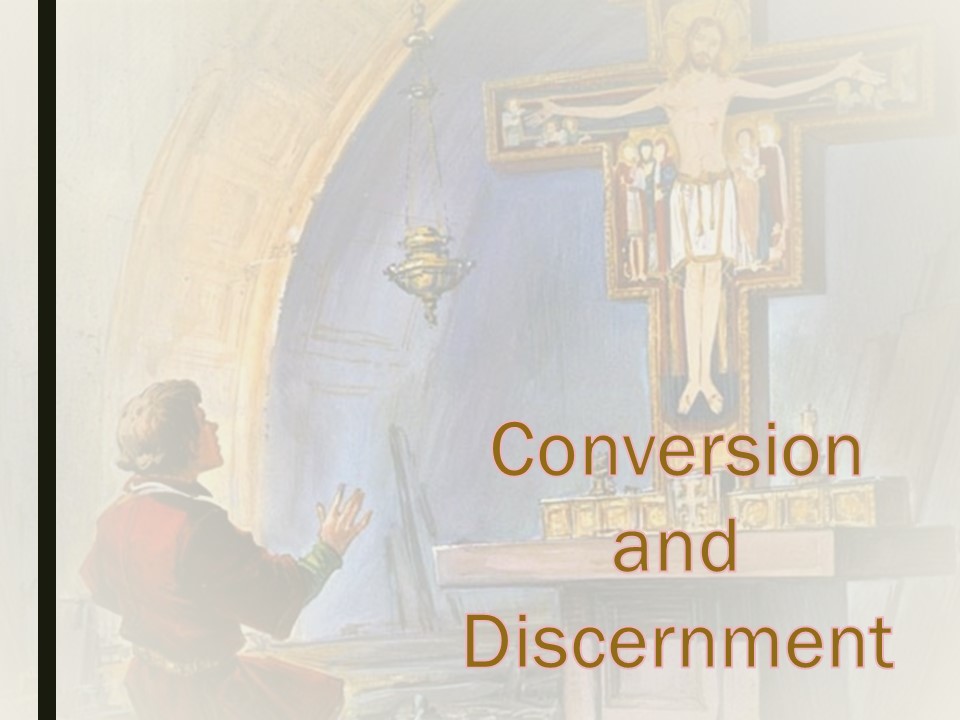
As we enter the new year, we focus on St. Francis’s conversion and how it can have a deep effect on our own conversion.
If you have read a good biography of St. Francis, it is easy to see different steps of a conversion process as they apply to different events in the life of Francis. During the time of discernment in the period of initial formation, or as professed members seek to strengthen their vocation, it is important to ponder the events of Francis’ conversion and vocation process and see how these might relate with your own conversion and vocation process.
As a help, you might use the following steps in a conversion process as they apply to the life of St. Francis, and then ask yourself how they might also apply in your own life:
· Darkness that can lead to openness (Questions and ambiguity can propel us
to God) [Think about: Francis’ desire to be a knight; his restlessness; his time in prison; his illnesses and dreams]
· Listening and hearing (Prayer) [Think about: Francis’ encounter with the leper and how he began to think about the poor Christ; after traveling to Rome, he returns home and prays and waits for an answer] –the voice in the dream; the voice from the San Damiano Cross; the time in solitude listening to the Lord
· Choosing to follow [Think about: Francis realizes that his true bride is Lady Poverty; He hears the voice from the San Damiano cross and responds immediately; Hears the voice in his dream-“Who do you want to follow, the servant or the master?” St. Clare and Bro. Sylvester counsel Francis to preach instead of becoming a hermit]
· Signs which strengthen our decisions and our walk [Kissing the leper; trading clothes with the beggar in Rome; He hears the voice from the San Damiano crucifix]
· Finding new direction [All of the above begin to move him in a new direction. He begins the “rebuilding” process.]
· Life of Christ/Gospel as point of contact and reference
· Finding support in this newness
· Walking in faith [“The Lord gave me brothers…]
· Trusting even in darkness
· Darkness that can lead to openness
· As conversion is ongoing, we “begin again”, returning to the top
From For Up to Now: Franciscan Movement Part 1 “The Journey of Francis” by Jan Parker, OFS
As you think about each of the above points,
+Think about your own life and the timeline that has brought you to where you are today.
+Has the discernment of your vocation taken a smooth path?
+How has the Holy Spirit helped you to overcome the bumps along the way?
+What still requires work and prayer in your life?
Comment in your journal or share with your fraternity or formation group.
Looking for a biography of St. Francis? Here are a few suggestions:
–St. Francis of Assisi: Passion, Poverty, and the Man who Transformed the Catholic Church. By Bret Thoman OFS (entry level)
— St. Francis of Assisi: A Biography by Omer Englebert
— Francis: The Journey and the Dream by Murray Bodo O.F.M. and John Michael Talbot (entry level)
–Francis of Assisi: The Life and Afterlife of a Medieval Saint by André Vauchez++++++++++++++++++++++
Formación 2 de enero 2026
Comparta con su fraternidad local. Conversión y discernimiento
Al entrar en el año nuevo, nos enfocamos en la conversión de San Francisco y cómo puede tener un efecto profundo en nuestra propia conversión.
Si ha leído una buena biografía de San Francisco, es fácil ver los diferentes pasos de un proceso de conversión que se aplican a diferentes eventos en la vida de Francisco. Durante el tiempo de discernimiento en el período de formación inicial, o cuando los miembros profesos buscan fortalecer su vocación, es importante reflexionar sobre los eventos del proceso de conversión y vocación de Francisco, y ver cómo estos pueden relacionarse con su propio proceso de conversión y vocación.
Como ayuda, puede utilizar los siguientes pasos en un proceso de conversión según se apliquen a la vida de San Francisco, y luego preguntarse cómo podrían aplicarse también en su propia vida:
• Oscuridad que puede conducir a la apertura (las preguntas y la ambigüedad pueden impulsarnos
a Dios) [Piense en: el deseo de Francisco de ser caballero; su inquietud; su tiempo en prisión; sus enfermedades y sueños]
• Escuchar y oír (oración) [Piense en: el encuentro de Francisco con el leproso y cómo empezó a pensar en el Cristo pobre; después de viajar a Roma, regresa a casa y reza y espera una respuesta] –la voz en el sueño; la voz de la Cruz de San Damián; el tiempo en soledad escuchando al señor
• Elegir seguir [Piense en: Francisco se da cuenta de que su verdadera esposa es Lady Poverty; Oye la voz desde la cruz de San Damiano y responde de inmediato; Oye la voz en su sueño: “¿A quién quieres seguir, al sirviente o al amo?” St. Clare y Bro. Sylvester aconseja a Francisco que predique en lugar de convertirse en ermitaño]
• Señales que fortalecen nuestras decisiones y nuestro caminar [Besar al leproso; intercambiar ropa con el mendigo en Roma; Oye la voz del crucifijo de San Damián]
• Encontrar una nueva dirección [Todo lo anterior comienza a moverlo en una nueva dirección. Comienza el proceso de “reconstrucción”.]
• Vida de Cristo / Evangelio como punto de contacto y referencia
• Encontrar apoyo en esta novedad
• Caminando en fe [“El Señor me dio hermanos…]
• Confiar incluso en la oscuridad
• Oscuridad que puede conducir a la apertura.
• A medida que la conversión está en curso, “comenzamos de nuevo”, volviendo a la parte superior
FOR UP TO NOW (FUN): Movimiento franciscano Parte 1 “El viaje de Francisco” por Jan Parker, OFS
Mientras reflexiona sobre cada uno de los puntos anteriores:
+Piense en su propia vida y en la trayectoria que le ha llevado hasta donde está usted hoy.
+¿Ha sido fácil discernir su vocación?
+¿Cómo le ha ayudado el Espíritu Santo a superar los obstáculos que se le han presentado?
+¿Qué aspectos de su vida aún requieren trabajo y oración?
Comente en su diario o comparta con su fraternidad o grupo de formación.
¿Busca una biografía de San Francisco? Aqui hay dos sugerencias:
Biografia de San Francisco de Asis: Francisci Assisensis vita et miracula (Spanish Edition) by Tomás de Celano
San Francisco de Asís (Spanish Edition) by G. K. ChestertonDiane F. Menditto, OFSVice Minister, National Fraternity, Secular Franciscan Order USA“Go into the world and proclaim the good news.”National Theme 2025-2028
Formation Friday – Lives of Prayer as OFS – December 26, 2025
(en español abajo) Korean translation attached in a separate PDF.Please share with your local fraternity.
Taking Stock in 2026 Our Lives of Prayer as Secular Franciscans
“As Minister General of a large Order, St. Bonaventure provided, among other things, spiritual direction for those seeking God. In a letter to Poor Clare nuns, he offered directives as to how we might enter into prayer by way of ‘descent.’
“The steps are summarized as follows:
· Return to yourself; Enter into your heart;
· Ponder what you were, are, should have been, called to be;
· What you are by nature;
· What you are through sin;
· What you should have been through effort;
· What you can still be through grace;
· Meditate in your heart;
· Let your spirit brood. (Are you resentful, angry, jealous?);
· Plow this field, work on yourself;
· Strive for freedom within, the freedom that leads to relationship with God, realizing that God will never force us to love him;
· Lack of self-knowledge and failure to appreciate one’s own worth make for faulty judgment in all other matters;
· If you are not able to understand (and accept) your own self, you will not be able to understand (or accept) what is beyond you.”
Bonaventure, Perfectione vitae ad sorores (Perf. Vit.) 1.5 (VIII, 109). Engl. trans. Jose de Vinck, “On the Perfection of Life, Addressed to Sisters,” in The Works of Bonaventure, vol. 1, Mystical Opscula (Paterson, N.J.: Saint Anthony Guild Press, 1960), 214.
Quoted in: Delio, Ilia. Franciscan Prayer (Kindle Locations 613-616). Kindle Edition.
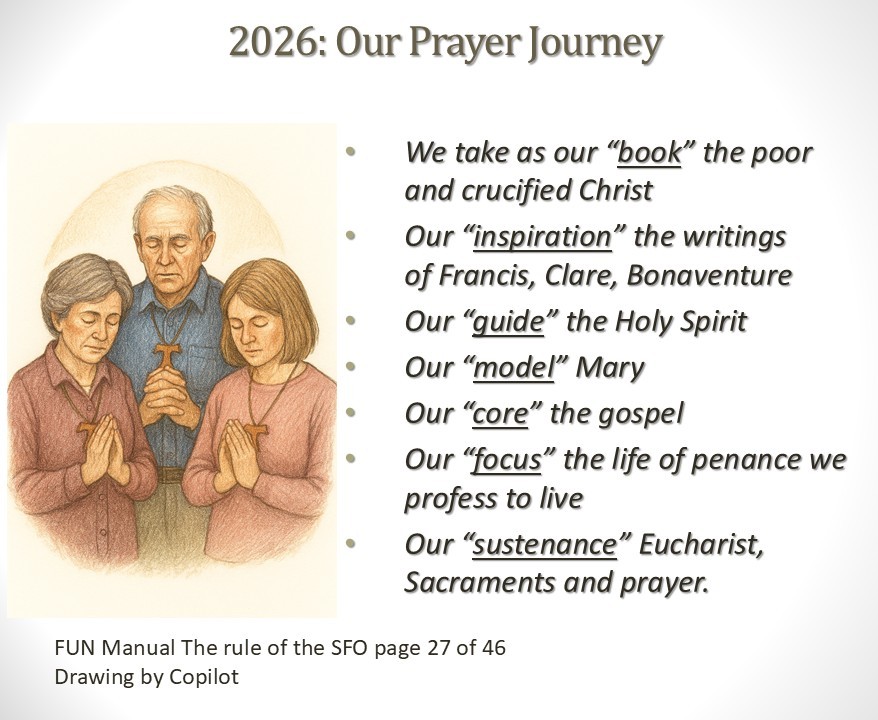
For our Prayer Journey as Secular Franciscans
• We take as our “book” the poor and crucified Christ
• Our “inspiration” the writings of Francis, Clare, Bonaventure
• Our “guide” the Holy Spirit
• Our “model” Mary
• Our “core” the gospel
• Our “focus” the life of penance we profess to live
• Our “sustenance” the Eucharist, Sacraments and prayer.
FUN Manual The rule of the SFO page 27 of 46
Questions for discussion or to comment on in your journal
+How has your prayer life changed over the years?
+If you are a Secular Franciscan, how does your prayer reflect who you are as member (or candidate) of the Order?
+Does prayer influence how you live your life?
+Based on St. Bonaventure’s directives above, how can you strengthen your prayer life?
+++++++++++++++++++
2026 Momento de examinar nuestras vidas de oración como franciscanos seglares
“Como Ministro General de una Orden grande, San Buenaventura proporcionó, entre otras cosas, dirección espiritual para quienes buscaban a Dios. En una carta a las monjas Clarisas, ofreció directivas sobre cómo podríamos entrar en oración a través de la ‘descendencia.’ “
“Los pasos se resumen a continuación:
• Regrese a usted mismo; Entre en su corazón;
• Reflexione sobre lo que usted fue, es, debería haber sido llamado a ser;
• Lo que usted es por naturaleza;
• Qué es usted por el pecado;
• Lo que debería haber sido a través del esfuerzo;
• Lo que aún puede ser gracias a la gracia;
• Medite en su corazón;
• Deje que su espíritu se dé vueltas. (¿Está resentido, enojado, celoso?);
• Are este campo, trabaje en si mismo;
• Luche por la libertad interior, la libertad que conduce a la relación con Dios, reconociendo que Dios nunca nos obligará a amarlo;
• La falta de autoconocimiento y la incapacidad de apreciar el valor propio dan lugar a un juicio erróneo en todos los demás asuntos;
• Si no puede entenderse (y aceptarse) a sí mismo, no podrá comprender (o aceptar) lo que está más allá de usted.”
Buenaventura, Perfectione vitae ad sorores (Perf. Vit.) 1.5 (VIII, 109). Engl. trans. José de Vinck, “Sobre la perfección de la vida, dirigida a las hermanas”, en Las obras de Buenaventura, vol. 1, Mystical Opscula (Paterson, Nueva Jersey: Saint Anthony Guild Press, 1960), 214.
Citado en: Delio, Ilia. Oración franciscana (ubicaciones de Kindle 613-616). Versión Kindle.
Por nuestro viaje de oración como franciscanos seglares
• Tomamos como nuestro “libro” al Cristo pobre y crucificado
• Nuestra “inspiración” los escritos de Francisco, Clara, Buenaventura
• Nuestro “guía” el Espíritu Santo
• Nuestra “modelo” María
• Nuestro “núcleo” el evangelio
• Nuestro “enfoque” la vida de penitencia que profesamos vivir
• Nuestro “sustento” la Eucaristía, los Sacramentos y la oración.
FUN Manual La regla de la OFS página 27 de 46
Preguntas para platicar o comentar en su diario
+ ¿Cómo ha cambiado su vida de oración a lo largo de los años?
+ Si es un franciscano seglar, ¿cómo refleja su oración quién es como miembro (o candidato) de la Orden?
+ ¿Influye la oración en cómo vive su vida?
+ Según las directivas de San Buenaventura ya mencionadas, ¿cómo puede fortalecer su vida de oración?
Diane F. Menditto, OFSVice Minister, National Fraternity, Secular Franciscan Order USA“Go into the world and proclaim the good news.”National Theme 2025-2028
Formation Friday – St. Francis & the Crib – December 19, 2025
(Please share with your local fraternity)-En español abajo
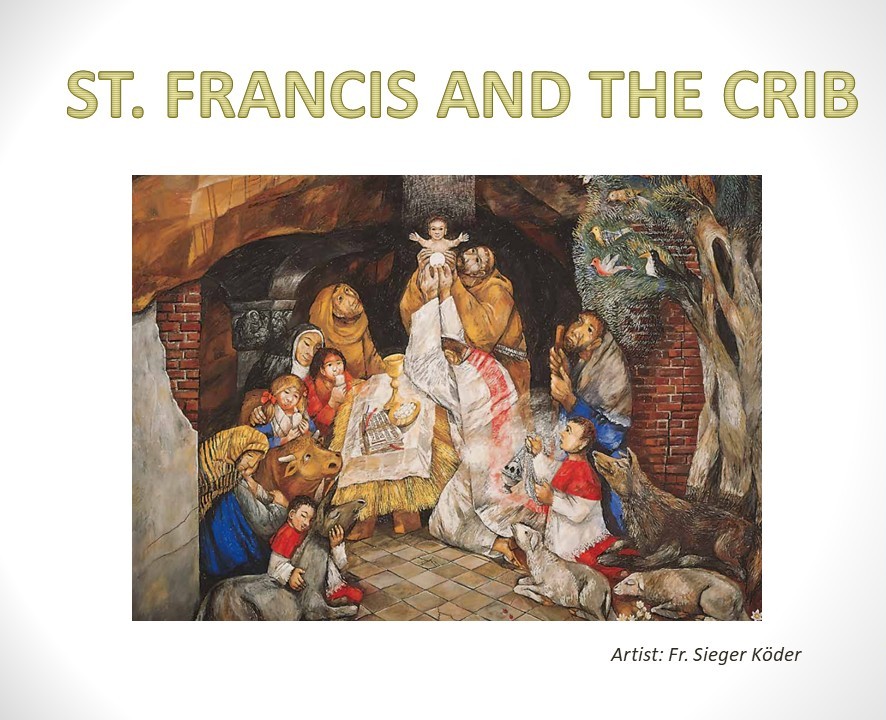
St. Francis and the Crib.
St. Francis centered his life and spirituality on the Incarnation, the humanity of Christ. He was in awe that God “bent down” to be with us through his birth; through his suffering and death on the cross; and through the Eucharist by which he remains with us for all time. As we approach Christmas, we reflect on St. Francis and the Crib.
++ “3We thank You for as through Your Son You created us, so through Your holy love with which You loved us Jn 17:26
You brought about His birth as true God and true man by the glorious, ever-virgin, most blessed, holy Mary and You willed to redeem us captives through His cross and blood and death.” FA:ED, vol. 1, 82 The Earlier Rule++ “Francis used to recall with regular meditation the words of Christ and recollect His deeds with most attentive perception. Indeed, so thoroughly did the humility of the Incarnation and the charity of the Passion occupy his memory
that he scarcely wanted to think of anything else. FA:ED, vol. 1, 254 The Life of Saint Francis by Thomas of Celano++“As usual, blessed Francis had John summoned to him some fifteen days prior to the birthday of the Lord. ‘If you desire to celebrate the coming feast of the Lord together at Greccio,’ he said to him, ‘hurry before me and carefully make ready Prv 24:27 the things I tell you. For I wish to enact the memory of that babe who was born in Bethlehem: to see as much as is possible with my own bodily eyes the discomfort of his infant needs, how he lay in a manger, Lk 2:7 and how, with an ox and an ass standing by, he rested on hay.’” FA:ED, vol. 1, 255 The Life of Saint Francis by Thomas of Celano
++ “Moreover, burning with excessive love, he often calls Christ the ‘babe from Bethlehem’ whenever he [Francis] means to call Him Jesus. Saying the word ‘Bethlehem’ in the manner of a bleating sheep, he fills his whole mouth with sound but even more with sweet affection. He seems to lick his lips whenever he uses the expressions ‘Jesus’ or ‘babe from Bethlehem,’ tasting the word on his happy palate and savoring the sweetness of the word.” FA:ED, vol. 1, 256 The Life of Saint Francis by Thomas of Celano
++ “Humility enabled Francis to celebrate the birth of the Incarnate Word that he heard, preached, and lived throughout his life.” The Life of Saint Francis by Thomas of Celano FA:ED, vol. 1, p. 177
Each of the above quotes can be found on the Franciscan Tradition website: (You will need to sign in, but the resources are worth it!
https://digitalcollections.franciscantradition.org/pages/early-sources-table-of-contentsQuestions to discuss or to answer in your journal
+Why do you think St. Francis was so in awe of the Incarnation of Christ?
+Give some examples of how St. Francis imitated Jesus.
+How do we see the Incarnate Lord? In His birth and in His passion and death?
++++++++++++++++
Formación 19 diciembre de 2025 (compartir con su fraternidad)
San Francisco y el Pesebre.
San Francisco centró su vida y espiritualidad en la Encarnación, la humanidad de Cristo. Estaba asombrado de que Dios “se inclinara” para estar con nosotros durante su nacimiento; por su sufrimiento y muerte en la cruz; y através de la Eucaristía por la que permanece con nosotros para siempre. Ahora que se acerca la Navidad, reflejamos sobre San Francisco y el Pesebre.
++ “3Y te damos gracias porque, así como por tu Hijo nos creaste, así, por tu santo amor con el que nos amaste (cf. Jn 17,26), hiciste que él, verdadero Dios y verdadero hombre, naciera de la gloriosa siempre Virgen la beatísima santa María, y quisiste que nosotros, cautivos, fuéramos redimidos por su cruz y sangre y muerte.” Regla no bulada Capítulo XXIII
++ “En asidua meditación recordaba sus palabras y con agudísima consideración repasaba sus obras. Tenía tan presente en su memoria la humildad de la encarnación y la caridad de la pasión, que difícilmente quería pensar en otra cosa.
1 Celano Capítulo XXX (84)++ “ Francisco le llamó (a Juan), como solía hacerlo con frecuencia, y le dijo: «Si quieres que celebremos en Greccio esta fiesta del Señor, date prisa en ir allá y prepara prontamente lo que te voy a indicar. Deseo celebrar la memoria del niño que nació en Belén y quiero contemplar de alguna manera con mis ojos (28) lo que sufrió en su invalidez de niño, cómo fue reclinado en el pesebre y cómo fue colocado sobre heno entre el buey y el asno»” 1 Celano Capítulo XXX (84)
++ “Muchas veces, al querer mencionar a Cristo Jesús, encendido en amor, le dice «el Niño de Bethleem», y, pronunciando «Bethleem» como oveja que bala, su boca se llena de voz; más aún, de tierna afección. Cuando le llamaba «niño de Bethleem» o «Jesús», se pasaba la lengua por los labios como si gustara y saboreara en su paladar la dulzura de estas palabras.” 1 Celano Capítulo XXX (86)
Todos los enlaces se encuentran aquí: https://franciscanos.org/esfa/menud2.html
Preguntas para platicar o responder en su diario
+ ¿Por qué crees que San Francisco estaba tan asombrado por la Encarnación de Cristo?
+ ¿Dar algunos ejemplos de cómo San Francisco imitó a Jesús.
+ ¿Cómo vemos al Señor Encarnado? ¿En su nacimiento y en su pasión y muerte?
Diane F. Menditto, OFSVice Minister, National Fraternity, Secular Franciscan Order USAGo into the world and proclaim the good news.” National Theme 2025-2028