Taking Stock 2024 Our Lives of Prayer as Secular Franciscans
“As Minister General of a large Order, St. Bonaventure provided, among other things, spiritual direction for those seeking God. In a letter to Poor Clare nuns, he offered directives as to how we might enter into prayer by way of ‘descent.’
“The steps are summarized as follows:
· Return to yourself; Enter into your heart;
· Ponder what you were, are, should have been, called to be;
· What you are by nature;
· What you are through sin;
· What you should have been through effort;
· What you can still be through grace;
· Meditate in your heart;
· Let your spirit brood. (Are you resentful, angry, jealous?);
· Plow this field, work on yourself;
· Strive for freedom within, the freedom that leads to relationship with God, realizing that God will never force us to love him;
· Lack of self-knowledge and failure to appreciate one’s own worth make for faulty judgment in all other matters;
· If you are not able to understand (and accept) your own self, you will not be able to understand (or accept) what is beyond you.”
Bonaventure, Perfectione vitae ad sorores (Perf. Vit.) 1.5 (VIII, 109). Engl. trans. Jose de Vinck, “On the Perfection of Life, Addressed to Sisters,” in The Works of Bonaventure, vol. 1, Mystical Opscula (Paterson, N.J.: Saint Anthony Guild Press, 1960), 214.
Quoted in: Delio, Ilia. Franciscan Prayer (Kindle Locations 613-616). Kindle Edition.
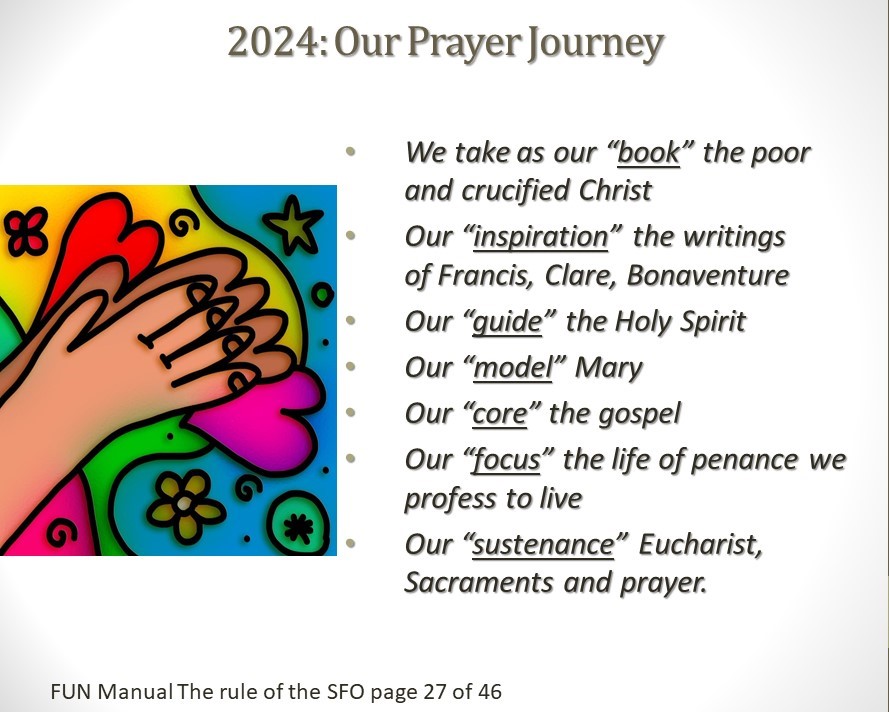
For our Prayer Journey as Secular Franciscans
• We take as our “book” the poor and crucified Christ
• Our “inspiration” the writings of Francis, Clare, Bonaventure
• Our “guide” the Holy Spirit
• Our “model” Mary
• Our “core” the gospel
• Our “focus” the life of penance we profess to live
• Our “sustenance” the Eucharist, Sacraments and prayer.
FUN Manual The rule of the SFO page 27 of 46
Questions for discussion or to comment on in your journal
+How has your prayer life changed over the years?
+If you are a Secular Franciscan, how does your prayer reflect who you are as member (or candidate) of the Order?
+Does prayer influence how you live your life?
+Based on St. Bonaventure’s directives above, how can you strengthen your prayer life?
+++++++++++++++++++
2024 Momento de examinar nuestras vidas de oración como franciscanos seglares
“Como Ministro General de una Orden grande, San Buenaventura proporcionó, entre otras cosas, dirección espiritual para quienes buscaban a Dios. En una carta a las monjas Clarisas, ofreció directivas sobre cómo podríamos entrar en oración a través de la ‘descendencia.’ “
“Los pasos se resumen a continuación:
• Regrese a usted mismo; Entre en su corazón;
• Reflexione sobre lo que usted fue, es, debería haber sido llamado a ser;
• Lo que usted es por naturaleza;
• Qué es usted por el pecado;
• Lo que debería haber sido a través del esfuerzo;
• Lo que aún puede ser gracias a la gracia;
• Medite en su corazón;
• Deje que su espíritu se dé vueltas. (¿Está resentido, enojado, celoso?);
• Are este campo, trabaje en si mismo;
• Luche por la libertad interior, la libertad que conduce a la relación con Dios, reconociendo que Dios nunca nos obligará a amarlo;
• La falta de autoconocimiento y la incapacidad de apreciar el valor propio dan lugar a un juicio erróneo en todos los demás asuntos;
• Si no puede entenderse (y aceptarse) a sí mismo, no podrá comprender (o aceptar) lo que está más allá de usted.”
Buenaventura, Perfectione vitae ad sorores (Perf. Vit.) 1.5 (VIII, 109). Engl. trans. José de Vinck, “Sobre la perfección de la vida, dirigida a las hermanas”, en Las obras de Buenaventura, vol. 1, Mystical Opscula (Paterson, Nueva Jersey: Saint Anthony Guild Press, 1960), 214.
Citado en: Delio, Ilia. Oración franciscana (ubicaciones de Kindle 613-616). Versión Kindle.
Por nuestro viaje de oración como franciscanos seglares
• Tomamos como nuestro “libro” al Cristo pobre y crucificado
• Nuestra “inspiración” los escritos de Francisco, Clara, Buenaventura
• Nuestro “guía” el Espíritu Santo
• Nuestra “modelo” María
• Nuestro “núcleo” el evangelio
• Nuestro “enfoque” la vida de penitencia que profesamos vivir
• Nuestro “sustento” la Eucaristía, los Sacramentos y la oración.
FUN Manual La regla de la OFS página 27 de 46
Preguntas para platicar o comentar en su diario
+ ¿Cómo ha cambiado su vida de oración a lo largo de los años?
+ Si es un franciscano seglar, ¿cómo refleja su oración quién es como miembro (o candidato) de la Orden?
+ ¿Influye la oración en cómo vive su vida?
+ Según las directivas de San Buenaventura ya mencionadas, ¿cómo puede fortalecer su vida de oración?
Diane F. Menditto, OFSVice Minister, National Fraternity, Secular Franciscan Order USAListen – Discern – Go Forth National Theme 2022-2025
Category: Formation Friday

Formation Friday – Examine our Love & Commitment – December 29, 2023
2024—Time to Examine our Love and Commitment
• CONVERSION: the letting go of one’s ego…”
• “One is dying to a false self that tries to BE God, that tries to always be in control.”
• This is a reversal, a “TURNING TOWARD” the Holy Spirit at work within us.
– Francis and Jesus by Murray Bodo, OFM
What can I do to make some beneficial changes in my attitude about fraternity and fraternal life?
1- Prayerfully participate in electing and supporting my local Council.
· Pray for them every day.
· Use my God-given talents to collaborate on and assist with all projects.
+What are some ways I can support my Council?
+Do I have talents and abilities that call me to serve on the Council?2- Love my fraternity
· Be present at gatherings.
· Listen to my brothers and sisters.
· Offer to help out.
· Reach out to excused members or to anyone who has missed a meeting. (Phone, email, card).
· Pray for our deceased members and for all those listed on your fraternity prayer list or prayer line
· Take note that for Franciscans, fraternity is a way of life (not just another “thing to do”).
+What talents do I have to offer my fraternity?
+Do I participate willingly in fraternity activities?3- Love our Rule
· Be sure that I am aware of what I promised at profession.
· Read, pray and meditate on the Rule—perhaps one or two articles each day.
· Think about how the Rule leads me closer to Christ.
+When was the last time I read the Rule?
+Do I make the effort to relate the Rule to my everyday life?
4- Love Scripture
· Be aware that St. Francis based everything he said or wrote on Scripture.
· Resolve to read a little Scripture each day.
· Pray the Liturgy of the Hours because it helps us to pray in fraternity (with the entire Church) and is filled with Scripture.
+Do I read Scripture each day? (How can I make time to do this?)
+Do I go from Gospel to life and life to the Gospel? (Do I understand what that means? How would I explain it to someone new or to a non-Secular Franciscan?
5- Strive for daily conversion
· Attempt to be a little better each day.
· Make use of the Sacrament of Reconciliation.
· Remember that we are the “Brothers and Sisters of Penance.”
+Do I review my actions and relationship with God each day?
+How have I changed since I first became a Franciscan? How have I changed since last week?BEST FOR LAST
6- Love the Eucharist and be changed by it
· Attend Mass on Sundays and Holy days and every day if I can
· Take advantage of opportunities for Adoration—holy hours or just a visit to the tabernacle
+What is my relationship to Jesus in the Eucharist?
+Do I often visit with Jesus when there is an opportunity to attend Adoration?
As we enter 2024, ask the Holy Spirit to guide you in everything you do!
The questions above are to answer in your journal and then to discuss in fraternity.
++++++++++++++++++++++++
2024 — Es hora de examinar nuestro amor y compromiso
• CONVERSIÓN: soltar el ego de uno … “
• “Uno se está muriendo a un falso yo que trata de SER Dios, que trata de tener siempre el control.”
• Esta es una inversión, un “GIRAR HACIA” el Espíritu Santo obrando dentro de nosotros.
– Francisco y Jesús de Murray Bodo, OFM
¿Qué puedo hacer para realizar cambios beneficiosos en mi actitud sobre la fraternidad y la vida fraterna?
1- Participar con oración en la elección y apoyo de mi Consejo local.
• Orar por ellos todos los días.
• Usar mis talentos dados por Dios para colaborar y ayudar con todos los proyectos.
+ ¿De qué formas puedo apoyar a mi Consejo?
+ ¿Tengo talentos y habilidades que me llamen a servir en el Consejo?
2- Amar mi fraternidad
• Estar presente en las reuniones.
• Escuchar a mis hermanos y hermanas.
• Ofrecerme para ayudar.
• Comunicarme con los miembros excusados o con cualquier persona que se haya perdido una reunión. (Por teléfono, correo electrónico, tarjeta).
• Orar por nuestros miembros fallecidos y por todos los que figuran en la lista de oración o línea de oración.
• Tener en cuenta que para los franciscanos, la fraternidad es una forma de vida (no simplemente otra “cosa que hacer.”)
+ ¿Qué talentos tengo para ofrecer a mi fraternidad?
+ ¿Participo de buena voluntad en las actividades de la fraternidad?
3- Amar nuestra regla
• Asegurarme de estar al tanto de lo que prometí en la profesión.
• Leer, orar y meditar en la Regla, tal vez uno o dos artículos cada día.
• Pensar en cómo la Regla me acerca a Cristo.
+ ¿Cuándo fue la última vez que leí la Regla?
+ ¿Me esfuerzo por relacionar la Regla con mi vida diaria?
4- Amar las Escrituras
• Tener en cuenta que San Francisco basó todo lo que dijo o escribió en las Escrituras.
• Tomar la determinación de leer un poco de las Escrituras todos los días.
• Rezar la Liturgia de las Horas porque me ayuda a rezar en fraternidad (con toda la Iglesia) y está llena de Escritura.
+ ¿Leo las Escrituras todos los días? (¿Cómo puedo apartar tiempo para hacer esto?)
+ ¿Paso del Evangelio a la vida y de la vida al Evangelio? (¿Entiendo lo que eso significa?) ¿Cómo se lo explicaría a alguien nuevo o a una persona que no es franciscano seglar?
5- Esforsarse por la conversión diaria
• Intentar mejorar un poco cada día.
• Hacer uso del Sacramento de la Reconciliación.
• Recordar que somos los “Hermanos y Hermanas de la Penitencia.”
+ ¿Reviso mis acciones y mi relación con Dios todos los días?
+ ¿Cómo he cambiado desde que me profesé como franciscano? ¿Cómo he cambiado desde la semana pasada?
LO MEJOR PARA EL FINAL
6- Amar la Eucaristía y ser cambiado por ella
• Asistir a misa los domingos y días santos y todos los días si puedo
• Aprovechar de las oportunidades de adoración: horas santas o simplemente una visita al tabernáculo.
+ ¿Cuál es mi relación con Jesús en la Eucaristía?
+ ¿Visito a menudo a Jesús cuando tengo la oportunidad de asistir a la Adoración?
Al entrar en 2024, ¡pídale al Espíritu Santo que lo guíe en todo lo que haga!
Las preguntas anteriores son para responder en su diario y luego para discutir en fraternidad.
Diane F. Menditto, OFSVice Minister, National Fraternity, Secular Franciscan Order USAListen – Discern – Go Forth National Theme 2022-2025
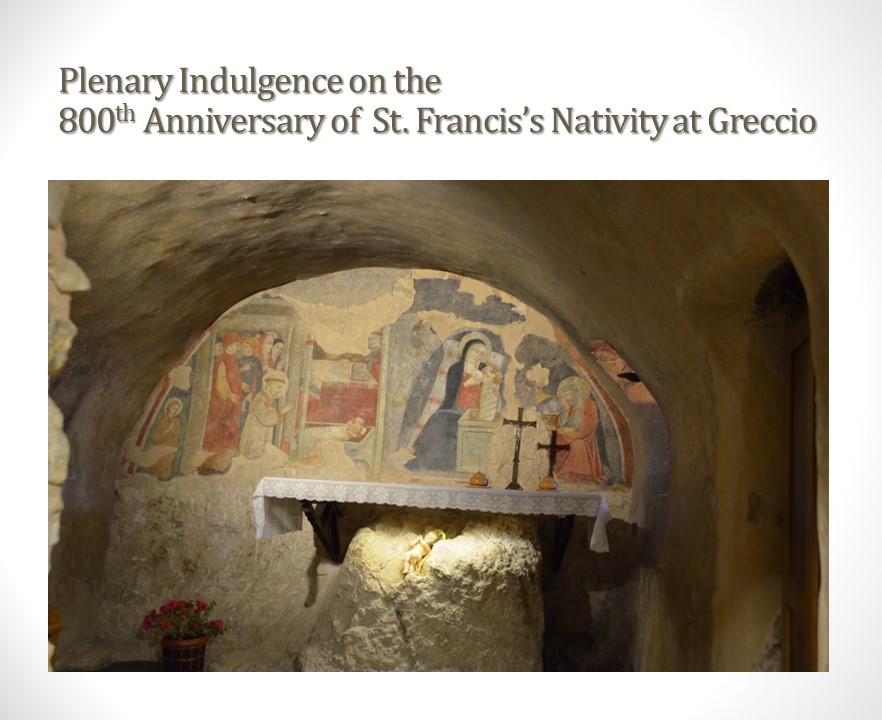
Formation Friday – The Centenary of Christmas at Greccio & newly granted Plenary Indulgence December 22, 2023
The Centenary of Christmas at Greccio
and the newly granted Plenary Indulgence
…Celebrating the centenary of Christmas in Greccio as a Franciscan Family is an invitation to pause before the mystery of the Incarnation to contemplate the greatness of divine love for humanity. The Son of God also becomes the Son of man, he becomes one of us, our brother (cf. Letter to the faithful, 2nd edition 56). Our faith in the Incarnation drives us to discover the seeds of the Word ( semina Verbi) present in all cultures and in contemporary society, so that the seeds of humanity found there may flourish. In addition, it urges us not only to defend life, but also to become instruments
of life and humanity in our families and fraternities, to reach out to those who are no longer considered human but are disposable members of society. The concreteness with which Francis of Assisi celebrated the mystery of the Incarnation in Greccio invites us to recover the awareness that “we are keepers of a good that humanizes, that helps to lead a new life. There is nothing better to transmit to others» ( Evangelii Gaudium 264)… ( Centennial Franciscan Family Conference 2022).
For discussion or to comment on in your journal
+Is our daily life, with its joys and difficulties, a privileged place of encounter with the Lord?
+Share your experiences.+Does the way we celebrate Christmas and other liturgical festivals reflect the simplicity, poverty and humility that +Francis of Assisi desired?
+Share your experiences.
Special resources from the CIOFS website, including the letter regarding the Plenary Indulgence available during the Christmas season.
Quote from the letter granting the Plenary Indulgence:
“During this Centenary, on 17 April 2023, we addressed the following petition to the Holy Father: “in order to promote the spiritual renewal of the faithful and increase the life of grace, we ask that the faithful receive a plenary indulgence under the usual conditions from 8 December 2023, the Solemnity of Immaculate Conception of the Blessed Virgin Mary, to 2 February 2024, Feast of the Presentation in the Temple of Our Lord Jesus Christ, by visiting the churches run by Franciscan families throughout the world and stopping in prayer in front of the nativity scenes set up there. Likewise, those who are sick or unable to participate physically can equally benefit from the gift of plenary indulgence, offering their sufferings to the Lord or carrying out practices of piety.”
The Apostolic Penitentiary favorably welcomed the request, granting the right to announce it publicly.
“Therefore, in all the churches entrusted to us for pastoral care,
it will be possible for all the faithful
to receive a plenary indulgence, under the usual conditions,
from 8 December 2023 to 2 February 2024.”
++++++++++++++++++++++++++++++++
Formación 22 de diciembre 2023
Por favor, comparta con su fraternidad local
El centenario de la Navidad en Greccio y la nueva indulgencia plenaria concedida
…Celebrar el centenario de la Navidad de Greccio como Familia Franciscana, es una invitación a detenerse ante el misterio de la Encarnación para contemplar la grandeza del amor divino por la humanidad. El Hijo de Dios se hace también Hijo del hombre, se hace uno de nosotros, nuestro hermano (cf. Carta a los fieles, 2ª redacción 56). Nuestra fe en la Encarnación nos impulsa a descubrir las semillas del Verbo (semina Verbi) presentes en todas las culturas y en la sociedad contemporánea, para que florezcan las semillas de humanidad que allí se encuentran. Además, nos insta no sólo a defender la vida, sino también a convertirnos en instrumentos de vida y humanidad en nuestras familias y
fraternidades, para llegar hasta aquellos que ya nadie considera humanos, sino sólo descartables de la sociedad. La concreción con la que Francisco de Asís celebró el misterio de la Encarnación en Greccio nos invita a recuperar la conciencia de que «somos depositarios de un bien que humaniza, que ayuda a llevar una vida nueva. No hay nada mejor para transmitir a los demás» (Evangelii gaudium 264)… (Centenario Conferencia Familia Franciscana 2022).
Para discutir o comentar en su diario
+Nuestra vida cotidiana, con sus alegrías y dificultades, ¿es un lugar privilegiado de encuentro con el Señor?
+Comparta sus experiencias.
+¿El modo en que celebramos la Navidad y otras fiestas litúrgicas reflejan la sencillez, la pobreza y la humildad que deseaba Francisco de Asís?
+Comparta sus experiencias.
Recursos especiales del sitio web del CIOFS, incluida la carta sobre la Indulgencia Plenaria disponible durante la temporada navideña.
Cita de la carta concediendo la Indulgencia Plenaria:
“Dentro de este Centenario, el 17 de abril de 2023, dirigimos la siguiente petición al Santo Padre: “Con el fin de promover la renovación espiritual de los fieles y acrecentar la vida de gracia, pedimos que desde el 8 de diciembre de 2023, solemnidad de la Inmaculada Concepción de la Bienaventurada Virgen María, hasta el 2 de febrero de 2024, fiesta de la Presentación en el Templo de Nuestro Señor Jesucristo, visitando las iglesias que las familias franciscanas tienen en todo el mundo y deteniéndose en oración ante los pesebres allí montados, los fieles puedan obtener la Indulgencia plenaria en las condiciones habituales. Asimismo, quienes estén enfermos o físicamente incapacitados para participar, también podrán gozar del don de la Indulgencia Plenaria ofreciendo sus sufrimientos al Señor o realizando prácticas piadosas”.
La Penitenciaría Apostólica ha aceptado positivamente la petición, concediendo la facultad de anunciarla públicamente.
“Por lo tanto, en todas las iglesias que nos han sido confiadas para el cuidado pastoral
será posible obtener la Indulgencia plenaria
por todos los fieles, en las condiciones habituales,
del 8 de diciembre de 2023 al 2 de febrero de 2024.”
Diane F. Menditto, OFSVice Minister, National Fraternity, Secular Franciscan Order USAListen – Discern – Go Forth National Theme 2022-2025
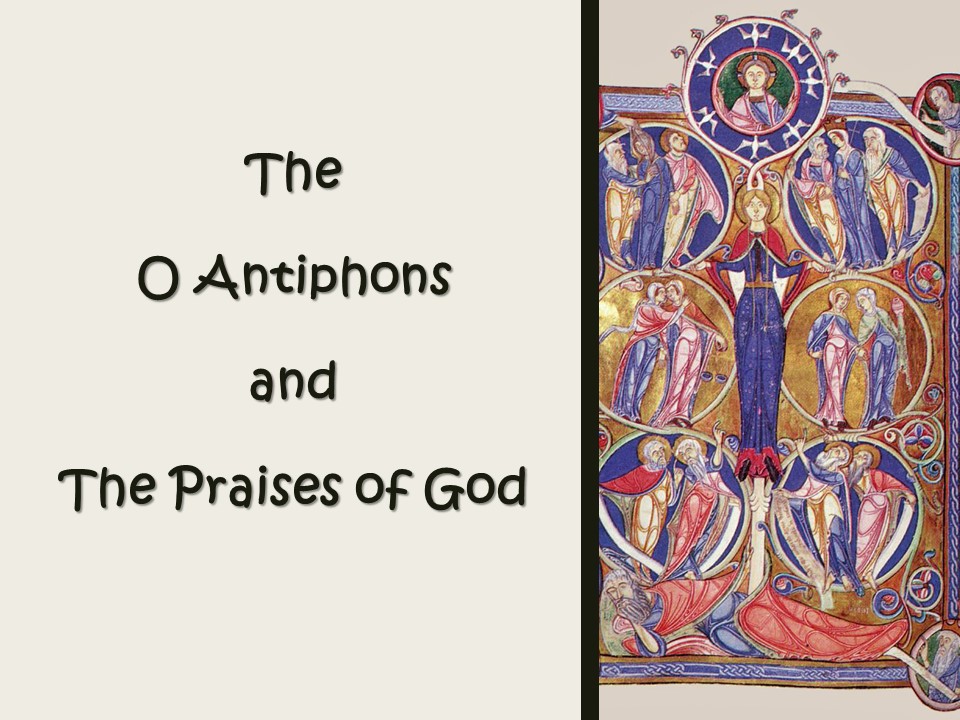
Formation Friday – O Antiphons – December 15, 2023
Please share with your local fraternity
Did you ever notice the relationship between the Praises of God and the O Antiphons? Now might be a good time to take a look.
“Leo of Assisi, who was with Francis on LaVerna in the Fall of 1224, wrote in red ink on one side of this piece of parchment: ‘Two years before his death, the blessed Francis spent forty days on Mount LaVerna from the Feast of the Assumption of the holy Virgin Mary until the September Feast of Saint Michael, in honor of the Blessed Virgin Mary, the Mother of God, and the blessed Michael the Archangel. And the Lord’s hand was upon him. After the vision and message of the Seraph and the impression of Christ’s stigmata upon his body, he composed these praises written on the other side of this page and wrote them in his own hand, thanking God for the kindness bestowed on him.’”
The Praises of God – St. Francis of AssisiYou are the holy Lord God Who does wonderful things.
You are strong. You are great. You are the most high.
You are the almighty king. You holy Father,
King of heaven and earth.You are three and one, the Lord God of gods;
You are the good, all good, the highest good,
Lord God living and true.You are love, charity; You are wisdom, You are humility,
You are patience, You are beauty, You are meekness,
You are security, You are rest,
You are gladness and joy, You are our hope, You are justice,
You are moderation, You are all our riches to sufficiency.You are beauty, You are meekness,
You are the protector, You are our custodian and defender,
You are strength, You are refreshment. 6You are our hope,
You are our faith, You are our charity,
You are all our sweetness, You are our eternal life:
Great and wonderful Lord, Almighty God, Merciful Savior.About the O Antiphons
https://www.usccb.org/prayer-and-worship/prayers-and-devotions/prayers/the-o-antiphons-of-advent
“The Roman Church has been singing the “O” Antiphons since at least the eighth century. They are the antiphons that accompany the Magnificat canticle of Evening Prayer from December 17-23. They are a magnificent theology that uses ancient biblical imagery drawn from the messianic hopes of the Old Testament to proclaim the coming Christ as the fulfillment not only of Old Testament hopes, but present ones as well. Their repeated use of the imperative “Come!” embodies the longing of all for the Divine Messiah.”
December 17: O Sapientia “O Wisdom, O holy Word of God, you govern all creation with your strong yet gentle care. Come and show your people the way to salvation.” (Antiphon: Canticle of Mary, Liturgy of the Hours)
“You are love, charity; You are wisdom,
You are patience, You are beauty, You are meekness,…” (From the Praises of God by St. Francis)
December 18: O Adonai “O sacred Lord of ancient Israel, who showed yourself to Moses in the burning bush, who gave him the holy law on Sinai mountain: come, stretch out your mighty hand to set us free. “You are the holy Lord God Who does wonderful things.” (Antiphon: Canticle of Mary, Liturgy of the Hours)
“You are strong. You are great. You are the most high.
You are three and one, the Lord God of gods;
You are the good, all good, the highest good,
Lord God living and true…” (From the Praises of God by St. Francis)
December 19: O Radix Jesse “O Flower of Jesse’s stem, you have been raised up as a sign for all peoples; kings stand silent in your presence; the nations bow down in worship before you. Come, let nothing keep you from coming to our aid.” (Antiphon: Canticle of Mary, Liturgy of the Hours)
“You are security, You are rest,
You are gladness and joy, You are our hope, You are justice,
You are moderation, You are all our riches to sufficiency.” (From the Praises of God by St. Francis)
December 20: O Clavis David “O Key of David, O royal Power of Israel, controlling at your will the gate of heaven: come, break down the prison walls of death for those who dwell in darkness and the shadow of death; and lead your captive people into freedom.” (Antiphon: Canticle of Mary, Liturgy of the Hours)
“You are the protector, You are our custodian and defender,
You are strength…” (From the Praises of God by St. Francis)December 21: O Oriens “O Radiant Dawn, splendor of eternal light, sun of justice: come, shine on those who dwell in darkness and the shadow of death.” (Antiphon: Canticle of Mary, Liturgy of the Hours)
“You are beauty, You are meekness,
You are refreshment. 6You are our hope,
You are our faith, You are our charity,…” (From the Praises of God by St. Francis)December 22: O Rex Gentium “O King of all the nations, the only joy of every human heart; O Keystone of the mighty arch of man, come and save the creature you fashioned from the dust.” (Antiphon: Canticle of Mary, Liturgy of the Hours)
“You are the almighty king. You holy Father,
King of heaven and earth.” (From the Praises of God by St. Francis)
December 23: O Emmanuel “O Emmanuel, king and lawgiver, desire of the nations, Savior of all people, come and set us free, Lord our God. (Antiphon: Canticle of Mary, Liturgy of the Hours)
“You are all our sweetness, You are our eternal life:
Great and wonderful Lord, Almighty God, Merciful Savior.” (From the Praises of God by St. Francis)To discuss or comment on in your journal
+ How does the text of the “Praises of God” help you to see how St. Francis thinks about God?
+ Think about the praises—perhaps at Adoration—How do they influence your closeness to and relationship with God, Father, Son and Holy Spirit?
+ Each day during the rest of Advent, take the O Antiphon for the day and think about it in light of the Praises of God. Discuss or comment on your prayer experience in your journal.
++++++++++++++++++++++++++++
Formación 15 de diciembre, 2023 (Por favor, comparta con su fraternidad.)
¿Alguna vez notó la relación entre las “ Alabanzas de Dios” y las “Antífonas O”? Ahora podría ser un buen momento para echarle un vistazo.
“León de Asís, que estuvo con Francisco en LaVerna en el otoño de 1224, escribió con tinta roja en un lado de este trozo de pergamino: ‘Dos años antes de su muerte, el bienaventurado Francisco pasó cuarenta días en el monte LaVerna desde la Fiesta de la Asunción de la Santísima Virgen María hasta la Fiesta de San Miguel de septiembre, en honor de la Santísima Virgen María, Madre de Dios, y del bienaventurado Miguel Arcángel. Y la mano del Señor estaba sobre él. Después de la visión y el mensaje del Serafín y la impresión de los estigmas de Cristo en su cuerpo, compuso estas alabanzas escritas al otro lado de esta página y las escribió de su propia mano, agradeciendo a Dios por la bondad que le había concedido.’”
ALABANZAS DEL DIOS ALTÍSIMO
http://www.franciscanos.org/esfa/ald.htmlTú eres santo, Señor Dios único, que haces maravillas.
Tú eres fuerte, tú eres grande, tú eres altísimo, tú eres rey omnipotente,
tú, Padre santo, rey del cielo y de la tierra.Tú eres trino y uno, Señor Dios de dioses,
tú eres el bien, todo el bien, el sumo bien,
Señor Dios vivo y verdadero.Tú eres amor, caridad; tú eres sabiduría,
tú eres humildad, tú eres paciencia, tú eres belleza, tú eres mansedumbre,
tú eres seguridad, tú eres quietud,
tú eres gozo, tú eres nuestra esperanza y alegría, tú eres justicia,
tú eres templanza, tú eres toda nuestra riqueza a satisfacción.Tú eres belleza, tú eres mansedumbre; tú eres protector,
tú eres custodio y defensor nuestro;
tú eres fortaleza, tú eres refrigerio.Tú eres esperanza nuestra, tú eres fe nuestra,
tú eres caridad nuestra, tú eres toda dulzura nuestra,
tú eres vida eterna nuestra:
Grande y admirable Señor, Dios omnipotente, misericordioso Salvador.El Significado de las antífonas de la O y la Fiesta de la expectación del Parto
https://www.aciprensa.com/recursos/el-significado-de-las-antifonas-de-la-o-y-la-fiesta-de-la-expectacion-del-parto-178417 de diciembre O Sapientia: ¡Oh Sabiduría “Oh Sabiduría, oh santa Palabra de Dios, tú gobiernas toda la creación con tu cuidado fuerte pero gentil. Ven y muestra a tu pueblo el camino de la salvación”!. (Antífona: Cántico de María, Liturgia de las Horas)
“Tú eres amor, caridad; tú eres sabiduría,
tú eres humildad, tú eres paciencia, tú eres belleza, tú eres mansedumbre”, (De las alabanzas de Dios altísimo—San Francisco de Asís)18 de diciembre O Adonai: “Oh sagrado Señor del antiguo Israel, que te mostraste a Moisés en la zarza ardiente, que le diste la santa ley en el monte Sinaí: ven, extiende tu mano poderosa para liberarnos. “Tú eres el santo Señor Dios que hace cosas maravillosas”. (Antífona: Cántico de María, Liturgia de las Horas)
“Tú eres fuerte, tú eres grande, tú eres altísimo, tú eres rey omnipotente,
tú, Padre santo, rey del cielo y de la tierra”. (De las alabanzas de Dios altísimo—San Francisco de Asís)19 de diciembre O Radix Jesse: “Oh Flor del tallo de Jesé, has sido levantada como signo para todos los pueblos; Los reyes callan ante ti; las naciones se postran en adoración ante ti. Venid, que nada os impida acudir en nuestra ayuda”. (Antífona: Cántico de María, Liturgia de las Horas)
“Tú eres seguridad, tú eres quietud,
tú eres gozo, tú eres nuestra esperanza y alegría, tú eres justicia,
tú eres templanza, tú eres toda nuestra riqueza a satisfacción”. (De las alabanzas de Dios altísimo—San Francisco de Asís)20 de diciembre O Clavis David: “Oh Llave de David, oh Poder real de Israel, que controlas a tu voluntad la puerta del cielo: ven, derriba los muros de la prisión de la muerte para los que habitan en tinieblas y sombra de muerte; y lleva a tu pueblo cautivo a la libertad”. (Antífona: Cántico de María, Liturgia de las Horas)
“Tú eres protector,
tú eres custodio y defensor nuestro;
tú eres fortaleza, tú eres refrigerio”. (De las alabanzas de Dios altísimo—San Francisco de Asís)21 de diciembre O Oriens: “Oh Aurora Radiante, esplendor de luz eterna, sol de justicia: ven, brilla sobre los que habitan en tinieblas y sombra de muerte”. (Antífona: Cántico de María, Liturgia de las Horas)
”Tú eres gozo, tú eres nuestra esperanza y alegría, tú eres justicia,
tú eres templanza, tú eres toda nuestra riqueza a satisfacción.” (De las alabanzas de Dios altísimo—San Francisco de Asís)22 de diciembre O Rex Gentium: “Oh Rey de todas las naciones, único gozo de todo corazón humano; Oh piedra angular del poderoso arco del hombre, ven y salva a la criatura que creaste del polvo”. (Antífona: Cántico de María, Liturgia de las Horas)
“Tú eres rey omnipotente,
tú, Padre santo, rey del cielo y de la tierra”. (De las alabanzas de Dios altísimo—San Francisco de Asís)23 de diciembre O Emmanuel: “Oh Emmanuel, rey y legislador, deseo de las naciones, Salvador de todos los pueblos, ven y libéranos, Señor Dios nuestro. (Antífona: Cántico de María, Liturgia de las Horas)
“Tú eres toda dulzura nuestra,
tú eres vida eterna nuestra:
Grande y admirable Señor, Dios omnipotente, misericordioso Salvador”. (Antífona: Cántico de María, Liturgia de las Horas)Para discutir o comentar en su diario
+ ¿Cómo le ayuda el texto de las “Alabanzas de Dios” para entender cómo piensa San Francisco sobre Dios?
+ Piense en las Alabanzas, tal vez durante la Adoración, ¿Cómo influyen en su cercanía y relación con Dios, Padre, Hijo y Espíritu Santo?
+ Cada día durante el resto del Adviento, piense en la “Antífona O” del día a la luz de las Alabanzas de Dios. Platique o comente sobre su experiencia de oración en su diario.
Diane F. Menditto, OFSVice Minister, National Fraternity, Secular Franciscan Order USAListen – Discern – Go Forth National Theme 2022-2025
Formation Friday December 8, 2023 – Advent
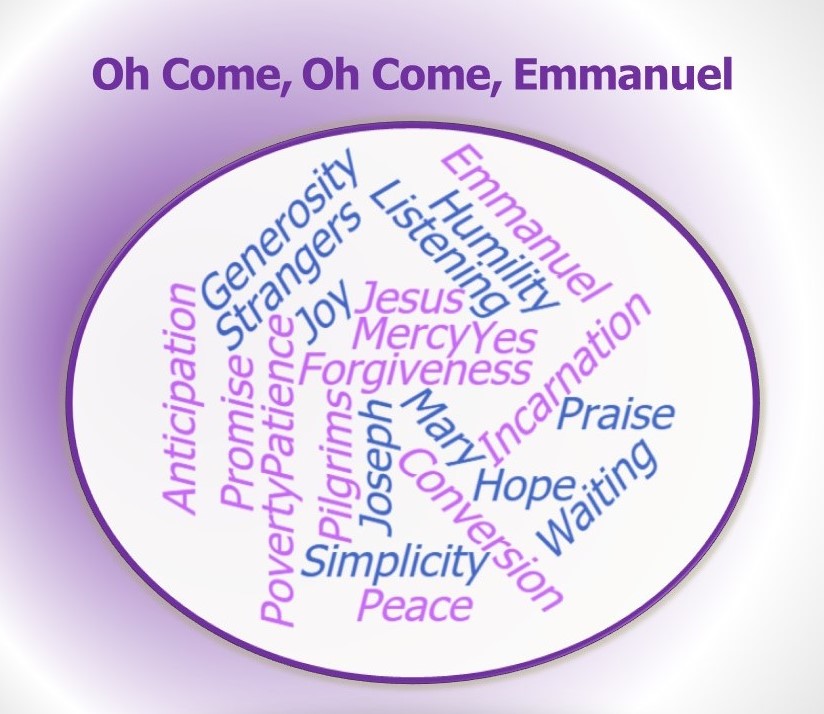
Advent is a time of waiting and meditation. We think about the coming of our Lord and Savior in the Incarnation and the part that Mary and Joseph played in his life. During this month we can use the words in the graphic (or the word bank below) in our prayer and meditation to focus on the meaning of this season. St. Francis was devoted to the Incarnation. This devotion came out in his prayer, his writings and in his actions.
Here are some ideas to put a Franciscan flavor in your Advent meditations:
· Choose a word or two from the word bank each day and see where those words or ideas come up in our Rule.
· Choose a word or two and see where they come up in Scripture—perhaps in the readings of the day or in the psalms as you pray the Liturgy of the Hours.
· Think of stories in Scripture and in the writings by and about Francis and Clare that typify hope and patience.
· Read online or in books that you have at home:
1 Celano chapter 30 (The story of the first Nativity scene at Greccio) (FA:ED, vol. 1, 254)
https://franciscantradition.org/francis-of-assisi-early-documents/the-saint/the-life-of-saint-francis-by-thomas-of-celano/695-fa-ed-1-page-254A Salutation of the Blessed Virgin Mary (FA:ED, vol. 1, 163)
The Praises of God (FA:ED, vol. 1, 109)
St. Clare’s Fourth Letter to Agnes of Prague (CA:ED, 56)
The references above (FA:ED and CA:ED) refer to Francis of Assisi: Early Documents and Clare of Assisi: Early Documents. These and many more writings of and about Francis and Clare can be found on the Franciscan Intellectual Tradition website:
https://franciscantradition.org/
Word Bank
Poverty, Peace, Emmanuel, Promise, Yes, Joy, Hope, Anticipation, Waiting, Praise, Generosity, Humility, Simplicity, Mary, Jesus, Joseph, Forgiveness, Mercy, Listening, Patience, Pilgrims, Strangers, Conversion, Incarnation, Greccio,
Manger
+++++++++++++++++++++
Formación 8 de diciembre, 2023 (Comparta con su fraternidad.)
El Adviento es una temporada de espera y meditación. Pensamos en la venida de nuestro Señor y Salvador en la Encarnación y el papel que María y José desarrollaron en su vida. Durante este mes podemos usar las palabras del banco de palabras abajo en nuestra oración y meditación para enfocarnos en el significado de esta temporada. San Francisco se dedicó a la Encarnación. Esta devoción se manifestó en su oración, sus escritos y sus acciones.
Aquí hay algunas ideas para darle un toque franciscano a sus meditaciones de Adviento:
• Elija una palabra o dos del banco de palabras cada día y vea dónde esas palabras o ideas aparecen en nuestra Regla.
• Elija una palabra o dos y vea dónde aparecen en las Escrituras, tal vez en las lecturas del día o en los salmos mientras reza la Liturgia de las Horas.
• Piense en historias en las Escrituras y en los escritos de Francisco y Clara y sobre ellos que tipifican la esperanza y la paciencia.
• Lea en Internet o en libros que tenga en casa:
1 Celano capítulo 30 (La historia del primer pesebre de Greccio) (FA: ED, vol. 1, 254)
Capítulo XXX (30)
http://www.franciscanos.org/fuentes/1Cel03.html (en español)Un saludo de la Santísima Virgen María (FA: ED, vol. 1, 163)
https://www.franciscanos.org/esfa/salvm.htmlLas alabanzas del Dios altísimo (FA: ED, vol. 1, 109)
http://www.franciscanos.org/esfa/ald.htmlCuarta carta de Santa Clara a Agnes de Praga (CA: ED, 56)
http://www.franciscanos.org/esscl/ctacla4.htmlLas referencias anteriores en inglés (FA: ED y CA: ED) se refieren a Francisco de Asís: Primeros documentos y Clara de Asís: Primeros documentos. Estos y muchos más escritos de Francisco y Clara se pueden encontrar en el sitio web de la Tradición Intelectual Franciscana: (en inglés)
https://franciscantradition.org/
Excelente sitio en español: http://www.franciscanos.org/frandp/menup.html
Banco de palabras
Pobreza, Paz, Emanuel, Promesa, Sí, Alegría, Esperanza, Anticipación, Espera, Alabanza, Generosidad, Humildad, Sencillez, María, Jesús, José, Perdón, Misericordia, Escucha, Paciencia, Peregrinos, Extranjeros, Conversión, Encarnación, Greccio, Pesebre
Diane F. Menditto, OFSVice Minister, National Fraternity, Secular Franciscan Order USAListen – Discern – Go Forth National Theme 2022-2025