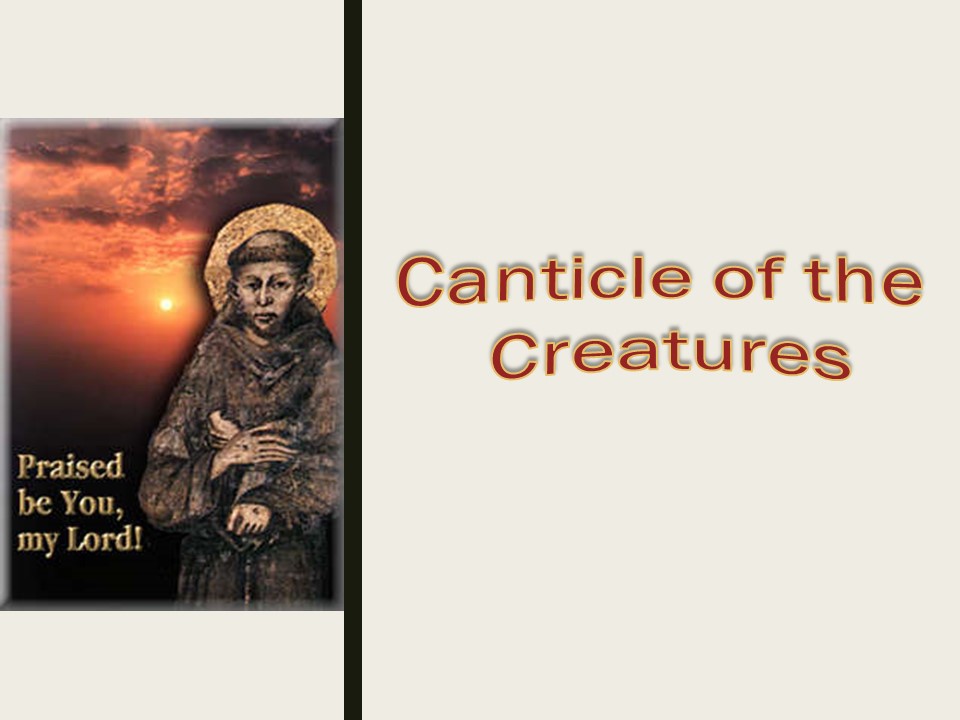
The Canticle of the Creatures
In 2025 we celebrate the 800th Anniversary of the Canticle of the Creatures. As we begin this year, we offer St. Francis’s own words as they appear in the Canticle. Composed in 1225 during his last illness, St. Francis gives glory to God through all of creation in the first portion of the canticle. Ever the peacemaker, he added verses 10 and 11 at a time when the political and religious authorities of Assisi were in conflict. Then, right before his death, he added two verses praising God for “Sister Bodily Death,” calling us to penance and conversion.
The Canticle of the Creatures
1Most High, all-powerful, good Lord,
Yours are the praises, the glory, and the honor, and all blessing, Rv 4:9 Rv 4:11
2To You alone, Most High, do they belong,
and no human is worthy to mention Your name.d
3Praised be You, my Lord, with all Your creatures, Tb 8:7
especially Sir Brother Sun,
Who is the day and through whom You give us light.e
4And he is beautiful and radiant with great splendor;
and bears a likeness of You, Most High One.
5Praised be You, my Lord, through Sister Moon and the stars, Ps 148:3
in heaven You formed them clear and precious and beautiful.a
6Praised be You, my Lord, through Brother Wind,
and through the air, cloudy and serene, and every kind of weather,
through whom You give sustenance to Your creatures.
7Praised be You, my Lord, through Sister Water, Ps 148:4 Ps 148:5
who is very useful and humble and precious and chaste.
8Praised be You, my Lord, through Brother Fire, Dn 3:66
through whom You light the night, Ps 78:14 [Vulgate, Ps 77:14]
and he is beautiful and playful and robust and strong.
9Praised be You, my Lord, through our Sister Mother Earth, Dn 3:74
who sustains and governs us,
and who produces various fruit with colored flowers and herbs. Ps 104:13 [Vulgate, Ps 103:13] Ps 104:14 [Vulgate, Ps 103:14]10Praised be You, my Lord, through those who give pardon for Your
love, Mt 6:12
and bear infirmity and tribulation.b
11Blessed are those who endure in peace
for by You, Most High, shall they be crowned.12Praised be You, my Lord, through our Sister Bodily Death,
from whom no one living can escape.c
13Woe to those who die in mortal sin.
Blessed are those whom death will find in Your most holy will,
for the second death Rv 2:11 Rv 20:6 shall do them no harm.d14Praise and bless my Lord Dn 3:85 and give Him thanks
and serve Him with great humility.After reading the Canticle, go back and look at the Scripture sources indicated—read the passages—see how Francis was influenced by his intimate knowledge of Scripture.
+What part does Scripture play in your daily life? What does “going from Gospel to life and life to the Gospel” (Article 4 of our Rule) mean to you?
The Canticle speaks of St. Francis’s love for all of creation.
+Using St. Clare’s advice to “Gaze, Contemplate, Meditate, and Imitate, think about your relationship to God’s creation.
+How does your relationship with creation affect your relationship with God and your brothers and sisters?Reread verses 10 and 11 of the Canticle.
+How do you serve as a peacemaker in your family, job, or community?
+In what ways is it difficult for you to “forgive” those who don’t agree with you?
+Verse 10 calls to mind the story of Perfect Joy. What is Francis telling us in that story and in this canticle?Verses 12 and 13 talk about the end of life and how we are to prepare.
+Give some thought to the qualities it takes to accept our eventual death or the death of someone we love.
+Reread the Prologue to the Rule of 1978, especially “Concerning Those Who Do Not Do Penance.” Why are penance and conversion so important to us?+++++++++++++
Formación 28 de febrero 2025 Por favor compartir con sus fraternidades locales
Cántico de las Criaturas
En 2025 celebramos el 800 aniversario del Cántico de las Criaturas. Al comenzar este año, ofrecemos las propias palabras de San Francisco tal como aparecen en el Cántico. Compuesto en 1225 durante su última enfermedad, San Francisco da gloria a Dios a través de toda la creación en la primera parte del cántico. Siempre pacificador, añadió los versículos 10 y 11 en un momento en que las autoridades políticas y religiosas de Asís estaban en conflicto. Luego, justo antes de su muerte, añadió dos versículos alabando a Dios por la “Hermana Muerte Corporal”, llamándonos a la penitencia y a la conversión.
ALABANZAS DE LAS CRIATURAS
1Altísimo, omnipotente, buen Señor,
tuyas son las alabanzas, la gloria y el honor y toda bendición.
2A ti solo, Altísimo, corresponden,y ningún hombre es digno de hacer de ti mención.
3Loado seas, mi Señor, con todas tus criaturas,especialmente el señor hermano sol,
el cual es día, y por el cual nos alumbras.
4Y él es bello y radiante con gran esplendor,
de ti, Altísimo, lleva significación.
5Loado seas, mi Señor, por la hermana luna y las estrellas,
en el cielo las has formado luminosas y preciosas y bellas.
6Loado seas, mi Señor, por el hermano viento,
y por el aire y el nublado y el sereno y todo tiempo,
por el cual a tus criaturas das sustento.
7Loado seas, mi Señor, por la hermana agua,
la cual es muy útil y humilde y preciosa y casta.
8Loado seas, mi Señor, por el hermano fuego,
por el cual alumbras la noche,
y él es bello y alegre y robusto y fuerte.
9Loado seas, mi Señor, por nuestra hermana la madre tierra,
la cual nos sustenta y gobierna,
y produce diversos frutos con coloridas flores y hierba.
10Loado seas, mi Señor, por aquellos que perdonan por tu amor,
y soportan enfermedad y tribulación.
11Bienaventurados aquellos que las soporten en paz,
porque por ti, Altísimo, coronados serán.
12Loado seas, mi Señor, por nuestra hermana la muerte corporal,
de la cual ningún hombre viviente puede escapar.
13¡Ay de aquellos que mueran en pecado mortal!:
bienaventurados aquellos a quienes encuentre en tu santísima voluntad,
porque la muerte segunda no les hará mal.
14Load y bendecid a mi Señor,
y dadle gracias y servidle con gran humildad.
http://franciscanos.org/esfa/cant.html
El Cántico habla del amor de San Francisco por toda la creación.
+Usando el consejo de Santa Clara de “Mirar, Contemplar, Meditar e Imitar, piense en su relación con la creación de Dios.
+¿Cómo afecta su relación con la creación su relación con Dios y con sus hermanos y hermanas?
Releer los versículos 10 y 11 del Cántico.
+ ¿Cómo se desempeña como pacificador en su familia, trabajo o comunidad?
+ ¿De qué manera te resulta difícil “perdonar” a los que no están de acuerdo contigo?
+ El versículo 10 recuerda la historia de Perfect Joy. ¿Qué nos dice Francisco en esa historia y en este cántico?
Los versículos 12 y 13 hablan sobre el final de la vida y cómo debemos prepararnos.
+ Piense un poco en las cualidades que se necesitan para aceptar nuestra eventual muerte o la muerte de alguien a quien amamos.
+ Releer el Prólogo de la Regla de 1978, en especial “Sobre los que no hacen penitencia”. ¿Por qué son tan importantes para nosotros la penitencia y la conversión?
Diane F. Menditto, OFSVice Minister, National Fraternity, Secular Franciscan Order USAListen – Discern – Go Forth National Theme 2022-2025
Category: Formation Friday
FORMATION FRIDAY – NFC Priorities for 2022 – 2025, Part 3 – February 21, 2025
Please share with your local fraternity.
At our National Chapter in October 2022, the National Fraternity Council decided that the priorities for 2022-2025 would be Vocations, Communications, and Relationships. For several weeks, Formation Friday has been exploring each of these priorities.
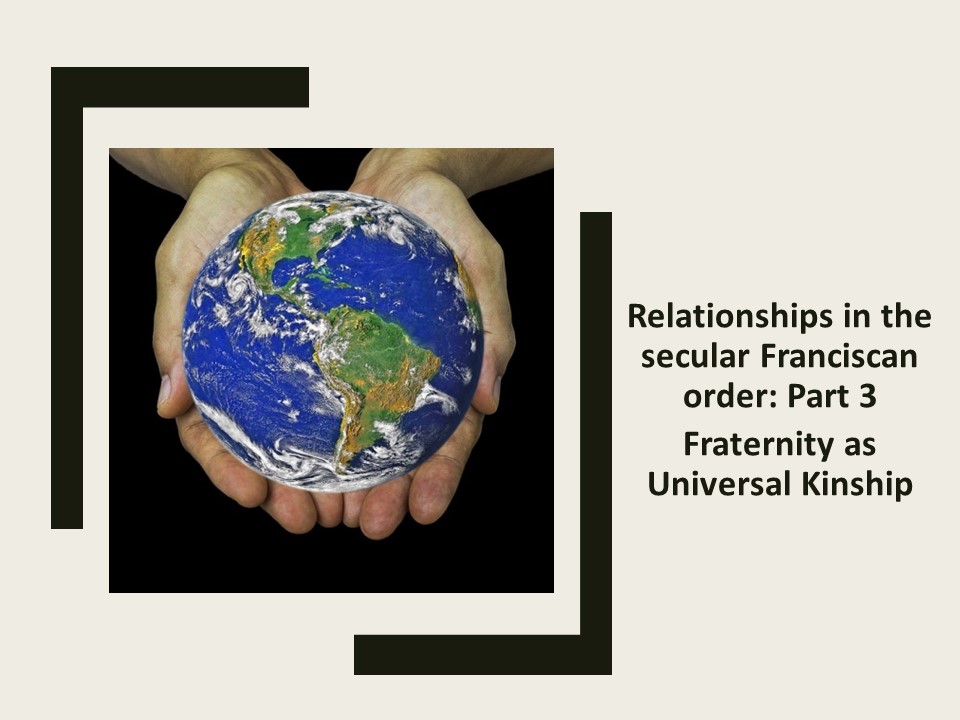
Relationships in the Secular Franciscan Order: Part 3
Fraternity as Universal Kinship
Prepared by Francine Gikow, OFS, Member, National Formation Commission
Relationship, or what we describe as “fraternity,” is foundational for living our Secular Franciscan charism and is the way we evangelize, going from gospel to life and life to the gospel. In this series of “Relationships in the Secular Franciscan Order,” we discussed:
· Love between each person of the Holy Trinity is our model for fraternity living; to love one another.
· Francis understood that we are all sons and daughters of the same Father and so we are all brothers and sisters, in a kinship relationship, with each other in fraternity.
· Our local fraternity is a school of love where we learn how to develop and sustain relationships. We live “fraternity” with our brothers and sisters within our fraternity, with others with whom we interact, those in our ministries, in our higher fraternities, in our relationships with the members of other Franciscan religious orders and to the whole world.
Francis’ concept of “fraternity,” however, expands even further to encompass all of creation- both animate and inanimate- which we call “universal kinship.” Our Rule, Article 18, states:
“Moreover they should respect all creatures, animate and inanimate, which bear the imprint of the Most High, and they should strive to move from the temptation of exploiting creation to the Franciscan concept of universal kinship.”
Francis saw God reflected in what He created- or in the words of our Rule- the imprint of the Most High who created all things; animate and inanimate. Since we are all created by the same Father in heaven, we are united as brothers and sisters to all creation and thus must treat creation with loving and fraternal care.
We are further instructed by our General Constitutions (Art. 18):
“Following the example of Francis, patron of ecologists, they should actively put forward initiatives that care for creation and should work with others in efforts that both put a stop to polluting and degrading nature and also establish circumstances of living and environment which would not be a threat to a human person.”
Francis’ legacy to us in his “Canticle of the Creatures,” is a song of praise, glory, honor and thanksgiving to God for Brother Sun, Sister Moon and all creation. The Canticle shows reverence for every “thing” created by God- a “kin” relationship. To honor that reverence, we are charged at profession to “build a more fraternal and evangelical world” (in our relationships with creation too) “so that the kingdom of God may be brought about more effectively.”(Rule, Art. 14)
In summary, our former, beloved, National Minister, Tom Bello, OFS, said of our fraternal relationships:
“Fraternity is a call to unity and harmony with all our brothers and sisters, all of whom are children of the same living God.
Fraternity is a call to unity and harmony with all of creation, plant and planet, all created by the same loving God.
Fraternity is a call to build a community of love that reflects Love back to the God of Love: Father, Son and Holy Spirit.” (FUN: Fraternity, p.7)
Reflection Questions:
· Read OFS General Constitutions, Article 18 “For a Just and Fraternal Society” and share what you have learned.
· What inspired you from this article? What drew your attention?
· What description of fraternal relationships challenged you and why. Share your thoughts with another person or in a spiritual journal.
· Bring to prayer the ideas of this article and ask God to help you discern how to use these ideas in your life and in the life of your fraternity.
++++++++++++++++++++++++++
Compartir con su fraternidad local 21 de febrero 2025
En nuestro Capítulo Nacional en octubre de 2022, el Consejo Nacional decidió que las prioridades para 2022-2025 serían Vocaciones, Comunicaciones y Relaciones. Durante varias semanas, Formation Friday ha estado explorando cada una de estas prioridades.
Relaciones en la Orden Franciscana Seglar: Parte 3
La fraternidad como parentesco universal
Preparado por Francine Gikow, OFS, Miembro, Comisión Nacional de Formación
La relación, o lo que describimos como “fraternidad”, es fundamental para vivir nuestro carisma franciscano seglar y es la forma en que evangelizamos, yendo del evangelio a la vida y de la vida al evangelio. En esta serie sobre “Relaciones en la Orden Franciscana Seglar”, ya discutimos:
- El amor entre cada persona de la Santísima Trinidad es nuestro modelo de vivencia de la fraternidad; amarnos unos a otros.
- Francisco entendió que todos somos hijos e hijas del mismo Padre y por lo tanto todos somos hermanos y hermanas, en una relación de parentesco, unos con otros en fraternidad.
- Nuestra fraternidad local es una escuela de amor donde aprendemos a desarrollar y mantener relaciones. Vivimos “fraternidad” con nuestros hermanos y hermanas dentro de nuestra fraternidad, con otros con quienes interactuamos, aquellos en nuestros ministerios, en nuestras fraternidades superiores, en nuestras relaciones con los miembros de otras órdenes religiosas franciscanas y con el mundo entero.
Sin embargo, el concepto de “fraternidad” de Francisco se expande aún más para abarcar toda la creación, tanto animada como inanimada, a la que llamamos “el parentesco universal”. En nuestra Regla, el artículo 18, establece:
“Sientan, además, respeto por las otras criaturas, animadas e inanimadas, que de ti, Altísimo, llevan significación 30 y procuren con ahínco pasar de la tentación de la explotación al concepto franciscano de la fraternidad universal.”
Francisco vio a Dios reflejado en lo que Él creó -o en las palabras de nuestra Regla- la huella del Altísimo que creó todas las cosas; animado e inanimado. Dado que todos somos creados por el mismo Padre en el cielo, estamos unidos como hermanos y hermanas a toda la creación y, por lo tanto, debemos tratar a la creación con cuidado amoroso y fraterno.
Nuestras Constituciones Generales nos instruyen además (Art. 18.1):
Los franciscanos seglares son llamados a ofrecer su contribución personal, inspirada en la persona y en el mensaje de San Francisco de Asís, en vistas a establecer una civilización en la que la dignidad de la persona humana, la corresponsabilidad y el amor sean realidades vivas.
El legado de Francisco para nosotros en su “Cántico de las Criaturas”, es un canto de alabanza, gloria, honor y acción de gracias a Dios por el Hermano Sol, la Hermana Luna y toda la creación. El Cántico muestra reverencia por cada “cosa” creada por Dios, una relación de “parentesco”. Para honrar esa reverencia, estamos llamados a la profesión a “construir un mundo más fraterno y evangélico” (también en nuestras relaciones con la creación) “a construir un mundo más fraterno y evangélico para la edificación del reino de Dios” (Regla, art. 14).
En resumen, nuestro amado Ministro Nacional de buena memoria, Tom Bello, OFS, dijo sobre nuestras relaciones fraternales:
“La fraternidad es un llamado a la unidad y armonía con todos nuestros hermanos y hermanas, todos hijos del mismo Dios vivo.
La fraternidad es un llamado a la unidad y armonía con toda la creación, planta y planeta, todo creado por el mismo Dios amoroso.
La fraternidad es un llamado a construir una comunidad de amor que refleje el Amor hacia el Dios del Amor: Padre, Hijo y Espíritu Santo”. (DIVERSIÓN: Fraternidad, p.7)
Para platicar con un grupo o en pareja o comentar en su diario.
- Lea las Constituciones Generales de la OFS, Artículo 18 “Por una Sociedad Justa y Fraterna” y comparta lo que ha aprendido.
- ¿Qué le inspiró de este artículo? ¿Qué le llamó la atención?
- ¿Qué descripción de las relaciones fraternales le desafió y por qué? Comparta sus pensamientos con otra persona o en un diario espiritual.
- Lleve a la oración las ideas de este artículo y pida a Dios que le ayude a discernir cómo usar estas ideas en su vida y en la vida de su fraternidad.
Diane F. Menditto, OFSVice Minister, National Fraternity, Secular Franciscan Order USAListen – Discern – Go Forth National Theme 2022-2025
FORMATION FRIDAY – National Priorities (cont) – Vocations, Communications, & Relationships – February 14,2025
At our National Chapter in October 2022, the National Fraternity Council decided that the priorities for 2022-2025 would be Vocations, Communications, and Relationships. For several weeks, Formation Friday has been exploring each of these priorities.
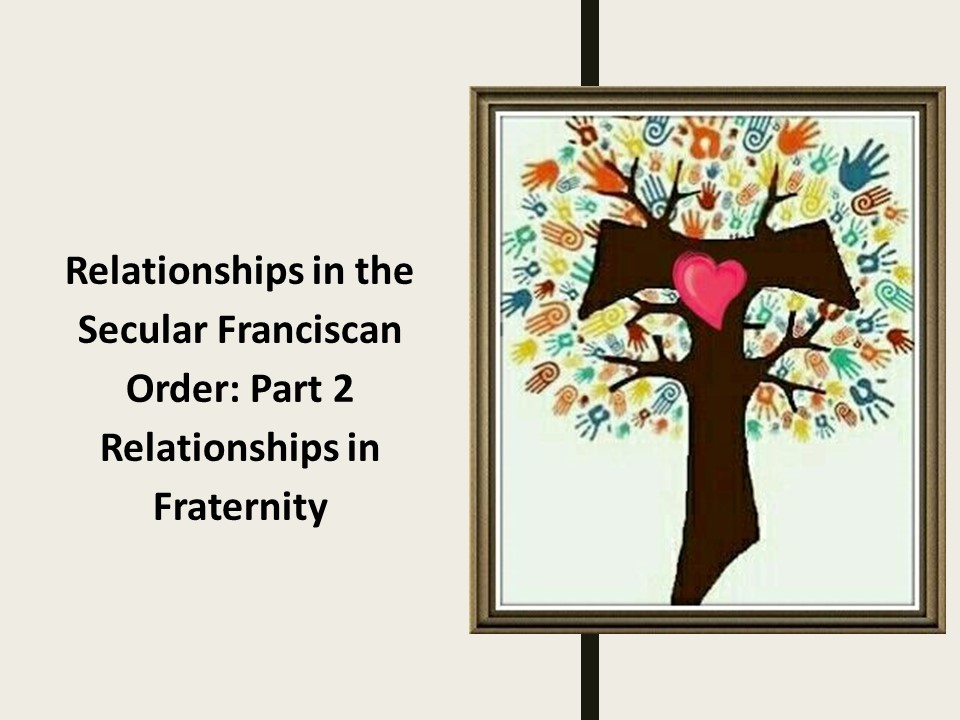
Relationships in the Secular Franciscan Order: Part 2
Relationships in Fraternity
Prepared by Francine Gikow, OFS, Member, National Formation Commission
“The vocation of the OFS is a vocation to live the Gospel in fraternal communion. For this purpose, the members of the OFS gather in ecclesial communities which are called fraternities.” (GC. 3.3)
Fraternal communion, commonly described as “relationships” within a fraternity, identifies a key element in our spiritual Franciscan charism- for we cannot be a Secular Franciscan without a fraternity. We are meant to be in relationship with each other and it is how we “do” our mission of building up the church. It takes the concrete experience of living in fraternity to teach us what true “communion” really means.
Here are some key concepts in Franciscan relationships within a fraternity:
· As discussed last week, the model of our relationships is the Holy Trinity– the relational love between the Father, Son and Holy Spirit. This unity of the Trinity should be reflected in our own relationships.
· We are all mothers, brothers, sisters and spouses of the same God (1LtF:8-11) and our relationships (in fraternity) should be reflective of our God of LOVE.
· Fraternity, then, is a call to unity as a model of Christ’s love to the whole world, all of whom are children of the same loving God.” (Rule Article 13)
· It is a privileged place for us- a place that nourishes ongoing conversion (GC.13) and imitates Christ’s relationship with his disciples and Francis and Clare’s relationship with their followers. This privileged place includes our different “levels” of participation and relationship: local, regional, national and international fraternities.
· Our relationships within the wider Franciscan Family (Friars, Poor Clares, and Religious Sisters) provide “vital reciprocity:” a life giving union with each other to make present the charism of their common Seraphic Father in the mission of the church.(Rule Article 1) Each branch of the Franciscan family brings to the greater Franciscan family their own experiences to enrich and enliven the other branches leading to greater unity.
· Fraternity is “an ecclesial community” for a lived experience of being “church” and a visible sign of the Church, a community of faith and love.(Rule Article 22)
· Fraternity is also, a “school of love.”(GC40, 2-3) It is how we learn about relationships: giving and receiving, learning and teaching, forgiving and asking for forgiveness. It is a sign of Christ’s love to the whole world which is a “call to unity and harmony with all our brothers and sisters, all of whom are children of the same loving God. (Rule Article 13)
· Our purpose of our relationships in Fraternity is: “together with all people of good will, to be called to build a more fraternal and evangelical world as Franciscans, so that the kingdom of God may be brought about more effectively.” (Rule Arrticle 5). We do this through our relationships.
In summary, Franciscans are all about relationships and fraternal communion. However, relationships do not end with just our experience within our fraternities and the Franciscan family- they extend into viewing all of creation and the world in which we live, while being in a “relationship and community of love.” This is called “Universal Kinship,” and in Part 3, the last of our series in “Franciscan Vocation as Relationship,” we will meditate on what it means to extend our concept of relationship to creation and the world.
Questions for reflection in your journal or to discuss with a prayer partner or small group:
· Look up the full references from the above citations of the OFS Rule, General Constitutions and the First Letter to the Faithful and discuss with a partner, what you have learned.
· What struck you from this article? Identify what drew your attention.
· What description of fraternal relationships challenged you and why? Share your thoughts with another.
· Bring to prayer the results of this review and ask God to enrich your relationships in fraternity.
+++++++++++++++++++++++++++++++++++++++++++++++
Formación 14 de febrero 2025 Por favor compartir con su fraternidad local.
En nuestro Capítulo Nacional en octubre de 2022, el Consejo Nacional decidió que las prioridades para 2022-2025 serán Vocaciones, Comunicaciones y Relaciones. Durante varias semanas, el Viernes de Formación ha estado explorando cada una de estas prioridades.
Relaciones en la Orden Franciscana Seglar: Parte 2Relaciones en Fraternidad
Preparado por Francine Gikow, OFS, Miembro, Comisión Nacional de Formación“La vocación a la OFS es una llamada a vivir el Evangelio en comunión fraterna. Con este fin, los miembros de la OFS se reúnen en comunidades eclesiales, que se llaman Fraternidades”. (CCGG. 3.3)
La comunión fraterna, comúnmente descrita como “relaciones” dentro de una fraternidad, identifica un elemento clave en nuestro carisma franciscano espiritual, porque no podemos ser franciscanos seglares sin una fraternidad. Estamos destinados a estar en relación unos con otros y así es como “realizamos” nuestra misión de edificar la iglesia. Se necesita la experiencia concreta de vivir en fraternidad para enseñarnos lo que realmente significa la verdadera “comunión”.
Aquí hay algunos conceptos clave en las relaciones franciscanas dentro de una fraternidad:
- Como se discutió la semana pasada , el modelo de nuestras relaciones es la Santísima Trinidad : el amor relacional entre el Padre, el Hijo y el Espíritu Santo. Esta unidad de la Trinidad debe reflejarse en nuestras propias relaciones.
- somos madres, hermanos, hermanas y esposos del mismo Dios (1CtF:8-11) y nuestras relaciones (en fraternidad) deben ser reflejo de nuestro Dios del AMOR.
- La fraternidad: “El sentido de fraternidad les hará felices de colocarse a la par de todos los hombres, especialmente con los más humildes, para los cuales se esforzarán en crear condiciones de vida dignas de criaturas redimidas por Cristo”. (Regla Artículo 13)
- Es un lugar privilegiado para nosotros, un lugar que alimenta la conversión permanente (GGCC.13) e imita la relación de Cristo con sus discípulos y la relación de Francisco y Clara con sus seguidores. Este lugar privilegiado incluye nuestros diferentes “niveles” de participación y relación: fraternidades locales, regionales, nacionales e internacionales.
- Nuestras relaciones dentro de la Familia Franciscana más amplia (frailes, clarisas y hermanas religiosas) proporcionan una “reciprocidad vital”: una unión que da vida entre nosotros para hacer presente el carisma de su Padre Seráfico común en la misión de la iglesia. (Artículo de la Regla 1) Cada rama de la familia franciscana aporta a la gran familia franciscana sus propias experiencias para enriquecer y animar a las otras ramas y conducirlas a una mayor unidad.
- La fraternidad es “una comunidad eclesial” para una experiencia vivida de ser “iglesia ” y signo visible de la Iglesia, comunidad de fe y de amor. (Regla Artículo 22)
- La fraternidad es también, una “escuela de amor” (CCGG40, 2-3). Es así como aprendemos sobre las relaciones: dar y recibir, aprender y enseñar, perdonar y pedir perdón. Es un signo del amor de Cristo al mundo entero que es un “llamado a la unidad y armonía con todos nuestros hermanos y hermanas, todos los cuales son hijos del mismo Dios amoroso. (Regla Artículo 13)
- Nuestro propósito de nuestras relaciones en Fraternidad es: “junto con todas las personas de buena voluntad, ser llamados a construir un mundo más fraterno y evangélico como franciscanos, para que el reino de Dios se realice con mayor eficacia”. (Regla Artículo 5). Hacemos esto a través de nuestras relaciones.
En resumen, los franciscanos tienen que ver con las relaciones y la comunión fraterna. Sin embargo, las relaciones no terminan solo con nuestra experiencia dentro de nuestras fraternidades y la familia franciscana, sino que se extienden hasta ver toda la creación y el mundo en el que vivimos, mientras estamos en una “relación y comunidad de amor”. Esto se llama el “Parentesco universal”, y en la Parte 3, la última de nuestra serie en “La vocación franciscana como relación”, meditaremos sobre lo que significa extender nuestro concepto de relación con la creación y el mundo.
Preguntas para reflexionar en su diario o para discutir con un compañero de oración o un grupo pequeño:
- Busque las referencias completas de las citas anteriores de la Regla OFS y las Constituciones Generales y la Primera Carta a los Fieles y discuta con un compañero lo que ha aprendido.
- ¿Qué le llamó la atención de este artículo? Identifica lo que llamó su atención.
- ¿Qué descripción de las relaciones fraternales le desafió y por qué? Comparta sus pensamientos con otro.
- Lleve a la oración los resultados de este repaso y pida a Dios que enriquezca sus relaciones de fraternidad.
Diane F. Menditto, OFSVice Minister, National Fraternity, Secular Franciscan Order USAListen – Discern – Go Forth National Theme 2022-2025
FORMATION FRIDAY – NFC Priorities – Vocations,Communication & Relationships – February 7, 2024
Please share with your local fraternity.
At our National Chapter in October 2022, the National Fraternity Council decided that the priorities for 2022-2025 would be Vocations, Communications, and Relationships. For several weeks, Formation Friday has been exploring each of these priorities.
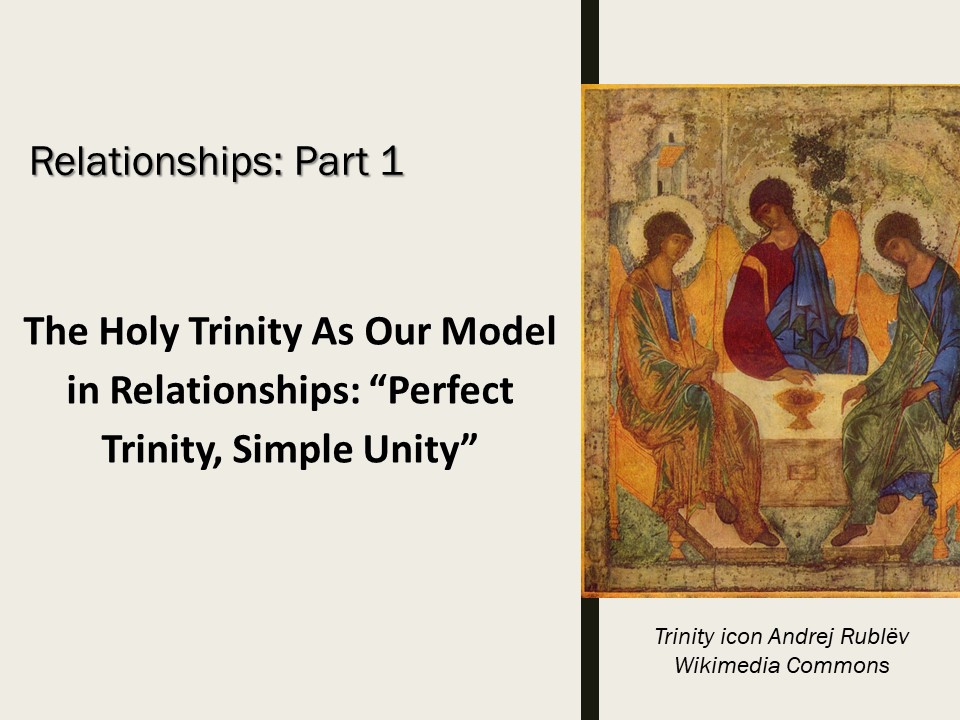
Relationships: Part 1
Prepared by Francine Gikow, OFS, Member, National Formation Commission
Relationships in the Secular Franciscan Order: Part 1
The Holy Trinity As Our Model in Relationships: “Perfect Trinity, Simple Unity”
For Francis, the Holy Trinity, has been the model for all relationships within and outside of the Order. Francis understood and proclaimed the Trinitarian perspective. O how glorious it is to have a holy and great Father in heaven! Oh, how holy, consoling to have such a beautiful and wonderful Spouse! O, how holy and how loving, gratifying, humbling, peace-giving, sweet, worthy of love, and above all things, desirable: to have such a Brother and such a Son, our Lord Jesus Christ….(1LtF)
The Catechism of the Catholic Church (259-260) describes some key characteristics of the Holy Trinity which are also common themes in Francis’ writings. They are:
· Unity: God has revealed himself to us as the Father, Son and Spirit- commonly known as the Holy Trinity. The Trinity expresses a unified love relationship among each person of the Trinity, and as Francis describes it in the FUN Manual, “Perfect Trinity, Simple Unity As Secular Franciscans, we are to share this love relationship of unity among ourselves (family and fraternity), our church (since “we are more intimately united with the Church by profession,”(OFS Rule Article 6) all people, creation, and the world.
· Love: Since God is pure Love, this love should permeate all who we are and do as Secular Franciscans, and be evident in all of our relationships. For “Christ, the gift of the Father’s love, is the way to him, the truth into which the Holy Spirit leads us, and the life which he has come to give abundantly. (Rule Article 4)
· “ Sonship:” Since we are all sons and daughters of the living God, “the Franciscan approach in prayer, is to lead us to imitate Jesus for the purpose of entering and deepening our relationship with Our Father, the Source of Love unimaginable.”(FUN Manual) In addition, the OFS Rule urges us to “conform their thoughts and deeds to those of Christ by means of that radical interior change which the gospel itself calls “conversion.”
Therefore, “…the whole Christian life is a communion with each of the divine persons, without in any way separating them…[and with] the ultimate end… the entry of God’s creatures into the perfect unity of the Blessed Trinity.”(CCC, 259-260)
O, happy and blessed are these men and women while they do such things and persevere in doing them because the Spirit of the Lord will rest upon them (cf. Is 11:2) and make Its home and dwelling place among them (cf. Jn 14:23) and they are children of the heavenly Father (cf. Mt 5:45) Whose works they do, and they are spouses, brothers, and mothers, of our Lord Jesus Christ (cf. Mt 12:50)(1LtF 5-7).
Wouldn’t you like to be a spouse, brother, mother and home for God?
Reflection Questions:
· Describe, in your own words, what unity, love and sonship mean to you as a Secular Franciscan.
· Identify how you can incorporate each of these characteristics of the Holy Trinity into your life as a Secular Franciscan.
· Do you see yourself as a “home for God?” If so, how? If not, why not?
++++++++++++++++++++++++++++++++++++++++++++++
Formación 7 de febrero 2025 Compartir con su fraternidad local.
En nuestro Capítulo Nacional de octubre 2022, el Consejo Nacional decidió que las prioridades para 2022-2025 serían “Vocaciones, Comunicaciones y Relaciones.” Durante varias semanas, Formation Friday ha estado explorando cada una de estas prioridades.
Relaciones: Parte 1
Preparado por Francine Gikow, OFS, Miembro, Comisión Nacional de FormaciónRelaciones en la Orden Franciscana Seglar: Parte 1
La Santísima Trinidad como nuestro modelo en las relaciones: “Trinidad perfecta, unidad simple.”
Para Francisco, la Santísima Trinidad ha sido el modelo de todas las relaciones dentro y fuera de la Orden. Francisco entendió y proclamó la perspectiva trinitaria. ¡Oh cuán glorioso, santo y grande es tener un Padre en los cielos! 12¡Oh cuán santo, consolador, bello y admirable, tener un tal esposo! 13¡Oh cuán santo y cuán amado, placentero, humilde, pacífico, dulce, amable y sobre todas las cosas deseable, tener un tal hermano y un tal hijo: Nuestro Señor Jesucristo! (CtaF1)
El Catecismo de la Iglesia Católica (259-260) describe algunas características clave de la Santísima Trinidad que también son temas comunes en los escritos de Francisco. Ellos son:
· Unidad : Dios se nos ha revelado como Padre, Hijo y Espíritu, comúnmente conocido como la Santísima Trinidad. La Trinidad expresa una relación de amor unificado entre cada persona de la Trinidad, y como Francisco lo describe, (citado en el Manual FUN,) “Trinidad Perfecta, Unidad Simple Como Franciscanos Seglares, debemos compartir esta relación de amor de unidad entre nosotros (familia y fraternidad) , nuestra iglesia (ya que estamos “más estrechamente vinculados por la Profesión” (Regla OFS Artículo 6) todas las personas, la creación y el mundo.
· Amor: Dado que Dios es puro amor, este amor debe impregnar todo lo que somos y hacemos como franciscanos seglares, y ser evidente en todas nuestras relaciones. Porque “Cristo, don del amor del Padre, es el camino hacia Él, es la verdad en la cual nos introduce el Espíritu Santo, es la vida que Él ha venido a dar abundantemente.” (Regla Artículo 4)
· “Puesto que todos somos hijos e hijas del Dios vivo”, el enfoque franciscano en la oración, es llevarnos a imitar a Jesús con el propósito de entrar y profundizar nuestra relación con Nuestro Padre, la Fuente del Amor inimaginable. (Manual FUN) Además, la Regla OFS nos exhorta a “conformar su modo de pensar y de obrar al de Cristo, mediante un radical cambio interior, que el mismo Evangelio denomina con el nombre de ‘conversión’;”.
Por tanto, “ … toda la vida cristiana es comunión con cada una de las personas divinas, sin separarlas en modo alguno… [y con] el fin último… la entrada de las criaturas de Dios en la unidad perfecta de la Santísima Trinidad”. (CIC, 259-260)
¡Oh, dichosos y dichosas estos hombres y mujeres mientras hacen tales cosas y perseveran en hacerlas porque el Espíritu del Señor reposará sobre ellos (cf. Is 11, 2) y hará en ellos su hogar y morada (cf. Jn 14,23) y son hijos del Padre celestial (cf. Mt 5,45) cuyas obras hacen, y son esposos, hermanos y madres de nuestro Señor Jesucristo (cf. Mt 12,50) (CtaF1 5-7).
¿No te gustaría ser esposo, hermano, madre, y hogar para Dios?
Preguntas de reflexión:
- Describa, con sus propias palabras, qué significan para usted como franciscano seglar la unidad, el amor y la filiación.
- Identifique cómo puede incorporar cada una de estas características de la Santísima Trinidad en su vida como franciscano seglar.
- ¿Usted se ve como un “hogar para Dios”? ¿Si es así, cómo? ¿Si no, porque no?
Diane F. Menditto, OFSVice Minister, National Fraternity, Secular Franciscan Order USAListen – Discern – Go Forth National Theme 2022-2025
FORMATION FRIDAY – National Priorities – Part 2 – Communications – January 31, 2025
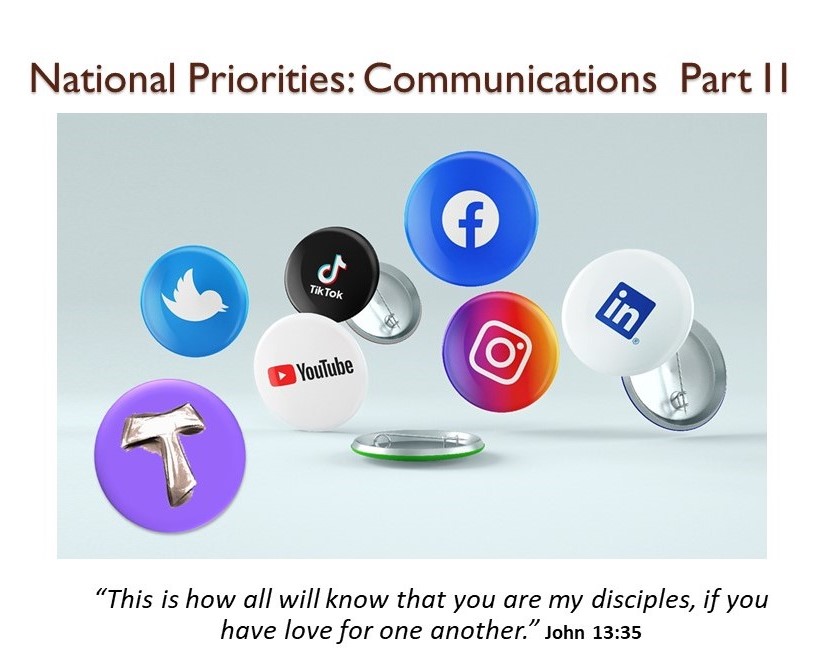
Communications Part 2: Social Media (en español abajo) Korean translation attached in separate PDF.
Please share with your local fraternity
The OFS USA National Priorities for 2022 to 2025 are, “Vocations, Communications and Relationships.”
#OFS, #Francis, #Justice, #Peace, #Love
Thank you to Layna Maher, OFS, Chair, National Formation Commission for preparing this piece.This Formation Friday looks at Social Media communications and offering an opportunity to reflect on our posts and perspective as Catholics and Secular Franciscans.
Imagine if St. Francis had a Facebook page. What do you think he would he be posting? How would St. Francis give praise to God and creation? How would he show solidarity with the poor and marginalized? How would he respond to injustice? It can be easy to be kind and loving as we go along with those that think like we do. When it comes to those we disagree with, however, we may also find it easy to justify lashing out with anger or condemnation. St. Francis once again gives us clear guidance on how we should go about things.
FA:ED, vol. 1, 72 The Earlier Rule, [Chapter XI: The Brothers Should Not Revile or Detract, But Should Love One Another] 1Let all the brothers be careful not to slander or engage in disputes; 2let them strive, instead, to keep silence whenever God gives them the grace.
FA:ED, vol. 1, 102 from the Later Rule 10I counsel, admonish and exhort my brothers in the Lord Jesus Christ not to quarrel or argue or judge others when they go about in the world; 11but let them be meek, peaceful, modest, gentle, and humble, 2 Tm 2:14 speaking courteously to everyone, as is becoming.
Pope Francis counsels us “It is necessary to overcome the tendency to “discredit and insult opponents from the outset [rather] than to open a respectful dialogue” in his Message for the 57th World Day of Social Communications. Let us move from the potential for negativity and embrace the positive potential as we’re guided in the Encyclical Letter Fratelli Tutti 205“In today’s globalized world, the media can help us to feel closer to one another, creating a sense of the unity of the human family which in turn can inspire solidarity and serious efforts to ensure a more dignified life for all…”
Let us stop and think before we post or comment. Or maybe decide it’s best to not comment or reply, but respond with a silent prayer. We can choose to use social media for good. Social media can help those in isolation feel connected. It can also be a great platform to share spiritual resources and come together in prayer. We can evangelize and share the Good News with how we show respect for all of God’s creation and cultivate the Franciscan spirit of peace. We can also use social media to show love and solidarity with our brothers and sisters in the world.
From the Gospel of John 13:35 “This is how all will know that you are my disciples, if you have love for one another.”
From the OFS Rule Article 14 Secular Franciscans, together with all people of good will, are called to build a more fraternal and evangelical world so that the kingdom of God may be brought about more effectively. Mindful that anyone “who follows Christ, the perfect man, becomes more of a man himself,” let them exercise their responsibilities competently in Christian spirit of service.
Reflect and discuss in your fraternity or comment in your journal.
+ Is the face of Christ visible on my Facebook or social media page?
+ How much love and peace am I sowing?
+ Are my posts and comments building a more fraternal world?
++++++++++++++++++++++++
Comunicaciones Parte 2: Las Redes Sociales 31 de enero de 2025
Por favor comparta con su fraternidad local
Las prioridades nacionales de OFS USA para 2022 a 2025 son ” vocaciones, comunicaciones y relaciones ” .
#OFS, #Francisco, #Justicia, #Paz, #Amor
Gracias a Layna Maher, OFS, Presidenta de la Comisión de formación nacional por preparar esta materia.
Esta formación semanal analiza las comunicaciones de las redes sociales y ofrece la oportunidad de reflexionar sobre nuestras publicaciones y nuestra perspectiva como católicos y franciscanos seglares.
Imagínese si San Francisco tuviera una página de Facebook. ¿Qué cree que estaría publicando? ¿Cómo alabaría San Francisco a Dios y a la creación? ¿Cómo mostraría su solidaridad con los pobres y marginados? ¿Cómo respondería a la injusticia? Puede ser fácil ser amable y cariñoso con aquellos que piensan como nosotros. Sin embargo, cuando se trata de aquellos con los que no estamos de acuerdo, también puede que nos resulte fácil justificar arremeter con ira o condena. San Francisco una vez más nos da una guía clara sobre cómo debemos hacer las cosas.
FA:ED , vol. 1, 72 La regla no bulada, [Capítulo XI:] Y todos los hermanos guárdense de calumniar y de contender de palabra (cf. 2 Tim 2,14); 2empéñense, más bien, en guardar silencio siempre que Dios les conceda la gracia.
FA:ED, vol. 1, 102 de la Regla bulada [Capítulo III:] 10 Aconsejo de veras, amonesto y exhorto a mis hermanos en el Señor Jesucristo que, cuando van por el mundo, no litiguen ni contiendan con palabras (cf. 2 Tim 2,14), ni juzguen a los otros; 11sino sean apacibles, pacíficos y moderados, mansos y humildes, hablando a todos honestamente, como conviene.
El Papa Francisco nos aconseja “Es necesario superar la tendencia a “desacreditar e insultar a los opositores desde el principio [en lugar de] abrir un diálogo respetuoso” en su Mensaje para la 57ª Jornada Mundial de las Comunicaciones Sociales .
Pasemos del potencial de negatividad y abracemos el potencial positivo como nos guía la Carta Encíclica Fratelli Tutti 205 “En el mundo globalizado de hoy, los medios pueden ayudarnos a sentirnos más cerca unos de otros, creando un sentido de unidad de la familia humana que a su vez puede inspirar solidaridad y esfuerzos serios para asegurar una vida más digna para todos…”
Detengámonos y pensemos antes de publicar o comentar. O tal vez decida que es mejor no comentar ni responder, sino responder con una oración en silencio. Podemos elegir usar las redes sociales por lo bueno. Las redes sociales pueden ayudar a las personas aisladas a sentirse conectadas. También puede ser una gran plataforma para compartir recursos espirituales y unirse en oración. Podemos evangelizar y compartir la Buena Nueva con la forma en que mostramos respeto por toda la creación de Dios y cultivamos el espíritu franciscano de paz. También podemos usar las redes sociales para mostrar amor y solidaridad con nuestros hermanos y hermanas en el mundo.
Del Evangelio de Juan 13:35 “En esto conocerán todos que sois mis discípulos, si tuviereis amor los unos con los otros.”
De la Regla OFS Artículo 14 “Llamados, juntamente con todos los hombres de buena voluntad, a construir un mundo más fraterno y evangélico para la edificación del reino de Dios, conscientes de que “quien sigue a Cristo, Hombre perfecto, se hace a sí mismo más hombre”, cumplan con competencia las propias responsabilidades con espíritu cristiano de servicio.”
Reflexione y comente en su fraternidad o comente en su diario.
+ ¿Se ve el rostro de Cristo en mi página de Facebook o redes sociales?
+ ¿Cuánto amor y paz estoy sembrando?
+ ¿Mis publicaciones y comentarios están construyendo un mundo más fraterno?
Diane F. Menditto, OFSVice Minister, National Fraternity, Secular Franciscan Order USAListen – Discern – Go Forth National Theme 2022-2025