“Peace With the Earth, Peace with Each Other, Peace Within”

Organizers of International World Day of Peace El Paso

by: Marie Bianca, OFS

Article 19 of our Rule calls us to be, “Mindful that they are bearers of peace which must be built up unceasingly, they should seek out ways of unity and fraternal harmony through dialogue, trusting in the presence of the divine seed in everyone and in the transformative power of love and pardon.” The question that follows is, “How is that accomplished?”

In late June, I was introduced to an amazing woman who was offering a wonderful gift to The Interfaith Alliance of the Southwest. This woman, Laurie Marshal, is the founder of The Singing Tree Foundation, promoting Unity Through Creativity. She wanted to partner with the Alliance and bring the Singing Tree Project to El Paso. It is the hope of both Laurie and the Interfaith Alliance of the Southwest to have the City of El Paso become declared an International City of Peace. On September 21, 2022, at Keystone Heritage Park Botanical Gardens in El Paso, from 12 PM to 8 PM, the gardens opened its doors to this wonderful celebration. The event welcomed vendors that promote peace, singers, dancers, speakers, and holistic healers, and promoted Peace Literacy.

Speakers spanned the world, from Mexico to Afghanistan. It was an honor to walk with these brothers and sisters from around the world, each bringing their unique story of peace. A local high school, Loreto Academy, asked the AP English class to speak to “Who is your Peace Hero.” They were asked to write essays about their peace hero, and the winners were invited to read their piece.

Each essay reflected a deep understanding of their world and most open of their families. Grandma Bea, (Beatriz Villegas), a native of the Ilhuicatlahulli-Bea tribe of Ciudad Juarez, Mexico, brought the opening ceremony alive with her message of peace through song and chant in her native tongue. Later, Neema Soratgar from Afghanistan spoke of her quest for peace after fleeing from her country to come to El Paso to live in peace and work in the field of Research  on Women’s Studies at the University of Texas-El Paso. Tigua dancers claiming the native lands in and around Las Cruces/El Paso danced for peace in traditional form. And the list of speakers went on, too many to list, each carrying the message of importance of communication, respect, and compassion for the earth, for each other and within ourselves.

An important expression of the day was the beautiful mural painted on one of the back walls of the park. This mural was worked on by members of the Interfaith team. Laurie Marshal did a very large piece of the mural, and each attendee was asked to add it to the wall of the Nectarine Tree. Blossoms, leaves, and birds were hand decorated by everyone and attached to the mural, to be adhered permanently later. It is Ms. Marshall’s belief that, with our combined efforts, we as a community can build a beautiful work of art displaying God’s presence, peace and joy in the world.

We are capable and called to do just that, working together building peace in the world. It did not matter what faith you practice, the color of your skin, the language you speak. The goal was unity and peace―something we all strive for in this world. Can you use your creativity to build peace in our world? When you do, your light shines even brighter. The world needs all the light we can shine with the Creator into this world.

“I slept and dreamt that life was joy. I awoke and saw that life was service.  I acted and behold, service was joy.”

Rabindranath Tagore

https://www.secularfranciscansusa.org/2023/05/15/peace-with-the-earth-peace-with-each-other-peace-within/

Open post

Formation Friday May 12, 2023 (Part 4-writings of Francis and Clare)

Formation Friday May 12, 2023 (Part 4-writings of Francis and Clare)
It is important that we get to know the many writings left to us by our founder. Franciscans are blessed to have many of St. Francis’s and St. Clare’s writings. By reading what they wrote, and praying as they prayed, we allow the Holy Spirit to strengthen our vocation and how we live the Franciscan Charism.

“As suggested in the introduction to A Salutation of the Blessed Virgin Mary, (See last week May 5th) the manuscript tradition suggests that Francis saw these virtues as hers; yet they are clearly those of any Christian who has died to sin. Francis greets each virtue in a fashion typical of a medieval troubadour, describes the predisposition which each Christian must have before possessing them, and concludes by interpreting the function of each.”

https://www.franciscantradition.org/francis-of-assisi-early-documents/the-saint/writings-of-francis/the-undated-writings/a-salutation-of-the-virtues/180-fa-ed-1-page-164

A Salutation of the Virtues

1Hail, Queen Wisdom!b
May the Lord protect You, with Your Sister, holy pure Simplicity!
2Lady holy Poverty, may the Lord protect You, with Your Sister, holy Humility!
3Lady holy Charity, may the Lord protect You, with Your Sister, holy Obedience.
4Most holy Virtues, may the Lord protect all of You from Whom You come and proceed.

5There is surely no one in the whole world who can possess any one of You
without dying first.
6Whoever possesses one and does not offend the others possesses all.
7Whoever offends one Jas 2:10 does not possess any and offends all.c
8And each one confounds vice and sin.

9Holy Wisdom confounds Satan and all his cunning.
10Pure holy Simplicity confounds all the wisdom of this world 1 Cor 2:6 and the wisdom of the body.
11Holy Poverty confounds the desire for riches, greed, and the cares of this world.
12Holy Humility confounds pride,
all people who are in the world and all that is in the world.a
13Holy Charity confounds every diabolical and carnal temptation and every carnal fear. 1 Jn 4:18
14Holy Obedience confounds every corporal and carnal wish,
15binds its mortified body to obedience of the Spirit
and obedience to one’s brother,
16so that it is subject and submissive to everyone in the world,
17not only to people but to every beast and wild animal as well
18that they may do whatever they want with it
insofar as it has been given to them from above Jn 19:11 by the Lord.

Please read the Salutation above. Read through once. Then prayerfully consider each word and sentence a second time.

  • Choose four words or phrases that touch you deeply. Spend some time thinking about why you chose those words.
  • In the first verse, we find the virtues most important to St. Francis. Can you think of why he pairs the virtues the way he does?
  • In the second verse he says that we cannot possess these virtues without dying. What does this mean?
  • He then goes on to explain the virtues. Please comment on what particularly touches you.
  • Personal challenge: Think about the virtues and pick two that you will try to strengthen in you this week.

++++++++++++++++++++++++

Formation Friday 12 de Mayo, 2023 (Parte 4-los escritos de Francisco y Clara)
Por favor compartir con su fraternidad local


Es importante que conozcamos los muchos escritos que nos dejó nuestro fundador. Los franciscanos tienen la bendición de tener muchos de los escritos de San Francisco y Santa Clara. Al leer lo que escribieron y orar como ellos oraron, permitimos que el Espíritu Santo fortalezca nuestra vocación y cómo vivimos el carisma franciscano.


“Como se sugiere en la introducción a Un saludo a la Santísima Virgen María, (ver la última semana del 5 de mayo), la tradición manuscrita sugiere que Francisco vio estas virtudes como suyas; sin embargo, son claramente los de cualquier cristiano que ha muerto al pecado. Francisco saluda cada virtud a la manera típica de un trovador medieval, describe la predisposición que debe tener cada cristiano antes de poseerlas y concluye interpretando la función de cada una”.

Aquí se puede leer más en inglés: https://www.franciscantradition.org/francis-of-assisi-early-documents/the-saint/writings-of-francis/the-undated-writings/a-salutation-of-the-virtues/180-fa-ed-1-page-164


SALUDO A LAS VIRTUDES [SalVir]

http://franciscanos.org/esfa/salvir.html


¡Salve, reina sabiduría!, el Señor te salve con tu hermana la santa pura sencillez.
¡Señora santa pobreza!, el Señor te salve con tu hermana la santa humildad.
¡Señora santa caridad!, el Señor te salve con tu hermana la santa obediencia.
¡Santísimas virtudes!, a todas os salve el Señor, de quien venís y procedéis.
No hay absolutamente ningún hombre en el mundo entero que pueda tener una de vosotras si antes él no muere.
El que tiene una y no ofende a las otras, las tiene todas. Y el que ofende a una, no tiene ninguna y a todas ofende. Y cada una confunde a los vicios y pecados.
La santa sabiduría confunde a Satanás y todas sus malicias.
La pura santa sencillez confunde a toda la sabiduría de este mundo y a la sabiduría del cuerpo.
La santa pobreza confunde a la codicia y avaricia y cuidados de este siglo.
La santa humildad confunde a la soberbia y a todos los hombres que hay en el mundo, e igualmente a todas las cosas que hay en el mundo.
La santa caridad confunde a todas las tentaciones diabólicas y carnales y a todos los temores carnales.
La santa obediencia confunde a todas las voluntades corporales y carnales, y tiene mortificado su cuerpo para obedecer al espíritu y para obedecer a su hermano, y está sujeto y sometido a todos los hombres que hay en el mundo, y no únicamente a solos los hombres, sino también a todas las bestias y fieras, para que puedan hacer de él todo lo que quieran, en la medida en que les fuere dado desde arriba por el Señor.


Por favor, lea el saludo anterior. Lea una vez. Luego, en oración, considere cada palabra y oración por segunda vez.


• Elija cuatro palabras o frases que le conmuevan profundamente. Dedque algo de tiempo a pensar por qué eligió esas palabras.

• En el primer verso encontramos las virtudes más importantes para San Francisco. ¿Puede pensar en por qué empareja las virtudes de la forma en que lo hace?

• En el segundo verso dice que no podemos poseer estas virtudes sin morir. ¿Qué quiere decir esto?

• Luego pasa a explicar las virtudes. Por favor, comente lo que le toque especialmente.

• Desafío personal: Piense en las virtudes y elija dos que intentará fortalecer en si esta semana.


Diane F. Menditto, OFS
Vice Minister, National Fraternity, Secular Franciscan Order USA
Listen – Discern – Go Forth National Theme 2022-2025


Open post

SHAPING THE FRANCISCAN FOOTPRINT – May 4 – May10 2023

Shaping the Franciscan Footprint

Five Important Spiritual Thoughts from the Liturgy of the Word

…and follow up for the Secular Franciscan

May 4 – May 10

1 — “Do not let your hearts be troubled. You have faith in God; have faith also in me.” (Jn 14:1)

…Do I show my faith the way I should?

2 — Jesus said to him, “I am the way and the truth and the life. No one comes to the Father except through me.”  (Jn 14:6)

…THE reason why we follow the Lord. Is it clear from my life?

3 — The Advocate, the Holy Spirit whom the Father will send in my name–he will teach you everything and remind you of all that I told you.” (Jn 14:26)

…Go through the gifts of the Holy Spirit (Wisdom, Understanding, Right Judgement, Knowledge, Courage, Awe [Fear of the Lord], Reverence) and determine which virtue I should work on more in the next couple days.

4 — “Peace I leave with you; my peace I give to you.” (Jn 14:27)

…Am I a truly “peaceful person,” that is, trying to bring about harmony in whatever situation?

5 – “Remain in me, as I remain in you.” (Jn 15:4)

…An obligation…and a promise. 

Extra meditation

BAPTISM

 “Amen, I say to you, unless one is born of water and Spirit
he[/she] cannot enter the Kingdom of God.”

(John 3:5)

+++

It happened in those days that Jesus came from Nazareth

of Galilee and was baptized in the Jordan by John.

(Mark 1:9)

        You have probably met a couple of saints in your life.  They may not be formally canonized, but they should be.  Two of them lived in the same town that the pastor lived in.

        One was in her 90’s and a little hard of hearing and could not walk long distances. It was too risky for her to go to Church, which she wanted to do in the worst way. She was one of the well-known people in her small town simply because of her holiness.  The pastor celebrated home Masses for her, and one particular time, he gave a little homily on whatever. After Mass, she told her granddaughter, in a pretty loud voice as many hard-of-hearing older people do, “I didn’t understand one thing that priest said!” The fact is: she did not need to because she was what can be called a practical theologian. She had put her faith into everything that she did.

        The other practical theologian in that same town helped the pastor of the town provide a temporary home for someone who really needed help and she literally saved that young person’s life. She also was a practical theologian. A little later as she neared the end of her life, she was involved in a very bad accident. She had to wear one of those braces that, in effect, molded a steel cage around her head to keep her from moving her neck. The medical field has something a little more user-friendly now, but she looked awful, and people felt awful for her. But she lived out her life with an attitude that she put into words at one time.  She said: “This is good. God still wants me to do something with my life.” There is little doubt that she did it. It is a statement of a practical theologian.

        A practical theologian is one who has put Baptism into practice. It makes our Baptism something that is a true guide for living well. We celebrate that thought on the feast of the Baptism of Jesus. Jesus used the Baptism of John to say to us that every one of us must begin using our Baptism as a guide just as Jesus did in a most human way. Baptism becomes a guide when we put into practice the characteristics of Jesus.

        All Christians are baptized, most of them very young. We are Christians, and almost immediately, we have to wonder why with so many baptized Christians, there are still so many problems in the Christian world, and in our own little worlds. If we were better practical theologians, that would change.

        A Methodist minister a couple of years ago put it this way. The minister stated that the problem with most Christians is that they have not fully embraced the call of Christianity. Using strong accusatory language, he said: “If ministers and their flocks would worry more about listening to the call of Jesus, and less about money and whose religion is right or wrong, we wouldn’t have the mire and misery that we have now.” He is a little negative, but there is a lot of truth there.

        Listening to the call of Christianity means being practical theologians, and how do we do that? We know the answer. We take the time to address the mire and misery in our own homes and in the situations that we can do something about. We can do things like: regulate TV and movies, make sure young people get the Christian education they need, pray more, go to the sacrament of Reconciliation more, volunteer more, and so forth.

        We need practical theologians in our Church today. They should be us.

www.frmikescully.com

www.thegospelandme.com

The Franciscan Centenary

(This article originally appeared in the TAU-USA Winter 2023 Issue #108)

by Bret Thoman OFS

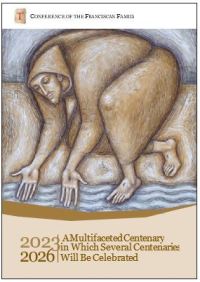
In January 2022, the Conference of the Franciscan Family sent out a letter to Franciscans everywhere announcing an important initiative: preparations for the next Franciscan Centenary.

https://ciofs.info/wp-content/uploads/2022/09/Centenario_ENG_def_pdf.pdf

A centenary is a 100-year commemoration of a significant event. In the same way we celebrate birthdays or wedding or profession anniversaries, our order commemorates significant events in the life of Francis. These are moments to reflect. We take time to consider what these events mean to us, how they shaped or formed us, and how they affect our identity. We look back at what happened in time in order to consider where we are now, and where we wish to go  from here.

Unlike our own life events, in which we recall such events in years, the order marks events in the life of St. Francis in terms of centuries. These are centenaries.

Anyone who has been on pilgrimage to Assisi may have noticed past centenaries. For example, in the cemetery chapel of Bastiola, not far from Assisi, there is a plaque dated 1912. It was placed there to commemorate the seventh centenary of St. Clare’s arrival; at the then monastery of San Paolo after leaving her family on Palm Sunday, 1212.

More recently, over the past two decades, there have been a number of eighth-centenary events. In 2006, there was the “spoliation” of Francis; that is, when he stripped before his father and the bishop (1206). In 2009, there was the oral approval of the rule by Pope

Innocent X and the creation of the order (1209). In 2012, there was Clare’s conversion (1212). In 2017, there was the chapter of mats (1217), while in 2021, we recalled the letter written by Francis that marks the beginning of the Third Order (1221).

But these were all minor commemorations compared to the centenary events that will take place over the next few years. From 1223 through 1226, a series of major milestones in the life of St. Francis will be celebrated.
This year, 2023, we commemorate the eighth centenary of the approval of the Later Rule of St. Francis and the Christmas at Greccio (1223). Next year, in 2024, we will recall the Reception of the Stigmata on Mt. Laverna (1224). Then in 2025, we will commemorate the composition of the Canticle of the Creatures (1225). Finally, what is being referred to as the Easter of Francis – that is, his death and passing to eternal life (1226/2026) will be celebrated. These events will coincide with the Jubilee in the Catholic Church in 2025.

In future articles, I will be exploring these important events in the life of St. Francis by describing where they took place.

https://www.secularfranciscansusa.org/2023/05/08/the-franciscan-centenary/

Open post

Formation Friday May 5, 2023 (Part 3-writings of Francis and Clare)

It is important that we get to know the many writings left to us by our founder. Franciscans are blessed to have many of St. Francis’s and St. Clare’s writings. By reading what they wrote, and praying as they prayed, we allow the Holy Spirit to strengthen our vocation and how we live the Franciscan Charism.

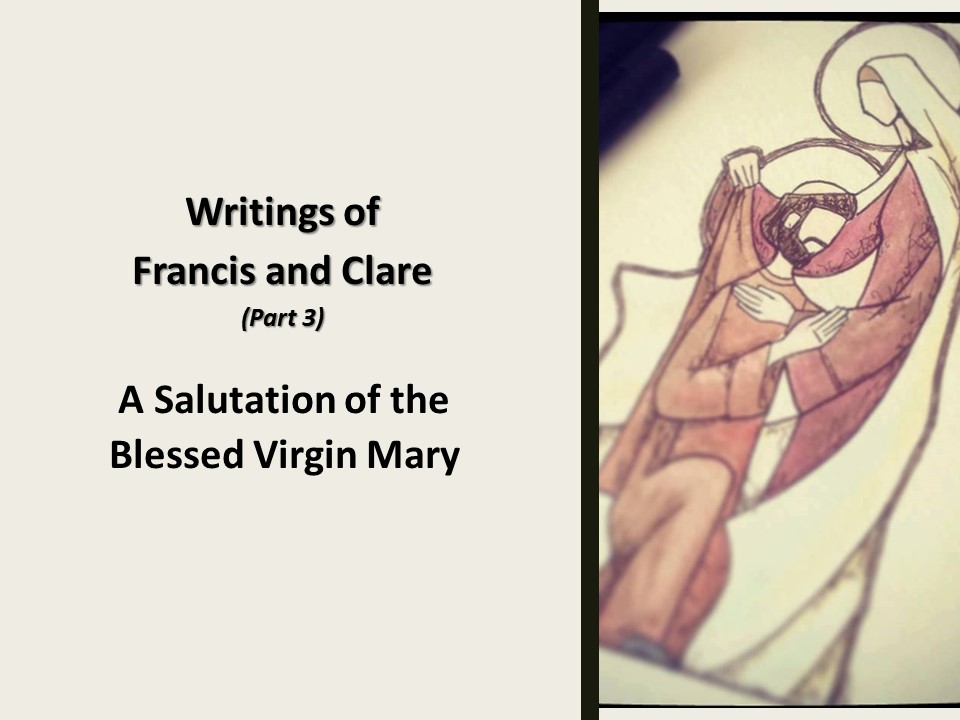
St. Francis had a great devotion to the Blessed Virgin Mary because of her role in the Incarnation and the example she set for us. He made her the protectress of the Order and thereby of the entire Franciscan family.

“This simple collection of titles forms a litany of greetings describing Mary’s role in the plan of salvation. The manuscript tradition suggests a close tie between this piece and the following, the A Salutation of the Virtues (We will feature these next week.) , and, therefore, presents the Virgin Mary as the model for every Christian who responds to God’s virtuous presence in his or her life.” https://www.franciscantradition.org/francis-of-assisi-early-documents/the-saint/writings-of-francis/the-undated-writings/a-salutation-of-the-blessed-virgin-mary/179-fa-ed-1-page-163

A Salutation of the Blessed Virgin Mary

1Hail, O Lady,
Holy Queen,
Mary, holy Mother of God,
Who are the Virgin made Church,a
2chosen by the most Holy Father in heaven
whom he consecrated with His most holy beloved Son
and with the Holy Spirit the Paraclete,
3in whom there was and is
all fullness of grace and every good.

4Hail His Palace!
Hail His Tabernacle!
Hail His Dwelling!
5Hail His Robe!
Hail His Servant!
Hail His Mother!

6And hail all You holy virtues
which are poured into the hearts of the faithful
through the grace and enlightenment of the Holy Spirit,
that from being unbelievers,
You may make them faithful to God.b

Please read the references to Mary above. Read through once. Then prayerfully consider each word and sentence a second time.

  • According to the phrases St. Francis used to describe the Blessed Mother, what do we learn about how he thought of her?
  • Choose four words or phrases that touch you deeply. Spend some time thinking about why you chose those words.
  • What does this Salutation, tell us about how St. Francis prayed?
  • How do you include the Blessed Mother in your prayers each day? What do you say to her?
  • Personal challenge: See if you can write some short phrases/praises of the Blessed Mother that are personal to you.

+++++++++++++++++

Formation Friday 5 de Mayo, 2023 (Parte 3-los escritos de Francisco y Clara)
Por favor compartir con su fraternidad local

Es importante que conozcamos los muchos escritos que nos dejó nuestro fundador. Los franciscanos tienen la bendición de tener muchos de los escritos de San Francisco y Santa Clara. Al leer lo que escribieron y orar como ellos oraron, permitimos que el Espíritu Santo fortalezca nuestra vocación y cómo vivimos el carisma franciscano.

San Francisco tenía una gran devoción a la Santísima Virgen María por su papel en la Encarnación y el ejemplo que nos dio. La hizo protectora de la Orden y, por tanto, de toda la familia franciscana.

“Esta sencilla colección de títulos forma una letanía de saludos que describen el papel de María en el plan de salvación. La tradición manuscrita sugiere un estrecho vínculo entre esta pieza y la siguiente, El saludo de las virtudes (presentaremos estas la próxima semana), y, por lo tanto, presenta a la Virgen María como modelo para todo cristiano que responde a la presencia virtuosa de Dios. en su vida.”

Saludo a la bienaventurada Virgen María [SalVM]

http://franciscanos.org/esfa/salvm.html

1Salve, Señora,
santa Reina,
santa Madre de Dios,
María, que eres virgen hecha iglesia
2y elegida por el santísimo Padre del cielo,
a la cual consagró Él con su santísimo amado Hijo
y el Espíritu Santo Paráclito,
3en la cual estuvo y está toda la plenitud de la gracia y todo bien.

4Salve, palacio suyo;
salve, tabernáculo suyo;
salve, casa suya.
5Salve, vestidura suya;
salve, esclava suya;
salve, Madre suya
6y todas vosotras, santas virtudes,
que sois infundidas por la gracia e iluminación del Espíritu Santo
en los corazones de los fieles,
para que de infieles
hagáis fieles a Dios.

Por favor, lea las referencias a María arriba. Lea una vez. Luego, en oración, considere cada palabra y frase por segunda vez.

• De acuerdo con las frases que usó San Francisco para describir a la Santísima Madre, ¿qué aprendemos acerca de cómo pensaba él en ella?

• Elija cuatro palabras o frases que le conmuevan profundamente. Dedique algo de tiempo a pensar por qué eligió esas palabras.

• ¿Qué nos dice este Saludo sobre cómo rezaba San Francisco?

• ¿Cómo incluye a la Santísima Madre en sus oraciones todos los días? ¿Qué le dice a ella?

• Desafío personal: vea si puede escribir algunas frases breves/alabanzas a la Santísima Madre que sean personales para usted.


Diane F. Menditto, OFS
Vice Minister, National Fraternity, Secular Franciscan Order USA
Listen – Discern – Go Forth National Theme 2022-2025


Scroll to top
Juan de Padilla