Formation Friday June 9, 2023 (en español abajo)
Please share with your local fraternityWhen we think of ourselves as Secular Franciscans, one of the characteristics that should come to mind is that we are welcoming. It is rare and surprising to hear that someone did not feel welcomed at an OFS event or fraternity gathering, but it does happen. As always, we can look to our Rule and General Constitutions (GC) for guidance.
Rule Article 13. As the Father sees in every person the features of his Son, the firstborn of many brothers and sisters, so the Secular Franciscans with a gentle and courteous spirit accept all people as a gift of the Lord and an image of Christ. A sense of community will make them joyful and ready to place themselves on an equal basis with all people, …
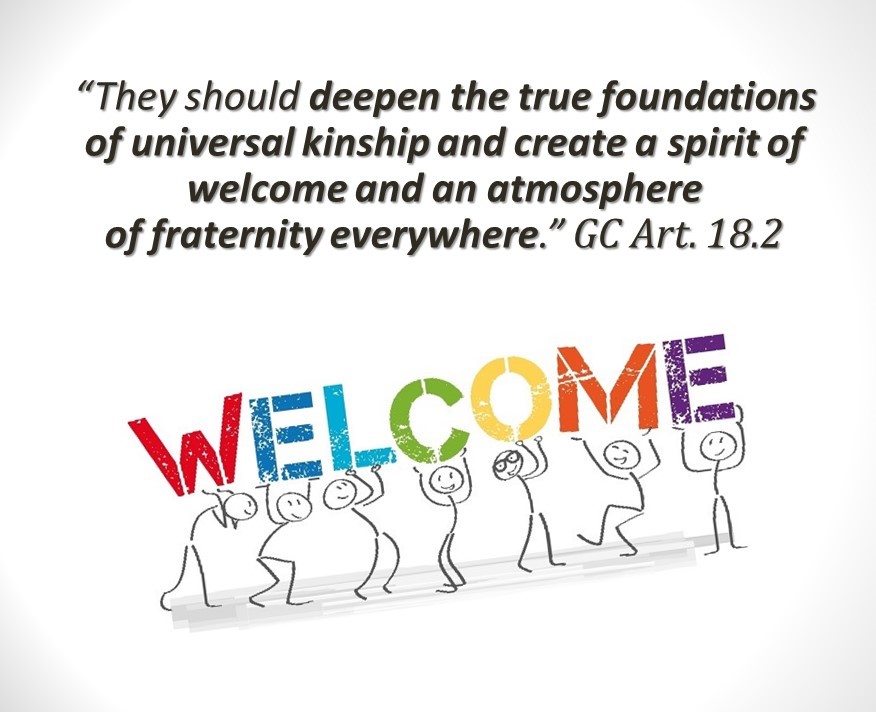
GC Article 18.2 They should deepen the true foundations of universal kinship and create a spirit of welcome and an atmosphere of fraternity everywhere. They should firmly commit themselves to oppose every form of exploitation, discrimination, and marginalization and against every attitude of indifference in relation to others.
Rule Art. 19. Mindful that they are bearers of peace which must be built up unceasingly, they should seek out ways of unity and fraternal harmony through dialogue, trusting in the presence of the divine seed in everyone and in the transforming power of love and pardon. Messengers of perfect joy in every circumstance, they should strive to bring joy and hope to others. …
GC Article 26.2 In the fraternity, the brothers and sisters should promote mutual understanding and they should ensure that the atmosphere of their meetings be welcoming and that it reflects joy. They should encourage one another for the good.
+++++++++++
Here are some tips for Council members and for all Secular Franciscans. You may be able to think of more.
· The spirit of welcoming begins before anyone arrives at the gathering place. The Council’s relationship with one another sets the tone for the entire fraternity, especially at the local level. They set the example for how the members treat one another.
· Greet one another by name. Are you glad to see your brothers and sisters? Can they tell? Remember, we are a fraternity (family). Our gathering is not a business meeting.
· Be prepared. The Council (and the set-up committee) should arrive early; there should be no frantic prep as other members arrive. Otherwise, you will not have time to chat with the members as they come in.
· Set up the room according to what the program will be. Can people see one another? Hear one another? Can they hear the person facilitating the meeting; leading the prayer; making the presentation?
· There should be opportunities for sharing during presentations—both before and after.
· Everyone should be given the opportunity to help out with fraternity tasks, even with the little things that the Council may think it can cover. Fraternity members like to feel “ownership” of what is going on in the fraternity.
· Ongoing formation should be at the group’s level and geared to their understanding. “Collective wisdom” discussions help members to get to know one another and help the council know what is interesting to the members.
· At large gatherings (regional or national)-it benefits everyone if council members circulate and chat with different groups. Ask how things are going in their local fraternity. Ask what they thought of the last newsletter…make fraternal “small talk.” You may discover an important issue that was not brought to the attention of the Council! But, more importantly, members feel heard and seen.
· What if YOU are at a large or small gathering and don’t feel welcome?
· If it’s your own fraternity, you might want to talk to a council member to see if there might be an Issue.
· Generally, though, you can help improve the atmosphere by greeting others yourself. You should be acquainted with everyone in your own fraternity, so ask how they are doing; how their family is etc. Don’t wait for people to come to you. Move around, sit with someone new.
· Get to know what interests your brothers and sisters. Be sure to stay for the social time!
· At a large gathering, (regional or national level), you might have come with someone or with a group. Perhaps one of them will walk around the room with you to meet some new people. If you are on your own, remember that these folks are your brothers and sisters. Walk around, introduce yourself, mention where you are from. You will be surprised how welcoming Franciscans can be!
For discussion in your fraternity, with a partner, or to answer in your journal.
+ How does your local fraternity provide a “welcoming atmosphere?”
+ Have you ever felt “unwelcome” at a fraternity event? What did you do about it?
+ What do you do to add to the welcoming atmosphere of your fraternity?
++++++++++++++++++++++++++++++++
Formation Friday 9 de junio de 2023
Por favor comparta con su fraternidad local
Cuando pensamos en nosotros mismos como franciscanos seglares, una de las características que debe venir a la mente es que somos acogedores. Es raro y sorprendente escuchar que alguien no se sintió bienvenido en un evento de la OFS o en una reunión de fraternidad, pero sucede. Como siempre, podemos consultar nuestra Regla y Constituciones Generales (CCGG) como guía.
Regla Artículo 13. De la misma manera que el Padre ve en cada uno de los hombres los rasgos de su Hijo, Primogénito de muchos hermanos, los Franciscanos seglares acojan a todos los hombres con ánimo humilde y cortés, como don del Señor e imagen de Cristo. El sentido de fraternidad les hará felices de colocarse a la par de todos los hombres,…
CCGG Artículo 18.2 Profundicen en los verdaderos fundamentos de la fraternidad universal y creen en todas partes espíritu de acogida y una atmósfera de hermandad. Rechacen con firmeza toda forma de explotación, de discriminación, de marginación y toda actitud de indiferencia hacia los demás.
Regla Art. 19 Como portadores de paz y conscientes de que ésta ha de construirse incesantemente, indaguen los caminos de la unidad y del entendimiento fraterno, mediante el diálogo, confiando en la presencia del germen divino que hay en el hombre y en la fuerza transformadora del amor y del perdón. Mensajeros de la perfecta alegría, esfuércense permanentemente en llevar a los demás el gozo y la esperanza.
CCGG Artículo 26.2 En la Fraternidad, los hermanos promuevan el entendimiento mutuo y procuren que el ambiente de las reuniones sea acogedor y refleje la alegría. Anímense mutuamente para obrar el bien.
++++++++++++
Aquí hay algunos consejos para los miembros del Consejo y para todos los franciscanos seglares. Es posible que usted pueda pensar en más.
- El espíritu de bienvenida comienza antes de llegar al lugar de reunión. La relación del Consejo entre sí establece el tono para los miembros de la fraternidad, especialmente a nivel local. Ellos dan el ejemplo de cómo los miembros se tratan unos a otros.
- Salúdense unos a otros por nombre. ¿Está contento de ver a sus hermanos y hermanas? ¿Pueden sentirlo? Recuerde, somos una fraternidad (familia). Nuestra reunión no es una reunión de negocios.
- Esté preparado. El Consejo, o el comité, debe llegar temprano; no debe haber una preparación frenética a medida que llegan otros miembros. De lo contrario, no tendrá tiempo para platicar con los miembros a medida que entren.
- Configure la sala de acuerdo con lo que será el programa. ¿Pueden las personas verse entre sí? ¿Escucharse unos a otros? ¿Pueden escuchar a la persona que facilita la reunión; que dirige la oración; que hace la presentación?
- Debe haber oportunidades para compartir durante las presentaciones, tanto antes como después.
- Todos deben tener la oportunidad de ayudar en las tareas de la fraternidad , incluso en las pequeñas cosas que el Consejo cree que puede cubrir. A los miembros de la fraternidad les gusta sentirse “propietarios” de lo que está pasando en la fraternidad.
- La formación permanente debe estar al nivel del grupo y orientada a su comprensión. Los debates de “sabiduría colectiva” ayudan a los miembros a conocerse unos a otros y ayudan al consejo a saber qué es lo que les interesa a los miembros.
- En grandes reuniones (regionales o nacionales), beneficia a todos si los miembros del consejo circulan y conversan con diferentes grupos. Pregunte cómo van las cosas en su fraternidad local. Pregúnteles qué pensaron del último boletín… conversen fraternalmente. ¡Es posible que descubra un tema importante que no se señaló a la atención del Consejo! Pero, lo que es más importante, los miembros se sienten escuchados y vistos.
- ¿Qué pasa si USTED está en una reunión grande o pequeña y no se siente bienvenido?
- Si es su propia fraternidad, es posible que desee hablar con un miembro del consejo para ver si puede haber un problema.
- Generalmente, sin embargo, puede ayudar a mejorar la atmósfera saludando a los demás usted mismo. Es probable que conozca a todos en su propia fraternidad, así que pregúnteles cómo les va; cómo es su familia, etc. No espere a que la gente venga a usted. Muévase, siéntese con alguien nuevo.
- Conozca lo que le interesa a sus hermanos y hermanas. ¡Asegúrese de quedarse para el momento social!
- En una gran reunión (a nivel regional o nacional), es posible que haya venido con alguien o con un grupo. Tal vez uno de ellos pasee por la habitación con usted para conocer a gente nueva. Si está solo, recuerde que estas personas son sus hermanos y hermanas. Acérquese, preséntese, mencione de dónde es . ¡Le sorprenderá lo acogedores que pueden ser los franciscanos!
Para discutir en sau fraternidad, con un compañero o para responder en su diario.
+ ¿Cómo proporciona su fraternidad local una “ambiente acogedor”?
+ ¿Alguna vez se ha sentido “no bienvenido” en un evento de fraternidad? ¿Qué hizo al respecto?
+ ¿Qué hace para añadir al ambiente acogedor de su fraternidad?
Diane F. Menditto, OFSVice Minister, National Fraternity, Secular Franciscan Order USAListen – Discern – Go Forth National Theme 2022-2025
What Way Are You Going?
(This article originally appeared in the TAU-USA spring Issue #109)
Fr. Jerome Wolbert, OFM
 Stories help us see ourselves from a different perspective. That could be one reason Jesus often told parables. It’s certainly one reason I seek out good movies and other programs. I recently found the Ukrainian comedy Servant of the People on YouTube (with subtitles in English). You might remember from news reports that the current president of Ukraine, Volodymyr Zelenskyy, was a comedian and actor and that he starred in this comedy (2016-2019) about a history teacher who is propelled to become President of Ukraine.
In one of the episodes, the TV-president is “visited” by Ivan the Terrible, who insists on one way of dealing with opponents or enemies that was eerily similar to our polarized culture of today. During a four-way debate in which his very reputation is at risk, Ivan the Terrible appears to the President, urging this younger “Tsar” to root out his enemies—the many corrupt officials—by torturous death. “Death is not enough,” says The Terrible. The TV-President rejects the title “Tsar,” as well as the cruelty. The Tsar laughs it off as the way things are, with a retort for every argument or situation the President presents to make roofing out corruption without death or cruelty credible.
The Tsar will not hear reason, so the President simply says, “You’re heading one way; we, another. Let’s go in different directions, and we’ll talk again in 300 years.”
How do we deal with people who expect that what we know is both bad and not inevitable? The TV- President ditches his limo for the bus. He makes little changes where he can, and with the few loyal people in his orbit, catches criminals when they are greedy or self-assured enough to fall into traps or in some cases to trap themselves and each other.
I have spent the better part of the past two months trying to think of how to write about the polarization we all encounter in our nation and in the Church. Cardinal Angelo Sodano, preaching at the Mass on the first day of the conclave that elected Pope Francis in 2013, described the importance of the papal ministry of mercy and building unity in the Church. Also at the conclave, Cardinal Prosper Grech noted the risk of schism:
Between ultra-traditionalist and ultra-progressive extremists, between priests who rebel against obedience and those who do not recognize the signs of the times, there is always the danger of minor schisms that not only damage the Church, but go against the will of God: unity at any cost.
Many of you know that I am a Byzantine Catholic. My sense of this means that I am standing on a bridge between the Latin West and the Orthodox East. Our liturgy and way of talking to and about God are like the Greeks, but we live in communion with Roman Catholics who speak and worship somewhat differently (though if you live in both traditions, you may also experience many similarities when each tradition is at its best).
The polarization in the Church is personally painful for me.
It happens when we are cruel and nasty to each other, demeaning or insulting because someone doesn’t do it the way we want it done, or doesn’t use the right words the way we expect (1 John 4:20-21, Matthew 5:21-22). “They’ll know we are Christians” when we finally decide to love each other.
It happens when we decide we are more knowledgeable than the bishop or bishops and we can make our own decisions about faith or morals, apart from the history of the Church, and teach our view as the only “right” or “true” one. Non-specialists and academic theologians do this in different ways, but we are all susceptible to a kind of self-righteousness on this count.
Polarization happens when we decide that we can reach out to certain people and ignore others who are on our doorstep (Luke 16:19-31). Lazarus on our doorstep is not only the poor and visibly downtrodden, but anyone we choose to ignore who might benefit from a crumb of the faith we profess and yet struggle to live.
We’re surrounded by polarization in our country, those who bemoan it and those who foster it, goading us to the fight. Dare we Christians have the courage to tell Ivan the Polarizer, “You’re heading one way; we, another. Let’s go in different directions, unless you also choose to follow The Way?”
https://www.secularfranciscansusa.org/2023/06/05/what-way-are-you-going/
Formation Friday June 2, 2023 (The Writings of Francis and Clare Part 7)
Formation Friday June 2, 2023 (The Writings of Francis and Clare Part 7)
Please share with your local fraternity. (en español abajo)
It is important that we get to know the many writings left to us by our founder. Franciscans are blessed to have many of St. Francis’s and St. Clare’s writings. By reading what they wrote, and praying as they prayed, we allow the Holy Spirit to strengthen our vocation and how we live the Franciscan Charism.
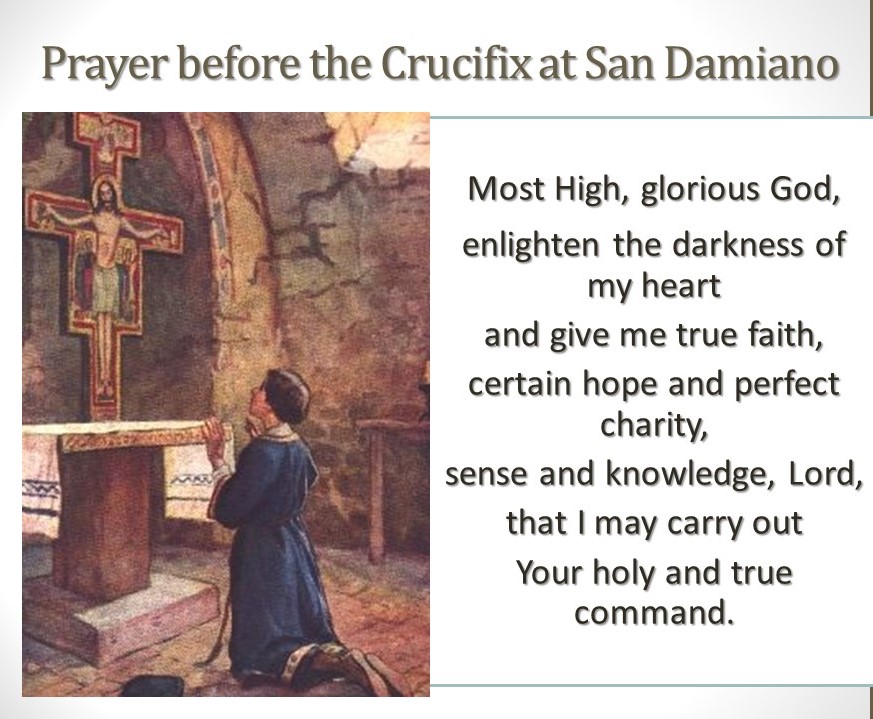
The Prayer before the Crucifix (1205-1206)
“While Thomas of Celano and Saint Bonaventure characterize the early years of Francis’s life as a struggle to discern God’s will, the author of The Legend of the Three Companions, according to two manuscripts, summarizes Francis’s yearnings in this simple prayer and places it on his lips as he kneels before the Crucifix of the crumbling church of San Damiano in Assisi. The prayer may have been influenced by the liturgical opening prayer of the Eucharistic liturgy. This version of the prayer is based on the simple text found in the majority of Latin manuscripts. As it became more popular, the prayer was embellished and lost some of its simplicity.”
FA:ED, vol. 1, 40 https://franciscantradition.org/francis-of-assisi-early-documents/the-saint/writings-of-francis/the-prayer-before-the-crucifix/58-fa-ed-1-page-40Most High, glorious God,
enlighten the darkness of my heart
and give me
true faith,
certain hope,
and perfect charity,
sense and knowledge,
Lord,
that I may carry out
Your holy and true command.As St. Francis knelt before the crucifix of San Damiano, he put himself in God’s hands. It was the beginning for him. Franciscans can pray this prayer every day, but it is especially meaningful for those who are at the “beginning,” those who are discerning a vocation to the Order.
Pray this prayer alone or in a group. Take time to think about the words. Each line has questions for discussion and for commenting on in your journal.
MOST HIGH, GLORIOUS GOD, (Praise)
+How did St. Francis see God? How did he praise him?
++How do you see God? Where do you find him? How do you praise God?
ENLIGHTEN THE DARKNESS OF MY HEART (Repentance)
+What was the “darkness” of his heart? What was he asking to have revealed?
++What is the darkness in your heart? What do you seek? What do you need God to show you?
AND GIVE ME TRUE FAITH, CERTAIN HOPE, AND PERFECT CHARITY, SENSE AND KNOWLEDGE, LORD, (Petition)
+What was Francis asking for? Why are these qualities significant in the spiritual life?
++What will you need to strengthen you spiritually as you discern? Give examples of the roles these virtues play in your life.
THAT I MAY CARRY OUT YOUR HOLY AND TRUE COMMAND. (Resolution)
+Francis stops and listens. Then he resolves to carry out God’s will in his life. What did he do?
++When you pray, do you take time to listen? Do you resolve to imitate Christ? How do you put God’s will into practice?
++++++++++++++++++
Es importante que conozcamos los muchos escritos que nos dejó nuestro fundador. Los franciscanos tienen la bendición de tener muchos de los escritos de San Francisco y Santa Clara. Al leer lo que escribieron y orar como ellos oraron, permitimos que el Espíritu Santo fortalezca nuestra vocación y cómo vivimos el carisma franciscano.
“Mientras Tomás de Celano y San Buenaventura caracterizan los primeros años de la vida de Francisco como una lucha por discernir la voluntad de Dios, el autor de La leyenda de los tres compañeros, según dos manuscritos, resume los anhelos de Francisco en esta sencilla oración y la coloca en su labios mientras se arrodilla ante el crucifijo de la desmoronada iglesia de San Damián en Asís. La oración puede haber sido influenciada por la oración litúrgica de apertura de la liturgia eucarística. Esta versión de la oración se basa en el texto simple que se encuentra en la mayoría de los manuscritos latinos. A medida que se hizo más popular, la oración se embelleció y perdió algo de su simplicidad .”
FA:ED, vol. 1, 40 https://franciscantradition.org/francis-of-assisi-early-documents/the-saint/writings-of-francis/the-prayer-before-the-crucifix/58-fa-ed-1-page-40
Oración ante el Crucifijo de San Damián [OrSD]
https://www.franciscanos.org/esfa/escritossf.html#orsd
Sumo, glorioso Dios,
ilumina las tinieblas de mi corazón
y dame fe recta,
esperanza cierta
y caridad perfecta,
sentido y conocimiento, Señor,
para que cumpla tu santo y verdadero mandamiento.
Cuando San Francisco se arrodilló ante el crucifijo de San Damián, se puso en las manos de Dios. Fue el comienzo para él. Los franciscanos pueden rezar esta oración todos los días, pero es especialmente significativa para aquellos que están en el “comienzo” de su jornada, aquellos que están discerniendo una vocación a la Orden.
Ore esta oración solo o en grupo. Tómese un tiempo para pensar en las palabras. Cada línea tiene preguntas para platicar y comentar en su diario.
SUMO, GLORIOSO DIOS, (Alabanza)
+¿Cómo veía San Francisco a Dios? ¿Cómo lo elogió?
++¿Cómo ve Ud. a Dios? ¿Dónde lo encuentra? ¿Cómo alaba Ud. a Dios?
ILUMINA LAS TINIEBLAS DE MI CORAZÓN (Arrepentimiento)
+¿Cuál era la “oscuridad” del corazón de Francisco? ¿Qué estaba pidiendo que se le revelara?
++¿Cuáles son las tinieblas de su corazón? ¿Qué busca? ¿Qué necesita que Dios le muestre?
Y DAME FE RECTA, ESPERANZA CIERTA Y CARIDAD PERFECTA, SENTIDO Y CONOCIMIENTO, SEÑOR, (Petición)
+¿Qué estaba pidiendo Francisco? ¿Por qué estas cualidades son importantes en la vida espiritual?
++¿Qué necesitará Ud. para fortalecerse espiritualmente mientras discierne? Dé ejemplos del papel que juegan estas virtudes en su vida.
PARA QUE CUMPLA TU SANTO Y VERDADERO MANDAMIENTO. (Resolución)
+Francisco se detiene y escucha. Entonces decide llevar a cabo la voluntad de Dios en su vida. ¿Qué hizo él?
++Cuando rezas, ¿se toma el tiempo para escuchar? ¿Decide imitar a Cristo? ¿Cómo se pone en práctica la voluntad de Dios?
Diane F. Menditto, OFSVice Minister, National Fraternity, Secular Franciscan Order USAListen – Discern – Go Forth National Theme 2022-2025


SHAPING THE FRANCISCAN FOOTPRINT – May 25 – May 31 2023
Shaping the Franciscan Footprint
Five Important Spiritual Thoughts from the Liturgy of the Word
…and follow up for the Secular Franciscan
May 25 – May 31
1 – “There are also many other things that Jesus did, but if these were to be described individually, I do not think the whole world would contain the books that would be written.” (Jn 21:25)
…Have I developed a truly spiritual life based on Jesus?
2 – “And they were all filled with the Holy Spirit and began to speak in different tongues, as the Spirit enabled them to proclaim.” (Acts 2:4)
…Do I “proclaim” the presence of God in the way I act?
3 – He said to his mother, “Woman, behold, your son.” Then he said to the disciple, “Behold, your mother.” (Jn 19:26-27)
Do I have a devotion to the Blessed Virgin Mary?
4 – “Many that are first will be last, and the last will be first.” (Mk 10:31)
HUMILITY
“For everyone who exalts himself will be humbled,
but the one who humbles himself will be exalted.”
(Luke 14:11)
+++
“Many that are first will be last, and the last will be first.”
(Mark 10:31)
+++
“My soul proclaims the greatness of the Lord; my spirit rejoices in God my Savior.”
(Luke 1:46-47
Jeff Kemp, former NFL quarterback in the 80’s, is the son of Jack Kemp also a quarterback who turned politician and who died in 2009. In a speech dealing with “Sports and the American Dream,” Jeff Kemp gave some rules to live by on and off the playing field. His first rule was incredible for a sports professional. His first rule: humility.
He tells a story on himself. He was drafted by the Los Angeles Rams (in those days) in 1981, designated fifth-string quarterback. Actually he became a rather successful quarterback in the NFL, but he did not think he would survive training camp. The rookies were called in first and after about two days, a young boy came to him, and asked if he could carry his helmet to the locker room. Jeff felt rather honored, and liked being an idol for the ten-year-old. During that first week of practice and survival, the young man carried his helmet to the locker room every day. A couple of days before the practice actually started for everyone, the young boy said to him: “Jeff, can I ask you a question?” Jeff thought: this is my first fan; he’s going to ask me for my autograph. He felt good, pleased that he had impressed someone, even if it was a ten-year-old. “Absolutely,” he said. The ten-year-old said: “When do the good football players come to camp?
”Humility,” Jeff Kemp goes on to say, “was a good thing. It helped me appreciate what I had and avoid dwelling on what I did not have. It prevented complaining, which drains the spirit and unity of any group. It also led me to persevere and be ready whenever opportunity presented itself.”
One might not expect humility to be a quality that a former professional player would espouse, but it is one that you might expect from a religious leader. Jesus did exactly that in the Gospels.
Most of us realize that humility is defined to be nothing more or less than the truth, that is, looking at something from an objective point of view. It is very difficult, because we have a tendency to look at everything through our own eyes, with our own agenda, and our own agenda “colors” everything that we see or consider.
In the Gospels, the Pharisees felt that they had the truth, a truth that made them feel more important than anyone else, that they were worthy of respect and admiration. Jesus knew what they were thinking. He explained it to them saying that they must learn humility, that is, the truth, and the truth when it concerns others is that everyone is important.
Lack of humility was a fault that even the Apostles fell into.
The application for us is that we are called to be humble people, people who are dedicated to the truth, and when it concerns others, to realize that they are all equally important. We have a tendency to judge that we are better than others for whatever reason. Maybe we think we have more knowledge, more talent, more age, more money, more maturity, more whatever, and consequently, we place ourselves above others in some sense. We do it in a subtle way, of course. We will never say, “I am more important than you,” but we do it in our thoughts, or in our passing conversations. The objective truth is that everyone is important and we may be distorting that truth by our own jealousy or our own selfishness.
Jesus teaches us a very practical lesson: we must be humble people, that is, we must honor the truth at all times. The Christian will be humble in his/her approach to others not only because he/she is modest and respectful, but because he/she seeks the truth of who they are.
5 – “Blessed are you who believed that what was spoken to you by the Lord would be fulfilled.” (Lk 1:45)
…Mary’s faith was real. Is my faith what it should be?
Good Communication As Part of Our Communications Plan
(This article originally appeared in the TAU-USA Spring Issue #109)
Diane F. Menditto, OFS, National Vice Minister
As Catholics and Secular Franciscans, we are called to shape society and our Order’s future. We are called to be good communicators and users of the means of communication available to us.
When we hear the word “communication,” the first thing that probably comes to mind is media, that is, forms of communication with an “s.” Pope Francis mentioned this in his statement for the 2014 Communications Day when he said, “…media can help us to feel closer to one another, creating a sense of the unity of the human family which can in turn inspire solidarity and serious efforts to ensure a more dignified life for all. Good communication helps us grow closer, to know one another better, and ultimately, to grow in unity.” But he goes on to make the following points:
- “The walls which divide us can be broken down only if we are prepared to listen and learn from one another.”
- “We need to resolve our differences through forms of dialogue which help us grow in understanding and mutual ”
- “A culture of encounter demands that we be ready not only to give, but also to ”
(Message of Pope Francis for the 48th World Communications Day, June 2014)
All the communications (media) in the world go to waste if we do not communicate who we are to others and seek to understand who they are.
How do we communicate? In the Later Rule, St. Francis inspires us, “I counsel, admonish and exhort my brothers in the Lord Jesus Christ not to quarrel or argue or judge others when they go about in the world; 11but let them be meek, peaceful, modest, gentle, and humble (2 Tim 2:14), speaking courteously to everyone, as is becoming.” (The Later Rule: FA:ED, vol. 1, p. 102)
How we communicate makes a big difference, because true communication requires more than words. Start with an open heart. We should not prejudge what another person is going to say. People remember how we handle a situation and, justly or not, assume that the treatment they have seen us give to others in the past will be how we will treat them in the present.
Creating a supportive environment in our fraternities, our families, and our places of work begins with sharing our own story and listening to another person’s story. Once we start to share ourselves with our listeners, they become ready to hear what we say and feel comfortable sharing themselves.
Authentic communication for us as followers of Christ and St. Francis is how others encounter the person of Jesus through us. We should ask ourselves, “How would Jesus communicate with us if he were here now? How did he communicate with those he met here on earth? How did he show that he valued the identity of his listeners?” As we read Scripture, we find Jesus communicating with his disciples, with sinners, with those possessed by evil. He listened to everyone with great empathy. Think also about his physical contact with others: helping someone to stand up; touching eyes and ears with his saliva; realizing that healing power has gone out from him—it’s not always words!
Today, we are bombarded by media and people talking at us. We have stopped listening to each other in many ways, because communications often drown out communication! Overcoming this phenomenon should be one of our goals as Secular Franciscans. But how?
If we examine many of the difficulties we encounter in fraternity, family, and workplace, we will often find a lack of communication at the outset. Often, the issue is compounded by further misunderstanding because we don’t stop to understand where our brother or sister is coming from. Every person deserves our respect because they, like us, are human beings with the Spirit of God within them. We may not like what they are saying, but we are called to respect their dignity, so, we don’t demean or tear them down.
 In our good communication toolbox, we find an excellent talk given by Fr. Eric Law, who spoke at the 2007 Quinquennial Congress. He used the acronym RESPECT to remind us of how we should communicate with one another. R: Take responsibility for what we say and feel without blaming others. E: Use “empathic listening,” meaning that we show the speaker that we are in tune with them and that they are valued and respected. S: Be sensitive to differences in communication styles. P: Ponder what you hear and feel before you speak. (Or before you send an email or make a post!) E: Examine your own assumptions and perceptions. C: Keep Confidentiality. T: Trust ambiguity because we are not here to debate who is right or wrong. Also, trust each other, and develop trust in your fraternity, family, and workplace.
We are called to demonstrate: simplicity—without pretense; poverty— confidence in the Father; humility—the truth of what and who we are before God; minority—recognition that we are servants, not superiors; an abandonment to God—trusting in God’s unconditional love. (See FUN Manual: Vocations; Article 30.2 General Constitutions; and The Franciscan Journey)
If these characteristics are present in us, we will be able and willing to establish trust with our brothers and sisters. We become better communicators, because our respect for others makes us approachable. We are responsive; we keep our promises; we say what we mean, and we mean what we say. We are humble enough to admit our mistakes or admit that not everything we say is the last word. Sometimes a lack of flexibility (stubbornness) can lead to a lack of trust and lack of communication.
Once we know who we are and how we can get along well on a personal level, we are ready to share who we are with others through a good communications plan. Our national and regional websites provide a welcoming environment for our members and those searching to discern a vocation. We attract vocations because visitors can tell that we love our Order and one another just by looking at the websites. We know that our Facebook page is not a place to argue or say controversial things. We try to share the best of who we are and who Francis and Clare are through quotes, formation pieces, wonderful homilies, and excitement over milestones attained by our fraternities. We use Twitter as positive outreach to the public, not to argue or tear down others, but to build up. Among ourselves and publicly, we highlight articles from the TAU newsletter, another communications powerhouse. Local fraternities should follow the example of the National and Regional fraternities. Examine how you communicate with each other and come up with a local plan to spread the word.
You probably have many communications ideas that you would love to share with us. Please do!
We are listening!
Communication is Not Only Words
- Undivided attention and eye contact
- Body Language
- Empathy and mutual support
- Collaboration and sharing of your personal story
- Invitation and outreach
- No personal agenda
- Prayer with and for one another
- Personal example
- Relationship and trust
https://www.secularfranciscansusa.org/2023/05/29/good-communication-as-part-of-our-communications-plan/