Taking Stock 2024 Our Lives of Prayer as Secular Franciscans
“As Minister General of a large Order, St. Bonaventure provided, among other things, spiritual direction for those seeking God. In a letter to Poor Clare nuns, he offered directives as to how we might enter into prayer by way of ‘descent.’
“The steps are summarized as follows:
· Return to yourself; Enter into your heart;
· Ponder what you were, are, should have been, called to be;
· What you are by nature;
· What you are through sin;
· What you should have been through effort;
· What you can still be through grace;
· Meditate in your heart;
· Let your spirit brood. (Are you resentful, angry, jealous?);
· Plow this field, work on yourself;
· Strive for freedom within, the freedom that leads to relationship with God, realizing that God will never force us to love him;
· Lack of self-knowledge and failure to appreciate one’s own worth make for faulty judgment in all other matters;
· If you are not able to understand (and accept) your own self, you will not be able to understand (or accept) what is beyond you.”
Bonaventure, Perfectione vitae ad sorores (Perf. Vit.) 1.5 (VIII, 109). Engl. trans. Jose de Vinck, “On the Perfection of Life, Addressed to Sisters,” in The Works of Bonaventure, vol. 1, Mystical Opscula (Paterson, N.J.: Saint Anthony Guild Press, 1960), 214.
Quoted in: Delio, Ilia. Franciscan Prayer (Kindle Locations 613-616). Kindle Edition.
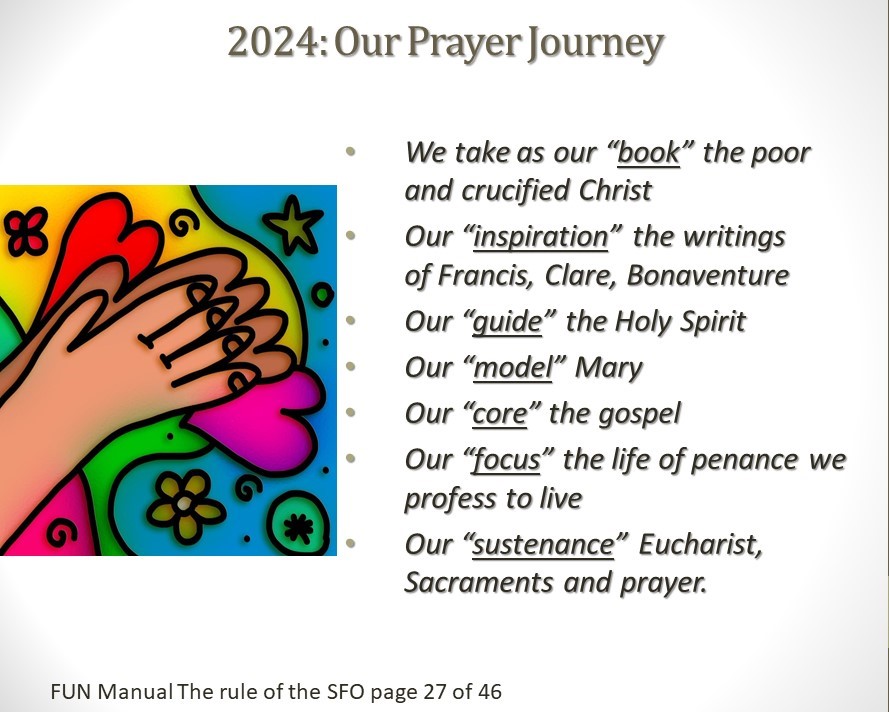
For our Prayer Journey as Secular Franciscans
• We take as our “book” the poor and crucified Christ
• Our “inspiration” the writings of Francis, Clare, Bonaventure
• Our “guide” the Holy Spirit
• Our “model” Mary
• Our “core” the gospel
• Our “focus” the life of penance we profess to live
• Our “sustenance” the Eucharist, Sacraments and prayer.
FUN Manual The rule of the SFO page 27 of 46
Questions for discussion or to comment on in your journal
+How has your prayer life changed over the years?
+If you are a Secular Franciscan, how does your prayer reflect who you are as member (or candidate) of the Order?
+Does prayer influence how you live your life?
+Based on St. Bonaventure’s directives above, how can you strengthen your prayer life?
+++++++++++++++++++
2024 Momento de examinar nuestras vidas de oración como franciscanos seglares
“Como Ministro General de una Orden grande, San Buenaventura proporcionó, entre otras cosas, dirección espiritual para quienes buscaban a Dios. En una carta a las monjas Clarisas, ofreció directivas sobre cómo podríamos entrar en oración a través de la ‘descendencia.’ “
“Los pasos se resumen a continuación:
• Regrese a usted mismo; Entre en su corazón;
• Reflexione sobre lo que usted fue, es, debería haber sido llamado a ser;
• Lo que usted es por naturaleza;
• Qué es usted por el pecado;
• Lo que debería haber sido a través del esfuerzo;
• Lo que aún puede ser gracias a la gracia;
• Medite en su corazón;
• Deje que su espíritu se dé vueltas. (¿Está resentido, enojado, celoso?);
• Are este campo, trabaje en si mismo;
• Luche por la libertad interior, la libertad que conduce a la relación con Dios, reconociendo que Dios nunca nos obligará a amarlo;
• La falta de autoconocimiento y la incapacidad de apreciar el valor propio dan lugar a un juicio erróneo en todos los demás asuntos;
• Si no puede entenderse (y aceptarse) a sí mismo, no podrá comprender (o aceptar) lo que está más allá de usted.”
Buenaventura, Perfectione vitae ad sorores (Perf. Vit.) 1.5 (VIII, 109). Engl. trans. José de Vinck, “Sobre la perfección de la vida, dirigida a las hermanas”, en Las obras de Buenaventura, vol. 1, Mystical Opscula (Paterson, Nueva Jersey: Saint Anthony Guild Press, 1960), 214.
Citado en: Delio, Ilia. Oración franciscana (ubicaciones de Kindle 613-616). Versión Kindle.
Por nuestro viaje de oración como franciscanos seglares
• Tomamos como nuestro “libro” al Cristo pobre y crucificado
• Nuestra “inspiración” los escritos de Francisco, Clara, Buenaventura
• Nuestro “guía” el Espíritu Santo
• Nuestra “modelo” María
• Nuestro “núcleo” el evangelio
• Nuestro “enfoque” la vida de penitencia que profesamos vivir
• Nuestro “sustento” la Eucaristía, los Sacramentos y la oración.
FUN Manual La regla de la OFS página 27 de 46
Preguntas para platicar o comentar en su diario
+ ¿Cómo ha cambiado su vida de oración a lo largo de los años?
+ Si es un franciscano seglar, ¿cómo refleja su oración quién es como miembro (o candidato) de la Orden?
+ ¿Influye la oración en cómo vive su vida?
+ Según las directivas de San Buenaventura ya mencionadas, ¿cómo puede fortalecer su vida de oración?
Diane F. Menditto, OFSVice Minister, National Fraternity, Secular Franciscan Order USAListen – Discern – Go Forth National Theme 2022-2025
Opening ceremony for the anniversary of the Stigmata of St. Francis is Friday
 The solemn opening ceremony of the 800th anniversary celebration of the Stigmata of St. Francis of Assisi will be broadcast online Friday, Jan. 5.
The event will be streamed live on the website centenarifrancescani.org at 11 a.m. in Rome, which is 5 a.m. Eastern Time in the U.S.
Resources for observing and learning more about the gift of the stigmata can be found on our website at https://www.secularfranciscansusa.org/centenary-resources-the-gift-of-the-stigmata/
https://www.secularfranciscansusa.org/2024/01/02/opening-ceremony-for-the-anniversary-of-the-stigmata-of-st-francis-is-friday/
Chapter Day Away
(This article originally appeared in the TAU-USA Fall 2023 Issue #110)
by Vickie Klick, OFS
Celebrating the Feast Day at the Cathedral Basilica of St. Louis
 100vw, 361px” data-recalc-dims=”1″></p>
<p id=) Off on a Day Away – Chapter attendees traveled to downtown
Off on a Day Away – Chapter attendees traveled to downtownSt. Louis for Mass and a tour of the St. Louis Basilica-
Cathedral on a record-breaking 104° day.
National Chapter attendees celebrated the feast of our patron, St. Louis IX, King of France, at a Mass at the Cathedral Basilica of St. Louis at its 2023 Chapter on the feast day of St. Louis, Aug. 25. Fr. Tom Nairn, OFM, provincial of Sacred Heart province, was the celebrant.
Fr. Nairn is author of “A Franciscan Spirituality of Discernment”, the source of the National Fraternity’s theme “Listen, Discern, Go Forth.” He is provincial minister of the Franciscan Province of the Sacred Heart located in St. Louis.
 St. Louis was king of France from 1226 to 1270. He is known for his kindness and service to the poor, which included making sure that those in his community were fed daily. He would often help serve the meals.
Fr. Tom’s homily reflected on how odd it seemed to have a king and a crusader as a patron of our order. He connected the readings from Wisdom, 2 Timothy, and the parable of the talents from Luke to show St. Louis as a king who was a servant leader, who cared for the poor personally, who worked for peace, and who was a true evangelist. Using Francis’ Letter to All the Faithful, Fr. Tom presented St. Louis as a model of what it means to be a member of the Franciscan family.
The cathedral is a stupendous experience in itself and a representation of Byzantine and Romanesque design. The interior is covered with 83,000 square feet of mosaics, depicting scenes from the Old and New Testaments, the religious history of the city of St. Louis, and, in the narthex, the life of St. Louis. One of the scenes shows St. Louis receiving the habit of the Third Order of St. Francis, our Secular Franciscan Order. It was very special to celebrate the feast there.
Originally designated a cathedral, it was given the distinction of a cathedral basilica in 1997 by Pope John Paul II who visited it in 1999. A basilica is the highest designation that can be given to a church building and is only bestowed by the Pope. The three signs that a church has been named a basilica are the presence of the Ombrellino (umbrella), Tintinnabulum (Bells), and the Papal Cross Keys. A cathedral is the home church for the bishop or archbishop of the diocese.
https://www.secularfranciscansusa.org/2024/01/01/chapter-day-away/

Formation Friday – Examine our Love & Commitment – December 29, 2023
2024—Time to Examine our Love and Commitment
• CONVERSION: the letting go of one’s ego…”
• “One is dying to a false self that tries to BE God, that tries to always be in control.”
• This is a reversal, a “TURNING TOWARD” the Holy Spirit at work within us.
– Francis and Jesus by Murray Bodo, OFM
What can I do to make some beneficial changes in my attitude about fraternity and fraternal life?
1- Prayerfully participate in electing and supporting my local Council.
· Pray for them every day.
· Use my God-given talents to collaborate on and assist with all projects.
+What are some ways I can support my Council?
+Do I have talents and abilities that call me to serve on the Council?2- Love my fraternity
· Be present at gatherings.
· Listen to my brothers and sisters.
· Offer to help out.
· Reach out to excused members or to anyone who has missed a meeting. (Phone, email, card).
· Pray for our deceased members and for all those listed on your fraternity prayer list or prayer line
· Take note that for Franciscans, fraternity is a way of life (not just another “thing to do”).
+What talents do I have to offer my fraternity?
+Do I participate willingly in fraternity activities?3- Love our Rule
· Be sure that I am aware of what I promised at profession.
· Read, pray and meditate on the Rule—perhaps one or two articles each day.
· Think about how the Rule leads me closer to Christ.
+When was the last time I read the Rule?
+Do I make the effort to relate the Rule to my everyday life?
4- Love Scripture
· Be aware that St. Francis based everything he said or wrote on Scripture.
· Resolve to read a little Scripture each day.
· Pray the Liturgy of the Hours because it helps us to pray in fraternity (with the entire Church) and is filled with Scripture.
+Do I read Scripture each day? (How can I make time to do this?)
+Do I go from Gospel to life and life to the Gospel? (Do I understand what that means? How would I explain it to someone new or to a non-Secular Franciscan?
5- Strive for daily conversion
· Attempt to be a little better each day.
· Make use of the Sacrament of Reconciliation.
· Remember that we are the “Brothers and Sisters of Penance.”
+Do I review my actions and relationship with God each day?
+How have I changed since I first became a Franciscan? How have I changed since last week?BEST FOR LAST
6- Love the Eucharist and be changed by it
· Attend Mass on Sundays and Holy days and every day if I can
· Take advantage of opportunities for Adoration—holy hours or just a visit to the tabernacle
+What is my relationship to Jesus in the Eucharist?
+Do I often visit with Jesus when there is an opportunity to attend Adoration?
As we enter 2024, ask the Holy Spirit to guide you in everything you do!
The questions above are to answer in your journal and then to discuss in fraternity.
++++++++++++++++++++++++
2024 — Es hora de examinar nuestro amor y compromiso
• CONVERSIÓN: soltar el ego de uno … “
• “Uno se está muriendo a un falso yo que trata de SER Dios, que trata de tener siempre el control.”
• Esta es una inversión, un “GIRAR HACIA” el Espíritu Santo obrando dentro de nosotros.
– Francisco y Jesús de Murray Bodo, OFM
¿Qué puedo hacer para realizar cambios beneficiosos en mi actitud sobre la fraternidad y la vida fraterna?
1- Participar con oración en la elección y apoyo de mi Consejo local.
• Orar por ellos todos los días.
• Usar mis talentos dados por Dios para colaborar y ayudar con todos los proyectos.
+ ¿De qué formas puedo apoyar a mi Consejo?
+ ¿Tengo talentos y habilidades que me llamen a servir en el Consejo?
2- Amar mi fraternidad
• Estar presente en las reuniones.
• Escuchar a mis hermanos y hermanas.
• Ofrecerme para ayudar.
• Comunicarme con los miembros excusados o con cualquier persona que se haya perdido una reunión. (Por teléfono, correo electrónico, tarjeta).
• Orar por nuestros miembros fallecidos y por todos los que figuran en la lista de oración o línea de oración.
• Tener en cuenta que para los franciscanos, la fraternidad es una forma de vida (no simplemente otra “cosa que hacer.”)
+ ¿Qué talentos tengo para ofrecer a mi fraternidad?
+ ¿Participo de buena voluntad en las actividades de la fraternidad?
3- Amar nuestra regla
• Asegurarme de estar al tanto de lo que prometí en la profesión.
• Leer, orar y meditar en la Regla, tal vez uno o dos artículos cada día.
• Pensar en cómo la Regla me acerca a Cristo.
+ ¿Cuándo fue la última vez que leí la Regla?
+ ¿Me esfuerzo por relacionar la Regla con mi vida diaria?
4- Amar las Escrituras
• Tener en cuenta que San Francisco basó todo lo que dijo o escribió en las Escrituras.
• Tomar la determinación de leer un poco de las Escrituras todos los días.
• Rezar la Liturgia de las Horas porque me ayuda a rezar en fraternidad (con toda la Iglesia) y está llena de Escritura.
+ ¿Leo las Escrituras todos los días? (¿Cómo puedo apartar tiempo para hacer esto?)
+ ¿Paso del Evangelio a la vida y de la vida al Evangelio? (¿Entiendo lo que eso significa?) ¿Cómo se lo explicaría a alguien nuevo o a una persona que no es franciscano seglar?
5- Esforsarse por la conversión diaria
• Intentar mejorar un poco cada día.
• Hacer uso del Sacramento de la Reconciliación.
• Recordar que somos los “Hermanos y Hermanas de la Penitencia.”
+ ¿Reviso mis acciones y mi relación con Dios todos los días?
+ ¿Cómo he cambiado desde que me profesé como franciscano? ¿Cómo he cambiado desde la semana pasada?
LO MEJOR PARA EL FINAL
6- Amar la Eucaristía y ser cambiado por ella
• Asistir a misa los domingos y días santos y todos los días si puedo
• Aprovechar de las oportunidades de adoración: horas santas o simplemente una visita al tabernáculo.
+ ¿Cuál es mi relación con Jesús en la Eucaristía?
+ ¿Visito a menudo a Jesús cuando tengo la oportunidad de asistir a la Adoración?
Al entrar en 2024, ¡pídale al Espíritu Santo que lo guíe en todo lo que haga!
Las preguntas anteriores son para responder en su diario y luego para discutir en fraternidad.
Diane F. Menditto, OFSVice Minister, National Fraternity, Secular Franciscan Order USAListen – Discern – Go Forth National Theme 2022-2025
Christmas at Greccio (1223)
(This article originally appeared in the TAU-USA Fall 2023 Issue #110)
by Bret Thoman, OFS
 100vw, 292px” data-recalc-dims=”1″></p>
<p id=) Greccio grotto where the first nativity scene took place
Greccio grotto where the first nativity scene took place
This year, the Franciscan Family continues to observe a series of eight-centenary commemorations. In 2023, we are reflecting on two important events that occurred 800 years ago: the Approval of the Later Rule and the reenactment of Christmas at Greccio.
Not far from Rieti, in the northernmost part of the eponymous valley, is the hill town of Greccio. Home to just about 100 residents, the village is famed for an event that took place in 1223. Within a grotto nestled within a cliff, here, St. Francis of Assisi reenacted the first nativity scene.
Referred to locally as the “New Bethlehem,” St. Francis desired to recreate a living nativity scene (with live animals and hay) in order to render the feast of the birth of Christ more real. Before this event, the feast of the Nativity of Christ was a minor feast in the liturgical calendar of the Church.
St. Francis had been to Greccio several times and was close to a local knight and tertiary named Giovanni (John).
Francis told John that he wished to “enact the memory of that babe who was born in Bethlehem: to see as much as is possible with my own bodily eyes the discomfort of his infant needs, how he lay in a manger, and how, with an ox and a donkey standing by, he rested on hay” (Thomas of Celano, First Life, Chapter 30).
The site was a cave on the face of a cliff some three kilometers (2 miles) from the village. With John’s assistance, animals were led to the grotto and hay and a manger were installed. St. Francis, a deacon, served at the Mass. The liturgy came to life spectacularly. The people gathered entered into the mystery of the incarnation in an entirely novel way as they saw with their eyes what Christmas meant.
Afterwards, an altar was constructed over the manger and a small church was built around the grotto. A similar Mass was celebrated the following year. In time, the practice spread to other parts of the region, then all of Italy. Soon, people everywhere began reenacting Christmas in such a way.
 100vw, 272px” data-recalc-dims=”1″></p>
<p id=) The hermitage of Greccio stands out prominently on the side of a cliff.
The hermitage of Greccio stands out prominently on the side of a cliff.
Today, Greccio is visited by tens of thousands of pilgrims each year. A hermitage staffed by OFM Franciscan friars safeguards the grotto where St. Francis recreated the first creche. Around the cave is an ancient hermitage where St. Francis and the early friars lived in the early thirteenth century. It includes a primitive refectory and dormitory. Above it is the newer hermitage (that is, from the mid-thirteenth century), built during the era of St. Bonaventure, the Minister General of the order. The small, wooden cells can be visited along with the ancient choir and church.
Next to the old church is a modern church with a display of hand-crafted creches along an upper corridor. Particularly striking are those from the school of Naples, known for a long tradition of artisanship and nativity scenes. The message is that the birth of Jesus was not an event that took place remotely in a faraway age and place; rather, our Savior is with us here and now
The grotto where the first nativity scene took place
The hermitage of Greccio stands out prominently on the side of a cliff.
https://www.secularfranciscansusa.org/2023/12/25/christmas-at-greccio-1223/