Open post

Formation Friday (with attachment) Apr 17, 2020

 
Examine your Love and Commitment


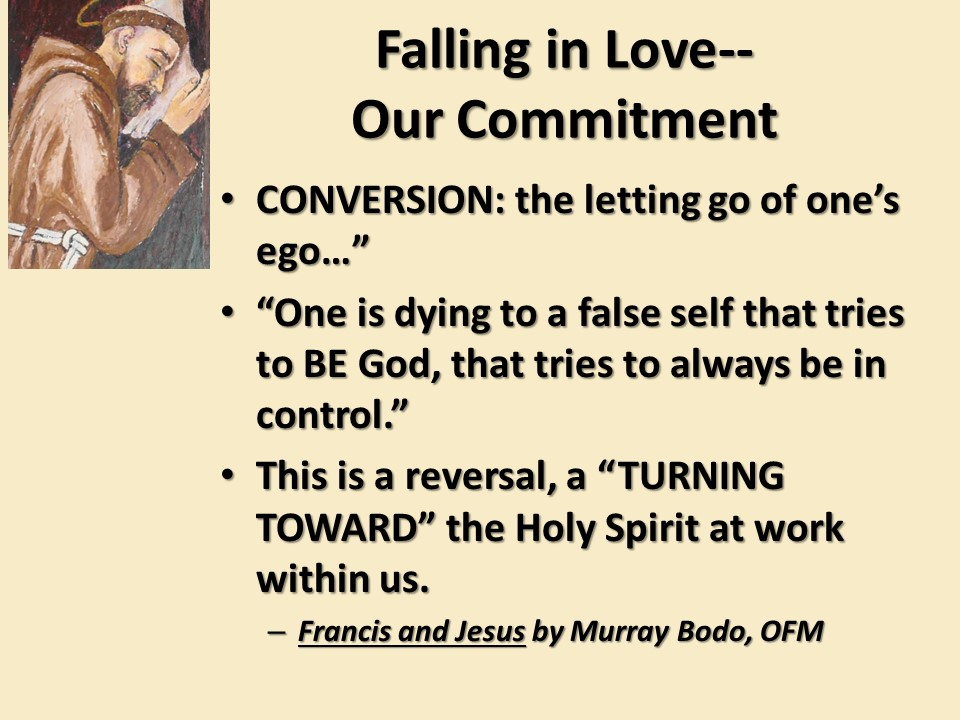
CONVERSION: the letting go of one’s ego…”


• “One is dying to a false self that tries to BE God, that tries to always be in control.”


• This is a reversal, a “TURNING TOWARD” the Holy Spirit at work within us.


Francis and Jesus by Murray Bodo, OFM


1- Prayerfully participate in electing and supporting my local Council.


• Pray for them every day
• Use my God-given talents to collaborate on and assist with all projects.
 
What are some ways I can support my Councill?
Do I have talents and abilities that call me to serve on the Council?
 
2- Love my fraternity


• Be present at gatherings.
• Listen to my brothers and sisters.
• Offer to help out
• Reach out to excused members or to anyone who has missed a meeting. (Phone, email, card).
• Pray for our deceased members and for all those listed on the Prayer list
• Take note that for Franciscans, fraternity is a way of life (not just another “thing to do”).
 
What talents do I have to offer my fraternity?
Do I participate willingly in fraternity activities?
 
3- Love our Rule


• Be sure that I am aware of what I promised at profession.
• Read, pray and meditate on the Rule—perhaps one or two articles each day.
• Think about how the Rule leads me closer to Christ.
 
When was the last time I read the Rule?
Do I relate the Rule to my everyday life?
 
4- Love Scripture


• Be aware that St. Francis based everything he said or wrote on Scripture.
• Resolve to read a little Scripture each day.
• Pray the Liturgy of the Hours because it helps me pray in fraternity (with the entire Church) and is filled with Scripture.
 
Do I read Scripture each day?
Do I go from Gospel to life and life to the Gospel?
 
5- Strive for daily conversion


• Attempt to be a little better each day.
• Make use of the Sacrament of Reconciliation.
• Remember that we are the “Brothers and Sisters of Penance.”
 
Do I review my actions and relationship with God each day?
How have I changed since I first became a Franciscan? How have I changed since last week?
 
BEST FOR LAST


6- Love the Eucharist and be changed by it
• Attend Mass on Sundays and Holy days and every day if I can
• Take advantage of opportunities for Adoration—holy hours or just a visit to the tabernacle
 
What is my relationship with Jesus in the Eucharist?
Do I often visit with Jesus when there is an opportunity to attend Adoration?


Diane F. Menditto, OFS

Chair, National Formation Commission


The (Still) Basic C’s of the Franciscan Charism 5PointPlan pg 64-70

The entire National Executive Council (NEC) was recently blessed to spend an entire day with all the current Friars on the Conference of National Spiritual Assistants (CNSA). We met together; celebrated the Holy Sacrifice of the Mass together, shared three regular meals together, walked and talked and relaxed together for an entire day, the first time I have enjoyed such an entire day with all the NEC and all the CNSA meeting and sharing together.

I would encourage the next NEC and CNSA, as well as Regional Executive Councils and Regional Spiritual Assistants in each of our 30 Regions to do the same: an entire day together, just with each other, at least once every three years.

During one of our discussions, Friar Matthias Wesnofske, OFM Capuchin, the only Friar I know who has, as his responsibilities, one National Fraternity, two Regional Fraternities and, I believe, seven Local Fraternities, as well as managing correspondence instruction for Spiritual Assistant Training, well, Friar Matthias said to the effect that despite all the “new scholarship” and “new insights” into Franciscan spirituality, he still felt that what he had learned and always believed and taught was true: that the four basic aspects of the Franciscan Charism were the Crib, the Cross, the Cup and Creation.

Not blessed with a tape recorder at the time or anything approaching “total recall,” permit me to expand Friar Matthias in my own words, with apologies to him, especially if I get something wrong!

The first C is the Crib. In my mind’s eye, I can still see the Giotto fresco of St. Francis preparing the Christmas crib or, in Italian, “presepe” at Greccio, hanging above me to the right as I faced the altar at the Upper Basilica of St. Francis in Assisi as we celebrated the Installation Mass for the newly elected officers of the International Fraternity in November 2014.  This fresco painting and the work of St. Francis to prepare and celebrate the birth of Christ have influenced every subsequent nativity scene in your house or local Church.

The Franciscan Charism with the Crib is our firm foundational Franciscan faith in the Incarnation; namely, that the Word was made flesh and dwelt among us. Jesus is Emmanuel, God with us, humbling Himself out of love for God and for all Creation.

The second C is the Cross. Of course, Jesus’ love did not stop at the Crib. Jesus’ love for us carried all the way to the Cross, to his laying down his life for all of us. ”Greater love has no one than this: to lay down one’s life for one’s friends” (John 15:13).

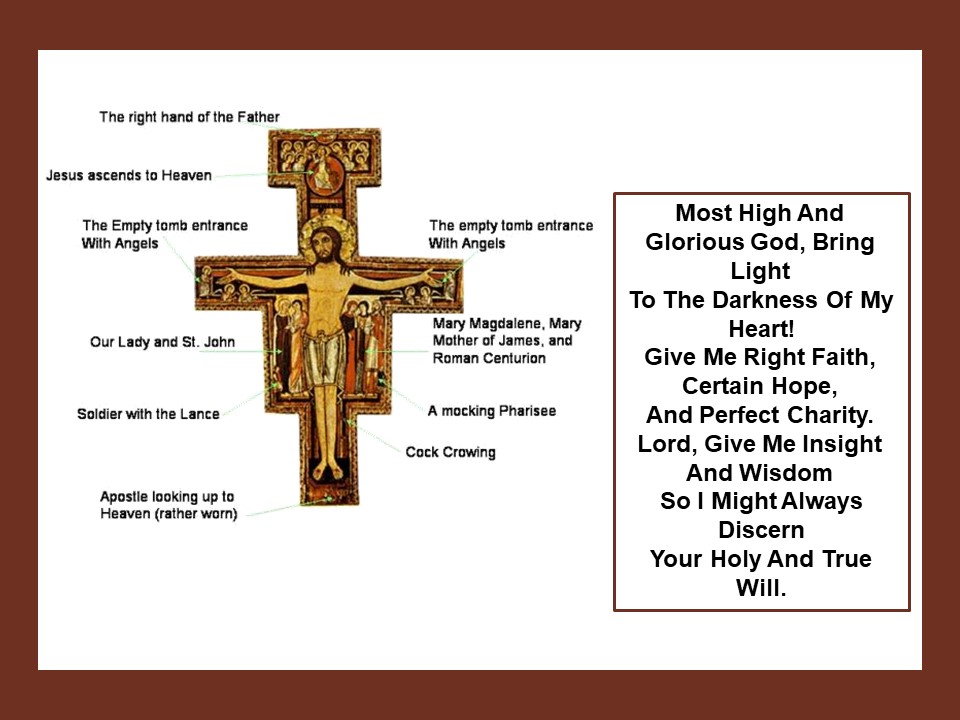
Again, in my mind’s eye, I can see above and before me the original San

Damiano Cross hanging in the Church of Santa Chiara in Assisi.

This Cross, so important to both Sts. Francis and Clare, depicts a loving, relational sacrifice shared with God’s Creation: angels, humans and even a rooster! Christ hangs bleeding on the Cross, yes, but His eyes are open, and His face shows that perfect joy of suffering accepted for the love of God and the love of all of us.

That love and sharing extend to the third C, which is the Cup.

The Cup of the Eucharist, the Blood and Body of Christ, keep us close to the Christ of the Crib, the Christ of the Incarnation, and the Christ of the Cross. The Holy Sacrifice of the Mass not only re-presents the Passion and Death of Christ, but also continues His loving, giving presence among us, Emmanuel, the God Who will never leave us.

As Saint Francis often said, “I see nothing bodily of the Most High Son of God in this world except his most holy body and blood” (Secular Franciscan Rule 5).

This presence of Christ in the Incarnation and in the Eucharist continues in the fourth C, which is Creation. Again, I can see in my mind’s eye, to the right, as I exit toward the front doors of the Upper Basilica of St. Francis in Assisi, the great Giotto fresco of St. Francis preaching to the birds.

This love of Francis for all of God’s Creation is a love of God in all Creation.

Thus, in the Franciscan Charism, the 4 C’s are inter-related, not unlike the inter-relationship of the Father, Son and Holy Spirit. Crib leads to Cross, which leads to Cup, which continues Christ’s Presence in all Creation, physically begun at the Incarnation.

A fifth and uniting C would be Christ Himself because all the 4 C’s focus on Christ. Christ is the center. Christ came among us poor and laid in a Crib. Christ lived among us, loving us, even to dying on the Cross for us. Christ continues to live with us both in His most bodily form in the Cup of the Holy Eucharist, and also in all of Creation, as both author and ultimate goal.

Indeed, a sixth C would be Christ’s example of Conversion. As we can read in Philippians 2:6-8: though Christ was in the form of God, Christ did not deem equality with God as something to be grasped. Rather He emptied Himself and became like us, human in appearance. He humbled Himself, becoming obedient to death, even death on a Cross.

So each of us is called, as followers of Christ in the footsteps of Sts. Francis and Clare, to daily, ongoing conversion, to a daily striving to model our thoughts and deeds to those of Christ (see Secular Franciscan Rule 7).

Friar Matthias said all this much better, and other Franciscan scholars have written longer and more clearly on each of these aspects, but I have tried to share the four foundational C’s of our great Franciscan Charism, reinforced so strongly for me in the great art seen so recently in Assisi and in the Celebration of the Holy Mass there by our friars and Pope Francis.

Peace and love,

Tom

Reflection Questions

  1. According to Friar Matthias Wesnofske, OFM Capuchin, what are still, despite all the new scholarship, the four basic aspects of the Franciscan charism?
  2. What would be the first basic aspect? Why might this aspect be listed first? Explain this aspect in your own words.
  3. What would be the second basic aspect? Why might this aspect be listed second? Explain this aspect in your own words.
  4. What would be the third basic aspect? Why might this aspect be listed third? Explain this aspect in your own words.
  5. What would be the fourth basic aspect? Why might this aspect be listed fourth? Explain this aspect in your own words.
  6. Who, of course, unites all these aspects?
  7. What might be a sixth aspect to guide our daily lives? Explain this aspect in your own words.

This is an excerpt from a series of articles by the late Deacon Tom Bello, OFS, former Minister of the National Secular Franciscan Order – USA.  “Many of these essays were originally published in TAU-USA, our national newsletter,” said Jan Parker, OFS, current National Minister. “They are excellent for reflection and ongoing formation.”  Jan helped Tom publish these  essays in book form.  It is called  For All The Saints:  St. Francis’s Five-Point Plan for Salvation and is available from Tau Publishing. These excerpts will appear several times a week on the Secular Franciscans website.

https://secularfranciscansusa.org/2020/04/15/the-still-basic-cs-of-the-franciscan-charism-5pointplan-pg-64-70/
Follow Me – Five Point Plan pgs 59-63

Permit me to offer in this article the “flip side” of the article “Miserando atque Eligendo.” In that article, I focused on Christ’s “looking with mercy” (miserando) on Levi, a tax collector, on our Holy Father Pope Francis and on all of us in “choosing” (eligendo) us to follow Him. In this article, I will focus on our response to our Lord’s merciful choice or election of us to “Follow me.” (Christ is on the right side of the great Caravaggio painting “The Calling of St. Matthew” above; now I will concentrate on Levi/Matthew on the left side of the painting.)
As you may recall, “Miserando atque Eligendo” is from a famous homily by St. Bede on the Call of St. Matthew in the Office of Readings for his Feast Day on September 21, and St. Bede wrote what it meant for Matthew and for us to “follow” the Lord Jesus:

“By ‘follow’ he meant not so much the movement of feet as of the heart, the carrying out of a way of life. For one who says that he lives in Christ ought himself to walk just as he walked, not to aim at earthly things, not to pursue perishable gains, but to flee base praise, to embrace willingly the contempt of all that is worldly for the sake of heavenly glory, to do good to all, to inflict injuries upon no one in bitterness, to suffer patiently those injuries that come to oneself, to ask God’s forgiveness for those who oppress, never to seek one’s own glory but always God’s, and to uphold whatever helps one love heavenly things. This is what is meant by following Christ. In this way, disregarding earthly gains, Matthew attached himself to the band of followers of One who had no riches. For the Lord himself, who outwardly called Matthew by a word, inwardly bestowed upon him the gift of an invisible impulse so that he was able to follow.”

That “gift of an invisible impulse” is the gift of sanctifying grace that Christ is ready, in His mercy, to bestow on all who, like Levi the tax collector, are ready to turn away from sin and be faithful to the Gospel.

Thus, the call to “follow me” is a call to conversion. This call to conversion is truly the Lenten call, clearly the Christian call, clearly our call as Secular Franciscans. Christ is calling all of us every day. Every day. All of us. Our very Secular Franciscan Rule 7 says “United by their vocation as ‘brothers and sisters of penance’ and motivated by the dynamic power of the gospel, let them conform their thoughts and deeds to those of Christ by means of that radical interior change which the gospel calls ‘conversion.’ Human frailty makes it necessary that this conversion be carried out daily.”

The very first words that Christ utters in the historically first written gospel are uttered to all, even before the call of the first disciples: “This is the time of fulfillment. The kingdom of God is at hand. Repent and believe in the gospel” (Mark 1:15).

And as we know from The Dogmatic Constitution of the Church, Lumen Gentium (LG), in its challenging Fifth Chapter, entitled “The Universal Call to Holiness in the Church,” that call to all, that universal call to “follow me,” is a call to holiness: “The Lord Jesus, the divine Teacher and Model of all perfection, preached holiness of life to each and every one of His disciples of every condition” (LG 40 1st Para.). “All are called to holiness” (Catechism of the Catholic Church (CCC) 2013). “All the faithful of Christ are invited to strive for the holiness and perfection of their own proper state. Indeed they have an obligation to so strive” (LG 42 5th Para.).

Okay, well, what is holiness? CCC 2028, quoting LG 40 2nd Para., reads “All Christians . . . are called to the fullness of Christian life and to the perfection of charity.” Wow! The perfection of charity. To which a quote from St. Gregory of Nyssa, brother of St. Basil, is added: “Christian perfection has but one limit, that of having none.”

There’s a worthy goal to wrap ourselves around: the perfection of charity. Let’s say it again: the perfection of charity! Now we know where we’re headed. Now we know the way to get there. Now we surely know we can’t do it on our own: be perfect in charity? We need God’s great grace. We need the help of our brothers and sisters, the help of our great Franciscan family.

We should also now know what sin is. Quite simply, sin detracts or draws us away from that perfection of charity. We are not following God; we are following our own will, our desire for pleasure,  the will of the world or, worst of all, the will of the devil: “sensual lust, enticement for the eyes, and a pretentious life” (1 John 2:16). Thus, the three great works of conversion, the three great works of Lent: self-denial or fasting to combat sensual lust; charity or almsgiving to combat enticements for the eyes; and prayer or turning to God to combat the pretentious life. All lead to holiness, the perfection of charity.

If we are sincere about following Christ and committed to pursuing the perfection of charity, let us learn, almost by second nature, always to ask: is this thought being thought in charity? Are these words being formed in charity? Will these words be spoken in charity? Is this contemplated action being contemplated in charity? Will this action thus be done in charity? Will I receive this person approaching me, sitting near me, driving beside me, in charity?

Of course, to some extent, we cannot control certain basic impulses or what other people may think about us or say or do to us. Nonetheless, we can try to control how we respond to those inner impulses and to what we receive or perceive from outside. That’s when and where charity must kick in.

Again, Christ or Charity is the way. Christ or Charity is the goal. Christ or Charity should be the spark that fires our thoughts, words and deeds. If not, we run the risk of not following Christ. We run the risk of imperfection. We run the risk of sin.

One final note. A friendly Pastor once pulled me aside and gave in similar words the following “chiding” I offer to you:

“Tom, the Lord said, ‘Follow me.’ He didn’t say ‘Go out in front and show me how it should be done. I went into the desert to be tempted directly by the devil so that you would not have to go and seek the devil directly. I was hung on the Cross for the ransom of many so that you do not need to try single-handedly to sacrifice yourself for the ransom of many. I need to go first, not you. Okay?”

Moreover, Christ said ‘Follow me,’ not ‘Tom, walk here beside me.’ Yes, I may need to carry you from time to time, but you don’t need to be beside me pointing out how you don’t like how this or that is done or not done in My Church, by My bishops and priests. No, I’m not looking for an equal. I already have the Father and the Holy Spirit. I just need you to ‘follow me.’ Okay?”

Sisters and Brothers, let us pray for one another that we may be given the grace to follow wherever Christ chooses to lead us.

Reflection Questions

  1. With what part of our bodies should we start with when we try to obey the Lord’s call to “follow me”? Whose help do we always need to answer this call?
  2. How is the Lord’s call to “follow me” a call to conversion? What other call does the Lord make to conversion in the Gospels?
  3. What are the exact words of our Secular Franciscan Rule 7?
  4. How is the Lord’s call to “follow me” a call to holiness? What is your personal definition of holiness?
  5. And what is your personal definition of sin? How do we avoid our own personal sins?
  6. In what ways is the Lord’s call to “follow me” NOT a call to go in front?
  7. In what ways is the Lord’s call to “follow me” NOT a call to walk side by side?

This is an excerpt from a series of articles by the late Deacon Tom Bello, OFS, former Minister of the National Secular Franciscan Order – USA.  “Many of these essays were originally published in TAU-USA, our national newsletter,” said Jan Parker, OFS, current National Minister. “They are excellent for reflection and ongoing formation.”  Jan helped Tom publish these  essays in book form.  It is called  For All The Saints:  St. Francis’s Five-Point Plan for Salvation and is available from Tau Publishing. These excerpts will appear several times a week on the Secular Franciscans website.

https://secularfranciscansusa.org/2020/04/13/follow-me-five-point-plan-pgs-59-63/

Open post

Formation Friday – The Cross of San Damiano Apr 12, 2020

Formation Friday – Good Friday 2020 (Important graphic attached)

Pray – Learn – Reflect
 
San Damiano Cross
 
Reflections on The Cross of San Damiano
By Patrick McNamara, OFM, Cap.
 
I look to the Cross, I gaze upon its figure,
I wait, I listen, I hope.
 
Will you speak, will you move, will I be moved.
 
Will you once again touch the heart of one who seeks.
Of one who questions, of one who seems so lost.
 
Will you embrace the soul, as you did that of Francis.
Will you take it to Yourself.
 
Will you give it peace, give it comfort, give it love
 
This soul waits, listens, prays for such grace.
This soul seeks the Love from the Lover.
 
It wavers. It stumbles. It falls.
 
Your gaze looks down, embraces all.
Takes all, Loves All. Your Grace heals, accepts.
 
Again you respond, Again you Love.
Again you speak to a searching and troubled heart. I turn.
I continue the journey. I continue in Hope.
I too have heard you Speak.
 
Read about the San Damiano Cross
 

Diane F. Menditto, OFS

Chair, National Formation Commission


__,_._,___


Peace and blessings, 
Dona Gibbons OFS
Regional Formation Director


Miserando atque Eligendo

On Tuesday evening, October 15, 2013, I welcomed everyone to our National Chapter at the Savior Pastoral Center outside of Kansas City, Kansas, with the words: “Miserando atque Eligendo.” I chose these words because since our last National Chapter in 2012, we and the whole Catholic Church have been blessed with a new Holy Father, the first who had chosen the name of Francis! These Latin words form Pope Francis’ Papal Motto, displayed just below his Papal Coat of Arms. Even if they are hard words to translate, “Miserando atque Eligendo” are words clearly important to our Holy Father, and they should be important to us as followers of Christ in the footsteps of St. Francis and Pope Francis.

The words, “Miserando atque Eligendo,” come from a description of the Call of Matthew by St. Bede, given in the Second Reading from the Divine Office for the Feast of St. Matthew on September 21. The whole Latin description “Vidit ergo Jesus publicanum, et quia miserando atque eligendo vidit, ait illi, ‘Sequere me’.” might be translated as “Jesus therefore sees the tax collector, and since he sees by having mercy (or by looking at him with the eyes of mercy) (or by “mercy-ing” him, as the Holy Father has translated it) (miserando)  and (atque) by choosing (eligendo), he says to him, ‘Follow me’.”

Thus, St. Bede’s inspiring homily offers a meditation on divine mercy, for Jesus calls Matthew (which means “gift of God”) not for what he was (a tax collector and sinner), but for what he could be (an Apostle and Gospel writer) if he only said yes to the grace of God. And once he said yes to God, “Matthew drew after him a whole crowd of sinners along the same road to salvation,” writes St. Bede.

According to the news agency ZENIT, which quoted a communiqué about the Papal Motto, a young Jorge Bergoglio, at the age of 17, after Confession, “experienced in a particular way, the loving presence of God in his life.  . . . (H)is heart was touched by the descent of the mercy of God, who with tender love called him to the religious life” (http://www.zenit.org/en/articles/pope-s-motto-miserando-atque-eligendo).

Jorge Bergoglio became, of course, our new Holy Father, and in a now-famous interview (“A Big Heart Open to God” http://www.americamagazine.org/pope-interview), Pope Francis compares his own conversion to Caravaggio’s beautiful painting, “The Calling of St. Matthew,” hanging in Rome. And like St. Matthew, Pope Francis has spent the early days of his Papacy calling sinners to the mercy and salvation of God.

Although we may never become Popes, all of us have received the Lord’s mercy and have been chosen “before the foundation of the world to be holy and without blemish before him” (Ephesians 1:4). The Lord looked with love upon us when He chose us, perhaps through our parents and the Holy Spirit, to receive the great Sacrament of Initiation at our Baptisms. The Lord “mercied” us, if you will, and chose us when He called us to profess ourselves permanently as Secular Franciscans.

The Lord continues to look upon us with mercy and choose us at every Holy Sacrifice of the Mass as we receive His Body, Blood, Soul and Divinity. The Lord continues to love us and shower us with mercy every time we confess our sins and choose, only with God’s great grace, to begin a new life of grace. The Lord continues to mercy us, if you will, every day by sustaining our very lives and by choosing us to follow Him anew as we turn away from sin and are faithful to the Gospel, a conversion we Secular Franciscans must make on a daily basis, even today as we read these words (Secular Franciscan Rule 7).

You may recall a recent Gospel from St. Luke on the Twenty-fourth Sunday in Ordinary Time. There were three mercy-ings, if you will, the return of the prodigal son, the finding of the lost sheep and the finding of the lost coin (Luke 15:1-32). The parable of the prodigal son is justly famous and has already been given as a Gospel by itself on the Fourth Sunday of Lent, but consider for a moment the other shorter parables of the lost sheep and coin. A lost coin cannot find itself! I don’t know much about sheep, but I don’t think a lost sheep can find itself either! Perhaps as with the tax collector Matthew, conversion or repentance is not so much by our willing or doing it as by God looking at us with mercy and choosing us (miserando atque eligendo). God is always calling us, always seeking us, always mercy-ing us. All we have to do is allow ourselves to be found and then follow the Lord.

In joy, as did Jorge Bergoglio as a young sinner of 17, as does Pope Francis today, still a sinner, let us, in our own sinfulness, accept the Lord’s mercy and follow Him. How do we best follow the Lord? By doing what He did. In Matthew’s Gospel, our Lord tells us in the Sermon on the Mount, “So be perfect, just as your heavenly Father is perfect” (Matthew 5:48). In Luke’s Gospel, our Lord tells us in the Sermon on the Plain, “Be merciful, just as your Father is merciful” (Luke 6:36). Perhaps the closest we can come to imitating the Lord’s perfection is by extending the Lord’s mercy and election (miserando atque eligendo) to all we meet.

This may indeed be the New Evangelization in our broken, often unmerciful, world: to proclaim to all, especially those who may feel the most lost, that Jesus is calling all in love and mercy to follow Him. This surely is one interpretation of the new theme adopted for all of us for all of 2014 by the National Fraternity at the end of our National Chapter in Kansas City, Kansas, on Saturday, October 19, 2013: “Be the Merciful Presence of God.”

Let us take this theme, let us take the Pope’s Motto, let us take the mercy we have all received and give that mercy to all we meet.

Reflection Questions

  1. Whose motto is “Miserando atque eligendo”?
  2. How would you translate this motto into your own words?
  3. How did Matthew the tax collector experience the Lord’s mercy and call? What did he do?
  4. How did a young Jorge Bergoglio experience the Lord’s mercy and call? What did he do?
  5. How have you experienced the Lord’s mercy and call? What have you done?
  6. What might be the best way we could further the New Evangelization?
  7. What was the National Fraternity’s Theme for 2014? How might you try to live this Theme today? How might your Fraternity better practice this Theme?

This is an excerpt from a series of articles by the late Deacon Tom Bello, OFS, former Minister of the National Secular Franciscan Order – USA.  “Many of these essays were originally published in TAU-USA, our national newsletter,” said Jan Parker, OFS, current National Minister. “They are excellent for reflection and ongoing formation.”  Jan helped Tom publish these  essays in book form.  It is called  For All The Saints:  St. Francis’s Five-Point Plan for Salvation and is available from Tau Publishing. These excerpts will appear several times a week on the Secular Franciscans website.

https://secularfranciscansusa.org/2020/04/10/miserando-atque-eligendo/

Scroll to top
Juan de Padilla