Prepare The Way of The Lord!

Don’t you think John the Baptist (pointing the way to the Lord in this painting by Leonardo da Vinci) would have made a great Franciscan? Or, to be more chronological, don’t you think Francis would have been a good disciple of John before the coming of the Lord?

After all, Francis would call his lay Third Order, us, his Seculars, “the Brothers and Sisters of Penance.” We are an “Order of Penance.” The entire Prologue of our SFO Rule contrasts between those “who do penance” and those “who do not do penance.” Thus Chapter Two, The Way of Life, Rule Seven reads:

“United by their vocation as ‘brothers and sisters of penance’ and motivated by the dynamic power of the gospel, let them conform their thoughts and deeds to those of Christ by means of that radical interior change which the gospel calls ‘conversion.’ Human frailty makes it necessary that this conversion be carried out daily.”

And what does John say? In what scholars say is the first written Gospel, the very first chapter, we read,

“John (the) Baptist appeared in the desert proclaiming a baptism of repentance for the forgiveness of sins. People of the whole Judean countryside and all the inhabitants of Jerusalem were going out to him and were being baptized by him in the Jordan River as they acknowledged their sins. John was clothed in camel’s hair, with a leather belt around his waist. He fed on locusts and wild honey. And this is what he proclaimed: ‘One mightier than I is coming after me. I am not worthy to stoop and loosen the thongs of his sandals. I have baptized you with water; he will baptize you with the holy Spirit’” (Mark 1:4-8; all Biblical quotes are NAB Revised).

In Matthew’s Gospel, John will say, “Repent, for the kingdom of heaven is at hand” (Matthew 3:2). I don’t see this as some moralistic browbeating to scare us into godliness. Rather, I think John is offering a realistic assessment of our human ways to God’s Way and truly wants us humans to repent and turn to God.

Finally, don’t John’s words in Luke’s Gospel below seem less like finger wagging and more like good advice within reach of people honestly seeking how to convert from their sinful ways?

“And the crowds asked him, ‘What then should we do?’ He said to them in reply, ‘Whoever has two cloaks should share with the person who has none. And whoever has food should do likewise.’ Even tax collectors came to be baptized and they said to him, ‘Teacher, what should we do?’ He answered them, ‘Stop collecting more than what is prescribed.’ Soldiers also asked him, ‘And what is it that we should do?’ He told them, ‘Do not practice extortion, do not falsely accuse anyone, and be satisfied with your wages’” (Luke 3:10-14).

St. Francis and all of us can surely admire John’s great humility in face of the coming of the Lord.

“You yourselves can testify that I said (that) I am not the Messiah, but that I was sent before him. The one who has the bride is the bridegroom; the best man, who stands and listens for him, rejoices greatly at the bridegroom’s voice. So this joy of mine has been made complete. He must increase; I must decrease” (John 3:28-30).

It’s the same thing, isn’t it? John realizes human unworthiness in face of the divine, just as he understands his own human insignificance before the coming of the Christ. Likewise, with an honest appraisal of our own human weakness and sincere need to turn away from sin to prepare the way of the Lord, let us look to our Father Francis and to the great Advent Apostle John the Baptist to see how we might decrease so that the Lord might increase in our lives.

Let us pray, “Dear Lord, in this holy Advent Season, let us prepare for the coming of the Lord by lowering the mountains of our pride and selfishness, by raising the valleys of our self-pity and despondency, by making straight the crooked ways of our self-will and sinfulness. Help us be always ready so that at the Lord’s Coming we will found watchful and awake, humble and loving. We pray in Jesus’ name. Amen.”

Reflection Questions

  1. Why might Francis of Assisi have been a good follower of John the Baptist before the Coming of the Lord?
  2. Why does John the Baptist in Matthew’s Gospel tell the people of his time to “repent”?
  3. Why does our Secular Franciscan Rule call professed Secular Franciscans to “conversion”? Why does the Rule say that that conversion needs to be “daily”?
  4. What was John the Baptist’s advice in Luke’s Gospel to people wanting to “repent” or “convert”?
  5. How did John the Baptist compare himself to Christ? Why?
  6. Again, how might Francis of Assisi have been like John the Baptist in comparing himself to Christ?
  7. How might all of us learn from the examples of Saints John the Baptist and Francis of Assisi in preparing ourselves for the Coming of the Lord?

This is an excerpt from a series of articles by the late Deacon Tom Bello, OFS, former Minister of the National Secular Franciscan Order – USA.  “Many of these essays were originally published in TAU-USA, our national newsletter,” said Jan Parker, OFS, current National Minister. “They are excellent for reflection and ongoing formation.”  Jan helped Tom publish these essays in book form.  It is called  For All The Saints:  St. Francis’s Five-Point Plan for Salvation and is available from Tau Publishing. These excerpts will appear several times a week on the Secular Franciscans website.

https://secularfranciscansusa.org/2020/05/05/prepare-the-way-of-the-lord/

What Does It Take to Get to Heaven – Five Point Plan Pgs 97-100

[Note: This is meant for November but it applies to our situation in these times]

According to St. Padre Pio: Prayer, meditation, confession, reception and reflection

Dear Sisters and Brothers called to Penance,

November should be the one month when we feel closest to the parts of the Church that we don´t physically see day in and day out: the Church Triumphant and the Church Suffering. After all, we open the month with the Feast of All Saints; the following day, we celebrate the Feast of All Souls; and we of the Franciscan family celebrate on November 29 the Feast of All Saints of the Seraphic Order, those women and men, known and unknown, First, Second and Third Orders, Regular and Secular, who followed Father Frances into Heaven.

So what does it take to get to Heaven?

On Sunday, September 27, 2009, I had the honor of serving at a special yearly Mass at the National Basilica of the Immaculate Conception in Washington, DC, to celebrate one of the most popular of the recently canonized Franciscan saints, St. Padre Pio of Pietrelcina. The main Celebrant was Father Jacob Smith OFM, and he offered St. Padre Pio’s advice to this question that St. Pio often gave to those under his spiritual direction: Prayer, Meditation, Confession, Reception, Reflection. St. Pio said that these five were available to all striving to be holy.

With apologies to Father Jacob, who only outlined his homily, and to St. Pio, about whom I could find no print or online reference to these five, what follows is my recollection and reflection on the five.

First, prayer. St. Pio said, “Pray, hope and don´t worry. Worry is useless. God is merciful and will hear your prayer.” He also said, “Prayer is the oxygen of the soul.” Prayer is the breath of the Spirit; prayer is our communication with God. Like all communication, prayer involves our active listening, clearly and correctly, to God, followed by our active response, appropriately, politely and effectively. We may pray by words, silence, sighs, tears, actions. Prayer comes from God and returns to God.

Second, meditation. Most of us probably spend most of our prayer time in one of the recognized forms of verbal prayer. The greatest prayer of the Church is, of course, the Holy Sacrifice of the Mass. We have the Liturgy of the Hours. We have the Our Father, the Hail Mary, the Glory Be, which all serve when we pray the Rosary. Yet meditation takes us deeper, closer to God the Father, the Son and the Holy Spirit. When we pray, we need to meditate on what we are praying, for whom and to Whom we are praying, and why we are praying. When we act, whatever actions we perform, we need to do the same: meditate on what we are doing, to whom and for whom we are doing what we are doing, and why are we doing what we are doing. Prayer may be noisy; meditation should usually be silent.

Third, confession. All Franciscans are called to Penance, a turning away from self and sin and a turning toward the Gospel Life. Article Seven of our Secular Franciscan Rule says it so well: “United by their vocation as ´brothers and sisters of penance´ and motivated by the dynamic power of the gospel, let them conform their thoughts and deeds to those of Christ by means of that radical interior change which the gospel calls ´conversion.´ Human frailty makes it necessary that this conversion be carried out daily. On this road to renewal the sacrament of reconciliation is the privileged sign of the Father´s mercy and the source of grace.” St. Pio spent hours and hours celebrating the Sacrament of Penance and urged frequent Confession, certainly as soon as possible after the commission of a major sin and as often as needed, at least once a month, since human memory is so short.

Fourth, reception. Our Lord Himself said: “Amen, amen, I say to you, unless you eat the flesh of the Son of man and drink his blood, you have no life in you” (John 6:53). Again, our Holy Rule, Article Five, guides us: “The faith of St. Francis, who often said, ´I see nothing bodily of the Most High Son of God in this world except His most holy body and blood,´ should be the inspiration and pattern of their Eucharistic life.” Because of the power and efficacy of proper reception of the Most Blessed Sacrament, St. Pio urged frequent, even daily, reception of Holy Communion, if and only if the recipient were properly disposed.

Fifth, reflection. St. Pio urged constant, even daily, reflection on “The Four Last Things”: Death, Judgment, Heaven and Hell. He urged that this reflection not be done in a fearful manner because of his quote above to pray, hope and not worry, trusting always in the love and mercy of God. Rather, the reflection on the four last things was to focus our lives. Where are we going? How are we getting there? If the basic purpose of our lives is not to know, love and serve God in this life with our whole hearts, minds, bodies and spirits, then what are we about? What is more important?

Note that St. Pio has made no comment on what exactly else we are doing with our lives. We may be Poor Clares spending our lives in cloistered contemplation, or we may be busy wives, mothers and workers out in the world. It doesn´t matter. Prayer, meditation, confession, reception and reflection can apply to all.

Reflection Questions

  1. Why is November a particularly good month for a Franciscan to pray seriously about how best to get to heaven?
  2. According to St. Padre Pio, what is one best way to get to heaven? Why?
  3. According to St. Padre Pio, what is a second best way to get to heaven? Why?
  4. According to St. Padre Pio, what is a third best way to get to heaven? Why?
  5. According to St. Padre Pio, what is a fourth best way to get to heaven? Why?
  6. According to St. Padre Pio, what is a fifth best way to get to heaven? Why?
  7. Of the five ways suggested by St. Padre Pio to get to heaven, which one do you feel you most need to work on? Why?

Note: This is meant for November but it applies to our situation in these times

This is an excerpt from a series of articles by the late Deacon Tom Bello, OFS, former Minister of the National Secular Franciscan Order – USA.  “Many of these essays were originally published in TAU-USA, our national newsletter,” said Jan Parker, OFS, current National Minister. “They are excellent for reflection and ongoing formation.”  Jan helped Tom publish these  essays in book form.  It is called  For All The Saints:  St. Francis’s Five-Point Plan for Salvation and is available from Tau Publishing. These excerpts will appear several times a week on the Secular Franciscans website.

https://secularfranciscansusa.org/2020/05/02/what-does-it-take-to-get-to-heaven-five-point-plan-pgs-97-100/

Open post

Formation Friday – Mary, Protectress of Our Order May 1st, 2020


Dear Brothers and Sisters,
Happy feast of St. Joseph the Worker!
Hopefully, we will be able to gather in person this May (not just on Zoom!).
Today’s Formation Friday might be a good way to begin May’s formation with a tribute to our Mother. Peace, Dona
____________________________________________________________________________
 
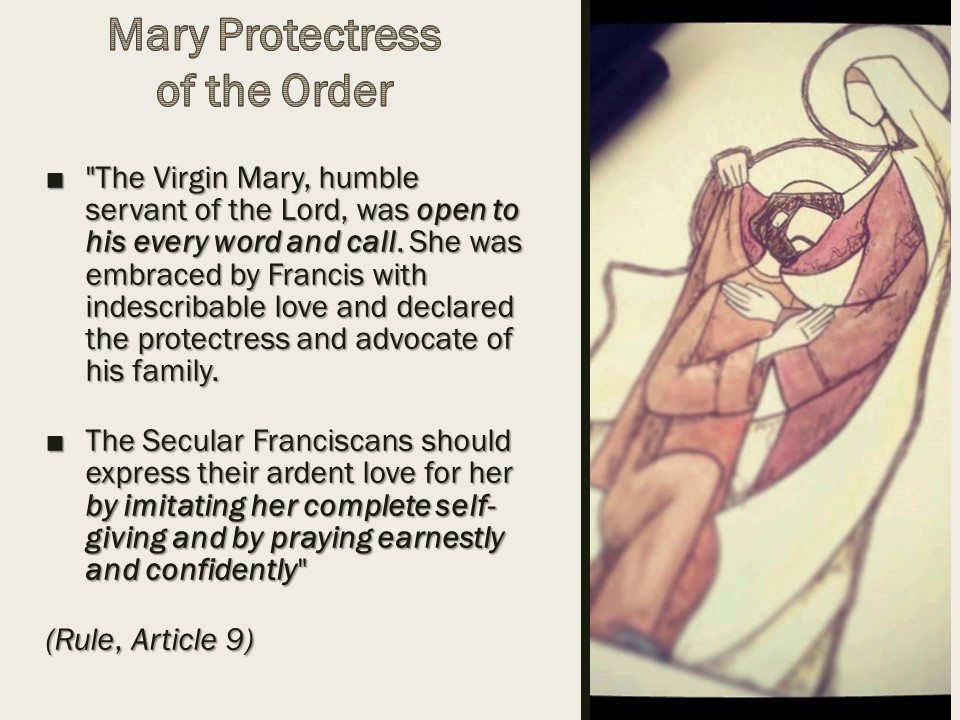
Mary Protectress of the Order (En español abajo)


“The Virgin Mary, humble servant of the Lord, was open to his every word and call.
She was embraced by Francis with indescribable love and declared the protectress and advocate of his family.


The Secular Franciscans should express their ardent love for her by imitating her complete self-giving and by praying earnestly and confidently”
 
(Rule, Article 9)


Mary, Mother of Jesus, is the model of listening to the Word and of faithfulness to vocations.
We, like Francis, seek all the gospel virtues realized in her.
 
The brothers and sisters should cultivate intense love for the most holy virgin, imitation, prayer, and filial abandonment.
They should manifest their own devotion with expressions of genuine faith, in forms accepted by the Church.
 
Mary is the model of fruitful and faithful love for the entire ecclesial community.
Secular Franciscans and their fraternities should seek to live the experience of Francis,
who made the Virgin the guide of his activity.
With her, like the disciples at Pentecost, they should welcome the Spirit to create a community of love.
(SFO Constitutions: Article 16.1, .2)
 
Questions for Sharing and Discussion


• What qualities of Mary are attractive to you?
 
• What is Mary’s role in our lives and in the life of the Church?
 
• What is the goal of devotion to Mary? How do you discern whether your devotion to Mary supports your Franciscan life?


• What example does Mary set for us as Secular Franciscans?


María Protectora de la Orden
 
 
“La Virgen María, humilde sierva del Señor, siempre atenta a su palabra y a todas sus mociones, fue para San Francisco centro de indecible amor, y por él declarada Protectora y Abogada de su familia.
 
Los Franciscanos seglares den testimonio de su ardiente amor hacia Ella, por la imitación de su disponibilidad incondicional, y en la efusión de una confiada y consciente oración.”
 
(Regla, Artículo 9)
 
María, Madre de Jesús, es el modelo para escuchar la Palabra y ser fieles a la vocación: en Ella, como Francisco, vemos realizadas todas las virtudes evangélicas.
 
Los hermanos cultiven el amor intenso a la Santísima Virgen, la imitación, la oración y la entrega filial. Manifiesten la propia devoción con expresiones de fe genuina en las formas aceptadas por la Iglesia.
 
María es modelo de amor fecundo y fiel para toda la comunidad eclesial. Los franciscanos seglares y las Fraternidades busquen vivir la experiencia de Francisco, que hizo de la Virgen guía de su vida y de su obra; con Ella, como los discípulos en Pentecostés, acojan el Espíritu para realizarse en comunidad de amor.
(Constituciones Generales de la OFS: Artículo 16.1, .2)
Para compartir y discutir
 
• ¿Qué cualidades de María son atractivas para ti?


• ¿Cuál es el papel de María en nuestras vidas y en la vida de la Iglesia?


• ¿Cuál es el objetivo de la devoción a María? ¿Cómo discernir si su devoción a María apoya su vida franciscana?


• ¿Qué ejemplo nos da María como franciscanos seglares?


Diane F. Menditto, OFS

Chair, National Formation Commission


The Blessed Mother, St. Francis & All of Us (from Five Point Plan)

The Blessed Mother certainly does not need me to sing her praises! Our Father Saint Francis did a far greater job both in word and in action; in word, by his Praises and Salutations, and in action, by entrusting the whole Order to her protection.

Thomas of Celano wrote of St. Francis, “Toward the Mother of Jesus he was filled with an inexpressible love, because it was she who made the Lord of Majesty our brother. He sang special Praises to her, poured out prayers to her, offered her his affections, so many and so great that the tongue of man cannot recount them. But what delights us most, he made her the advocate of the order and placed under her wings the sons he was about to leave that she might cherish them and protect them to the end” (Second Life of St. Francis, 198).

Our SFO Rule 9 states: “The Virgin Mary, humble servant of the Lord, was open to His every word and call. She was embraced by Francis with indescribable love and declared the protectress and advocate of his family. The Secular Franciscans should express their ardent love for her by imitating her complete self-giving and by praying earnestly and confidently.” (See also General Constitutions, Article 16.)

The only way that we can see the Blessed Mother directly, outside of private revelation, is through Holy Scripture; and each time she appears, she is, to me, fascinating and unpredictable. I am filled with wonder. Although this Monthly Message is not enough to share all of her moments in Sacred Scripture, permit me to speak on two of them, both in John’s Gospel, one at the very beginning of our Lord’s ministry and one at the very end.

As we know, just three days into our Lord’s public ministry and call of His disciples, there is a wedding at Cana in Galilee (Chapter 2). The Blessed Mother has been invited and perhaps because of her, Jesus, and perhaps because of Jesus, His disciples. We don’t see St. Joseph because presumably he had already died. The wine runs short, perhaps because of the unexpected presence of the recently called disciples, and the Blessed Mother tells her son, “They have no wine” (vs. 3). Jesus replies, “Woman, how does your concern affect me? My hour has not come” (vs. 4). Mary says to the servers, “Do whatever he tells you” (vs. 5).

Jesus promptly tells the servers to fill six twenty to thirty gallon stone water jars with water and take some to the headwaiter. The water miraculously turns to wine; the headwaiter does not know from whence it comes and cannot believe why the bridegroom would save the best for last, so high is the quality of the wine. John concludes, “Jesus did this as the beginning of his signs in Cana in Galilee and so revealed his glory, and his disciples began to believe in him” (vs. 11).

Well, books have been written and paintings painted about the Wedding of Cana, which now forms the Second of the great Luminous Mysteries of the Holy Rosary. My question to you and to myself is, “Who was the couple?” Why do they receive Christ’s first miracle (not to mention 180 free gallons of the best quality wine)? To me, this couple is you and I, ordinary lay people trying to live our lives in the world not quite having all that we need without some divine help. Note that Jesus does not say it is “their concern,” but says to His Mom, it is “your concern.”

Flash forward to the very end of His short life. Jesus again has saved the best for last, only this time it is not wine but Himself, hanging on the Cross pouring out His blood and His life for all of us. He is alive and around Him are exactly the people that we find in the Cross of San Damiano and see in John 19:25. And seeing his Mom and the disciple whom He loved, both present at the Wedding of Cana, Christ “pays back” His Mom. His hour has indeed come. Since she was so concerned about ordinary humanity at the very beginning of His ministry, so He will keep her concerned, “Woman, behold your son” (vs. 26). And to the disciple, “Behold your mother” (vs. 27).

Just as Jesus did not say “No” to His Mom at Cana, so Mary does not say “No” to her Son on the Cross. She has been concerned with all humanity at the beginning, so Jesus wants her concerned now. She is truly our Mother.

Let us pray: “Lord Jesus, Your Mother made her concerns Your concern, and You repaid the compliment by making Your concerns her concern. Help us to respect her role in Your plan of salvation. Help us to love and praise Mary as Your Mother and our Mother, as St. Francis showed us so well. We ask this grace in Your name, You Who live and reign with the Father and the Holy Spirit, one God forever and ever. Amen.”

Reflection Questions

  1. How did St. Francis feel about the Blessed Mother?
  2. How did St. Francis evidence this feeling?
  3. How should Secular Franciscans feel about the Blessed Mother?
  4. Besides private revelation, where can most of us meet the Blessed Mother most directly?
  5. Who are the wedding couple in the Wedding at Cana?
  6. Who is concerned about them?
  7. Whose mother does Mary ultimately become at the foot of the Cross?

This is an excerpt from a series of articles by the late Deacon Tom Bello, OFS, former Minister of the National Secular Franciscan Order – USA.  “Many of these essays were originally published in TAU-USA, our national newsletter,” said Jan Parker, OFS, current National Minister. “They are excellent for reflection and ongoing formation.”  Jan helped Tom publish these  essays in book form.  It is called  For All The Saints:  St. Francis’s Five-Point Plan for Salvation and is available from Tau Publishing. These excerpts will appear several times a week on the Secular Franciscans website.

https://secularfranciscansusa.org/2020/04/29/the-blessed-mother-st-francis-all-of-us-from-five-point-plan/

The Virus and the Emmaus Road – Fr. Christopher, T.O.R.

We have all travelled the road the two disciples walked that Easter night—the road of deep disappointment, sadness, despair, and anger. But it is also a road in which we meet the Risen One in the guise of those who offer us support, compassion and counsel along the way.

One of my favorite holy pictures shows this scene of three robed figures walking along a dirt road, shafts of sunlight breaking through trees and clouds. The person in the middle, hand upraised as he talks, seems to fascinate the others. I like this artistic rendition because it allows us to observe the travelers from behind. They are walking away from some event; they are walking away from something. They have wavered from their calling.

Today, a different kind of stranger joins us. It’s a death-dealing presence, a presence from which we cannot walk away. It has interrupted our lives, our happiness, our social gatherings and fraternal responsibilities. We wish this stranger, this threat, not be in our company. It has invaded everything that we enjoy doing and loving. As in the story of St Francis and the wolf of Gubbio, so now with us—befriending the present danger we must, for our sakes, and the sake of others.

Befriending is not easy; it takes courage, it takes faith. For us today, it means: shelter-in-place, isolation, surrendering freedoms and routines. The Risen Lord surrounds us. God is with us. Everything in the Emmaus story is applicable to our life today. Jesus was more with the two disciples on their journey—even in their doubt and unbelief—than when they actually saw and recognized Him and finally believed. I find this paradox of faith—this distance and closeness, of belief and unbelief—repeated over and over again in our lives.

As Vatican II teaches, we meet Christ in the Scriptures. Let this time of deprivation help us intensify our love. Routine can become very customary. Teilhard de Chardin once wrote poetically about offering Christ on the altar of the world, “The Divine assails us, penetrates us and molds us   We imagined it as distant and inaccessible, when in fact we live steeped in its burning layers.” If Emmaus is correct, then the Risen Christ surrounds us. Yes, He stays with us through the entire journey of life.

https://secularfranciscansusa.org/2020/04/27/the-virus-and-the-emmaus-road/

Scroll to top
Juan de Padilla