[Recursos en español abajo] (Please share with your local fraternities) Korean translation attached in separate PDF.
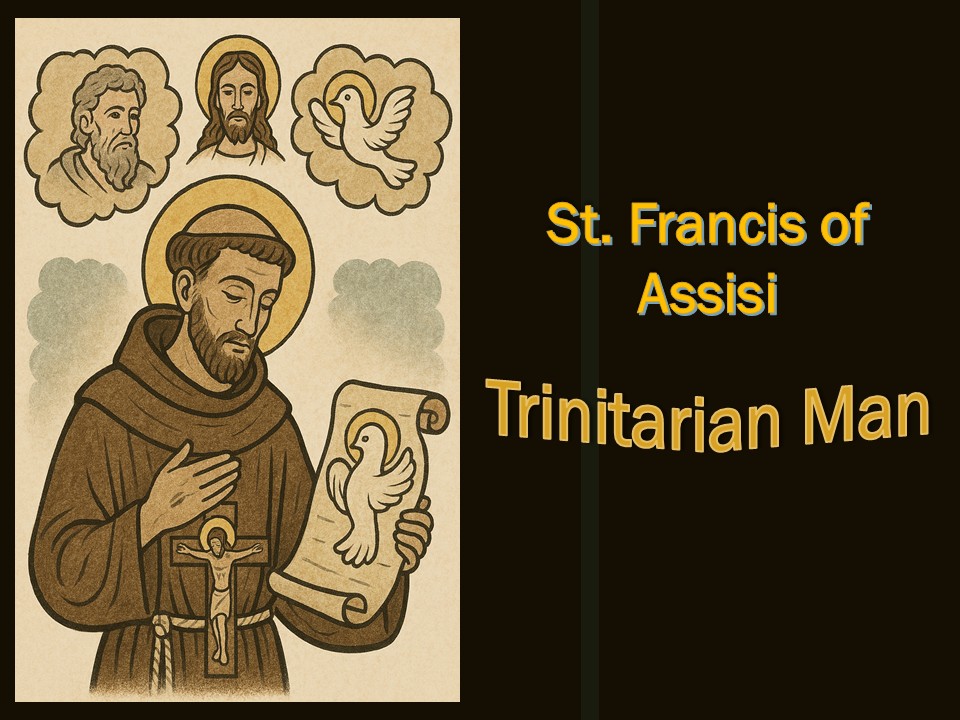
St. Francis of Assisi: Trinitarian Man
St. Francis yearned for relationship with God the Father. His goal was to follow Christ who would guide him to the Father. He wanted to be loved by the Father as Jesus is loved.FRANCIS: Child of the Father
• Lived in radical trust and dependence on God’s providence
• Saw all creation as a reflection of the Father’s love and generosity
• Embraced poverty as a way to honor the Father’s care for all creatures
FRANCIS: Imitator of the Son
• Modeled his life on Jesus’ humility, compassion, and sacrificial love
• Embraced suffering and service as a path to union with Christ
• Called himself the “Herald of the Great King,” reflecting his devotion to Christ’s kingship
FRANCIS: Bearer of the Spirit
• Radiated joy, peace, and simplicity—fruits of the Holy Spirit
• Discerned God’s will through prayer and contemplation
• Inspired communal life rooted in love, reconciliation, and spiritual renewal
FRANCIS: Trinitarian in Prayer
• Frequently invoked the Trinity in his writings and praises
• Composed prayers that glorified each Person of the Trinity distinctly yet harmoniously
• Experienced mystical union with God, especially through the stigmata—a sign of deep communion with Christ crucified
FRANCIS: Trinitarian in Mission
• Evangelized through presence, humility, and peace rather than domination
• Fostered fraternity among all people and creatures, echoing the unity of the Trinity
• Encouraged his followers to live in fraternity, mirroring the relational love of Father, Son, and Spirit
St. Francis desired to conform himself to the image of Jesus so he might be able to realize that he is also a beloved son and experience as much as possible the wonder of the Father’s love. He saw the Holy Spirit as the source of power and inspiration that opens our hearts to relationship with the Father—and the Blessed Trinity. Francis pursued a vital relationship with all three persons of the Trinity. To be in unity with the Father, Francis is willing to offer himself completely just as Jesus did.
Did you know that in Francis’s writings God is present on each page?
• Father (attributed to God) is used 97 times
• Designated by name (God) 219 times
• Designated as Lord 364 times
Take some time this week to read examples of Francis’s relationship with God in his writings. Three of his writings provide a good starting place:
The Earlier Rule—especially chapter 23 “Prayer and Thanksgiving” FA:ED, vol. 1, 81
Admonition I FA:ED, vol. 1, 128
The Praises to be Said at all the Hours FA:ED, vol. 1, 161
A Prayer Inspired by the Our Father: FA:ED, vol. 1, p. 158
Questions to discuss or to answer in your journal.
+ How do you imitate Jesus in your life? Where do you find inspiration?
+ What do the writings of St. Francis tell you about his spirituality?
+ What is your image of God—Father, Son, and Holy Spirit?
Formación 26 de septiembre 2025
San Francisco de Asís: hombre trinitario
San Francisco anhelaba una relación con Dios Padre. Su objetivo era seguir a Cristo, quien lo guiaría hacia el Padre. Quería ser amado por el Padre como Jesús es amado.
FRANCISCO: Hijo del Padre
• Vivió con una confianza y dependencia radicales en la providencia de Dios.
• Veía toda la creación como un reflejo del amor y la generosidad del Padre.
• Abrazó la pobreza como una forma de honrar el cuidado del Padre por todas las criaturas.
FRANCISCO: Imitador del Hijo
• Modeló su vida según la humildad, la compasión y el amor sacrificial de Jesús.
• Abrazó el sufrimiento y el servicio como un camino hacia la unión con Cristo.
• Se llamaba a sí mismo «Heraldo del Gran Rey», lo que reflejaba su devoción por la realeza de Cristo.
FRANCISCO: Portador del Espíritu
• Irradiaba alegría, paz y sencillez, frutos del Espíritu Santo.
• Discernía la voluntad de Dios a través de la oración y la contemplación.
• Inspiró una vida comunitaria arraigada en el amor, la reconciliación y la renovación espiritual.
FRANCISCO: Trinitario en la oración
• Invocaba frecuentemente a la Trinidad en sus escritos y alabanzas.
• Compuso oraciones que glorificaban a cada Persona de la Trinidad de forma distinta pero armoniosa.
• Experimentó la unión mística con Dios, especialmente a través de los estigmas, signo de profunda comunión con Cristo crucificado.
FRANCISCO: Trinitario en la misión
• Evangelizó a través de la presencia, la humildad y la paz, en lugar de la dominación.
• Fomentó la fraternidad entre todas las personas y criaturas, haciéndose eco de la unidad de la Trinidad.
• Animó a sus seguidores a vivir en fraternidad, reflejando el amor relacional del Padre, el Hijo y el Espíritu.
San Francisco deseaba conformarse a la imagen de Jesús para poder darse cuenta de que él también era un hijo amado y experimentar en la medida de lo posible la maravilla del amor del Padre. Veía al Espíritu Santo como la fuente de poder e inspiración que abre nuestros corazones a la relación con el Padre y con la Santísima Trinidad. Francisco buscó una relación vital con las tres personas de la Trinidad. Para estar en unidad con el Padre, Francisco está dispuesto a ofrecerse completamente, tal como lo hizo Jesús.
¿Sabía que en los escritos de Francisco Dios está presente en cada página?
• Padre (atribuido a Dios) se utiliza 97 veces.
• Designado por su nombre (Dios) 219 veces.
• Designado como Señor 364 veces.
Dedique algo de tiempo esta semana a leer ejemplos de la relación de Francisco con Dios en sus escritos. Tres de sus escritos proporcionan un buen punto de partida:
REGLA NO BULADA Capítulo 23 “Oración y acción de gracias” https://www.franciscanos.org/esfa/escritossf.html#rnb1r Admonición I https://www.franciscanos.org/esfa/escritossf.html#adm
Alabanzas que se han de decir en todas las Horas https://www.franciscanos.org/esfa/escritossf.html#alhor
Exposición del Padre Nuestro https://www.franciscanos.org/esfa/escritossf.html#exppnPreguntas para platicar o responder en su diario.
+ ¿Cómo imita a Jesús en tu vida? ¿Dónde encuentra inspiración?
+ ¿Qué le dicen los escritos de San Francisco sobre su espiritualidad?+ ¿Cuál es su imagen de Dios: ¿Padre, Hijo y Espíritu Santo?
Diane F. Menditto, OFSVice Minister, National Fraternity, Secular Franciscan Order USAListen – Discern – Go Forth National Theme 2022-2025
Category: Formation Friday
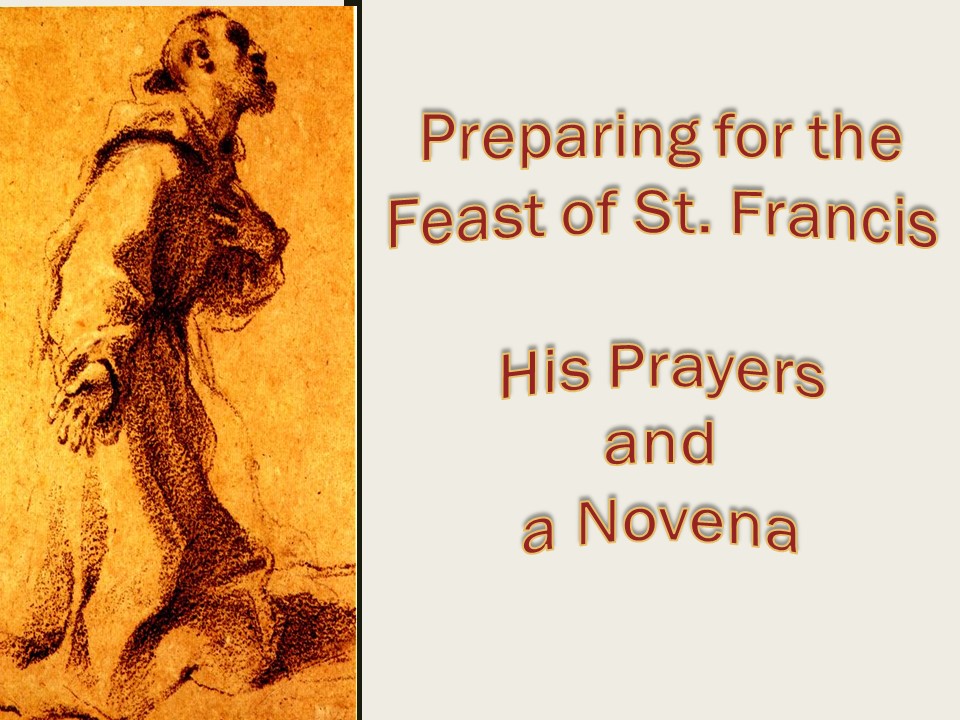
Formation Friday – Preparing for the Feast of St. Francis – Prayers and Novena – September 19, 2025
(en español abajo) Korean translation attached in separate PDF.
Preparing for the Feast of St. Francis–His Prayers and a Novena
Please share with your local fraternity
As the feast day of St. Francis approaches, we share a link to the Novena to St. Francis which starts on September 25th. Also, this week we provide links to the special prayers of St. Francis with some general questions for meditation. (Please be patient with the links on the Franciscan Tradition website. It is easy to sign up and it is worth it!!)
Novena on the St. Anthony Shrine website started on 9/25: https://www.stanthony.org/st-francis-novena-2021/
Links to some of the prayers of St. Francis with which we should all be familiar: (Over the next few days, read the complete prayer and some background material on the Franciscan Intellectual Tradition website.)
THE TESTAMENT PRAYER
“We adore you, Lord Jesus Christ, in all your churches throughout the whole world, and we bless you, because by your holy cross you have redeemed the world.”
https://franciscantradition.org/francis-of-assisi-early-documents/the-saint/writings-of-francis/the-testament/140-fa-ed-1-page-124
PRAYER BEFORE THE CRUCIFIX
“Most high, glorious God, enlighten the darkness of my heart. And give me true faith, certain hope, and perfect charity…”
https://franciscantradition.org/francis-of-assisi-early-documents/the-saint/writings-of-francis/the-prayer-before-the-crucifix/58-fa-ed-1-page-40#ges:searchword%3Dprayer%2Bbefore%2Bthe%2Bcrucifix%26searchphrase%3Dall%26page%3D1
PRAYER FROM THE LETTER TO THE ENTIRE ORDER
https://franciscantradition.org/francis-of-assisi-early-documents/the-saint/writings-of-francis/a-letter-to-the-entire-order/136-fa-ed-1-page-120
A PRAYER INSPIRED BY THE OUR FATHER
https://franciscantradition.org/francis-of-assisi-early-documents/the-saint/writings-of-francis/the-undated-writings/a-prayer-inspired-by-the-our-father/174-fa-ed-1-page-158#ges:searchword%3DOUR%2BFATHER%26searchphrase%3Dall%26page%3D1
THE PRAISES TO BE SAID AT ALL THE HOURS
“Holy, holy, holy Lord God Almighty, Who is, and Who was, and Who is to come: And let us praise and glorify Him forever…”
https://franciscantradition.org/francis-of-assisi-early-documents/the-saint/writings-of-francis/the-undated-writings/the-praises-to-be-said-at-all-the-hours/177-fa-ed-1-page-161#ges:searchword%3DTHE%2BPRAISES%2BBEFORE%2BTHE%2BOFFICE%26searchphrase%3Dall%26page%3D1
THE PRAISES OF GOD AND THE BLESSING
“You are the holy Lord God Who does wonderful things. You are strong. You are great. You are the most high….”
https://franciscantradition.org/francis-of-assisi-early-documents/the-saint/writings-of-francis/the-praises-of-god-and-the-blessing/125-fa-ed-1-page-109
THE CANTICLE OF BROTHER SUN
“Most High, all-powerful, good Lord, Yours are the praises, the glory, the honor, and all blessing,”
https://franciscantradition.org/clare-of-assisi-early-documents/related-documents/franciscan-documents/the-canticle-of-brother-sun-1225/568-ca-ed-1-page-391
PRAYER AND THANKSGIVING (Chapter XXIII of the Earlier Rule—Regula non Bullata)
“All-powerful, most holy, Almighty and supreme God,…”
https://franciscantradition.org/francis-of-assisi-early-documents/the-saint/writings-of-francis/the-earlier-rule/96-fa-ed-1-page-81
SALUTATION OF THE BLESSED VIRGIN MARY
“Hail, O Lady, Holy Queen, Mary, holy Mother of God, Who are the Virgin made Church, chosen by the most Holy Father in heaven whom he consecrated with His most holy beloved Son and with the Holy Spirit the Paraclete, 3in whom there was and is all fullness of grace and every good….”
https://franciscantradition.org/francis-of-assisi-early-documents/the-saint/writings-of-francis/the-undated-writings/a-salutation-of-the-blessed-virgin-mary/179-fa-ed-1-page-163#ges:searchword%3DSALUTATION%2BOF%2BTHE%2BBLESSED%26searchphrase%3Dall%26page%3D1
Some questions to think about, discuss, or to answer in your journal.
If you cannot read all of the prayers listed above in one sitting, choose 2 or 3 at a time. As you read and then pray, please think about the following:
+What are the common themes in all of Francis’s prayers?
+Where can these prayers fit into our prayer lives as Franciscans?
+As you consider the words of these prayers, what stands out as being important to St. Francis? How do these ideas and feelings affect us as Franciscans?
++++++++++++++++++++++
Formación 19 de septiembre, 2025
Preparándonos para la fiesta de San Francisco: sus oraciones y una novena (Compartir con su fraternidad local.)
A medida que se acerca el día de la fiesta de San Francisco, compartimos un enlace a la Novena a San Francisco que comienza el 25 de septiembre. Además, esta semana proporcionamos enlaces a las oraciones especiales de San Francisco con algunas preguntas generales para la meditación durante estos días tan importantes.
NOVENA A SAN FRANCISCO en español (Comienza el 25 de septiembre.)
https://www.aciprensa.com/recursos/novena-a-san-francisco-de-asis-1587
Enlaces a algunas de las oraciones de San Francisco con las que todos deberíamos estar familiarizados: (Lea la oración completa en http://franciscanos.org/ ).
LA ORACIÓN DEL TESTAMENTO
5”Te adoramos, Señor Jesucristo, también en todas tus iglesias que hay en el mundo entero, y te bendecimos, porque por tu santa cruz redimiste al mundo.” http://franciscanos.org/esfa/teste.html
LA ORACIÓN ANTE EL CRUCIFIJO DE SAN DAMIÁN
“Sumo, glorioso Dios, ilumina las tinieblas de mi corazón y dame fe recta, esperanza cierta y caridad perfecta,
sentido y conocimiento, Señor, para que cumpla tu santo y verdadero mandamiento.” http://franciscanos.org/esfa/orsd.html
ORACIÓN DE LA CARTA A TODA LA ORDEN http://franciscanos.org/esfa/ctao.html
EXPOSICIÓN DEL PADRE NUESTRO http://franciscanos.org/esfa/exppn.html
ALABANZAS QUE SE HAN DE DECIR EN TODAS LAS HORAS
1”Santo, santo, santo Señor Dios omnipotente, el que es y el que era y el que ha de venir (cf. Ap 4,8):
Y alabémoslo y ensalcémoslo por los siglos.”
http://franciscanos.org/esfa/alhor.html
ALABANZAS DEL DIOS ALTÍSIMO
“1Tú eres santo, Señor Dios único, que haces maravillas (Sal 76,15). 2Tú eres fuerte, tú eres grande (cf. Sal 85,10), tú eres altísimo, …” http://franciscanos.org/esfa/ald.html
CÁNTICO DEL HERMANO SOL o ALABANZAS DE LAS CRIATURAS
“Altísimo, omnipotente, buen Señor, tuyas son las alabanzas, la gloria y el honor y toda bendición.”
http://franciscanos.org/esfa/cant.html
REGLA NO BULADA Cap. XXIII: Oración y acción de gracias
“Omnipotente, santísimo, altísimo y sumo Dios,…” http://franciscanos.org/esfa/rnb1r.html
SALUDO A LA BIENAVENTURADA VIRGEN MARÍA
“Salve, Señora, santa Reina, santa Madre de Dios, María, que eres virgen hecha iglesia 2y elegida por el santísimo Padre del cielo, a la cual consagró Él con su santísimo amado Hijo y el Espíritu Santo Paráclito, 3en la cual estuvo y está toda la plenitud de la gracia y todo bien….” http://franciscanos.org/esfa/salvm.html
Algunas preguntas para pensar, platicar, o responder en su diario.
Si no puede leer todas las oraciones enumeradas anteriormente de una sola vez, elija 2 o 3 a la vez. Mientras lee y luego ora, piense en lo siguiente:
+ ¿Cuáles son los temas comunes en todas las oraciones de Francisco?
+ ¿Dónde pueden encajar estas oraciones en nuestra vida de oración como franciscanos?
+ Al considerar las palabras de estas oraciones, ¿qué se destaca como importante para San Francisco? ¿Cómo nos afectan estas ideas y sentimientos como franciscanos?
Diane F. Menditto, OFS
Vice Minister, National Fraternity, Secular Franciscan Order USA
Listen – Discern – Go Forth National Theme 2022-2025
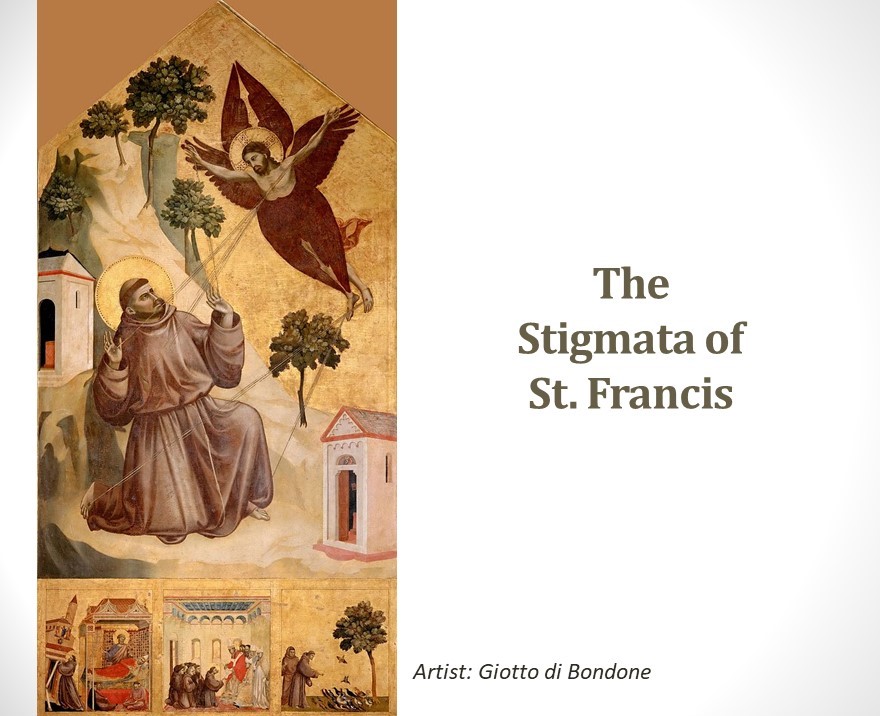
FORMATION FRIDAY – Stigmata of St. Francis – September 12, 2025
The Stigmata of St. Francis September 17th
Did you know that…?
+ St. Francis received the Stigmata around the feast of the Triumph of the Holy Cross in
September of 1224–two years before his death.
+He was praying on Mt. La Verna preparing for the feast of St. Michael the Archangel. Brother Leo was nearby.
+While praying, He asked God for two things. One, to let him experience the suffering Christ endured on the Holy Cross and two, for him to experience the love in which He did it.
+ Shortly thereafter, Francis saw a Seraph with six wings. (Seraphs are angels of the highest order who are closest to God and most passionate in praising Him.) Between the wings was the image of a crucified man. When the vision disappeared, Francis was marked with the wounds of Christ. (St. Francis’s encounter with the Seraph and his passion in praising the Father has caused the Franciscan Order to be called the Seraphic Order and St. Francis our Seraphic Father.
+ We celebrate the Feast of the Stigmata on September 17th
+ St. Francis is the first person in recorded Christian history to receive the Stigmata.The Stigmata: Inspiration for our spiritual lives as Franciscans
The marks in our lives:
–What does it mean to be marked?
–What marks us in our lives?
–As Catholics, how are we marked? How are we marked as Franciscans?
–How do the things that mark us, help us to move forward in our spiritual lives?Now, Gaze at the Cross:
–As we gaze at the wounds of Christ, what comes to mind?
–As we consider what Jesus suffered for us, how do we respond?
–As we contemplate Jesus’s willingness to die for us, what are we willing to do for our brothers and sisters?
–As we imitate Jesus in our lives, how are we willing to use our lives in the service of others?Prayer to the Five Wounds of the Lord prayed by St. Clare of Assisi
https://digitalcollections.franciscantradition.org/document/bx4700-c6a2-2005-d035/the_prayer_to_the_five_wounds_of_the_lord/undated?searchOption=transcriptions&term=The%20prayer%20to%20the%20five%20wounds%20of%20the%20lord&searchType=exact_phrasePrayer of Pope St. John Paul II (On a visit to Mt. La Verna in 1983)
O St Francis, stigmatized on La Verna, the world longs for you, that icon of the crucified Jesus.
It has need of your heart, open to God and to others; of your bare, wounded feet, of your pierced hands raised in supplication.
It longs for your voice so frail yet forceful with the power of the Gospel.
Francis, help the people of this age to recognize the evil of sin and to seek purification from it in penance.
Help them to become free from the very structures of sin that oppress today’s society.
Rekindle in the consciousness of those in government an urgent need for peace between nations and peoples.
Instill in young people your freshness of life that is capable of withstanding the snares of the many cultures of death.
To those injured by every type of evil teach, O Francis, the joy of being able to forgive.
To all those crucified by suffering, hunger and war, reopen the doors of hope. Amen.Formación 12 de septiembre 2025
Los estigmas de San Francisco 17 de septiembre
¿Sabía que…?
+ San Francisco recibió los estigmas en torno a la fiesta del Triunfo de la Santa Cruz en septiembre de 1224, dos años antes de su muerte.
+ Estaba orando en el monte La Verna preparándose para la fiesta de San Miguel Arcángel. El hermano León estaba cerca.
+ Mientras oraba, le pidió a Dios dos cosas. Una, dejarle experimentar el sufrimiento que Cristo soportó en la Santa Cruz y dos, que experimentara el amor en el que lo hizo.
+ Poco después, Francisco vio un Serafín con seis alas. (Los serafines son ángeles del orden más alto que están más cerca de Dios y más apasionados en alabarlo.) Entre las alas estaba la imagen de un hombre crucificado. Cuando la visión desapareció, Francisco quedó marcado con las llagas de Cristo. (El encuentro de San Francisco con el Serafín y su pasión por alabar al Padre ha hecho que la Orden Franciscana sea llamada Orden Seráfica y Francisco nuestro Seráfico Padre.
+ Celebramos la Fiesta de los Estigmas el 17 de septiembre
+ San Francisco es la primera persona en la historia cristiana registrada en recibir los estigmas.Los estigmas: inspiración para nuestra vida espiritual como franciscanos
Las marcas en nuestras vidas:
-¿Qué significa estar marcado?
-¿Qué nos marca en nuestra vida?
-Como católicos, ¿cómo estamos marcados? ¿Cómo franciscanos?
– ¿Cómo nos ayudan las cosas que nos marcan a avanzar en nuestra vida espiritual?Ahora, mirar la cruz:
– Al contemplar las heridas de Cristo, ¿qué nos viene a la mente?
-Al considerar lo que Jesús sufrió por nosotros, ¿cómo respondemos?
–Al contemplar la disposición de Jesús a morir por nosotros, ¿qué estamos dispuestos a hacer por nuestros hermanos y hermanas?
–Al imitar a Jesús en nuestra vida, ¿cómo estamos dispuestos a usar nuestra vida al servicio de los demás?Consideraciones sobre las Llagas de San Francisco
https://www.franciscanos.org/florecillas/llagas4.htmOración del Papa San Juan Pablo II (En una visita al Monte La Verna en 1983)
Oh, San Francisco, estigmatizado en La Verna, el mundo te anhela, ese icono de Jesús crucificado.
Necesita tu corazón, abierto a Dios ya los demás; de tus pies descalzos y heridos, de tus manos traspasadas alzadas en súplica.
Anhela tu voz tan frágil pero contundente con el poder del Evangelio.
Francisco, ayuda a la gente de esta época a reconocer la maldad del pecado y a buscar la purificación de él en la penitencia.
Ayúdalos a liberarse de las mismas estructuras del pecado que oprimen a la sociedad actual.
Reavivar en la conciencia de los gobernantes una urgente necesidad de paz entre naciones y pueblos.
Inculca en los jóvenes tu frescura de vida que es capaz de resistir las trampas de las muchas culturas de la muerte.
A los heridos por todo tipo de mal, enséñales, oh Francisco, la alegría de poder perdonar.
A todos los crucificados por el sufrimiento, el hambre y la guerra, reabre las puertas de la esperanza. Amén.Diane F. Menditto, OFSVice Minister, National Fraternity, Secular Franciscan Order USAListen – Discern – Go Forth National Theme 2022-2025

FORMATION FRIDAY- Discernment before electing or being elected to Secular Franciscan Council – September 5, 2025
(en español abajo) Korean translation attached in a separate PDF.
Please share with your local fraternityDiscernment before electing or being elected to a Secular Franciscan Council
National elections are coming up on September 13th. There will also be elections in many regions and in many local fraternities. If you are thinking of nominating or voting for someone, or accepting a nomination yourself, here are some things to think about.
Take into consideration the following items when thinking about your own or someone else’s service:
- Love of the Order and willingness to serve
- Faith in the guidance of the Holy Spirit. Prayer is an important factor in daily life.
- Time– A willingness to make working with the fraternity a priority even if it means leaving other activities, and realizing that we ask nothing in return for our service.
- Experience: At the local level—participation in fraternity activities; at the regional level—prior service on the council at the local level and participation in regional events; at the national level—service on the local and regional levels, especially having served on the council.
- Organizational skills—demonstrates timeliness in completing projects as promised. Shows a willingness to prepare ahead of time.
- Communication skills—ability and desire to keep our members up to date with what is going on at the higher level in a variety of ways including print, verbally, and on social media. On the local level desire and ability to communicate with all members.
- Fraternal dialogue—willingness to listen to others, ask for, and act on their input and suggestions.
- Collaborative spirit—ability to recognize and appreciate the gifts others have and allow them to use their talents to move the Order and its projects forward.
- Ability to support others as they carry out their assigned tasks. If the council works together, the load we carry is much lighter.
- Trust in the abilities and integrity of others in the fraternity.
- Understanding that we can only move forward if we are well-formed as Secular Franciscans. Personal Formation and formation for councils should never end.
- Energy and enthusiasm—councils are called to “animate and guide” the members. Having enthusiasm for living the gift of our Rule and Constitutions and encouraging others to understand how important our documents are to every aspect of our lives as Secular Franciscans is important.
- Desire and willingness to collaborate with our spiritual assistants, friars, and other members of the Franciscan family, and with the Church in general
- Willingness to ask for assistance from the higher level
- Desire and ability to build on what has been accomplished by the prior Council—local, regional, or national.
For discussion in your fraternity, with a prayer partner, or to comment on in your journal.
+Think of the Franciscan servant leaders you have known. Which characteristics above apply to them?
+What kind of effect do these servant leaders have on the fraternity?
+Think about your qualities as a servant leader. How do you measure up?Formación 5 de septiembre de 2025 (Comparta con su fraternidad local)
Discernimiento antes de elegir o ser elegido para un Consejo Franciscano Seglar
Las elecciones nacionales serán el 13 de septiembre. También habrá elecciones en muchas regiones y en muchas fraternidades locales. Si está pensando en nominar o votar por alguien, o aceptar una nominación usted mismo, aquí hay algunas cosas en las que debe pensar.
Tenga en cuenta los siguientes elementos cuando piense en su propio servicio o en el de otra persona:
- Amor a la Orden y voluntad de servicio
- Fe en la guía del Espíritu Santo. La oración es un factor importante en la vida diaria.
- Tiempo: la voluntad de hacer que trabajar con la fraternidad sea una prioridad, incluso si eso significa dejar otras actividades y darse cuenta de que no pedimos nada a cambio de nuestro servicio.
- Experiencia: A nivel local—participación en las actividades de la fraternidad; a nivel regional—servicio previo en el consejo a nivel local y participación en eventos regionales; a nivel nacional— servicio a nivel local y regional, especialmente haber servido en el concilio.
- Habilidades organizativas: demuestra puntualidad en la finalización de los proyectos según lo prometido. Muestra disposición a prepararse con anticipación.
- Habilidades de comunicación: capacidad y deseo de mantener a nuestros miembros actualizados con lo que sucede en el nivel superior en una variedad de formas, que incluyen impresos, verbalmente y en las redes sociales. A nivel local deseo y capacidad de comunicarse con todos los miembros.
- Diálogo fraterno: disponibilidad para escuchar a los demás, pedir y actuar sobre sus aportes y sugerencias.
- Espíritu de colaboración: capacidad de reconocer y apreciar los dones que tienen los demás y permitirles usar sus talentos para hacer avanzar la Orden y sus proyectos.
- Habilidad para apoyar a otros mientras llevan a cabo sus tareas asignadas. Si el consejo trabaja en conjunto, la carga que llevamos es mucho más liviana.
- Confiar en las capacidades y la integridad de los demás en la fraternidad.
- Comprender que solo podemos avanzar si estamos bien formados como franciscanos seglares. La Formación personal y la formación para los consejos nunca debe terminar.
- Energía y entusiasmo: los concilios están llamados a “animar y guiar” a los miembros. Tener entusiasmo por vivir el don de nuestra Regla y Constituciones y alentar a otros a comprender cuán importantes son nuestros documentos para cada aspecto de nuestras vidas como franciscanos seglares es importante.
- Deseo y disposición de colaborar con nuestros asistentes espirituales, frailes y demás miembros de la familia franciscana, y con la Iglesia en general
- Voluntad de pedir ayuda al nivel superior
- Deseo y capacidad de construir sobre lo logrado por el Concilio anterior—local, regional o nacional.
Para discutir en su fraternidad, con un compañero de oración, o para comentar en tu diario.
+Piense en los líderes servidores franciscanos que ha conocido. ¿Qué características anteriores se aplican a ellos?
+¿Qué tipo de efecto tienen estos líderes servidores en la fraternidad?
+Piense en sus cualidades como líder servidor. ¿Cómo se mide?Diane F. Menditto, OFSVice Minister, National Fraternity, Secular Franciscan Order USAListen – Discern – Go Forth National Theme 2022-2025
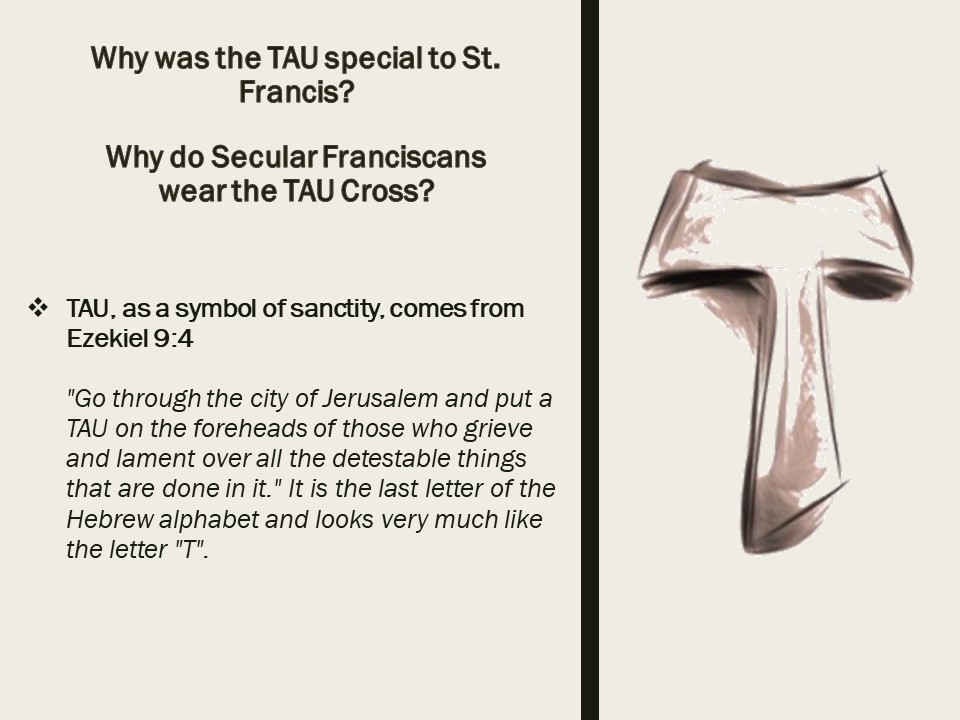
FORMATION FRIDAY – Why Tau Cross so Important to St. Francis? Why We Wear the Tau? – August 29, 2025
(en español abajo)
Please share with your local fraternityWhy was the TAU Cross so important to St. Francis? Why do we OFS wear the TAU?The TAU, as a symbol of sanctity, comes from Ezekiel 9:4
- “Go through the city of Jerusalem and put a TAU on the foreheads of those who
grieve and lament over all the detestable things that are done in it.” It is the last
letter of the Hebrew alphabet and looks very much like the letter “T”.- Franciscan scholarship points to St. Francis’s being present at the Lateran Council in 1215
While attending he would have heard Pope Innocent III announce that every Catholic should take the TAU Cross as the symbol of their Passover. “The Pope set forth the Tau as a sign of penance and renewal in Christ. Francis embraced this sign as an expression of Christ’s cross. In hearing the story, Francis experienced a confirmation of the LIFE and MISSION of his new order. The Tau became for him a symbol of exodus and pilgrimage with which he wanted his companions signed as ‘the new and humble people of God.’”
- He would have heard that the elect, the chosen will be marked with the sign of the TAU (Ezekiel 9:4)
- He would have heard the pope say that the TAU has the form of the Cross on which our Lord was crucified and that those who had mortified their flesh and conformed their life to that of Christ crucified will obtain mercy.
- From then on, the TAU became Francis’s own coat of arms and he often used it in his writings as his personal signature.
Why do many Secular Franciscans wear the TAU cross?
· Article 43 of the General Constitutions establishes that: “The distinctive sign of belonging to the Order (the “TAU” or other Franciscan symbol).
· Article 16.4 of the National Statutes of the United States states: “The external sign of the OFS in the United States is the TAU.
“The Tau Cross [adapted from Catch Me A Rainbow Too by Fr. Lester Bach, O.F.M. Cap.] Franciscans use the Tau as a symbol of commitment to Jesus through the O.F.S. Way of Life. The Tau cross is the sign of the O.F.S. in this country, not the San Damiano crucifix, not a medal of St. Francis, not a scapular and cord (such as were mandated under the Rule of 1883), and not a modified religious habit such as the friars wear! The Tau is worn with pride and joy. Francis saw the Tau as a symbol of the cross of Christ. It was the sign of salvation. It was a sign of belonging to God, being chosen and saved. Francis embraced it with love. It was pregnant with meaning for him. Franciscans wear it as a sign of their commitment to Jesus and the Gospel way of life.”
Direct quotes from: Tau Cross Statements by Deacon Dave and Thérèse Ream, OFS
The following questions are for discussion in fraternity, with a prayer partner, or to answer in your journal.
+Do you always wear your TAU cross? Why or why not?
+When you received your TAU at the Rite of Admission, what did it symbolize to you?
+If someone asks you what the TAU is and why you wear it, what is your answer to them?
Formación 29 de agosto de 2025
Comparta con su fraternidad local
¿Por qué la Cruz TAU fue tan importante para San Francisco? ¿Por qué los Seglares franciscanos llevamos la TAU?
- La TAU, como símbolo de santidad, proviene de Ezequiel 9,4
“Pasen por la ciudad de Jerusalén y poned una TAU en la frente de los que
se entristecen y lamentan por todas las cosas detestables que en ella se hacen.” Es la última letra del alfabeto hebreo y se parece mucho a la letra “T.”- La erudición franciscana apunta a la presencia de San Francisco en el Concilio de Letrán en 1215.
Mientras asistía, habría escuchado al Papa Inocencio III anunciar que todos los católicos deberían llevar la Cruz TAU como símbolo de su Pascua. “El Papa planteó la Tau como signo de penitencia y renovación en Cristo. Francisco abrazó este signo como expresión de la cruz de Cristo. Al escuchar la historia, Francisco experimentó una confirmación de la VIDA y MISIÓN de su nueva orden. La Tau se convirtió para él en un símbolo de éxodo y peregrinaje con el que quería que sus compañeros se firmaran como ‘el nuevo y humilde pueblo de Dios.’”
- él hubiera escuchado que los elegidos, los escogidos serán marcados con la señal de la TAU (Ezequiel 9,4)
- él hubiera escuchado al Papa cuando dijo que la TAU tiene la forma de la Cruz en la que nuestro Señor fue crucificado y que aquellos que mortificaran su carne y conformaran su vida a la de Cristo crucificado obtendrían misericordia.
- A partir de entonces, la TAU se convirtió en el escudo de armas de Francisco y a menudo lo utilizó en sus escritos como su firma personal.
¿Por qué muchos franciscanos seglares llevan la cruz TAU?
· El artículo 43 de las Constituciones Generales establece que: “el signo distintivo de pertenencia a la Orden es (la “TAU” u otro símbolo franciscano).
· El artículo 16.4 de los Estatutos Nacionales de los Estados Unidos establece: “El signo externo de la OFS en los Estados Unidos es la TAU.”
“La Cruz Tau [adaptado de Catch Me A Rainbow Too por el Padre Lester Bach, OFM Cap.] Los franciscanos usan la Tau como símbolo de compromiso con Jesús a través del Modo de Vida de la OFS. La cruz Tau es el signo de la OFS en este país, no el crucifijo de San Damián, no es una medalla de San Francisco, no es un escapulario y un cordón (como se ordenó bajo la Regla de 1883), y ¡no es un hábito religioso modificado como los que usan los frailes! La Tau se lleva con orgullo y alegría. Francisco vio la Tau como un símbolo de la cruz de Cristo. Era la señal de la salvación. Era un signo de pertenencia a Dios, de ser elegido y salvado. Francisco lo abrazó con amor. Estaba preñado de significado para él. Los franciscanos lo usan como un signo de su compromiso con Jesús y el estilo de vida del Evangelio.”
Citas directas de: “Tau Cross Statements” del diácono Dave y Thérèse Ream, OFS
Las siguientes preguntas son para discutir en fraternidad, con un compañero de oración, o para responder en su diario.
+¿Siempre lleva su cruz TAU? ¿Por qué sí o por qué no?
+Cuando recibió su TAU en el Rito de Admisión, ¿qué simbolizó para usted?
+Si alguien le pregunta qué es el TAU y por qué lo lleva, ¿cuál es su respuesta?
Diane F. Menditto, OFSVice Minister, National Fraternity, Secular Franciscan Order USAListen – Discern – Go Forth National Theme 2022-2025