Open post

Formation Friday 6/26/2020

Please share with your local fraternities (abajo en español)


We are all part of a history and a story. We are part of a “tribe.” We are part of the story of our families, of our religion, of the time in which we live. As Franciscans we are also part of the Franciscan story. There are traditions, stories, devotions, prayers and sayings involved with all of these groups. Knowing about them helps us to be part of the family. Every so often, Formation Friday will highlight one of these important parts of our story.

Why was the TAU special to St. Francis? Why do Secular Franciscans wear the TAU?

The TAU Cross

·        TAU, as a symbol of sanctity, comes from Ezekiel 9:4
“Go through the city of Jerusalem and put a TAU on the foreheads of those who grieve and lament over all the detestable things that are done in it.” It is the last letter of the Hebrew alphabet and looks very much like the letter “T”.

·        Franciscan scholarship points to St. Francis’s being present at the Lateran Council in 1215

·        He would have heard Pope Innocent III announce that every Catholic should take the TAU Cross as the symbol of their Passover

·        He would have heard that the elect, the chosen will be marked with the sign of the TAU (Ezekiel 9:4)

·        He would have heard the pope say that the TAU has the form as the Cross on which our Lord was crucified and that those who had mortified their flesh and conformed their life to that of Christ crucified will obtain mercy.


·        From then on, the TAU became Francis’s own coat of arms and he often used it in his

writings as his personal signature.

St. Bonaventure said, “This TAU symbol had all the veneration and all the devotion of the saint: he spoke of it often in order to recommend it, and he traced it on himself before beginning each of his actions.”

Thomas of Celano, another Franciscan historian and biographer of Francis, writes, “Francis preferred the Tau above all other symbols: he utilized it as his only signature for his letters, and he painted the image of it on the walls of all the places in which he stayed.”


In the famous blessing of Brother Leo, Francis wrote on parchment,

“May the Lord bless you and keep you! May the Lord show His

face to you and be merciful to you! May the Lord lift up His

countenance upon you and give you peace! God bless you Brother

Leo!” Francis sketched a head (of Brother Leo) and then drew the TAU over this portrait.


Due, no doubt, in large part to Francis’ own affection for and devotion to the TAU, it has been a well-recognized and accepted Franciscan symbol among Franciscans of various denominations and of all orders within those denominations for centuries. It remains so today. The TAU carries with it all of the symbolism of the Cross of Christ as well as Francis’ ideal of life and dream for himself and his followers.


The TAU is the designated as the distinctive sign of the Secular Franciscan Order of

the United States.


Secular Franciscans, do you wear your TAU every day? What do you think about when you put on your TAU?

(Information from the FUN Manual)


Todos somos parte de una historia y una historia. Somos parte de una “tribu”. Somos parte de la historia de nuestras familias, de nuestra religión, del tiempo en que vivimos. Como franciscanos, también somos parte de la historia franciscana. Hay tradiciones, historias, devociones, oraciones y dichos relacionados con todos estos grupos. Saber sobre ellos nos ayuda a ser parte de la familia. De vez en cuando, el Viernes de Formación destacará una de estas partes importantes de nuestra historia.

¿Por qué la TAU fue especial para San Francisco? ¿Por qué usan la TAU los franciscanos seglares?

La cruz TAU

• La TAU, como símbolo de santidad, proviene de Ezequiel 9: 4

“Pase por la ciudad de Jerusalén y ponga un TAU en la frente de aquellos que lloran y lamentan todas las cosas detestables que se hacen en él”. Es la última letra del alfabeto hebreo y se parece mucho a la letra “T”.

• La erudición franciscana apunta a la presencia de San Francisco en el Concilio de Letrán en 1215.

• Habría escuchado al Papa Inocencio III anunciar que todo católico debería tomar la Cruz TAU como símbolo de su Pascua.

• Habría escuchado que los elegidos, los escogidos serían marcados con el signo de la TAU (Ezequiel 9: 4)

• Habría escuchado al Papa decir que la TAU tiene la forma de la Cruz en la cual nuestro Señor fue crucificado y que aquellos que mortifiquen su carne y conformen su vida a la de Cristo crucificado obtendrán misericordia.

• A partir de entonces, la TAU se convirtió en el escudo de armas de Francisco y él lo usó a menudo en sus

escritos como su firma personal.


San Buenaventura dijo: “Este símbolo TAU tenía toda la veneración y la devoción del santo: hablaba de él a menudo para recomendarlo, y lo trazó sobre sí mismo antes de comenzar cada una de sus acciones.”

Tomás de Celano, otro historiador franciscano y biógrafo de Francisco, escribe: “Francisco prefería el Tau sobre todos los demás símbolos: lo utilizaba como su única firma para sus cartas, y pintaba la imagen en las paredes de todos los lugares en que se quedó “.

En la famosa bendición del hermano Leo, Francisco escribió en pergamino:

“El Señor te bendiga y te guarde;
t e muestre su faz y tenga misericordia de ti.
Vuelva a ti su rostro y te conceda la paz.
El Señor te bendiga, hermano León.”


Francisco dibujó la cabeza (del hermano León) y luego dibujó la TAU sobre este retrato.


Debido, sin duda, en gran parte al afecto y la devoción de Francisco por la TAU, ha sido un símbolo franciscano bien reconocido y aceptado entre los franciscanos de varias denominaciones y de todas las órdenes dentro de esas denominaciones durante siglos. Sigue siendo así hoy. La TAU lleva consigo todo el simbolismo de la Cruz de Cristo, así como el ideal de vida y sueño de Francisco para él mismo y sus seguidores.

La TAU es designada como el signo distintivo de la Orden Franciscana Seglar de los Estados Unidos.


Hermanos y hermanas franciscanos seglares, ¿Usas tu TAU todos los días? ¿En qué piensas cuando te pones la TAU?

Información de la Manual FUN


Diane F. Menditto, OFS
Chair, National Formation Commission


Open post

Formation Friday – Building a Just Society

Dear Brothers and Sisters,  May the Sacred Heart of Jesus bless you, your families, and our Nation.  This is a holy weekend celebrating the Sacred Heart of Jesus and tomorrow, the Immaculate Heart of Mary.  Please pray for our families and this country.
Please share this formation lesson with your fraternities.  You can use the questions at the end to start discussions.   Peace, Dona
 
Relationships: Building a Just Society  Part 3 June 19, 2020
 
 
Deciding how to handle social matters:
               Observe  –  Judge  –  Act
 
O- The situation is examined
J- Situation is evaluated according to Catholic Social Teaching
A- Then it is decided what can and should be done
 
 
 There are three stages that should normally be followed in the reduction of social principles into practice.
  • First, one reviews the concrete situation; 
  • Secondly, one forms a judgment on it in the light of these same principles;
  • Thirdly, one decides what in the circumstances can and should be done to implement these principles. 

These are the three stages that are usually expressed in the three terms: look, judge, act.      (Christianity and Social Progress #236  Pope St. John XXIII-1961)


Our Rule inspires us to develop the qualities we need to be successful
  1. Build relationships with others
  2. Listen without prejudice
  3. Don’t blame others
  4. Give yourself time to think before you speak
  5. Don’t assume
Respect  –  Love  –  Empathy  –  Compassion
 
When Differences Arise…
 
238. Differences of opinion in the application of principles can sometimes arise even among sincere Catholics. When this happens, they should be careful not to lose their respect and esteem for each other. Instead, they should strive to find points of agreement for effective and suitable action, and not wear themselves out in interminable arguments, and, under the pretext of the better or the best, omit to do the good that is possible and therefore obligatory.
 
239. In their economic and social activities, Catholics often come into contact with others who do not share their view of life. In such circumstances, they must, of course, bear themselves as Catholics and do nothing to compromise religion and morality. Yet at the same time, they should show themselves animated by a spirit of understanding and unselfishness, ready to cooperate loyally in achieving objects which are good in themselves or can be turned to good. Needless to say, when the Hierarchy has made a decision on any point Catholics are bound to obey their directives. The Church has the right and obligation not merely to guard ethical and religious principles, but also to declare its authoritative judgment in the matter of putting these principles into practice.
(Christianity and Social Progress #238 &239 Pope St. John XXIII-1961)
 
       How have you learned to build relationships in your family? At work? In your fraternity?
       Can you think of times when respect, love, empathy, and compassion were in short supply on your part? How could you have done better?
 
 
Las relaciones: edificando una sociedad justa
 
Decidir cómo manejar los asuntos sociales:
               Observar – Juzgar – Actuar
 
O- Examinar la situación.
J- Evaluar la situación según la enseñanza social católica.
A- Decidir lo que se puede y se debe hacer
 
 Hay tres etapas que normalmente deben seguirse en la reducción de los principios sociales a la práctica. Primero, uno revisa la situación concreta; en segundo lugar, se forma un juicio al respecto a la luz de estos mismos principios; tercero, uno decide qué circunstancias pueden y deben hacerse para implementar estos principios. Estas son las tres etapas que generalmente se expresan en los tres términos: observar, juzgar, actuar. (Cristianismo y progreso social # 236 Papa San Juan XXIII-1961)
 
Nuestra regla nos inspira a desarrollar las cualidades que necesitamos para tener éxito.
1. Construir relaciones con otros
2. Escuchar sin prejuicios
3. No culpar a los demás
4. Tomar tiempo para pensar antes de hablar
5. No asumir
 
El respeto – El amor – La empatía – La compasión
 
Cuando surgen las diferencias …
 
238. Las diferencias de opinión en la aplicación de principios a veces pueden surgir incluso entre católicos sinceros. Cuando esto sucede, deben tener cuidado de no perder el respeto y la estima entre ellos. En cambio, deben esforzarse por encontrar puntos de acuerdo para una acción efectiva y adecuada, y no agotarse en argumentos interminables y, con el pretexto de lo mejor o lo mejor, omitir hacer el bien que es posible y por lo tanto obligatorio.
 
239. En sus actividades económicas y sociales, los católicos a menudo entran en contacto con otros que no comparten su visión de la vida. En tales circunstancias, deben, por supuesto, comportarse como católicos y no hacer nada para comprometer la religión y la moral. Sin embargo, al mismo tiempo, deberían mostrarse animados por un espíritu de comprensión y desinterés, dispuestos a cooperar fielmente para lograr objetos que sean buenos en sí mismos o que puedan convertirse en buenos. Huelga decir que cuando la Jerarquía ha tomado una decisión sobre cualquier punto, los católicos están obligados a obedecer sus directivas. La Iglesia tiene el derecho y la obligación no solo de proteger los principios éticos y religiosos, sino también de declarar su juicio autoritario en la cuestión de poner en práctica estos principios.
(El Cristianismo y el progreso social # 238 & 239 Papa San Juan XXIII-1961)
 
• ¿Cómo has aprendido a construir una relación en tu familia? ¿En el trabajo? En tu fraternidad?
 
• ¿Puedes pensar en momentos en que el respeto, el amor, la empatía y la compasión eran escasos por tu parte? ¿Cómo pudiste haberlo hecho mejor?


Diane F. Menditto, OFS

Chair, National Formation Commission



Open post

Formation Friday – Come Holy Spirit! May 29, 2020

Formation Friday
Please share with your local fraternities – Peace, Dona
 
The Holy Spirit is at work in us.
When we profess, we strengthen our Baptismal promises. At Baptism and Confirmation, we are imbued with the Holy Spirit. At Profession, we are further strengthened by the Spirit to proclaim Christ by our life and our words.
 
“By their fruits, you will know them.” Matt 7:16
The Holy Spirit will guide us:
       The fruits of the Holy Spirit
(Gal. 5:22-23)
Joy, Peace, Patience, Kindness, Generosity, Faithfulness, Gentleness, And Self-Control
 
When we think about how others see us, as always, the Holy Spirit can guide us in the right direction. If we are following our Rule, the Gospels, and Franciscan spirituality, the FRUITS OF THE HOLY SPIRIT will become apparent in us. When these fruits are in full bloom, we know that the Spirit has been working in us and that we have been open to Him. The seeds have been planted by the Spirit and we nourish them throughout our lives as we seek daily conversion. As Franciscans, these are particularly important to us because they encompass the qualities called for in our Rule.
 
Examples:
Joy: Pope Francis: “Joy adapts and changes, but it always endures” (7). In another place, he humorously reminds Christians that we must not constantly look like we are returning from a funeral (10). As a fruit of the Spirit, joy is the lived awareness that God is faithful, loving, and merciful and that he will never leave us orphans. (Joy of the Gospel)
 
Rejoice and be Glad…
Patience allows us to listen to others;  It allows us to facilitate rather than control. We nourish others so that they may shine;  Patience takes great humility.
Self-control:  Not saying what we are thinking in the heat of anger or disappointment
When we are generous, kind, loving, and gentle, other people are transformed by our example. The gifts of the Spirit are nourished and grow in them because of what they see in us.
 
  •  Which gifts of the Holy Spirit do you exhibit in your life?
  • Which gifts do you wish were more apparent?
  • How does living our Rule help you to demonstrate the gifts the Spirit has given you?
 ________________________________________________________________________________________________
El Espíritu Santo está trabajando en nosotros.
Cuando profesamos, fortalecemos nuestras promesas bautismales. En el Bautismo y la Confirmación estamos imbuidos del Espíritu Santo. En la profesión, el Espíritu nos fortalece aún más para proclamar a Cristo por nuestra vida y nuestras palabras.
 
“Por sus frutos los conocerás”. Mateo 7:16
El Espíritu Santo nos guiará:
• Los frutos del Espíritu Santo.
(Gálatas 5: 22-23)
Alegría, paz, paciencia, amabilidad, generosidad, fidelidad, gentileza y autocontrol
 
Cuando pensamos en cómo nos ven los demás, como siempre, el Espíritu Santo puede guiarnos en la dirección correcta. Si seguimos nuestra Regla, los Evangelios y la espiritualidad franciscana, los FRUTOS DEL ESPÍRITU SANTO se harán evidentes en nosotros. Cuando estos frutos están en plena floración, sabemos que el Espíritu ha estado trabajando en nosotros y que hemos sido abiertos a Él. Las semillas han sido plantadas por el Espíritu y las alimentamos a lo largo de nuestras vidas mientras buscamos la conversión diaria. Como franciscanos, estos son particularmente importantes para nosotros porque abarcan las cualidades requeridas en nuestra Regla.
 
Ejemplos:
La alegría: El Papa Francisco: “La alegría se adapta y cambia, pero siempre perdura” (7). En otro lugar, recuerda con humor a los cristianos que no debemos parecer constantemente que estamos regresando de un funeral (10). Como fruto del Espíritu, el gozo es la conciencia vivida de que Dios es fiel, amoroso y misericordioso y que nunca nos dejará huérfanos. (Alegría del evangelio)
 
Regocíjate y alégrate …
La paciencia nos permite escuchar a los demás; Nos permite facilitar en lugar de controlar. Alimentamos a otros para que brillen; La paciencia requiere mucha humildad.
Autocontrol: no decir lo que estamos pensando en el calor de la ira o la decepción.
Cuando somos generosos, amables, amables y gentiles, otras personas se transforman con nuestro ejemplo. Los dones del Espíritu se nutren y crecen en ellos debido a lo que ven en nosotros.
 
• ¿Cuáles dones del Espíritu Santo exhibes en tu vida?
• ¿Cuáles dones deseas que sean más aparentes?
• Viviendo nuestra Regla, ¿cómo te ayuda a demostrar los dones que el Espíritu te ha dado?


Diane F. Menditto, OFS

Chair, National Formation Commission


Open post

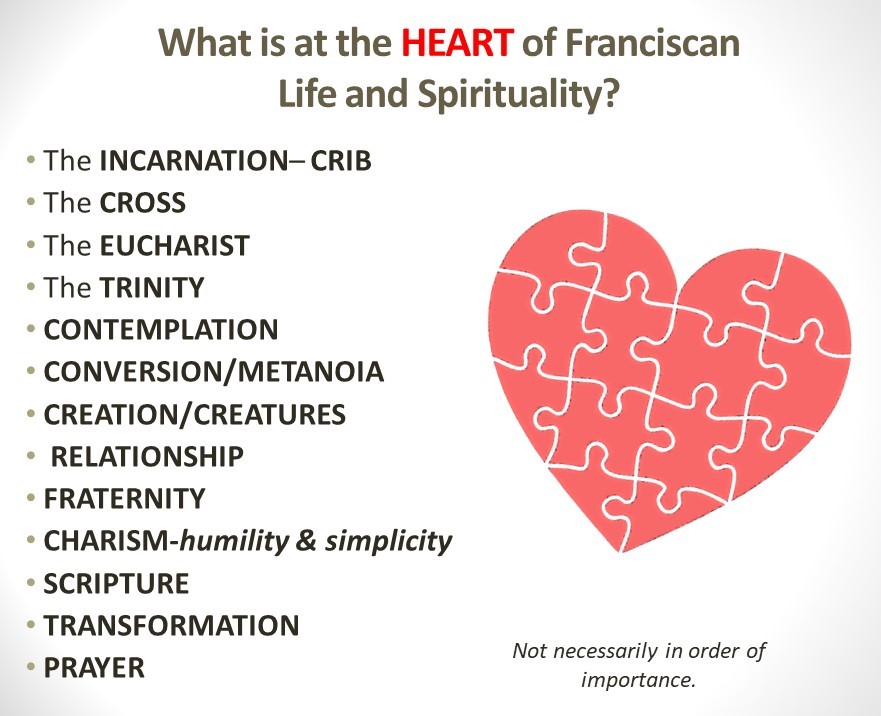
Formation Friday – Incarnational Spirituality May 22, 2020

Dear Brothers and Sisters, 

Here’s is this Friday’s Formation from the NFC.  Please be sure to share with your fraternities.   There is an attachment  ?
 
Franciscan Spirituality is Incarnational:    (En español abajo)
It is based on the greatest gift of God to the human race.
The Word of the Father took on our flesh so that we could enter more fully into the life God has prepared for us.
 
Rule Article 5
“Secular Franciscans, therefore, should seek to encounter the living and active person of Christ in their brothers and sisters, in Sacred Scripture, in the Church, and in liturgical activity. The faith of Saint Francis, who often said “I see nothing bodily of the Most High Son of God in this world except his most holy body and blood,” should be the inspiration and pattern of their Eucharistic life.”
 
“The spirituality of the Secular Franciscan is a plan of life centered on the person and on the following of Christ, rather than a detailed program to be put into practice (GC 9.1).”
 
Article 5 of the Rule enumerates various ways by which we can develop our Secular Franciscan spirituality. Although not in the flesh, we are still able to encounter Christ in our brothers and sisters, in the Scriptures, within the Church and its sacramental life.
 
 
+ Call to mind the times you have encountered Christ in your brothers and sisters.
+ Why is “relationship” so important to Franciscans?
+ What are the special devotions of Franciscans that show our devotion to the Incarnation? How do these practices affect your spiritual life?
 ________________________________________________________
La espiritualidad franciscana es encarnada:
Se basa en el mayor don de Dios para la raza humana.
La Palabra del Padre tomó nuestra carne para que pudiéramos entrar más plenamente en la vida que Dios ha preparado para nosotros.
Regla Artículo 5
“Los franciscanos seglares, por lo tanto, deben buscar encontrarse con la persona viva y activa de Cristo en sus hermanos y hermanas, en la Sagrada Escritura, en la Iglesia y en la actividad litúrgica. La fe de San Francisco, que a menudo decía: “No veo nada corporal del Altísimo Hijo de Dios en este mundo, excepto su santísimo cuerpo y sangre,” debería ser la inspiración y el patrón de su vida eucarística “.
“La espiritualidad del franciscano seglar es un plan de vida centrado en la persona y en el seguimiento de Cristo, en lugar de un programa detallado para poner en práctica (GC 9.1).”
El artículo 5 de la Regla enumera varias formas por las cuales podemos desarrollar nuestra espiritualidad franciscana seglar. Aunque no en la carne, todavía podemos encontrarnos con Cristo en nuestros hermanos y hermanas, en las Escrituras, dentro de la Iglesia y su vida sacramental.
 
+ Acuérdate de las veces que has encontrado a Cristo en tus hermanos y hermanas.
+ ¿Por qué es tan importante la “relación” para los franciscanos?
+ ¿Cuáles son las devociones especiales de los franciscanos que muestran nuestra devoción a la Encarnación? ¿Cómo afectan estas prácticas a tu vida espiritual?


Diane F. Menditto, OFS

Chair, National Formation Commission


Open post

Formation Friday – Our Challenge Today May 15, 2020

Formation Friday
(Please share with your local fraternities)
Our Challenge as Secular Franciscans: Show that Living the Gospel is Possible (en inglés y abajo en español)
 
 
       Fraternity is the perfect workshop for testing ourselves
       Poverty, humility, meekness… In fraternity, we hone our…
       Willingness to yield to others
       Willingness to see that those who are different than we have value
       Call to be “poor enough” to be generous

       Call to make ourselves available to bring others to God


       In the “Workshop” of the Fraternity we find that:
      “The identity of the Secular Franciscan is expressed in a triple dimension
       Personal (the inner life),
       Fraternal (co-responsibility)
       Universal (the mission).”

Emanuela  DeNunzio: Belonging to the SFO GENERAL CHAPTER on November 15-22, 2008


       Fraternity is the perfect workshop to prepare us for our Mission
       We are strengthened in our efforts
       Through prayer
       Through study of the Scriptures
       Through study of our Rule
       Through our service to the fraternity
To think about or to discuss in a virtual gathering with a few fraternity members:
 
+What is your favorite part of fraternity?
+What have you missed about being able to gather with your fraternity during the time of quarantine?
+What part of the “workshop” of fraternity life has made the biggest change in your life?
 _____________________________________________________________________________________
 
Nuestro desafío como franciscanos seglares: demostrar que vivir el Evangelio es posible
• La fraternidad es el taller perfecto para ponernos a prueba.
• La pobreza, la humildad, la mansedumbre … En la fraternidad afinamos nuestra/o …
• Voluntad de ceder ante los demás.
• Voluntad de ver que aquellos que son diferentes a nosotros tienen valor
• Llamado a ser “lo suficientemente pobre” para ser generoso

• Llamado para estar disponibles para traer a otros a Dios


• En el “Taller” de la Fraternidad encontramos que:
• “La identidad del franciscano seglar se expresa en una triple dimensión
• Personal (la vida interior),
• Fraternal (corresponsabilidad)
• Universal (la misión) “.
Emanuela DeNunzio: “Belonging to the OFS” CAPÍTULO GENERAL 15-22 de noviembre de 2008
 
• La fraternidad es el taller perfecto para prepararnos para nuestra misión.
• Nos fortalecemos en nuestros esfuerzos
• A través de la oración.
• A través del estudio de las Escrituras.
• A través del estudio de nuestra Regla
• A través de nuestro servicio a la fraternidad
 
Para pensar o discutir en una reunión virtual con algunos miembros de la fraternidad:
+¿Cuál es tu parte favorita de la fraternidad?
+¿Qué te has perdido de poder reunirte con tu fraternidad durante el período de cuarentena?
+¿Qué parte del “taller” de la vida de fraternidad ha hecho el mayor cambio en tu vida?


Diane F. Menditto, OFS

Chair, National Formation Commission


Scroll to top
Juan de Padilla