Open post

Formation Friday – March 19, 2021 – St. Francis’ Relationship with God


Dear Brothers and Sisters, 

Today’s lesson is so important for understanding our great saint, Francis.  Please read and share with your fraternities.   Peace, Dona

+++++++++++++++++++++++++++++++++++++++++++

St. Francis’s Relationship with God

St. Francis yearned for a relationship with God the Father. His goal was to follow Christ who would guide him to the Father. He wanted to be loved by the Father as Jesus is loved.


Francis desired to conform himself to the image of Jesus so he might be able to realize that he is also a beloved son and experience as much as possible the wonder of the Father’s love. He saw the Holy Spirit as the source of power and inspiration that opens our hearts to a relationship with the Father—and the Blessed Trinity. Francis pursued a vital relationship with all three persons of the Trinity.  To be in unity with the Father, Francis is willing to offer himself completely just as Jesus did.


God is the central reality from whom everything draws origin and toward which everything is oriented.


Did you know that in Francis’s writings God is present on each page?

 Father (attributed to God) is used 97 times

• Designated by name (God) 219 times

• Designated as Lord 364 times


Take some time this week to read examples of Francis’s relationship with God in his writings. Three of his writings provide a good starting place: (Click on the links below to read the writings.)


The Earlier Rule—especially chapter 23 “Prayer and Thanksgiving”  FA: ED, vol. 1, 81


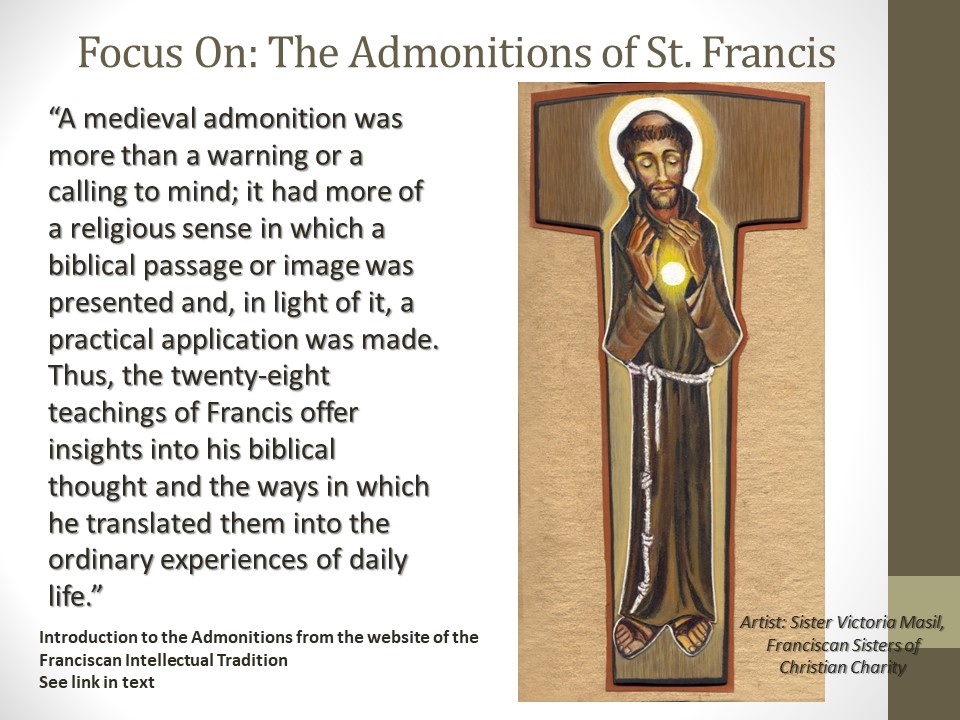
Admonition I  FA: ED, vol. 1, 128


The Praises to be Said at all the Hours  FA: ED, vol. 1, 161


A Prayer Inspired by the Our Father: FA: ED, vol. 1, p. 158


Questions to discuss or to answer in your journal.

+ How do you imitate Jesus in your life? Where do you find inspiration?

+ What do the writings of St. Francis tell you about his spirituality?

+ What is your image of God—Father, Son, and Holy Spirit?

 ++++++++++

La relación de San Francisco con Dios

San Francisco anhelaba tener una relación con Dios Padre. Su meta era seguir a Cristo quien lo guiaría al Padre. Quería ser amado por el Padre como se ama a Jesús.

Francisco deseaba conformarse a la imagen de Jesús para poder darse cuenta de que él también es un hijo amado y experimentar lo más posible la maravilla del amor del Padre. Vio al Espíritu Santo como la fuente de poder e inspiración que abre nuestros corazones a la relación con el Padre y la Santa Trinidad. Francisco mantuvo una relación vital con las tres personas de la Trinidad. Para estar en unidad con el Padre, Francisco está dispuesto a ofrecerse completamente como lo hizo Jesús.

Dios es la realidad central de la que todo se origina y hacia la que todo se orienta.

¿Sabía que en los escritos de Francisco Dios está presente en cada página?

• Padre (atribuido a Dios) se usa 97 veces

• Designado por nombre (Dios) 219 veces

• Designado como Señor 364 veces

Tómese un tiempo esta semana para leer ejemplos de la relación de Francisco con Dios en sus escritos. Tres de sus escritos proporcionan un buen punto de partida:  (Pulse los enlaces para leer los escritos.)

REGLA NO BULADA Capítulo 23  Oración y acción de gracias

Admonición I


 Alabanzas que se han de decir en todas las Horas


Exposición del Padre Nuestro


Preguntas para platicar o responder en su diario.

+ ¿Cómo imita a Jesús en tu vida? Dónde encuentra inspiración?

+ ¿Qué le dicen los escritos de San Francisco sobre su espiritualidad?

+ ¿Cuál es su imagen de Dios: Padre, Hijo y Espíritu Santo?


Diane F. Menditto, OFS
Chair, National Formation Commission
Minister, Our Lady of the Angels Region


Open post

FORMATION FRIDAY – MARCH 12, 2021 – Part 5 – Instrumentum Laboris

Dear Brothers and Sisters,  Today we continue to review the summary of the Instrumentum Laboris.   And now the most interesting part (opinion) –
Proposals & Suggestions that were discussed in the General Chapter. Peace, Dona
 
++++++++++++++++++++++++++++++++++++++++++++++++++++++++++++++++
Instrumentum Laboris—Part 5 
Animate and Guide: Bonus-Proposals and Suggestions   March 12, 2021 
(Continued from March 5th) Please share with your local fraternities  (En español abajo)


These posts (1-5) are intended to serve as a summary of this important document. It is also intended to assist in the individual study of the document and in presentations made to our fraternities. We encourage you to read the entire document at this link:

 INSTRUMENTUM LABORIS IN ENGLISH

Proposals, ideas, suggestions, and solutions: (The items below are suggestions—remember, this is from the working document for what will be discussed at the General Chapter.)

·        Continuity of service from the outgoing Council to the new Council

o   After elections, there should be more than one transition meeting

o   There should be adequate and proper transfer of materials (digital and physical)

o   The outgoing Council should explain how and why they carried out the vision

o   The outgoing Council should explain how they gave continuity to the work of the previous Council


·        Evaluation of Servant Leaders

o   It is not necessary that servant leaders be charismatic—strong personalities are sometimes counterproductive.

o   How were collegiality, companionship, and collaboration modeled?

o   How has the outgoing council involved the fraternity and helped it progress?


·        Criteria to remember regarding servant leaders

o   Service is temporary in nature – there should be a good rotation of leadership

o   The servant leader not only guides but accompanies

o   He/she must have a vision consistent with that of the fraternity—this must reflect the OFS rule

o   He/she must be productive—attracting new vocations and helping people so that they can take over leadership of the fraternity

o   He/she should develop a sense of belonging among the members

o   It should be clear that the OFS is an Order of the church and does not depend on the First Order

o   He/she should have the ability to involve, delegate, and inform the membership


·        Formation of Servant Leaders

o   Possibility of courses developed by CIOFS

o   This would provide a common base for all members of the Order

o   The course could be implemented at the regional level for local leaders and at the national level for regional leaders

o   The role of servant leadership should be discussed thoroughly in initial formation

o   Candidates should have a clear understanding of what it means to be co-responsible for the fraternity

o   Candidates should examine their talents to determine what they can offer the fraternity

o   Throughout candidacy they should develop a good idea of how commitment to the fraternity fits into their daily lives (Work and family commitments)


·        Finding suitable Servant Leaders   

o   One of the duties of Councils is to identify those who might serve in the future

o   Candidates should be invited to get involved in fraternity life

o   Generosity and volunteering are part of our OFS life—making yourself available is part of the charism

o   If formators are passionate about the Order, candidates will become passionate and “fall in love” with our life and commitment

o   It is important to remember that rotating roles refreshes the life of the fraternity

o   The role of the Spiritual Assistant should be understood well—both by the Council and the Spiritual Assistant

o   It is important to understand and develop the relationship among the council members themselves and with the entire fraternity


·        YOUFRA (Youth and Young Adults)

o   This relationship is very important

o   Councils should be familiar with the documents on Youth particular to their country

o   Where there are YOUFRA groups, the fraternal animator should be a valued member of the YOUFRA Council

o   Section 14 of the IL document takes this a bit further


Key questions in preparation for the General Chapter (Please discuss with your fraternity council)

+ What kinds of general and fundamental problems are we experiencing in our fraternities? Explain the effect the pandemic has had on local, regional and national levels.

+ Have the major problems mentioned been addressed by the Instrumentum Laboris?

+ What else would you like to see included?


+++++++++++++++++++++++++++++++++++++++++++++++++++++++++++

Instrumentum Laboris — Parte 5–Animar y guiar: Propuestas y sugerencias   12 de marzo de 2021 (Continuación del 5 de marzo)

Por favor, comparta con sus fraternidades locales.


Estas publicaciones (1-5) están destinadas a servir como resumen y guía para este importante documento. También está destinado a ayudar en el estudio individual del documento y en las presentaciones realizadas a nuestras fraternidades. Le animamos a leer el documento completo en este enlace:


INSTRUMENTUM LABORIS EN ESPAÑOL


Propuestas, ideas, sugerencias y soluciones: (Los puntos a continuación son sugerencias; recuerde, esto es del documento de trabajo para lo que se discutirá en el Capítulo General).


• Continuidad del servicio del Consejo saliente al nuevo Consejo

o Después de las elecciones, debería haber más de una reunión de transición

o Debe haber una transferencia adecuada de materiales (digitales y físicos)

o El Consejo saliente debe explicar cómo y por qué llevaron a cabo la visión.

o El Consejo saliente debe explicar cómo dieron continuidad al trabajo del Consejo anterior.

• Evaluación de líderes de servicio

o No es necesario que los líderes de servicio sean carismáticos; las personalidades fuertes a veces son contraproducentes.

o ¿Cómo se modeló la colegialidad, el compañerismo y la colaboración?

o ¿Cómo ha involucrado el consejo saliente a la fraternidad y la ha ayudado a progresar?

• Criterios para recordar con respecto a los líderes de servicio

o El servicio es de naturaleza temporal: debe haber una buena rotación de liderazgo

o El líder servidor no solo guía sino que acompaña

o Él / ella debe tener una visión consistente con la de la fraternidad; esto debe reflejar la regla OFS

o Debe ser productivo, atrayendo nuevas vocaciones y ayudando a las personas para que asuman el liderazgo de la fraternidad.

o Debe desarrollar un sentido de pertenencia entre los miembros

o Debe quedar claro que la OFS es una Orden de la iglesia y no depende de la Primera Orden

o Debe tener la capacidad de involucrar, delegar e informar a los miembros

• Formación de líderes de servicio

o Posibilidad de cursos desarrollados por CIOFS

o Esto proporcionaría una base común para todos los miembros de la Orden.

o El curso podría implementarse a nivel regional para líderes locales y a nivel nacional para líderes regionales

o El papel del liderazgo de servicio debe discutirse a fondo en la formación inicial.

o Los candidatos deben tener una comprensión clara de lo que significa ser corresponsable de la fraternidad.

o Los candidatos deben examinar sus talentos para determinar qué pueden ofrecer a la fraternidad

o A lo largo de la candidatura deben desarrollar una buena idea de cómo encaja el compromiso con la fraternidad en su vida diaria (Compromisos laborales y familiares).

• Encontrar líderes de servicio adecuados

o Uno de los deberes de los Consejos es identificar a aquellos que podrían servir en el futuro

o Se debe invitar a los candidatos a participar en la vida de la fraternidad.

o La generosidad y el voluntariado son parte de nuestra vida OFS; estar disponible es parte del carisma.

o Si a los formadores les apasiona la Orden, los candidatos se apasionarán y se “enamorarán” de nuestra vida y compromiso.

o Es importante recordar que la rotación de roles refresca la vida de la fraternidad.

o El papel del Asistente espiritual debe entenderse bien, tanto por el Consejo como por el Asistente espiritual.

o Es importante comprender y desarrollar la relación entre los propios miembros del consejo y con toda la fraternidad.

 JUFRA (Jóvenes y adultos jóvenes)

o Esta relación es muy importante

o Los consejos deben estar familiarizados con los documentos sobre la Juventud propios de su país.

o Donde haya grupos de la JUFRA, el animador fraterno debe ser un miembro valioso del Consejo de la JUFRA.

o La sección 14 del documento del IL lleva esto un poco más lejos


Preguntas clave en preparación para el Capítulo General (por favor, discuta con su consejo de fraternidad)

+ ¿Qué tipo de problemas generales y fundamentales estamos viviendo en nuestras fraternidades? Explique el efecto que ha tenido la pandemia a nivel local, regional y nacional.

+ ¿Los principales problemas mencionados han sido abordados por el Instrumentum Laboris?

+ ¿Qué más le gustaría que se incluyera?
 
Diane F. Menditto, OFS
Chair, National Formation Commission
Minister, Our Lady of the Angels Region


Open post

FORMATION FRIDAY – March 5, 2021 – Part 4 – Instrumentum Laboris (continued from Part 3 February 26th)

Dear Brothers and Sisters, 
We are now studying the summary and guide to Part 4 of Instrumentum Laboris which addresses how to better animate and guide our fraternities.  It addresses various questions that each fraternity needs to discuss.  Again, Diane mentioned answering questions in a journal.  This is important because each member can really think about the question then prepare their thoughts before the Gathering.  This will make the group discussion more fruitful.  
 (the previous Formation Fridays had the total download link for Instrumentum Laboris.  If you want to have another link, just let me know.)  Peace, Dona
+++++++++++++++++++++++++++++++++++++++++++++++++++++++++++++++++++++++++++++++++++++++++++++++++++++++++
Instrumentum Laboris—Part 4 Animate and Guide: Challenges and Questions at Various Levels   
 

These posts (1-4) are intended to serve as a summary and guide to this important document. It is also intended to assist in the individual study of the document and in presentations made to our fraternities. We encourage you to read the entire document at this link:  https://secularfranciscansusa.org/wp-content/uploads/Instrumentum-Laboris-2020.docx

World-wide challenges to be addressed


·        The Secular Franciscan Order is a “Fraternity of Fraternities” spread all over the world. (See GC Article 1.3)

o National, regional, and local fraternities are of different sizes—in some countries the number of local fraternities is small so there are no regional fraternities yet.

o Fraternities at all levels may have different cultures and different languages.

o all levels of fraternity need to communicate properly.

·        National Statutes regulate the existence of Regional Fraternities according to the norms of the General Constitutions.

·        identify and recognize the responsibilities and duties of the OFS itself toward YouFra. (See IL section 5.2.6)

·        Structure of all fraternities (local, regional and national) needs to be well-balanced

·        Maintain focus on fraternal lifepersonal contacts, fraternal sharing among the members, and seeking God’s will within the fraternity


Challenges with Leadership [Concept of Servant Leadership was explained in part 2 of these posts.]


·        Servant leadership should be modeled by those who animate and guide fraternities on various levels.

o Ways and techniques of leadership should be shared from one level to another.

·        If there are difficulties, check to see what might be lacking:

o Possible lack of “core values” – Christian/Franciscan values

o Lack of Franciscan spirituality; basic human virtues

o Collegiality and collaboration—Minister and Council (including the Spiritual Assistant work TOGETHER)

·        Roots and reasons for challenges with the concept of leadership

o Incorrect understanding of leadership and what the role of leaders should be

§  Leadership incorrectly seen as a “pious service” only

§  Creativity is missing among the leaders.

§  Minister and Council members act like bosses— we are called to service, not power


o Those who serve fraternities at all levels must be persons of prayer who seek the will of God and the good of all the brothers and sisters and the entire Order.


·        Challenges with nominations and elections of excellent leaders

o Lack of capable persons (possibly because the fraternity is small; some are “hiding” their talents; too involved in other things)

o Acceptable reasons for not serving: Family or work responsibilities

·        To prepare for elections, it is especially important that those who will vote (and those who will nominate and be nominated) understand the General Constitutions and the role our Councils play in the life of the fraternity.
 
NEXT WEEK (March 12th): Bonus section on characteristics of a Servant Leader; proposals, and suggestions


Questions to discuss or to answer in your journal:


What suggestions can you make to improve the integration of cultural, language, and size differences in your local and regional fraternities?

+ In what ways do your local and/or regional servant leaders model good leadership techniques?

+ How can election preparation be improved in your local fraternity? In your region?


+++++++++++++++++++++++++++++++++++++++++++++++++++++++++++++++++++++++++++++++++++++++++++++++++++++++++++++++++++++++++++++++++++++


Instrumentum Laboris — Parte 4–Animar y guiar: Formación y comunicación   5 de marzo de 2021

Por favor, comparta con sus fraternidades locales.


Estas publicaciones (1-4) están destinadas a servir como resumen y guía para este importante documento. También está destinado a ayudar en el estudio individual del documento y en las presentaciones realizadas a nuestras fraternidades. Le animamos a leer el documento completo en este enlace:

https://secularfranciscansusa.org/wp-content/uploads/ES-Instrumentum-Laboris.pdf


Desafíos mundiales que deben abordarse


• La Orden Franciscana Seglar es una “Fraternidad de Fraternidades” esparcida por todo el mundo. (Ver artículo 1.3 de las CG)

   o Las fraternidades nacionales, regionales y locales son de diferentes tamaños; en algunos países, el número

     de fraternidades locales es pequeño por eso todavía no hay fraternidades regionales.

   o Las fraternidades de todos los niveles pueden tener diferentes culturas y diferentes idiomas.

   o Es importante que todos los niveles de la fraternidad se comuniquen correctamente.

• Los Estatutos Nacionales regulan la existencia de Fraternidades Regionales según las normas de las Constituciones Generales.

• Identificar y reconocer las responsabilidades y deberes de la propia OFS hacia la JuFra. (Consulte la sección 5.2.6 de IL)

• La estructura de todas las fraternidades (locales, regionales y nacionales) debe estar bien equilibrada

• Hay que mantener el enfoque en: la vida fraterna, los contactos personales, el compartir fraterno entre los miembros y la búsqueda de la voluntad de Dios dentro de la fraternidad.


Desafíos con el liderazgo [El concepto de liderazgo de servicio se explicó en la parte 2 de estas publicaciones].
• El liderazgo de servicio debe ser modelado por aquellos que animan y guían a las fraternidades en varios niveles.

   o Las formas y técnicas de liderazgo deben compartirse de un nivel a otro.

• Si hay dificultades, verifique qué puede faltar:

   o Posible falta de “valores fundamentales” – valores cristianos / franciscanos

   o Falta de espiritualidad franciscana; virtudes humanas básicas

   o Colegialidad y colaboración: Ministro y Concilio (incluso el  Asistente espiritual trabajan JUNTOS)

• Raíces y razones de los desafíos con el concepto de liderazgo.

   o Comprensión incorrecta del liderazgo y cuál debe ser el papel de los líderes

     — Liderazgo visto incorrectamente solo como un “servicio piadoso”

     — Falta de creatividad entre los líderes.

     — Los ministros y los miembros del Consejo actúan como jefes: estamos llamados a servir, no al poder.

   o Quienes sirven a las fraternidades en todos los niveles deben ser personas de oración que busquen la   

      voluntad de Dios y el bien de todos los hermanos y hermanas y de toda la Orden.

• Desafíos con nominaciones y elecciones de líderes excelentes

   o Falta de personas capaces (posiblemente porque la fraternidad es pequeña; algunos están “escondiendo”

      sus talentos; demasiado involucrados en otras cosas)

   o Razones aceptables para no servir: responsabilidades familiares o laborales

• Para prepararse para las elecciones, es especialmente importante que quienes votarán (y quienes nominarán y serán nominados) comprendan las Constituciones Generales y el papel que desarrollan nuestros Concilios en la vida de la fraternidad.


LA SEMANA PRÓXIMA (12 de marzo): ofreceremos una sección de bonificación sobre las características de un líder de servicio; propuestas, y sugerencias


Preguntas para platicar o responder en su diario:

+ ¿Qué sugerencias puede hacer para mejorar la integración de las diferencias culturales, lingüísticas y de tamaño en sus fraternidades locales y regionales?

+ ¿De qué manera sus líderes de servicio locales y / o regionales modelan buenas técnicas de liderazgo?

               + ¿Cómo se puede mejorar la preparación para las elecciones en su fraternidad local? ¿En su región?

 
Diane F. Menditto, OFS
Chair, National Formation Commission
Minister, Our Lady of the Angels Region


Open post

Formation Friday, February 26, 2021 – Part 3 Instrumentum Laboris

Dear Brothers and Sisters,  
Praying that you are having a prayerful Lent.  If you need ideas for Lent, go to our regional website, https://jdpofs.org/ for a multitude of ideas and prayers, not to mention many formation ideas.
In Formation Friday today, we continue studying the importance of communication and formation.  Both are needed to nurture our fraternities.  In the end, there are questions for your journals.  You may want to discuss this as a fraternity to help improve communications and learn from each other.  


Instrumentum Laboris
—Part 3 Animate and Guide: Formation and Communication   February 26, 2021 (Continued from February 19th)

 Please share with your local fraternities

These posts (1-4) are intended to serve as a summary and guide to this important document. It is also intended to assist in the individual study of the document and in presentations made to our fraternities.  We encourage you to read the entire document at this link:


INSTRUMENTUM LABORIS IN ENGLISH

Formation

·        Formation continues to be the first challenge for our Order

·        Formation programs should emphasize a formation on BEING

·        The priority of BEING over DOING is strongly reaffirmed in Article 100.3 of the General Constitutions

·        If we emphasize “doing” (activism) without “being,” our Order will not mature

o   We will end up with a simple and boring routine

o   We will end up as “activists” and “social workers” without the spiritual component and without being transformed spiritually

·        Formation is not only intellectual/scholastic

·        Formation leads us to adhere to the “heart of the Gospel.

·        A good leader guides like Jesus—so that anyone can understand

o   The Instrumentum Laboris tells us: “…brothers or sisters with little or no education can be received into the OFS if they are formed well and adhere to the spirituality of Francis of Assisi.”

·        The local fraternity council must ensure:

o   Adequate formation of new members

o   That the times established for Profession in the General Constitutions and National Statutes be followed (the time-frame may differ from country to country)

o   That those who do not know the Rule cannot be admitted to Profession

Communication

·        Essential: vital communion among all the brothers and sisters

·        Essential: among all the fraternities

·        Essential: must be a priority of Councils at all levels

·        Essential: for building and maintaining relationships within the Order

·        Lack of communication is a serious flaw in the Order.

o   Inhibits fraternal life

o   Overcoming this lack will facilitate communion between the various levels of the Order

o   Overcoming this lack will promote harmony within the Order

o   Overcoming this lack supports the growth of the Order, guarantees transparency, and builds mutual trust.


Questions for discussion or to answer in your journal.

+ How does the ongoing formation program in your local fraternity make YOU a better Franciscan?

+ What are some suggestions you might make to your formation team based on the statements above?

+ If you are in initial formation, what are three things you particularly like about your formation sessions? What are three things you wish were different? (Be sure to share these with your formator.)

+Council members (all levels): How can you make communication a priority in your fraternity? (Local, Regional, National levels)


(Will be continued on March 5th)

++++++++++++++++++++++++++++++++++++++++++++++++++++++++++++++++++++++++++++++++++++++++++++

Instrumentum Laboris — Parte 3–Animar y guiar: Formación y comunicación   26 de febrero de 2021

Por favor, comparta con sus fraternidades locales.


Estas publicaciones (1-4) están destinadas a servir como resumen y guía para este importante documento. También está destinado a ayudar en el estudio individual del documento y en las presentaciones realizadas a nuestras fraternidades.

Le animamos a leer el documento completo en este enlace:


INSTRUMENTUM LABORIS EN ESPAÑOL


Formación

• La formación sigue siendo el primer desafío de nuestra Orden

• Los programas de formación deben enfatizar una formación en SER

• La prioridad del SER sobre el HACER se reafirma con fuerza en el artículo 100.3 de las Constituciones Generales.

• Si enfatizamos el “hacer” (activismo) sin el “ser,” nuestra Orden no madurará

o Terminaremos con una rutina sencilla y aburrida

o Terminaremos como “activistas” y “trabajadores sociales” sin el componente espiritual y sin ser transformados espiritualmente

• La formación no es sólo intelectual / escolar

• La formación nos lleva a adherirnos al “corazón del Evangelio.”

• Un buen líder guía como Jesús, para que cualquiera pueda entender

o El Instrumentum Laboris nos dice: “… hermanos o hermanas con poca o ninguna educación pueden ser recibidos en la OFS si están bien formados y se adhieren a la espiritualidad de Francisco de Asís.”

• El concilio de la fraternidad local debe garantizar:

o Formación adecuada de nuevos miembros

o Que se sigan los tiempos establecidos para la Profesión en las Constituciones Generales y los Estatutos Nacionales (el plazo puede diferir de un país a otro)

o Que quienes no conozcan la Regla no puedan ser admitidos a la Profesión


Comunicación

• Esencial: la comunión vital entre todos los hermanos y hermanas

• Esencial: entre todas las fraternidades

• Esencial: debe ser una prioridad de los Concilios de todos los niveles.

• Esencial: para establecer y mantener relaciones dentro de la Orden.

• La falta de comunicación es una falla grave en la Orden.

o Inhibe la vida fraterna

o Superar esta carencia facilitará la comunión entre los distintos niveles de la Orden.

o Superar esta carencia promoverá la armonía en la Orden.

o Superar esta carencia apoya el crecimiento de la Orden, garantiza la transparencia, y genera confianza mutua.


Preguntas para platicar  o para responder en su diario.

+ ¿Cómo logra el programa de formación permanente en su fraternidad local que usted sea un mejor franciscano?

+ ¿Cuáles son algunas sugerencias que usted podría hacer a su equipo de formación basadas en las declaraciones anteriores?

+ Si está en formación inicial, ¿cuáles son tres cosas que le gustan especialmente de sus sesiones de formación? ¿Cuáles son las tres cosas que desearía que fueran diferentes? (Asegúrese de compartirlos con su formador).

+ Consejeros (de todos los niveles): ¿Cómo puede hacer de la comunicación una prioridad en su fraternidad? (Nivel local, regional, nacional)

Continuará el 5 de marzo


Diane F. Menditto, OFS
Chair, National Formation Commission
Minister, Our Lady of the Angels Region
 
 
Open post

Formation Friday – Instrumentum Laboris – Part 2 – Challenges in Fraternity Life, Service, and more

Dear Brothers and Sisters, 
Today’s lesson again focuses upon the document Instrumentum Laboris.  This is a document written in preparation for the upcoming celebration of the 2021 General Chapter, which constitutes the highest governing body of our OFS.  This work is a compilation of input from all members of the Order.  The full document is attached to this email along with PowerPoint slide #2. 
Lent is a great time to reflect along with our fraternities, our responsibilities as a member of our Order.  
If you do take this to heart and discuss it within your fraternities, it will help all of us understand the responsibilities of each member so that we all can become united in prayer and in living the Gospel Life together.
Peace, Dona
++++++++++++++++++++++++++++++++++++++++++++++++++++++++++++++++++++++++++++++++++++++++++++
 
Instrumentum Laboris—Part 2 

Animate and Guide: Challenges in Fraternal Life February 19, 2021 (Continued from February 12th)   Please share with your local fraternities

These posts (1-3) are intended to serve as a summary and guide to this important document. It is also intended to assist in the individual study of the document and presentations made to our fraternities.

 
We encourage you to read the entire document at this link:
https://secularfranciscansusa.org/wp-content/uploads/Instrumentum-Laboris-2020.docx


  • Through FRATERNAL SERVICE we bear each other’s burdens
  • Our service mirrors Jesus’s service—he gave his life for others
    • Humility and suffering
    • We carry our brothers and sisters
  • Servant Leaders help the brothers and sisters to:
    • Understand that our plan of life must be centered on Christ and in following him. (See GC 9.1)
    • Help the brothers and sisters to understand that all (the entirety) of the brothers and sisters make up the fraternity.
    • Pray—recognize the word and message of Jesus and know what God wishes to say to the world with your life.
    • Promote participation in the field of justice and public life with courageous initiatives and using one’s own life as an example. (Rule Art. 14) Political debate—a source of tension—must be avoided in the fraternity.
    • Form the brothers and sisters through the example of what is called for in Chapter 2 of the General Constitutions: “Active Presence in the Church and in the World.”
    • Grow within the Franciscan family making the charism of St. Francis present in the Church and in the world. (Rule Article 1)
    • Understand the importance of the Rule, General Constitutions, and Statutes regarding the orderly development of our fraternity life and of the communion of all fraternities in the Order.
    • Participate unconditionally in the life of one’s fraternity.
    • Understand and distinguish between: “not being able to participate in fraternity life;” “not wanting to participate;” or being “too lazy to participate.”
    • Accept with serenity, humility, and the spirit of obedience the decisions of the General Chapters which are the highest expression of responsibility of our Order.
  • When preparing for elections, the following must be taken into account:
    • To be elected to serve it is necessary to be familiar with the Rule and the General Constitutions
    • Prospective servant leaders must have and make available the time to carry out their service.
    • Fraternity gatherings respond to the needs of the members.
    • Brothers and sisters should participate in the fraternity gatherings. Having a large membership with little or no participation is “useless.”
    • They need to maintain a dialogue with the brothers and sisters and care for and engage “non-compliant” members.
    • They should give due importance to Article 50.1 of the General Constitutions, developing the life of the fraternity, its presence in the world, and adoption of courageous measures in the apostolic life of the fraternity.


Questions for discussion or to answer in your journal.

+ According to the items above, how do your local and regional councils serve the membership?

+ Which characteristics mentioned above do you see in yourself?

+ How might you serve your fraternity now or in the future?


To be continued on February 26th


+++++++++++++++++++++++


Instrumentum Laboris — Parte 2 Animar y guiar: Desafíos en la vida fraterna
19 de febrero de 2021 (Continuación del 12 de febrero) Comparta con sus fraternidades locales

Estas publicaciones (1-3) están destinadas a servir como resumen y guía de este importante documento. También está destinado a ayudar en el estudio individual del documento y en las presentaciones realizadas a nuestras fraternidades.

Le animamos a leer el documento completo en este enlace:  
https://secularfranciscansusa.org/wp-content/uploads/ES-Instrumentum-Laboris.pdf

• A través del SERVICIO FRATERNAL llevamos las cargas de los demás

• Nuestro servicio refleja el servicio de Jesús: dio su vida por los demás

o Humildad y sufrimiento

o Cargamos a nuestros hermanos y hermanas


• Los líderes servidores ayudan a los hermanos y hermanas a:

o Comprender que nuestro proyecto de vida debe estar centrado en Cristo y en seguirlo. (Ver CCGG 9.1)

o Ayudar a los hermanos y hermanas a comprender que todos (la totalidad) de los hermanos y hermanas forman la fraternidad.

o Orar: reconocer la palabra y el mensaje de Jesús y saber lo que Dios desea decirle al mundo con su vida.

o Promover la participación en el campo de la justicia y la vida pública con iniciativas valientes y tomando como ejemplo la propia vida. (Art. 14 de la Regla) El debate político, fuente de tensión, debe evitarse en la fraternidad.

o Formar a los hermanos y hermanas con el ejemplo de lo que pide el Capítulo 2 de las Constituciones Generales: “Presencia activa en la Iglesia y en el mundo”.

o Crecer en la familia franciscana haciendo presente el carisma de San Francisco en la Iglesia y en el mundo. (Artículo 1 de la regla)

o Comprender la importancia de la Regla, de las Constituciones Generales y de los Estatutos para el desarrollo ordenado de nuestra vida fraterna y de la comunión de todas las fraternidades de la Orden.

o Participar incondicionalmente en la vida de la fraternidad.

o Comprender y distinguir entre: “no poder participar en la vida de fraternidad;” “No querer participar” o ser “demasiado vago para participar.”

o Aceptar con serenidad, humildad y espíritu de obediencia las decisiones de los Capítulos Generales que son la máxima expresión de responsabilidad de nuestra Orden.


• Al prepararse para las elecciones, se debe tener en cuenta lo siguiente:

o Para ser elegido para servir es necesario conocer la Regla y las Constituciones Generales.

o Los líderes servidores potenciales deben tener y hacer disponible el tiempo para llevar a cabo su servicio.

o Las reuniones de fraternidad responden a las necesidades de los miembros.

o Los hermanos y hermanas deben participar en los encuentros de fraternidad. Tener una gran cantidad de miembros con poca o ninguna participación es “inútil.”

o Necesitan mantener el diálogo con los hermanos y hermanas y cuidar e involucrar a los miembros “no cumplidores”.

o Dar la debida importancia al artículo 50.1 de las Constituciones Generales, desarrollando la vida de la fraternidad, su presencia en el mundo y la adopción de medidas valientes en la vida apostólica de la fraternidad.


Preguntas para platicar o para responder en su diario.

+ De acuerdo con los puntos anteriores, ¿cómo sirven sus concilios locales y regionales a los miembros?

+ ¿Qué características mencionadas arriba ve en sí mismo?

+ ¿Cómo podría servir a su fraternidad ahora o en el futuro?


Continuará el 26 de febrero


Diane F. Menditto, OFS
Chair, National Formation Commission
Minister, Our Lady of the Angels Region


Scroll to top
Juan de Padilla