Please share with your local fraternity
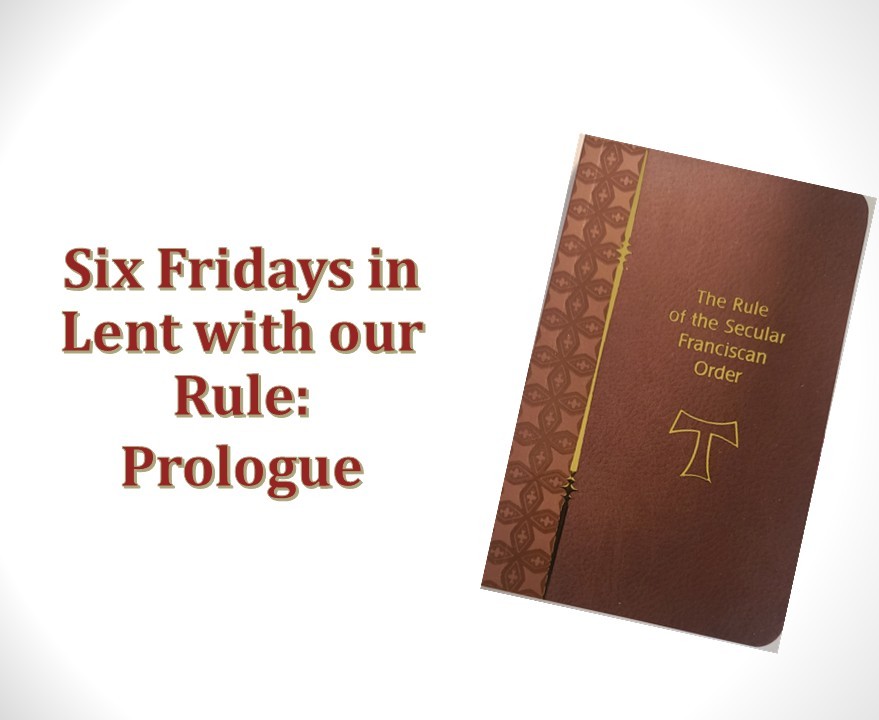
For the 6 Fridays of Lent, we will read and meditate on our Rule. Each week, we ask that you read a portion of the Rule at this link: https://ciofs.info/wp-content/uploads/2021/01/EN-OFS-Rule-s.pdf (You can download the PDF to your computer or tablet.)
The reflections and questions that follow will focus on how our Rule asks us to live, the role that conversion and penance play in our lives, and our mission as members of the Church of Christ. The topics below will guide you as you write in your journal or discuss with your fraternity, a small group, or a prayer partner. We hope that this series will aid you in strengthening your vocation and provide opportunities for daily conversion.
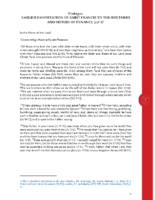
Week One: Please read the Prologue to our Rule (both sections) Concerning Those Who Do Penance and Concerning Those Who Do Not Do Penance. Pages 6-7 of the PDF above. (This section is also attached but not on Facebook.)
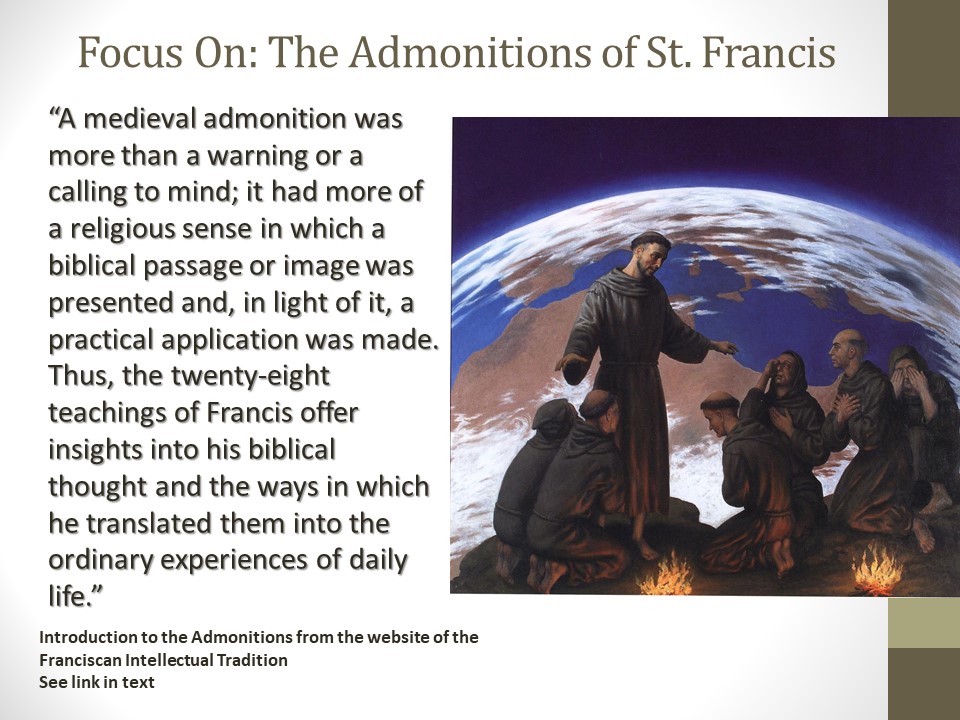
St. Francis speaks directly to us in the Prologue to our Rule. The earliest version of “The First Letter to the Faithful” (the Earlier Exhortation) is housed in a library in the city of Volterra in Italy. Therefore, it is often called the “ Volterra Letter.” You can read the letter on the Franciscan Intellectual Tradition website. Francis talks to us about the joy we will have if we live a life of penance and what we will suffer if we do not. Both portions of the Prologue encourage us to examine our lives as Catholics and Franciscans and to make changes where needed.
(Before proceeding to the questions, read and consider both sections of the Prologue.)
+Key Learnings: What are the four most important points (in your opinion) that you discovered as you read the Prologue?
+Living the OFS Rule: What about the Prologue presents a challenge for you to live out? Why?
+Conversion: The Holy Spirit speaks to each of us in a very personal way. As you read the Prologue, please explain how it touched and changed you and brought you closer to God.
+Discernment: What can you put into practice right away?
+Key Takeaways: Please list three key takeaways to living as a Franciscan that this portion of the Rule will help you to achieve.
+Challenge Yourself: Choose one of the takeaways as your personal spiritual challenge for this week and resolve to carry it out.
Formación 20 de febrero de 2026
La Regla OFS: Instrumento de Conversión OFS (Semana Uno)
Para los 6 viernes de Cuaresma, leeremos y meditaremos en nuestra Regla. Cada semana, le pedimos que lea una parte de la Regla que aparece en este enlace: https://ciofs.info/es/library/official-documents/ (Puede descargar el PDF a su computadora o tableta).
Las reflexiones y preguntas que siguen se centrarán en cómo nuestra Regla nos pide que vivamos, el papel que la conversión y la penitencia desarrollan en nuestras vidas y nuestra misión como miembros de la Iglesia de Cristo. Los temas a continuación lo guiarán mientras escribe en su diario o discute con su fraternidad, un grupo pequeño o un compañero de oración. Esperamos que esta serie les ayude a fortalecer su vocación y les brinde oportunidades para la conversión diaria.
Semana Uno: Por favor, lea el Prólogo de nuestra Regla (ambas secciones) “Los que hacen penitencia” y “Los que no hacen penitencia.” Páginas 6-7 del PDF anterior. (Esta sección también se adjunta pero no en Facebook).
San Francisco nos habla directamente en el Prólogo de nuestra Regla. La primera versión de “La Primera Carta a los Fieles” (la Exhortación Anterior) se encuentra en una biblioteca en la ciudad de Volterra en Italia. Por lo tanto, a menudo se la llama la “Carta de Volterra.” Puede leer la carta en el sitio web FRANCISCANOS.ORG Francisco nos habla de la alegría que tendremos si vivimos una vida de penitencia y lo que sufriremos si no lo hacemos. Ambas partes del Prólogo nos animan a examinar nuestras vidas como católicos y franciscanos y a hacer cambios donde sea necesario.
(Antes de continuar con las preguntas, lea y considere ambas secciones del Prólogo).
+Aprendizajes clave: ¿Cuáles son los cuatro puntos más importantes (en su opinión) que descubrió al leer el Prólogo?
+Viviendo la Regla OFS: ¿Qué pasa con el Prólogo que presenta un desafío para que lo vivas? ¿Por qué?
+Conversión: El Espíritu Santo nos habla a cada uno de nosotros de una manera muy personal. Mientras lee el Prólogo, explique cómo lo tocó y lo cambió y lo acercó a Dios.
+Discernimiento: ¿Qué puedes poner en práctica de inmediato?
+Puntos clave: Enumere tres puntos clave para vivir como franciscano que esta parte de la Regla le ayudará a lograr.
+Desafíese a usted mismo: Elija uno de los puntos clave como su desafío espiritual personal para esta semana y decida llevarlo a cabo.
Diane F. Menditto, OFSVice Minister, National Fraternity, Secular Franciscan Order USA“Go into the world and proclaim the good news.”National Theme 2025-2028
Category: Formation Friday
FORMATION FRIDAY – Focus Upon Admonitions- #10 – February 13, 2026
Please share with your fraternities (En español abajo) Korean translation attached in separate PDF.
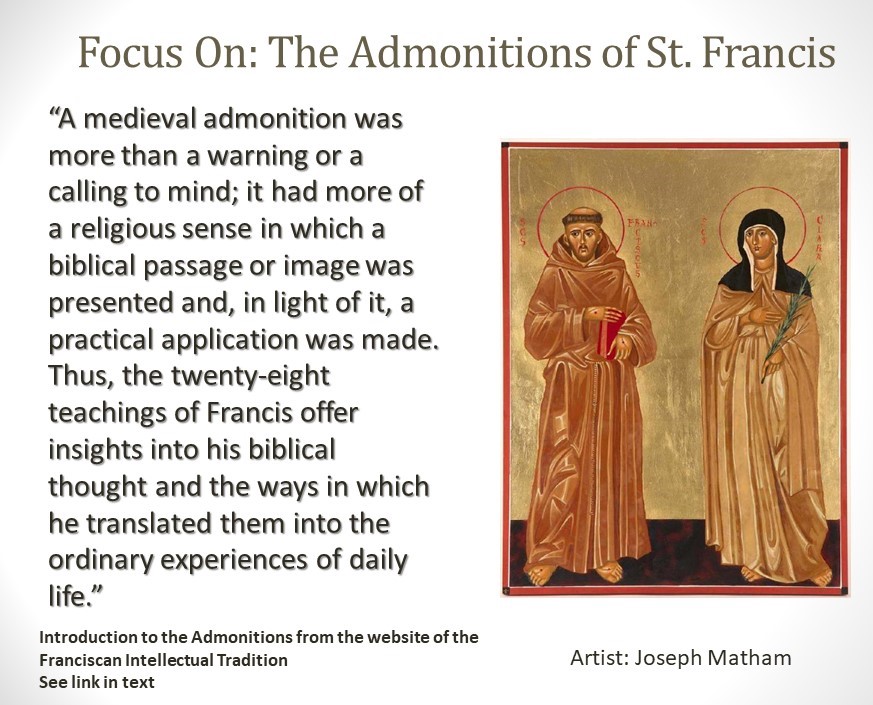
Focus on the Admonitions (#10)
[X. Castigating the Body]1There are many people who, when they sin or are injured, frequently blame the enemy or their neighbor. Gn 3:12 Gn 3:13 2But it is not so, because each one has the enemy in his power, that is his body through which he sins.
3Blessed is the servant, Mt 24:46 then, who always holds captive the enemy delivered into his power and wisely safeguards himself from him; 4because, as long as he does this, no other enemy visible or invisible will be able to harm him.
From the Prologue to our Rule
“1All those men and women who are not living in penance, 2who do not receive the Body and Blood of our Lord Jesus Christ, 3who practice vice and sin and walk after the evil concupiscence and the evil desires of their flesh, 4who do not observe what they have promised to the Lord, 5and who in their body serve the world and the cares of this life: 6They are held captive by the devil, whose children they are, and whose works they do (Jn 8:41) 7They are blind because they do not see the true light, our Lord Jesus Christ.”
“11See you blind ones, deceived by your enemies: the flesh, the world and the devil, because it is sweet for the body to sin and it is bitter to serve God, 12for every vice and sin flow and proceed from the human heart (Mt 15:19, Mk 7:21) as the Lord says in the gospel. 13And you have nothing in this world or in that to come. 14And you think you will possess this world’s vanities for a long time, but you are deceived because a day and hour will come of which you give no thought, which you do not know, and of which you are unaware when the body becomes weak, death approaches, and it dies a bitter death.”
As you read Admonition X and the two paragraphs from the Prologue to our Rule (Concerning Those Who Do Not Do Penance), please consider the following questions. Record your thoughts in your journal or share them in a small group with other fraternity members.
+Blaming others has become the answer many in today’s society use when explaining why they have done something wrong. They say, “Yes, but…” Or “That’s how I was raised.” Or “No one told me/taught me.” Or “That’s just the way I am.”
–Explain the advice that St. Francis gives us on this topic in Admonition 10.
–How does he speak to us in the Prologue to our Rule to follow up on this advice?
–How often are we tempted to blame others for the wrongs we commit? Can you think of an example?
–Which Franciscan virtues can help us to avoid the temptation to blame others?
–What do I want to change about myself when it comes to blaming others?++++++++++++++++++
Formación 13 de febrero, 2026
Enfoque en las admoniciones de San Francisco (Admonición X)
https://www.franciscanos.org/esfa/escritossf.html#adm[Cap. X: Del castigo del cuerpo]
1Hay muchos que, cuando pecan o reciben una injuria, con frecuencia acusan al enemigo o al prójimo. 2Pero no es así, porque cada uno tiene en su poder al enemigo, es decir, al cuerpo, por medio del cual peca. 3Por eso, bienaventurado aquel siervo (Mt 24,46) que tiene siempre cautivo a tal enemigo entregado en su poder, y se guarda sabiamente de él; 4porque, mientras haga esto, ningún otro enemigo, visible o invisible, podrá dañarle.
http://franciscanos.org/esfa/adm-ae.html
Del Prólogo de nuestra regla
“Por el contrario, todos aquellos y aquellas que no viven en penitencia, ni reciben el cuerpo y la sangre de nuestro Señor Jesucristo, y viven en el vicio y el pecado, y van tras la mala concupiscencia (cf. Col 3,5) y los malos deseos de su carne (cf. Gál 5,16), y no cumplen lo que prometieron al Señor, y sirven corporalmente al mundo con los deseos carnales (1Pe 2,11) y con los afanes de este mundo (cf. Mt 13,22; Lc 21,34) y las preocupaciones de esta vida, engañados por el diablo, cuyos hijos son y cuyas obras hacen (cf. Jn 8,41), son unos ciegos (cf. Mt 15,14), pues no ven al que es la luz verdadera (cf. Jn 1,9), nuestro Señor Jesucristo.”
“Mirad, ciegos, engañados por vuestros enemigos, la carne, el mundo y el diablo, que al cuerpo le es dulce pecar y amargo servir a Dios; pues todos los vicios y pecados salen y proceden del corazón del hombre, como dice el Señor en el Evangelio (cf. Mc 7,21.23; Mt 15,18-19). Y nada tenéis en este mundo ni en el futuro. Pensáis poseer por mucho tiempo las vanidades de este mundo, pero estáis engañados, porque vendrán el día y la hora que no pensáis, que desconocéis e ignoráis (cf. Mt 24,44; 25,13): enferma el cuerpo, se acerca la muerte, y se muere así con muerte amarga (1Sam 15,32).”
Mientras lee la Admonición X y los dos párrafos del Prólogo de nuestra Regla (De los que no hacen penitencia), considere las siguientes preguntas. Escriba sus pensamientos en su diario o compártalos en un grupo pequeño con otros miembros de la fraternidad.
+Culpar a los demás se ha convertido en la respuesta que muchos en la sociedad actual utilizan para explicar por qué han hecho algo mal. Dicen: “Sí, pero…” o “Así me criaron.” O “Nadie me dijo/me enseñó.” O “Así soy yo.”
–Explique el consejo que nos da San Francisco sobre este tema en la Admonición 10.
–¿Cómo nos habla en el Prólogo de nuestra Regla para dar seguimiento a este consejo?
–¿Con qué frecuencia nos sentimos tentados a culpar a otros por los errores que cometemos? ¿Puede pensar en un ejemplo?
–¿Qué virtudes franciscanas pueden ayudarnos a evitar la tentación de culpar a los demás?
–¿Qué quiero cambiar de mí mismo cuando se trata de culpar a los demás?
Diane F. Menditto, OFSVice Minister, National Fraternity, Secular Franciscan Order USA“Go into the world and proclaim the good news.”National Theme 2025-2028
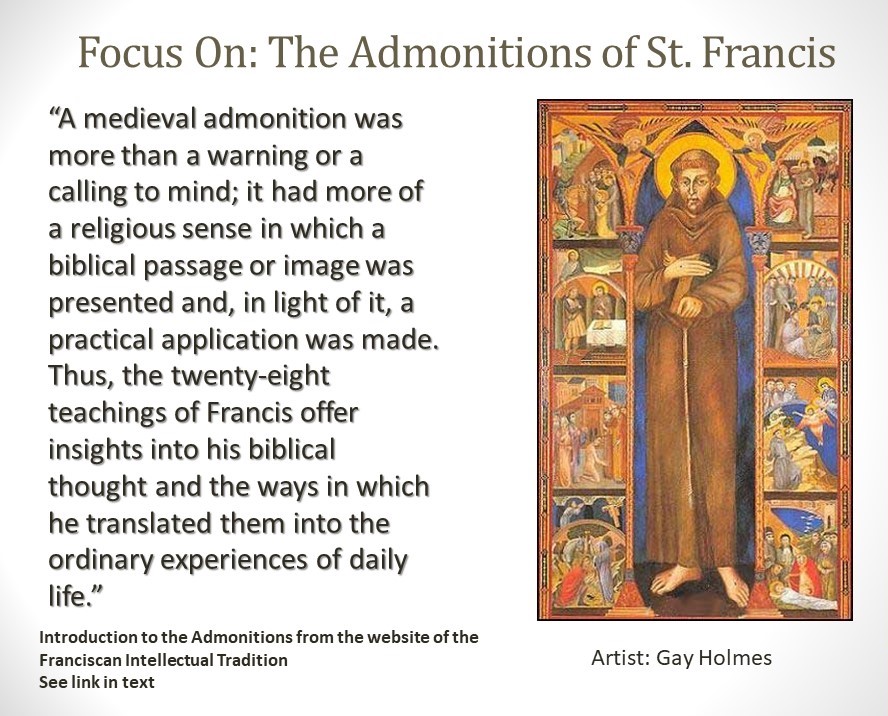
Formation Friday – Focus on the Admonitions (VII and VIII) – February 6, 2026
(Please share with your fraternities) Korean translation attached in a separate PDF.
Focus on the Admonitions (VII and VIII)
[VII: Let Good Action Follow Knowledge]
1The apostle says: The letter kills, but the spirit gives life. 2 Cor 3:6
2Those people are put to death by the letter who only wish to know the words alone, that they might be esteemed wiser than others and be able to acquire great riches to give to their relatives and friends.
3And those religious are put to death by the letter who are not willing to follow the spirit of the divine letter but, instead, wish only to know the words and to interpret them for others.
4And those people are brought to life by the spirit of the divine letter who do not attribute every letter they know, or wish to know, to the body but, by word and example, return them to the most high Lord God to Whom every good belongs.
[VIII. Avoiding the Sin of Envy]
1The apostle says: No one can say: Jesus is Lord, except in the Holy Spirit; 1 Cor 12:3 2and: There is not one who does good, not even one. Rom 3:12
3Therefore, whoever envies his brother the good that the Lord says or does in him incurs a sin of blasphemy because he envies the Most High Himself Who says and does every good thing. Mt 20:15
Questions to discuss or to answer in your journal+ Come, Holy Spirit! Open my mind and heart as I contemplate Admonition VII.
- How do we get sidetracked in our lives by the “letter of the law” (the literal words) as opposed to the spirit of the law (the intent of the law)?
- What are some ways that we can come to understand the spirit of what is asked of us in Scripture?
- Try to give an example of where “the letter” and “the spirit” affect us as Secular Franciscans.
+ Admonition VIII—Holy Spirit, help us to increase our humility as we consider Admonition VIII.
- First, take a look in the Catechism to see what it says about sinful envy. (2538-2540) (2553)
https://www.vatican.va/archive/ENG0015/__P8U.HTM- When we see the gifts of others, what are some ways that we can avoid the sin of envy?
- Spend some time thinking about the gifts that the Holy Spirit has given you. How can you make the most of these gifts in your spiritual life? In your family life? In your life in fraternity?
++++++++++++++
Formación 6 de febrero, 2026
Enfoque en las Admoniciones VII y VIII
http://franciscanos.org/esfa/adm-ae.html
[Admonición VII: Que el buen obrar siga a la ciencia]
1Dice el Apóstol: La letra mata, pero el espíritu vivifica (2 Cor 3,6). 2Son matados por la letra aquellos que únicamente desean saber las palabras solas, para ser tenidos por más sabios entre los otros y poder adquirir grandes riquezas que dar a consanguíneos y amigos. 3Y son matados por la letra aquellos religiosos que no quieren seguir el espíritu de la divina letra, sino que desean más bien saber únicamente las palabras e interpretarlas para los otros. 4Y son vivificados por el espíritu de la divina letra aquellos que no atribuyen al cuerpo toda la letra que saben y desean saber, sino que, con la palabra y el ejemplo, la devuelven al altísimo Señor Dios, de quien es todo bien.
[Admonición VIII: Del pecado de envidia, que se ha de evitar]
1Dice el Apóstol: Nadie puede decir: Señor Jesús, sino en el Espíritu Santo (1 Cor 12,3); 2y: No hay quien haga el bien, no hay ni siquiera uno (Rom 3,12). 3Por consiguiente, todo el que envidia a su hermano por el bien que el Señor dice y hace en él, incurre en el pecado de blasfemia, porque envidia al mismo Altísimo (cf. Mt 20,15), que dice y hace todo bien.
Preguntas para platicar o responder en su diario
+ ¡Ven, Espíritu Santo! Abre mi mente y mi corazón mientras contemplo la Admonición VII.
• ¿Cómo nos desviamos en nuestras vidas por la “letra de la ley” (las palabras literales) en oposición al espíritu de la ley (la intención de la ley)?
• ¿Cuáles son algunas formas en que podemos llegar a comprender el espíritu de lo que se nos pide en las Escrituras?
• Trate de dar un ejemplo de dónde “la letra” y “el espíritu” nos afectan como franciscanos seglares.
+ Admonición VIII—Espíritu Santo, ayúdanos a aumentar nuestra humildad mientras consideramos la Admonición VIII.
• Primero, eche un vistazo al Catecismo para ver lo que dice acerca de la envidia pecaminosa. (2538-2540) (2553) https://www.vatican.va/archive/catechism_sp/p3s2c2a0_sp.html
• Cuando vemos los dones de los demás, ¿cuáles son algunas formas en que podemos evitar el pecado de la envidia?
• Dedique algún tiempo a pensar en los dones que el Espíritu Santo le ha dado. ¿Cómo puede aprovechar al máximo estos dones en tu vida espiritual? ¿En su vida familiar? ¿En su vida en fraternidad?
Diane F. Menditto, OFSVice Minister, National Fraternity, Secular Franciscan Order USA“Go into the world and proclaim the good news.”National Theme 2025-2028
Formation Friday Focus on the Admonitions – January 30, 2026
(Please share with your fraternities)
(En español abajo) Korean translation attached in separate PDF.Focus on the Admonitions (V)
[V. Let No One Be Proud, but Boast in the Cross of the Lord]
1Consider, O human being, in what great excellence the Lord God has placed you, for He created and formed you to the image of His beloved Son according to the body and to His likeness according to the Spirit. Gn 1:27
2And all creatures under heaven serve, know, and obey their Creator, each according to its own nature, better than you. 3And even the demons did not crucify Him, but you, together with them, have crucified Him and are still crucifying Him by delighting in vices and sins.
4In what, then, can you boast? 5Even if you were so skillful and wise that you possessed all knowledge, 1 Cor 13:2 knew how to interpret every kind of language, 1 Cor 12:28 and to scrutinize heavenly matters with skill: you could not boast in these things. 6For, even though someone may have received from the Lord a special knowledge of the highest wisdom, one demon knew about heavenly matters and now knows more about those of earth than all human beings.a
7In the same way, even if you were more handsome and richer than everyone else, and even if you worked miracles so that you put demons to flight: all these things are contrary to you; nothing belongs to you; you can boast in none of these things.
8But we can boast in our weaknesses 2 Cor 12:5 and in carrying each day the holy cross of our Lord Jesus Christ. Lk 14:27
For discussion in fraternity, with a partner, or in your journal.
+What is challenging to you about this Admonition?
+Are you able to see your strengths and weaknesses?
+How do you view humility?
+Do you try to hide your strengths in an effort to be humble? +How can you avoid this?Formación 30 de enero de 2026
Enfoque en las admoniciones de San Francisco (V)
http://www.franciscanos.org/esfa/adm-ae.html
[Cap. V: Que nadie se ensoberbezca, sino que se gloríe en la cruz del Señor]
1Considera, oh hombre, en cuán grande excelencia te ha puesto el Señor Dios, porque te creó y formó a imagen de su amado Hijo según el cuerpo, y a su semejanza (cf. Gén 1,26) según el espíritu. 2Y todas las criaturas que hay bajo el cielo, de por sí, sirven, conocen y obedecen a su Creador mejor que tú. 3Y aun los demonios no lo crucificaron, sino que tú, con ellos, lo crucificaste y todavía lo crucificas deleitándote en vicios y pecados. 4¿De qué, por consiguiente, puedes gloriarte? 5Pues, aunque fueras tan sutil y sabio que tuvieras toda la ciencia (cf. 1 Cor 13,2) y supieras interpretar todo género de lenguas (cf. 1 Cor 12,28) e investigar sutilmente las cosas celestiales, de ninguna de estas cosas puedes gloriarte; 6porque un solo demonio supo de las cosas celestiales y ahora sabe de las terrenas más que todos los hombres, aunque hubiera alguno que hubiese recibido del Señor un conocimiento especial de la suma sabiduría. 7De igual manera, aunque fueras más hermoso y más rico que todos, y aunque también hicieras maravillas, de modo que ahuyentaras a los demonios, todas estas cosas te son contrarias, y nada te pertenece, y no puedes en absoluto gloriarte en ellas; 8por el contrario, en esto podemos gloriarnos: en nuestras enfermedades (cf. 2 Cor 12,5) y en llevar a cuestas a diario la santa cruz de nuestro Señor Jesucristo (cf. Lc 14,27).
Para platicar en fraternidad, con un compañero o en su diario.
+¿Qué le resulta difícil de esta admonición?
+¿Es usted capaz de reconocer sus puntos fuertes y débiles?
+¿Cómo ve la humildad?
+¿Intenta ocultar sus puntos fuertes en un esfuerzo por ser humilde? +¿Cómo puede evitarlo?
Diane F. Menditto, OFSVice Minister, National Fraternity, Secular Franciscan Order USA“Go into the world and proclaim the good news.”National Theme 2025-2028
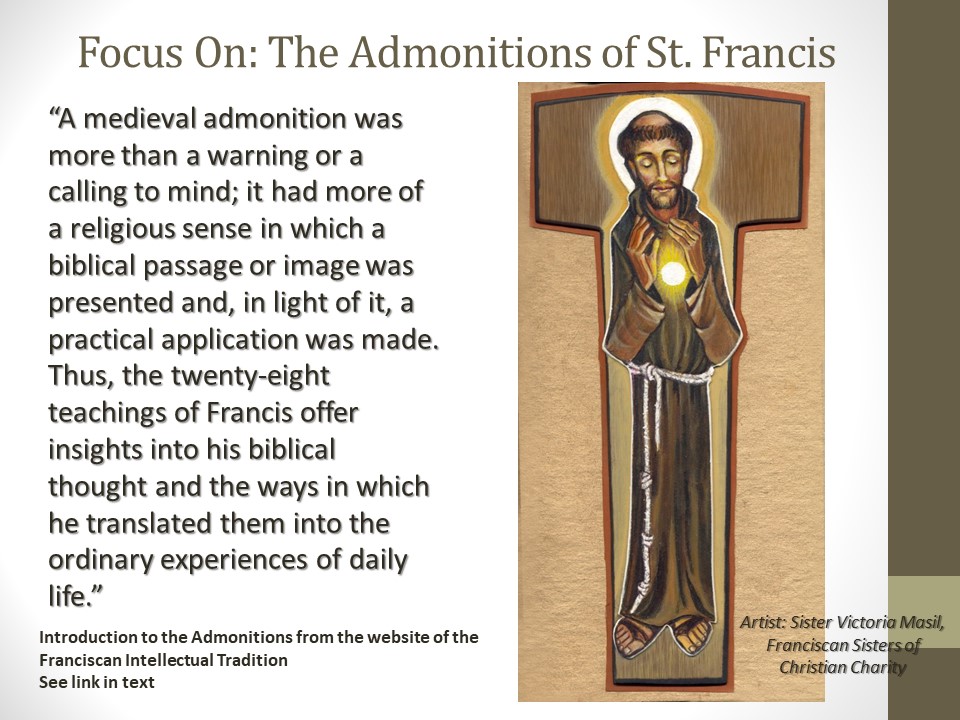
Formation Friday – Focus on the Admonitions (IV, VI and IX) -January 23, 2026
(En español abajo) Korean translation attached in a separate PDF. (Please share with your fraternities)
Focus on the Admonitions (IV, VI and IX)
[IV: Let No One Make Being Over Others His Own]
1I did not come to be served, but to serve, says the Lord. Mt 20:28
2Let those who are placed over others boast about that position as much as they would if they were assigned the duty of washing the feet of their brothers. 3And if they are more upset at having their place over others taken away from them than at losing their position at their feet, the more they store up a money bag Jn 12:6 to the peril of their soul.c
[VI: Imitation of Christ]
1Let all of us, brothers, consider the Good Shepherd Who bore the suffering of the cross to save His sheep.
2The Lord’s sheep followed Him in tribulation and persecution, in shame and hunger, in weakness and temptation, and in other ways; and for these things they received eternal life from the Lord.
3Therefore, it is a great shame for us, the servants of God, that the saints have accomplished great things and we want only to receive glory and honor by recounting them.
[IX: Love]
1The Lord says: Love your enemies [do good to those who hate you and pray for those who persecute and slander you]. Mt 5:44
2For that person truly loves his enemy who is not hurt by an injury done to him, 3but, because of love of God, is stung by the sin of his soul. 4Let him show him love by his deeds.
To discuss or answer in your journal:
+How does Admonition IV inspire me in my role as a servant leader in my fraternity?
+What does it say to me as a parent or as a leader in my community?+How does Admonition VI encourage me to be strong in my following of Christ?
+How do I handle suffering for Christ?
+How do I explain my commitment to Christ to others?+When you think about Admonition IX, what is your reaction?
+Are you able to live out this admonition?
+++++++++++++++++++++++
Formación 23 de enero de 2026
Enfoque en las admoniciones de San Francisco (IV, VI y IX)
http://www.franciscanos.org/esfa/adm-ae.html
[Cap. IV: Que nadie se apropie la prelacía]
1No he venido a ser servido, sino a servir, dice el Señor (cf. Mt 20,28). 2Aquellos que han sido constituidos sobre los otros, gloríense de esa prelacía tanto, cuanto si hubiesen sido destinados al oficio de lavar los pies a los hermanos. 3Y cuanto más se turban por la pérdida de la prelacía que por la pérdida del oficio de lavar los pies, tanto más acumulan en la bolsa para peligro de su alma (cf. Jn 12,6).
[Cap. VI: De la imitación del Señor]
1Consideremos todos los hermanos al buen pastor, que por salvar a sus ovejas sufrió la pasión de la cruz. 2Las ovejas del Señor le siguieron en la tribulación y la persecución, en la vergüenza y el hambre, en la enfermedad y la tentación, y en las demás cosas; y por esto recibieron del Señor la vida sempiterna. 3De donde es una gran vergüenza para nosotros, siervos de Dios, que los santos hicieron las obras y nosotros, recitándolas, queremos recibir gloria y honor.
[Cap. IX: Del amor]
1Dice el Señor: Amad a vuestros enemigos, [haced el bien a los que os odian, y orad por los que os persiguen y calumnian] (Mt 5,44). 2En efecto, ama de verdad a su enemigo aquel que no se duele de la injuria que le hace, 3sino que, por amor de Dios, se consume por el pecado del alma de su enemigo. 4Y muéstrele su amor con obras.
Para platicar o contestar en su diario:
+¿Cómo me inspira la Admonición IV en mi papel de líder servidor en mi fraternidad?
+¿Qué me dice como padre o líder en mi comunidad?+¿Cómo me anima la Admonición VI a ser fuerte en mi seguimiento de Cristo?
+¿Cómo manejo el sufrimiento por Cristo?
+¿Cómo explico mi compromiso con Cristo a los demás?+Cuando piensa en la Admonición IX, ¿cuál es su reacción?
+¿Tiene usted éxito en vivir esta Admonición?
Diane F. Menditto, OFSVice Minister, National Fraternity, Secular Franciscan Order USA“Go into the world and proclaim the good news.”National Theme 2025-2028