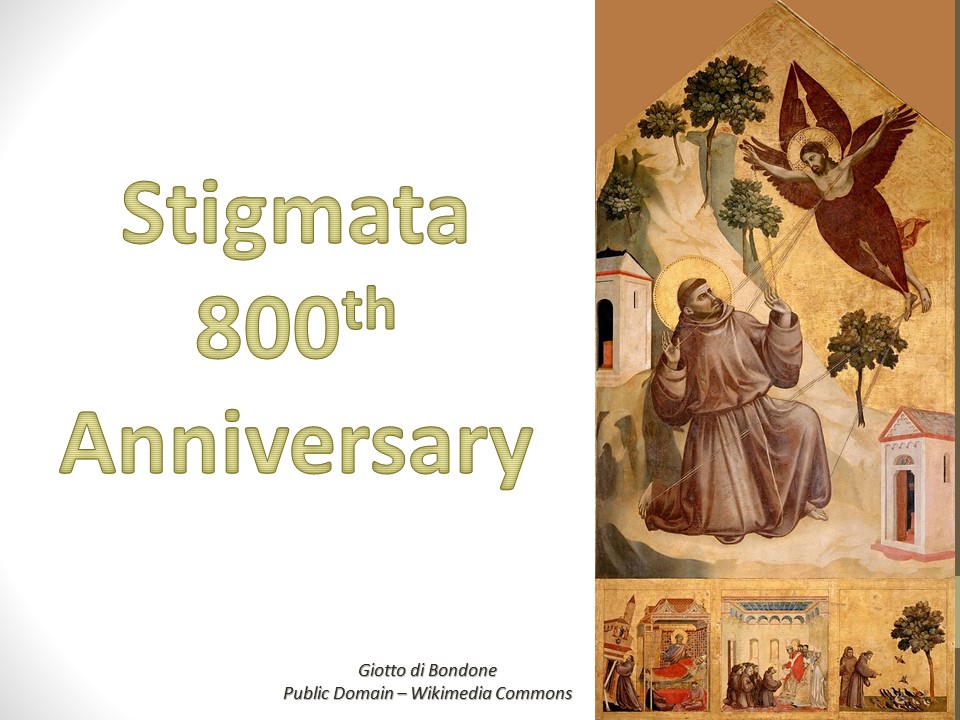
The Stigmata of St. Francis September 17th (800th Anniversary)
We interrupt our series on the frequently asked questions answered by our General Constitutions to highlight the 800th Anniversary of St. Francis being marked with the wounds of Christ. (The Stigmata)
+ St. Francis received the Stigmata around the feast of the Triumph of the Holy Cross in
September of 1224–two years before his death.
+He was praying on Mt. La Verna preparing for the feast of St. Michael the Archangel. Brother Leo was nearby.
+While praying, He asked God for two things. One, to let him experience the suffering Christ endured on the Holy Cross and two, for him to experience the love in which He did it.
+ Shortly thereafter, Francis saw a Seraph with six wings. (Seraphs are angels of the highest order who are closest to God and most passionate in praising Him.) Between the wings was the image of a crucified man. When the vision disappeared, Francis was marked with the wounds of Christ. (St. Francis’s encounter with the Seraph and his passion in praising the Father has caused the Franciscan Order to be called the Seraphic Order and St. Francis our Seraphic Father.
+ We celebrate the Feast of the Stigmata on September 17th
+ St. Francis is the first person in recorded Christian history to receive the Stigmata.The Stigmata: Inspiration for our spiritual lives as Franciscans
The marks in our lives:
–What does it mean to be marked?
–What marks us in our lives?
–As Catholics, how are we marked? How are we marked as Franciscans?
–How do the things that mark us, help us to move forward in our spiritual lives?Now, Gaze at the Cross:
–As we gaze at the wounds of Christ, what comes to mind?
–As we consider what Jesus suffered for us, how do we respond?
–As we contemplate Jesus’s willingness to die for us, what are we willing to do for our brothers and sisters?
–As we imitate Jesus in our lives, how are we willing to use our lives in the service of others?Prayer to the Five Wounds of the Lord prayed by St. Clare of Assisi
https://digitalcollections.franciscantradition.org/document/bx4700-c6a2-2005-d035/the_prayer_to_the_five_wounds_of_the_lord/undated?searchOption=transcriptions&term=The%20prayer%20to%20the%20five%20wounds%20of%20the%20lord&searchType=exact_phrasePrayer of Pope St. John Paul II (On a visit to Mt. La Verna in 1983)
O St Francis, stigmatized on La Verna, the world longs for you, that icon of the crucified Jesus.
It has need of your heart, open to God and to others; of your bare, wounded feet, of your pierced hands raised in supplication.
It longs for your voice so frail yet forceful with the power of the Gospel.
Francis, help the people of this age to recognize the evil of sin and to seek purification from it in penance.
Help them to become free from the very structures of sin that oppress today’s society.
Rekindle in the consciousness of those in government an urgent need for peace between nations and peoples.
Instill in young people your freshness of life that is capable of withstanding the snares of the many cultures of death.
To those injured by every type of evil teach, O Francis, the joy of being able to forgive.
To all those crucified by suffering, hunger and war, reopen the doors of hope. Amen.Formación 13 de septiembre 2024
Los estigmas de San Francisco 17 de septiembre (Celebrando 800 años.)
Interrumpimos nuestra serie sobre las preguntas frecuentes respondidas por nuestras Constituciones Generales para destacar el 800 aniversario de San Francisco marcado con las llagas de Cristo. (Los estigmas)
+ San Francisco recibió los estigmas en torno a la fiesta del Triunfo de la Santa Cruz en septiembre de 1224, dos años antes de su muerte.
+ Estaba orando en el monte La Verna preparándose para la fiesta de San Miguel Arcángel. El hermano Leo estaba cerca.
+ Mientras oraba, le pidió a Dios dos cosas. Una, dejarle experimentar el sufrimiento que Cristo soportó en la Santa Cruz y dos, que experimentara el amor en el que lo hizo.
+ Poco después, Francisco vio un Serafín con seis alas. (Los serafines son ángeles del orden más alto que están más cerca de Dios y más apasionados en alabarlo.) Entre las alas estaba la imagen de un hombre crucificado. Cuando la visión desapareció, Francisco quedó marcado con las llagas de Cristo. (El encuentro de San Francisco con el Serafín y su pasión por alabar al Padre ha hecho que la Orden Franciscana sea llamada Orden Seráfica y Francisco nuestro Seráfico Padre.
+ Celebramos la Fiesta de los Estigmas el 17 de septiembre
+ San Francisco es la primera persona en la historia cristiana registrada en recibir los estigmas.Los estigmas: inspiración para nuestra vida espiritual como franciscanos
Las marcas en nuestras vidas:
-¿Qué significa estar marcado?
-¿Qué nos marca en nuestra vida?
-Como católicos, ¿cómo estamos marcados? ¿Cómo franciscanos?
– ¿Cómo nos ayudan las cosas que nos marcan a avanzar en nuestra vida espiritual?Ahora, mirar la cruz:
– Al contemplar las heridas de Cristo, ¿qué nos viene a la mente?
-Al considerar lo que Jesús sufrió por nosotros, ¿cómo respondemos?
–Al contemplar la disposición de Jesús a morir por nosotros, ¿qué estamos dispuestos a hacer por nuestros hermanos y hermanas?
–Al imitar a Jesús en nuestra vida, ¿cómo estamos dispuestos a usar nuestra vida al servicio de los demás?Consideraciones sobre las Llagas de San Francisco
https://www.franciscanos.org/florecillas/llagas4.htmOración del Papa San Juan Pablo II (En una visita al Monte La Verna en 1983)
Oh, San Francisco, estigmatizado en La Verna, el mundo te anhela, ese icono de Jesús crucificado.
Necesita tu corazón, abierto a Dios ya los demás; de tus pies descalzos y heridos, de tus manos traspasadas alzadas en súplica.
Anhela tu voz tan frágil pero contundente con el poder del Evangelio.
Francisco, ayuda a la gente de esta época a reconocer la maldad del pecado y a buscar la purificación de él en la penitencia.
Ayúdalos a liberarse de las mismas estructuras del pecado que oprimen a la sociedad actual.
Reavivar en la conciencia de los gobernantes una urgente necesidad de paz entre naciones y pueblos.
Inculca en los jóvenes tu frescura de vida que es capaz de resistir las trampas de las muchas culturas de la muerte.
A los heridos por todo tipo de mal, enséñales, oh Francisco, la alegría de poder perdonar.
A todos los crucificados por el sufrimiento, el hambre y la guerra, reabre las puertas de la esperanza. Amén.Diane F. Menditto, OFSVice Minister, National Fraternity, Secular Franciscan Order USAListen – Discern – Go Forth National Theme 2022-2025
Category: Formation Friday
FORMATION FRIDAY – Frequently Asked Questions #6 – September 6, 2024
Formation Friday September 6, 2024 Frequently Asked Questions #6
Please share with your local fraternity (en español abajo) Korean translation attached in separate PDF.Frequently Asked Questions answered by our General Constitutions (GC): For the next several weeks we will take a look at some questions given in the 2010 edition of the Handbook for Servant Leadership. The same questions often arise on our councils and in our fraternities. Becoming familiar with the Constitutions is very helpful in addressing issues that arise in fraternities at all levels. For the complete, latest translation of the entire document, visit: https://ciofs.info/library/official-documents/ or https://www.secularfranciscansusa.org/the-general-constitutions-of-the-secular-franciscan-order-2000/
+ What are the required leadership positions for a fraternity? [GC Article 49]
1. The Council of the local Fraternity is composed of the following offices: Minister, Vice-Minister, Secretary, Treasurer, and Teacher of Formation (Formation Director). Other offices may be added according to the needs of each Fraternity. The Spiritual Assistant of the Fraternity forms part of the Council by right.
2. The Fraternity, meeting in an Assembly or Chapter, discusses questions regarding its own life and organization. Every three years, in an Elective Assembly or Chapter, the Fraternity elects the Minister and the Council in the way established by the Constitutions and Statutes. (See General Constitutions Title IV Articles 76-80 and National Statutes for election procedures.)
After reading Article 49, please discuss the following with your fraternity members.
+Who are the members of your local fraternity council?
+Please give some examples of what your fraternity council does for the fraternity.
+If you have not read about our election procedures in the Constitutions and Statutes, please do so. If your fraternity has questions, be sure to check with your region before the next fraternity elections.
+What are the duties of the council? [GC Article 50]
1. It is the duty of the Council of the local Fraternity:
– to promote the initiatives necessary for fostering fraternal life, for improving the human, Christian, and Franciscan formation of its members and for sustaining them in their witness and commitment in the world;
– to make concrete and courageous choices, appropriate for the situation of the Fraternity, from among the numerous activities possible in the field of the apostolate.
2. The duties of the Council are also:
a) to decide on the acceptance and admission to Profession of new brothers and sisters;
b) to establish a fraternal dialogue with members in particular difficulties and to adopt subsequent measures;
c) to receive the request for withdrawal and to decide on the suspension of a member from the Fraternity;
d) to decide on the establishment of sections or groups in conformity with the Constitutions and the Statutes;
e) to decide on the use of available funds and, in general, to deliberate on matters concerning financial management and economic affairs of the Fraternity;
f) to assign duties to the Councilors and to the other professed members;
g) to request from the competent Superiors of the First Order and the TOR suitable and prepared religious as Assistants;
h) to perform such other duties as are required by these Constitutions or which are necessary to carry out its proper purposes.
After reading Article 50, please discuss the following with your fraternity members.
+Which of the council duties above surprised you? Why?
+Discuss with a partner or group how you would fulfill these duties if you were elected to your local council.
+Why do you think it is essential that fraternity members discern serving on the council?
Formación 6 de septiembre, 2024 (Compartir con su fraternidad local.) Preguntas frecuentes #6
Preguntas Frecuentes Respondidas por nuestras Constituciones Generales (CG): Durante las próximas semanas echaremos un vistazo a algunas preguntas dadas en la edición 2010 del Manual para el Liderazgo de Servicio. Las mismas preguntas surgen a menudo en nuestros consejos y en nuestras fraternidades. Familiarizarse con las Constituciones es muy útil para abordar los problemas que surgen en las fraternidades a todos los niveles. Para obtener la traducción completa y más reciente del documento completo, visite: https://ciofs.info/wp-content/uploads/2021/01/ES-Constituciones-generales-OFS-s.pdf
+ ¿Cuáles son las posiciones de liderazgo requeridas para una fraternidad? [CCGG Artículo 49]
1. El Consejo de la Fraternidad local está formado por los siguientes oficios: Ministro, Viceministro, Secretario, Tesorero y Maestro de la formación. Según las exigencias de cada Fraternidad pueden añadirse otros oficios. Forma parte del Consejo, por derecho, el Asistente espiritual de la Fraternidad.
2. La Fraternidad, reunida en Asamblea o Capítulo, trata los asuntos que interesan a su vida y organización. Cada tres años, en Asamblea o Capítulo electivo, elige al Ministro y al Consejo, según las normas previstas en las Constituciones y en el Estatuto.
Después de leer el Artículo 49, por favor discuta lo siguiente con los miembros de su fraternidad.
+¿Quiénes son los miembros del consejo de su fraternidad local?
+Por favor, dé algunos ejemplos de lo que su consejo de fraternidad hace por la fraternidad.
+Si no ha leído sobre nuestros procedimientos de elección en las Constituciones y Estatutos, por favor hágalo. Si su fraternidad tiene preguntas, asegúrese de consultar con su región antes de las próximas elecciones de fraternidad.
+¿Cuáles son los deberes del consejo? [Artículo 50]
1. Corresponde al Consejo de la Fraternidad local:
– Promover las iniciativas necesarias para favorecer la vida fraterna, para incrementar la formación humana, cristiana y franciscana de sus miembros, y para sostenerlos en su testimonio y compromiso en el mundo;
– Adoptar opciones concretas y valientes, adecuadas a la situación de la Fraternidad, entre las múltiples actividades posibles en el campo apostólico.
2. Son, además, competencias del Consejo:
a) decidir la aceptación y la admisión a la Profesión de los nuevos hermanos33;
b) establecer un diálogo fraterno con los miembros que se hallan en dificultades particulares y adoptar las disposiciones oportunas;
c) aceptar la petición de baja y decidir la suspensión de un miembro de la Fraternidad;
d) decidir la constitución de secciones o grupos, de acuerdo con las Constituciones y los Estatutos;
e) decidir sobre la destinación de los fondos disponibles y, en general, deliberar sobre todo lo referente a la administración financiera y a los asuntos económicos de la Fraternidad;
f) confiar encargos a los consejeros y a otros profesos;
g) pedir religiosos idóneos y preparados como Asistentes a los Superiores competentes de la Primera Orden y de la TOR;
h) cumplir los demás deberes indicados en las Constituciones o necesarios para alcanzar sus fines propios.
Después de leer el Artículo 50, por favor discuta lo siguiente con los miembros de su fraternidad.
+¿Cuáles de los deberes del consejo anteriores le sorprendió? ¿Por qué?
+Discuta con un compañero o grupo cómo usted cumpliría con estos deberes si fuera elegido para su consejo local.
+¿Por qué cree que es esencial que los miembros de la fraternidad disciernan servir en el consejo?
Diane F. Menditto, OFSVice Minister, National Fraternity, Secular Franciscan Order USAListen – Discern – Go Forth National Theme 2022-2025
FORMATION FRIDAY – Frequently Asked Question #5 – August 30, 2024
Formation Friday August 30, 2024 Frequently Asked Questions #5
Please share with your local fraternity (en español abajo) Korean translation attached in separate PDF.Frequently Asked Questions answered by our General Constitutions (GC): For the next several weeks we will take a look at some questions given in the 2010 edition of the Handbook for Servant Leadership. The same questions often arise on our councils and in our fraternities. Becoming familiar with the Constitutions is very helpful in addressing issues that arise in fraternities at all levels. For the complete, latest translation of the entire document, visit: https://ciofs.info/library/official-documents/ or https://www.secularfranciscansusa.org/the-general-constitutions-of-the-secular-franciscan-order-2000/
+ What are the guidelines for ongoing formation? [GC Article 44]
1. Begun by the preceding stages, the formation of the brothers and sisters takes place in a permanent and continuous way. It should be understood as an aid in the conversion of each and everyone, and in the fulfilment of their proper mission in the Church and in society.
2. The Fraternity has the duty to give special attention to the formation of the newly professed and of the temporarily professed, to help them become more mature in their vocation and develop a true sense of belonging.
3. Permanent (ongoing) formation – accomplished by means of courses, gatherings, and the sharing of experience – aims to assist the brothers and sisters:
– Rule 4. in listening to and meditating on the Word of God, “going from Gospel to life and from life to Gospel”;
– in reflecting on events in the Church and in society in the light of faith and with the help of the documents of the Magisterium consequently taking consistent positions;
– in updating and deepening their Franciscan vocation by studying the writings of Saint Francis, Saint Clare and Franciscan authors.
After reading Article 44, please discuss the following with your fraternity members.
44.1- Describe the ongoing formation portion of your fraternity gatherings.
–How does the formation at your gatherings help you to grow as a Secular Franciscan?
–What suggestions would you make to your formator and council about the topics discussed at your gatherings?
–How does your fraternity’s ongoing formation aid in your daily conversion?
–How does it help you to work toward your “mission in the Church and in society?”
44.2 How does your fraternity assist the newly professed to become more mature in their vocation and develop a true sense of belonging?
–Is there a special program for the newly professed in your fraternity?
–If you are newly professed, what would you suggest to your formator and council that would help you strengthen your vocation?
44.3 This section mentions courses, gatherings, and sharing of experiences. These experiences would not necessarily take place at the local gatherings.
–Discuss some possibilities where we can participate in these opportunities.
–How would you find out about them? (Even if your formator and council do not advertise opportunities.)
–Does your fraternity read together and discuss Sacred Scripture? How could this be incorporated into the gatherings?
This section also makes important suggestions about documents and writings that would be important to study together. (Documents of the Magesterium and the writings of Francis and Clare.) You can find Church documents here: http://www.educatio.va/content/cec/en/documents/papal-documents-and-Magisterium-of-the-Church.html
–A treasure trove of the writings of Francis and Clare (and other authors of the Franciscan Intellectual Tradition) can be found here: https://digitalcollections.franciscantradition.org/
Formación 30 agosto, 2024 (Compartir con su fraternidad local.) Preguntas frecuentes #5
Preguntas Frecuentes Respondidas por nuestras Constituciones Generales (CG): Durante las próximas semanas echaremos un vistazo a algunas preguntas dadas en la edición 2010 del Manual para el Liderazgo de Servicio. Las mismas preguntas surgen a menudo en nuestros consejos y en nuestras fraternidades. Familiarizarse con las Constituciones es muy útil para abordar los problemas que surgen en las fraternidades a todos los niveles. Para obtener la traducción completa y más reciente del documento completo, visite: https://ciofs.info/wp-content/uploads/2021/01/ES-Constituciones-generales-OFS-s.pdf
+¿Cuáles son las directrices para la formación permanente? [CCGG Artículo 44]
1. Iniciada en las etapas precedentes, la formación de los hermanos se realiza de modo permanente y continuo. Es una ayuda para la conversión de todos y cada uno30 y para el cumplimiento de la propia misión en la Iglesia y en la sociedad.
2. La Fraternidad tiene el deber de dedicar especial atención a la formación de los neoprofesos y de los profesos temporales, para ayudarles a madurar su vocación y arraigar el sentido de pertenencia.
3. La formación permanente, también mediante cursos, encuentros, intercambio de experiencias, tiene como finalidad ayudar a todos los hermanos:
– Regla 4. a escuchar y meditar la Palabra de Dios, “pasando del Evangelio a la vida y de la vida al Evangelio”;
– a reflexionar, iluminados por la fe y ayudados por los documentos del Magisterio, sobre los acontecimientos de la Iglesia y de la sociedad, tomando consiguientemente posiciones coherentes;
– a actualizar y profundizar la vocación franciscana estudiando los escritos de San Francisco, Santa Clara y otros autores franciscanos.
Después de leer el Artículo 44, por favor discuta lo siguiente con los miembros de su fraternidad.
44.1- Describa la formación permanente ofrecida en los encuentros de su fraternidad.
–¿Cómo le ayuda a crecer como franciscano seglar esta formación permanente?
–¿Qué sugerencias haría a su formador y consejo sobre los temas discutidos en sus encuentros?
–¿Cómo ayuda la formación permanente ofrecida por su fraternidad en su conversión diaria?
–¿Cómo le ayuda a trabajar en su “misión en la Iglesia y en la sociedad”?
44.2 ¿Cómo ayuda su fraternidad a los nuevos profesos a “madurar en su vocación y a desarrollar un verdadero sentido de pertenencia”?
–¿Hay un programa especial para los nuevos profesos de su fraternidad?
–Si usted es recién profeso/a, ¿qué sugeriría a su formador y consejo que le ayudaría a fortalecer su vocación?
44.3 En esta sección se mencionan cursos, encuentros e intercambio de experiencias. Estas experiencias no necesariamente tendrían lugar en las reuniones locales.
–Discuta algunas posibilidades en las que podemos participar en estas oportunidades.
–¿Cómo se enteraría de ellos? (Incluso si su formador y consejo no anuncian oportunidades).
–¿Lee y discute juntos su fraternidad las Sagradas Escrituras? ¿Cómo se podría incorporar esta práctica en los encuentros?
En esta sección también se hacen sugerencias importantes sobre documentos y escritos que sería importante estudiar juntos. (Documentos del Magisterio y los escritos de Francisco y Clara.)
Aquí encontrarán recursos:
Documentos de la Iglesia: https://www.vatican.va/roman_curia/congregations/cfaith/doc_doc_index_sp.htmY https://www.vatican.va/offices/papal_docs_list_sp.html
Los escritos de Francisco y Clara en español: https://www.franciscanos.org/frandp/menup.html
Diane F. Menditto, OFSVice Minister, National Fraternity, Secular Franciscan Order USAListen – Discern – Go Forth National Theme 2022-2025
FORMATION FRIDAY – General Constitution Question #4 – August 23, 2024
Formation Friday August 23, 2024 Frequently Asked Questions #4
Please share with your local fraternity (en español abajo) Korean translation attached in separate PDF.Frequently Asked Questions answered by our General Constitutions (GC): For the next several weeks we will take a look at some questions given in the 2010 edition of the Handbook for Servant Leadership. The same questions often arise on our councils and in our fraternities. Becoming familiar with the Constitutions is very helpful in addressing issues that arise in fraternities at all levels. For the complete, latest translation of the entire document, visit: https://ciofs.info/library/official-documents/ or https://www.secularfranciscansusa.org/the-general-constitutions-of-the-secular-franciscan-order-2000/
+ What are the important basics of the time of initial formation? [GC Articles 41 and 43]
Article 41
1. Rule 23. Having completed the time of initial formation, the candidate submits to the Minister of the local Fraternity a request to make his or her profession. Having heard the Teacher of Formation (Formator) and the Spiritual Assistant, the Fraternity Council decides by secret ballot on the admission to profession, and gives its reply to the candidate, and informs the Fraternity.
2. The conditions for Profession or Promise to live the Gospel life are:
– attainment of the age established by the National Statutes; (In the USA 21 years for permanent profession and 18 years for temporary profession.)
– active participation during the time of initial formation for at least one year; (In the USA the time of initial formation [candidacy] is no less than 18 months and no more than 36 months.)
– the consent of the Council of the local Fraternity.
3. Where it is considered necessary to lengthen the time of Initial Formation, it must not be extended to more than a year beyond the time established by the National Statutes. (In the USA no more than 36 months.)
Article 43
The National Statutes establish:
– Rule 23. The minimum age for Profession which, however, may not be less than eighteen years completed. (See 41.2 above.)
– The distinctive sign of belonging to the Order (the “TAU” or other Franciscan symbol). [In the USA the TAU]
(See Formation Friday June 21, 2024 regarding use of the habit.)
After reading Articles 41 and 43, please discuss the following with your fraternity members.
+What portions of Article 41 surprised you?
+What is “active participation” for a candidate? For a professed member?
+Do you wear your TAU every day? Is this important? Why/why not?
+ What are the individual’s and fraternity’s responsibilities and the nature of profession? [Article 42.1, .2 and .4]
1. Profession is the solemn ecclesial act by which the candidate, remembering the call received from Christ, renews the baptismal promises and publicly affirms his or her personal commitment to live the Gospel in the world according to the example of Francis and following the Rule of the OFS.
2. Rule 23. Profession incorporates the candidate into the Order and is by its nature a perpetual commitment. …
4. Profession does not only commit those professed to the Fraternity, but also, at the same time, it commits the Fraternity to take care of the human and religious well-being of the professed.
After reading article 42.1, .2, and .4, please discuss the following questions:
+Please read the Rite of Profession in the Ritual. ( https://ciofs.info/wp-content/uploads/2021/01/EN-OFS-Ritual-s.pdf ) What stands out to you about what you promised at profession? What are the challenges?
+Please explain your personal commitment to fraternity life. Are you satisfied with how you carry this out?
+Give examples of how your fraternity takes care of your human and religious well-being. What suggestions could you offer your council about fulfilling the members’ needs?
Formación 23 agosto, 2024 (Compartir con su fraternidad local.) Preguntas frecuentes #4
Preguntas Frecuentes Respondidas por nuestras Constituciones Generales (CG): Durante las próximas semanas echaremos un vistazo a algunas preguntas dadas en la edición 2010 del Manual para el Liderazgo de Servicio. Las mismas preguntas surgen a menudo en nuestros consejos y en nuestras fraternidades. Familiarizarse con las Constituciones es muy útil para abordar los problemas que surgen en las fraternidades a todos los niveles. Para obtener la traducción completa y más reciente del documento completo, visite: https://ciofs.info/wp-content/uploads/2021/01/ES-Constituciones-generales-OFS-s.pdf
+ ¿Cuáles son los fundamentos importantes del tiempo de la formación inicial? [Artículos 41 y 43 de las CCGG]
Artículo 41
1. Regla 23. El candidato, terminado el tiempo de formación inicial, pedirá ser admitido a la Profesión al Ministro de la Fraternidad local. El Consejo de la Fraternidad, oído el Maestro de la formación y el Asistente, decide, mediante votación secreta, la admisión a la Profesión, y da respuesta al candidato y lo anuncia a la Fraternidad.
2. Las condiciones para la Profesión o Compromiso de vida evangélica son:
– tener la edad establecida por el Estatuto nacional;
– la participación activa en la formación inicial, al menos, durante un año;
– el consentimiento del Consejo de la Fraternidad local.
3. Cuando parezca oportuno prolongar el tiempo de formación inicial, éste no se alargará más de un año sobre el tiempo establecido por el Estatuto nacional.
Artículo 43
Los Estatutos nacionales establecen:
– Regla 23. la edad mínima para la Profesión, que no será, de ninguna manera, inferior a los dieciocho años cumplidos;
– el signo distintivo de pertenencia a la Orden (la “TAU” u otro símbolo franciscano). [En EUA la TAU]
(Vea “Formation Friday” 21 de junio, 2024 en cuanto al uso del hábito.)
Después de leer el Artículo 31 y 43, por favor discuta lo siguiente con los miembros de su fraternidad.
+¿Qué partes del artículo 41 le sorprendieron?
+¿Qué es la “participación activa” para un candidato? ¿Para un miembro profeso?
+¿Usa usted su TAU todos los días? ¿Es esto importante? ¿Por qué sí o por qué no?
+ ¿Cuáles son las responsabilidades del individuo y de la fraternidad y la naturaleza de la profesión? [Artículo 42.1, .2 y .4]
1. La Profesión es el acto eclesial solemne con el que el candidato, recordando la llamada recibida de Cristo, renueva las promesas bautismales y afirma públicamente su compromiso de vivir el Evangelio en el mundo siguiendo el ejemplo de Francisco y según la Regla de la OFS.
2. Regla 23. La Profesión incorpora al candidato a la Orden y es de por sí un compromiso perpetuo. A la Profesión perpetua, por razones pedagógicas objetivas y concretas, puede preceder una Profesión temporal, renovable anualmente. El tiempo total de la Profesión temporal no puede superar los tres años28.
4. La Profesión no compromete únicamente a los profesos con la Fraternidad, sino que del mismo modo compromete a la Fraternidad a procurar su bienestar humano y religioso.
Después de leer el artículo 42.1, .2 y .4, por favor, discuta las siguientes preguntas:
+Por favor, lea el Rito de la Profesión en el Ritual. (https://ciofs.info/wp-content/uploads/2021/01/ES-Ritual-OFS-s.pdf )
¿Qué es lo que más le llama la atención de lo que prometió en la profesión? ¿Cuáles son los desafíos?
+Por favor, explique su compromiso personal con la vida de fraternidad. ¿Está satisfecho con la forma en que lo lleva a cabo?
+Dé ejemplos de cómo su fraternidad cuida de su bienestar humano y religioso. ¿Qué sugerencias podría ofrecer a su consejo para satisfacer las necesidades de los miembros?
Diane F. Menditto, OFSVice Minister, National Fraternity, Secular Franciscan Order USAListen – Discern – Go Forth National Theme 2022-2025
FORMATION FRIDAY – Frequently Asked Question #3 – August 16, 2024
Please share with your local fraternity (en español abajo) Korean translation is attached in a separate PDF.
Frequently Asked Questions answered by our General Constitutions (GC): For the next several weeks we will take a look at some questions given in the 2010 edition of the Handbook for Servant Leadership. The same questions often arise on our councils and in our fraternities. Becoming familiar with the Constitutions is very helpful in addressing issues that arise in fraternities at all levels. For the complete, latest translation of the entire document, visit: https://ciofs.info/library/official-documents/ or https://www.secularfranciscansusa.org/the-general-constitutions-of-the-secular-franciscan-order-2000/
+ Who is responsible for formation and entrance into the Order? [GC Article 37]
1. Rule 23. Membership in the Order is attained through a time of initiation, a time of formation, and the Profession of the Rule.
2. The journey of formation, which should develop throughout life, begins with entrance into the fraternity. Mindful that the Holy Spirit is the principal agent of formation and always attentive to collaboration with Him, those responsible for formation are: the candidate, the entire Fraternity, the Council with the Minister, the Teacher of Formation (formator), and the Spiritual Assistant.
3. The brothers and sisters are responsible for their own formation, developing in an ever more perfect way the vocation received from the Lord. The Fraternity is called to help the brothers and sisters on this journey by means of a warm welcome, prayer, and example.
4. The National and Regional Councils, by common agreement, are expected to develop and adopt means of formation, adapted to the local situations and offered as a help to those responsible for formation in the individual Fraternities.
After reading Article 37, please discuss the following with your fraternity members.
+What do you remember about your time of initial formation?
–If you are now an aspirant or a candidate, share the highlights of your formation with the professed members.
–If you are a professed member, how does the present initial formation program compare with what you experienced?
+Explain why the Holy Spirit is the principal agent of formation.
+What are some ways that we can be responsible for our own formation? Give examples of how the members of your fraternity help to “form” you?
+Has your fraternity/region reached out to the regional or national formation teams for assistance? National and regional formation teams are happy to give help, talks, and general encouragement.
+ What are the conditions, process, and responsibilities for entrance into the Order? [GC Article 39]
1. Rule 23. The request for admission to the Order is presented by the aspiring member to the Minister of a local or personal Fraternity by a formal act, in writing if possible.
2. Conditions for admission are: to profess the Catholic faith, to live in communion with the Church, to be of good moral standing, and to show clear signs of a vocation.
3. The Council of the Fraternity decides collegially on the request, gives a formal answer to the aspiring member, and communicates this to the Fraternity.
4. The rite of admission is performed according to the Ritual27. The act is to be registered and preserved in the records of the Fraternity.
After reading article 39, please discuss the following questions:
+Why is #2 above so important for those who wish to be admitted to the Order (and also for professed members)?
+Read the Rite of Admission in the Ritual (also available on pages 7-11 of the PDF at this link: https://ciofs.info/wp-content/uploads/2021/01/EN-OFS-Ritual-s.pdf )
–What stands out to you about the commitment we make when we are admitted to the Order?
Formación 16 agosto, 2024 (Compartir con su fraternidad local.) Preguntas frecuentes #3
Preguntas Frecuentes Respondidas por nuestras Constituciones Generales (CG): Durante las próximas semanas echaremos un vistazo a algunas preguntas dadas en la edición 2010 del Manual para el Liderazgo de Servicio. Las mismas preguntas surgen a menudo en nuestros consejos y en nuestras fraternidades. Familiarizarse con las Constituciones es muy útil para abordar los problemas que surgen en las fraternidades a todos los niveles. Para obtener la traducción completa y más reciente del documento completo, visite: https://ciofs.info/wp-content/uploads/2021/01/ES-Constituciones-generales-OFS-s.pdf
+ ¿Quién es el responsable de la formación y el ingreso en la Orden? [CCGG Artículo 37]
1. Regla 23. La inserción en la Orden se realiza mediante un tiempo de iniciación, un tiempo de formación y la Profesión de la Regla.
2. Desde el ingreso en la Fraternidad se inicia el camino de formación, que debe desarrollarse durante toda la vida. Teniendo presente que el Espíritu Santo es el principal agente de la formación, y atentos siempre a colaborar con Él, los responsables de la formación son: el propio candidato, la Fraternidad entera, el Consejo con el Ministro, el Maestro de formación y el Asistente.
3. Los hermanos son responsables de su formación para acrecentar cada vez más la vocación recibida del Señor. La Fraternidad está llamada a ayudar a los hermanos en este camino con la acogida, la oración y el ejemplo.
4. Corresponde a los Consejos nacionales y regionales, de común acuerdo, la elaboración y adopción de medios de formación adecuados a las situaciones locales, como ayuda a los responsables de la formación de cada Fraternidad.
Después de leer el Artículo 37, por favor discuta lo siguiente con los miembros de su fraternidad.
+¿Qué recuerda usted de su época de formación inicial?
–Si ahora es un aspirante o un candidato, comparta los aspectos más destacados de su formación con los miembros profesos.
–Si usted es un miembro profeso, ¿cómo se compara el actual programa de formación inicial con lo que usted vivió? +Explique por qué el Espíritu Santo es el principal agente de formación.
+¿Cuáles son algunas maneras en que podemos ser responsables de nuestra propia formación? ¿Dé ejemplos de cómo los miembros de su fraternidad ayudan a “formarlo/la”?
+¿Su fraternidad/región se ha puesto en contacto con los equipos de formación regionales o nacionales para pedir ayuda? Los equipos nacionales y regionales de formación están dispuestos a dar ayuda, charlas y aliento general.
+ ¿Cuáles son las condiciones, el proceso y las responsabilidades para ingresar en la Orden? [CCGG Artículo 39]
1. Regla 23. La petición de admisión a la Orden es presentada por el aspirante al Ministro de una Fraternidad local o personal con un acto formal y, si puede ser, por escrito.
2. Las condiciones para la admisión son: profesar la fe católica, vivir en comunión con la Iglesia, tener una buena conducta moral, mostrar signos claros de vocación.
3. El Consejo de la Fraternidad decide colegialmente sobre la petición y da respuesta formal al aspirante y lo comunica a la Fraternidad.
4. El rito de admisión se desarrolla conforme al Ritual. El acto es registrado y conservado en el archivo de la Fraternidad.
Después de leer el artículo 39, sírvase analizar las siguientes preguntas:
+¿Por qué el #2 anterior es tan importante para aquellos que desean ser admitidos a la Orden (y también para los miembros profesos)?
+Leer el Rito de Admisión disponible en las páginas 7-11 del PDF en este enlace: https://ciofs.info/wp-content/uploads/2021/01/ES-Ritual-OFS-s.pdf
–¿Qué le llama la atención del compromiso que asumimos cuando somos admitidos en la Orden?
Diane F. Menditto, OFSVice Minister, National Fraternity, Secular Franciscan Order USAListen – Discern – Go Forth National Theme 2022-2025