Please share with your local fraternity (en español abajo) Korean translation attached in separate PDF.
Frequently Asked Questions answered by our General Constitutions (GC): This week, and for several more, we continue to spotlight the questions given in the 2010 edition of the Handbook for Servant Leadership. Becoming familiar with the Constitutions is very helpful in addressing these questions and others that arise in fraternities at all levels. For the complete, latest translation of the entire document, visit: https://ciofs.info/library/official-documents/ or https://www.secularfranciscansusa.org/the-general-constitutions-of-the-secular-franciscan-order-2000/
+ What are the provisions for voluntary temporary withdrawal or suspension? [GC Article 57]
Constitutions Article 57: Voluntary withdrawal or suspension
1. In the case of voluntary withdrawal or of suspension from the Fraternity, the Secular Franciscan may ask to be readmitted by submitting an appropriate written request to the Minister.
2. After examining the reasons offered by the person involved, the Council evaluates whether the causes which led to the withdrawal or suspension can be considered resolved. If the conclusion is affirmative, the Council readmits him or her and the decision is recorded in the proceedings of the Fraternity.
+After reading the above article [57]:
–Discuss with a partner or with your fraternity what reasons a member might offer for wanting to return to the fraternity after a TEMPORARY (VOLUNTARY) WITHDRAWAL.
–Discuss why the Council should discuss and evaluate whether the person should return to fraternity life.
–Discuss what reasons a person might offer for wanting to return after SUSPENSION from the fraternity. [How might these reasons be different from those given for returning from temporary (voluntary) withdrawal?]
–Discuss what the Council might be looking for to make a decision regarding readmission of a member after suspension from fraternity life.
PLEASE KEEP IN MIND that both the member and the Council need to be open to the action of the Holy Spirit. These can be very challenging discussions. Discussing the circumstances before they ever occur can prepare everyone for what may be needed in the future.
Definitive Provisions (It is necessary to read the entire article 58 here: https://www.secularfranciscansusa.org/wp-content/uploads/2020_Dec-updated-Translation_OFS-General-Constitutions-s1469.pdf )
Article 58 (highlights)
In 58.1 The member wants to withdraw definitively from the Order. Take note of the important steps:
–Inform Minister in writing; dialogue with the Minister and Spiritual Assistant; confirm in writing to the Council; Council acts and informs the member in writing; withdrawal is recorded in the register and database. (Keep in mind that “definitive provisions” are irrevocable.)
+What are some reasons why a member might decide to withdraw permanently from the Order?
+What kind of discernment should take place before this decision is made?
58.2 Dismissal from the Order (This portion of the article should be read carefully and prayerfully.)
It is to be noted that for dismissal, the reasons must be: “grave reasons, that are external, imputable and juridically proven.” [Endnote xix defines “external” as “external to the Order.”]
+According to Article 58.2, under what circumstances might a member be dismissed from the Order?
Please spend some time with the remainder of Article 58.3 and.4. If further clarification is needed, please contact your Region for assistance.
ormación 18 de octubre, 2024 (Compartir con su fraternidad local.) Preguntas frecuentes #9
Preguntas Frecuentes Respondidas por nuestras Constituciones Generales (CCGG): Esta semana, y por varias más, volvemos a las preguntas dadas en la edición 2010 del Manual para el Liderazgo de Servicio. Las mismas preguntas surgen a menudo en nuestros consejos y en nuestras fraternidades. Familiarizarse con las Constituciones es muy útil para abordar los problemas que surgen en las fraternidades a todos los niveles. Para obtener la traducción completa y más reciente del documento completo, visite: https://ciofs.info/wp-content/uploads/2021/01/ES-Constituciones-generales-OFS-s.pdf
+ ¿Cuáles son las disposiciones para el retiro o suspensión temporal voluntaria? [Artículo 57 de las CCGG]
Constituciones Artículo 57: Abandono voluntario o suspensión
1. El franciscano seglar, en caso de abandono voluntario o de suspensión de la Fraternidad, puede pedir la readmisión dirigiendo una solicitud adecuada, por escrito, al Ministro.
2. El Consejo, examinadas las razones expuestas por el interesado, sopesa si pueden considerarse superados los motivos que habían determinado el abandono o la suspensión y, en caso afirmativo, lo readmite, anotando la decisión en las actas de la Fraternidad.
Después de leer el artículo anterior [57]
–Discuta con un compañero o con su fraternidad qué razones podría ofrecer un miembro para querer regresar a la fraternidad después de un RETIRO TEMPORAL (VOLUNTARIO).
–Discutir por qué el Consejo debe discutir y evaluar si la persona debe volver a la vida de fraternidad.
–Discuta qué razones podría ofrecer una persona para querer regresar después de la SUSPENSIÓN de la fraternidad. [¿En qué podrían diferir estas razones de las que se dan para regresar de un retiro temporal (voluntario)?]
–Discutir lo que el Consejo podría estar buscando para tomar una decisión con respecto a la readmisión de un miembro después de la suspensión de la vida de fraternidad.
POR FAVOR, TENGA EN CUENTA que tanto el miembro como el Consejo deben estar abiertos a la acción del Espíritu Santo. Estas pueden ser discusiones muy desafiantes. Analizar las circunstancias antes de que ocurran puede preparar a todos para lo que pueda ser necesario en el futuro.
Procedimientos definitivos (Es necesario leer todo el artículo 58 aquí:) https://www.secularfranciscansusa.org/wp-content/uploads/2020_Constituciones-generales-OFS-s2296_Sp.pdf
Artículo 58 (destacados)
En 58.1 El miembro desea retirarse definitivamente de la Orden. Tome nota de los pasos importantes:
–Informar al Ministro por escrito; dialogar con el Ministro y el Asistente Espiritual; confirmar por escrito al Consejo; El Consejo actúa e informa al miembro por escrito; El retiro se registra en el registro y en la base de datos. (Tenga en cuenta que las “disposiciones definitivas” son irrevocables).
+¿Cuáles son algunas de las razones por las que un miembro podría decidir retirarse permanentemente de la Orden?
+¿Qué tipo de discernimiento debe tener lugar antes de tomar esta decisión?
58.2 Desestimación de la Orden (Esta parte del artículo debe leerse detenidamente y con oración).
Cabe destacar que para el despido, las causas deben ser: “causas graves, que sean externas, imputables y jurídicamente probadas”. [Nota xix define “externo” como “externo a la Orden”.]
+Según el artículo 58.2, ¿en qué circunstancias se puede desvincular a un miembro de la Orden?
Sírvanse dedicar algún tiempo al resto de los párrafos 3 y 4 del artículo 58. Si necesita más aclaraciones, póngase en contacto con su región para obtener ayuda.f
Diane F. Menditto, OFSVice Minister, National Fraternity, Secular Franciscan Order USAListen – Discern – Go Forth National Theme 2022-2025
Category: Formation Friday
Formation Friday – Fruently Asked Questions #8 – October 11, 2024
Please share with your local fraternity (en español abajo) Korean translation attached in a separate PDF.
Frequently Asked Questions answered by our General Constitutions (GC): This week, and for several more, we return to the questions given in the 2010 edition of the Handbook for Servant Leadership. The same questions often arise on our councils and in our fraternities. Becoming familiar with the Constitutions is very helpful in addressing issues that arise in fraternities at all levels. For the complete, latest translation of the entire document, visit: https://ciofs.info/library/official-documents/ or https://www.secularfranciscansusa.org/the-general-constitutions-of-the-secular-franciscan-order-2000/
+ How may an individual transfer from one fraternity to another? [GC Article 55]
If a brother or sister, for any reasonable cause, desires transfer to another Fraternity, he or she first informs the Council of the Fraternity to which he or she belongs and then makes the request, including the reasons for the transfer, to the Minister of the Fraternity to which he or she wishes to belong. The Council makes its decision after having received the necessary information in writing from the Fraternity of origin. (Please see the transfer form on the OFS-USA website. Print out and fill in the form—follow the instructions on page 1.) https://www.secularfranciscansusa.org/wp-content/uploads/Transfer-Form-OFS-USA-Dec-7-2022.pdf
—What are some reasons for wanting to transfer to another fraternity?
–After reading the transfer form, what questions do you have?
–Why would the transferring member need to attend gatherings of the new fraternity for a few months?
–Why do you think that the council of the receiving fraternity votes on acceptance of a transferee?
+What are the provisions for temporary or permanent withdrawal or removal from the Order? [GC Article 56]
56.1 Brothers and sisters who find themselves in difficulty may ask, with a formal act, temporary withdrawal from the Fraternity. The Council will evaluate the request with love and prudence, after a fraternal dialogue between the Minister and the Spiritual Assistant with the person concerned. If the reasons appear to be well founded, after the brother or sister in difficulty has been given time to reconsider, the Council agrees to the request.
–Under what circumstances would a member ask for temporary withdrawal from the fraternity?
–Have you ever thought of asking for temporary withdrawal? How was it handled in your fraternity?
56.2 Repeated and prolonged failure to fulfil the obligations required for the life of the Fraternity and other conduct in serious conflict with the Rule have to be discussed by the Council in dialogue with the person at fault.
Only in the case of obstinacy or relapse may the Council decide, with a secret vote, to suspend someone. It communicates its decision in writing to the person concerned.
–Which obligations would affect the fraternity in such a way as to have the Council consider suspension of a member?
–What conduct might be in serious conflict with the Rule?
–Why must the Council discuss this with the person? Why would dialogue be very important in this case?
–Why would the suspension only come after “obstinacy or relapse?”
56.3 Voluntary withdrawal or the provision for suspension must be noted in the registers of the Fraternity. It involves exclusion from the meetings and activities of the fraternity, including the right of active and passive voice, but membership in the Order itself is not affected.
–Why is it important for members to be clear about what voluntary withdrawal or suspension means to them with regard to the fraternity?
[More on withdrawals, suspensions, reinstatements, and permanent withdrawals in the coming weeks.]
Formación 11 de octubre, 2024 (Compartir con su fraternidad local.) Preguntas frecuentes #8
Preguntas Frecuentes Respondidas por nuestras Constituciones Generales (CG): Esta semana, y por varias más, volvemos a las preguntas dadas en la edición 2010 del Manual para el Liderazgo de Servicio. Las mismas preguntas surgen a menudo en nuestros consejos y en nuestras fraternidades. Familiarizarse con las Constituciones es muy útil para abordar los problemas que surgen en las fraternidades a todos los niveles. Para obtener la traducción completa y más reciente del documento completo, visite:: https://ciofs.info/wp-content/uploads/2021/01/ES-Constituciones-generales-OFS-s.pdf
+ ¿Cómo puede un individuo transferirse de una fraternidad a otra? [CCGG Artículo 55].
Constituciones Artículo 55
Si un hermano, por cualquier causa razonable, desea pasar a otra Fraternidad, previa información al Consejo de la Fraternidad a la que pertenece, presente una petición motivada al Ministro de la Fraternidad a la cual desea ser agregado. El Consejo de esta Fraternidad decide, después de haber obtenido por escrito de la Fraternidad de procedencia, los informes necesarios. (Consulte el formulario de transferencia en el sitio web de OFS-USA. Imprime y llene el formulario, siga las instrucciones de la página 1). https://www.secularfranciscansusa.org/wp-content/uploads/ES-Transfer-Form-OFS-USA-Dec-7-2022.pdf
—¿Cuáles son algunas de las razones para querer transferirse a otra fraternidad?
–Después de leer el formulario de transferencia, ¿qué preguntas tiene?
–¿Por qué el miembro que se transfiere tendría que asistir a las reuniones de la nueva fraternidad durante unos meses?
–¿Por qué cree que el consejo de la fraternidad receptora vota sobre la aceptación de un cesionario?
+¿Cuáles son las disposiciones para la retirada o expulsión temporal o permanente de la Orden? [CCGG Artículo 56]
56.1 Los miembros que se encuentren en dificultad pueden pedir, con un acto formal, dejar por un tiempo la Fraternidad. El Consejo valorará la solicitud, con caridad y prudencia, después de un diálogo fraterno del Ministro y del Asistente con el interesado. Si los motivos parecen fundados, después de un tiempo de reflexión concedido al hermano que se encuentra en dificultades, el Consejo acoja su solicitud.
–¿Bajo qué circunstancias un miembro pediría un retiro temporal de la fraternidad?
–¿Alguna vez ha pensado en pedir un retiro temporal? ¿Cómo se manejó en su fraternidad?
56.2 Las repetidas y prolongadas inobservancias de las obligaciones derivadas de la vida de Fraternidad y otros comportamientos en grave contradicción con la Regla deben ser tratados por el Consejo en diálogo con el hermano incumplidor. Sólo en caso de obstinación o reiteración, el Consejo puede decidir, por votación secreta, la suspensión, comunicándosela por escrito al interesado.
–¿Qué obligaciones afectarían a la fraternidad de tal manera que el Consejo consideraría la suspensión de un miembro? –¿Qué conductas podrían estar en grave conflicto con la Regla?
–¿Por qué el Consejo debe discutir esto con la persona? ¿Por qué sería tan importante el diálogo en este caso?
–¿Por qué la suspensión solo se produce después de “obstinación o recaída”?
56.3 El abandono voluntario o la suspensión serán anotados en el registro de la Fraternidad. Conllevan la exclusión de las reuniones y actividades de la Fraternidad, incluido el derecho de voz activa y pasiva, permaneciendo firme la pertenencia a la Orden.
–¿Por qué es importante que los miembros tengan claro lo que significa para ellos el retiro voluntario o la suspensión con respecto a la fraternidad?
[Más sobre retiros, suspensiones, restablecimientos y retiros permanentes en las próximas semanas.]
Diane F. Menditto, OFSVice Minister, National Fraternity, Secular Franciscan Order USAListen – Discern – Go Forth National Theme 2022-2025
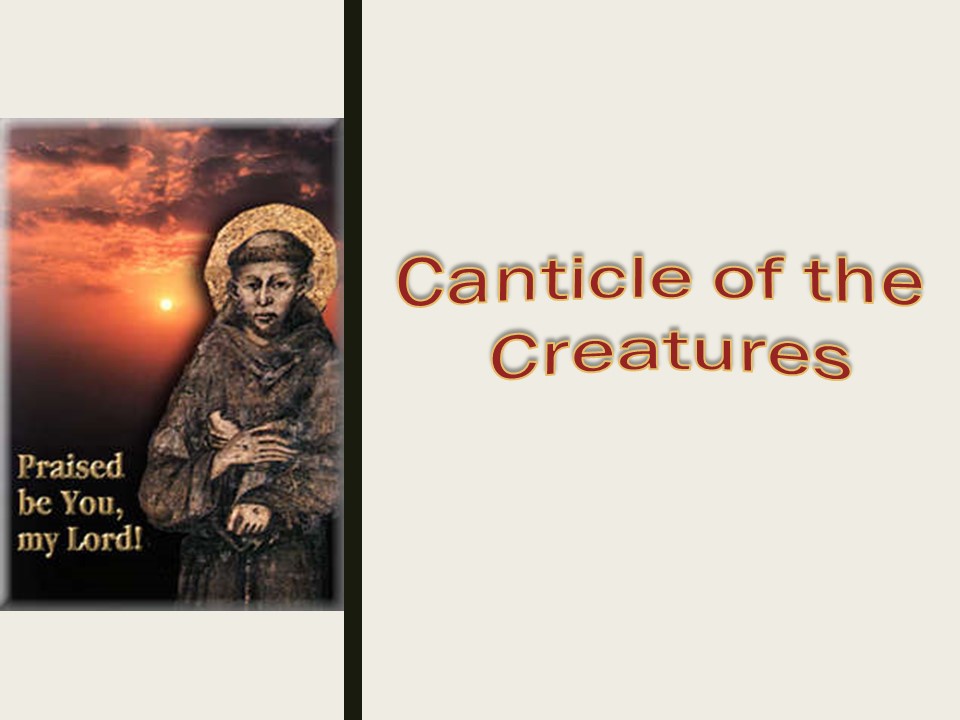
FORMATION FRIDAY – Happy Feast Day – October 4, 2024
HAPPY FEAST DAY!Please share with your local fraternity
The Canticle of the Creatures
Today, on the Feast Day of our Seraphic Father St. Francis, we offer his own words as they appear in the Canticle of the Creatures. Composed in 1225 during his last illness, St. Francis gives glory to God through all of creation in the first portion of the canticle. Ever the peacemaker, he added verses 10 and 11 at a time when the political and religious authorities of Assisi were in conflict. Then, right before his death, he added two verses praising God for “Sister Bodily Death,” calling us to penance and conversion.
The Canticle of the Creatures
1Most High, all-powerful, good Lord,
Yours are the praises, the glory, and the honor, and all blessing, Rv 4:9 Rv 4:11
2To You alone, Most High, do they belong,
and no human is worthy to mention Your name.d
3Praised be You, my Lord, with all Your creatures, Tb 8:7
especially Sir Brother Sun,
Who is the day and through whom You give us light.e
4And he is beautiful and radiant with great splendor;
and bears a likeness of You, Most High One.
5Praised be You, my Lord, through Sister Moon and the stars, Ps 148:3
in heaven You formed them clear and precious and beautiful.a
6Praised be You, my Lord, through Brother Wind,
and through the air, cloudy and serene, and every kind of weather,
through whom You give sustenance to Your creatures.
7Praised be You, my Lord, through Sister Water, Ps 148:4 Ps 148:5
who is very useful and humble and precious and chaste.
8Praised be You, my Lord, through Brother Fire, Dn 3:66
through whom You light the night, Ps 78:14 [Vulgate, Ps 77:14]
and he is beautiful and playful and robust and strong.
9Praised be You, my Lord, through our Sister Mother Earth, Dn 3:74
who sustains and governs us,
and who produces various fruit with colored flowers and herbs. Ps 104:13 [Vulgate, Ps 103:13] Ps 104:14 [Vulgate, Ps 103:14]10Praised be You, my Lord, through those who give pardon for Your
love, Mt 6:12
and bear infirmity and tribulation.b
11Blessed are those who endure in peace
for by You, Most High, shall they be crowned.12Praised be You, my Lord, through our Sister Bodily Death,
from whom no one living can escape.c
13Woe to those who die in mortal sin.
Blessed are those whom death will find in Your most holy will,
for the second death Rv 2:11 Rv 20:6 shall do them no harm.d14Praise and bless my Lord Dn 3:85 and give Him thanks
and serve Him with great humility.After reading the Canticle, go back and look at the Scripture sources indicated—read the passages—see how Francis was influenced by his intimate knowledge of Scripture.
+What part does Scripture play in your daily life? What does “going from Gospel to life and life to the Gospel” (Article 4 of our Rule) mean to you?
Reread verses 10 and 11 of the Canticle.
+How do you serve as a peacemaker in your family, job, or community?
+In what ways is it difficult for you to “forgive” those who don’t agree with you?
+Verse 10 calls to mind the story of Perfect Joy. What is Francis telling us in that story and in this canticle?Verses 12 and 13 talk about the end of life and how we are to prepare.
+Give some thought to the qualities it takes to accept our eventual death or the death of someone we love.
+Reread the Prologue to the Rule of 1978, especially “Concerning Those Who Do Not Do Penance.” Why are penance and conversion so important to us?Here is a short video about the Transitus of St. Francis celebrated on October 3rd.
https://www.youtube.com/watch?v=lTRzZz0Rmdg+++++++++++++
FELIZ FIESTA DE SAN FRANCISCO DE ASÍS!
Por favor compartir con sus fraternidades locales
Cántico de las Criaturas
Hoy, en la Fiesta de nuestro Seráfico Padre San Francisco, ofrecemos sus propias palabras tal como aparecen en el Cántico de las Criaturas. Compuesto en 1225 durante su última enfermedad, San Francisco da gloria a Dios a través de toda la creación en la primera parte del cántico. Siempre pacificador, agregó los versículos 10 y 11 en un momento en que las autoridades políticas y religiosas de Asís estaban en conflicto. Luego, justo antes de su muerte, añadió dos versos alabando a Dios por la “Hermana Muerte Corporal” y, como siempre, llamándonos a la penitencia y la conversión.
ALABANZAS DE LAS CRIATURAS
1Altísimo, omnipotente, buen Señor,
tuyas son las alabanzas, la gloria y el honor y toda bendición.
2A ti solo, Altísimo, corresponden,y ningún hombre es digno de hacer de ti mención.
3Loado seas, mi Señor, con todas tus criaturas,especialmente el señor hermano sol,
el cual es día, y por el cual nos alumbras.
4Y él es bello y radiante con gran esplendor,
de ti, Altísimo, lleva significación.
5Loado seas, mi Señor, por la hermana luna y las estrellas,
en el cielo las has formado luminosas y preciosas y bellas.
6Loado seas, mi Señor, por el hermano viento,
y por el aire y el nublado y el sereno y todo tiempo,
por el cual a tus criaturas das sustento.
7Loado seas, mi Señor, por la hermana agua,
la cual es muy útil y humilde y preciosa y casta.
8Loado seas, mi Señor, por el hermano fuego,
por el cual alumbras la noche,
y él es bello y alegre y robusto y fuerte.
9Loado seas, mi Señor, por nuestra hermana la madre tierra,
la cual nos sustenta y gobierna,
y produce diversos frutos con coloridas flores y hierba.
10Loado seas, mi Señor, por aquellos que perdonan por tu amor,
y soportan enfermedad y tribulación.
11Bienaventurados aquellos que las soporten en paz,
porque por ti, Altísimo, coronados serán.
12Loado seas, mi Señor, por nuestra hermana la muerte corporal,
de la cual ningún hombre viviente puede escapar.
13¡Ay de aquellos que mueran en pecado mortal!:
bienaventurados aquellos a quienes encuentre en tu santísima voluntad,
porque la muerte segunda no les hará mal.
14Load y bendecid a mi Señor,
y dadle gracias y servidle con gran humildad.
http://franciscanos.org/esfa/cant.html
+ ¿Qué papel juegan las Escrituras en su vida diaria? ¿Qué significa para usted “ir del Evangelio a la vida y de la vida al Evangelio” (artículo 4 de nuestra Regla)?
Releer los versículos 10 y 11 del Cántico.
+ ¿Cómo se desempeña como pacificador en su familia, trabajo o comunidad?
+ ¿De qué manera te resulta difícil “perdonar” a los que no están de acuerdo contigo?
+ El versículo 10 recuerda la historia de Perfect Joy. ¿Qué nos dice Francisco en esa historia y en este cántico?
Los versículos 12 y 13 hablan sobre el final de la vida y cómo debemos prepararnos.
+ Piense un poco en las cualidades que se necesitan para aceptar nuestra eventual muerte o la muerte de alguien a quien amamos.
+ Releer el Prólogo de la Regla de 1978, en especial “Sobre los que no hacen penitencia”. ¿Por qué son tan importantes para nosotros la penitencia y la conversión?
Un breve video sobre la vida de San Francisco en español
https://www.youtube.com/watch?v=RTNq9pGF4C0Diane F. Menditto, OFSVice Minister, National Fraternity, Secular Franciscan Order USAListen – Discern – Go Forth National Theme 2022-2025


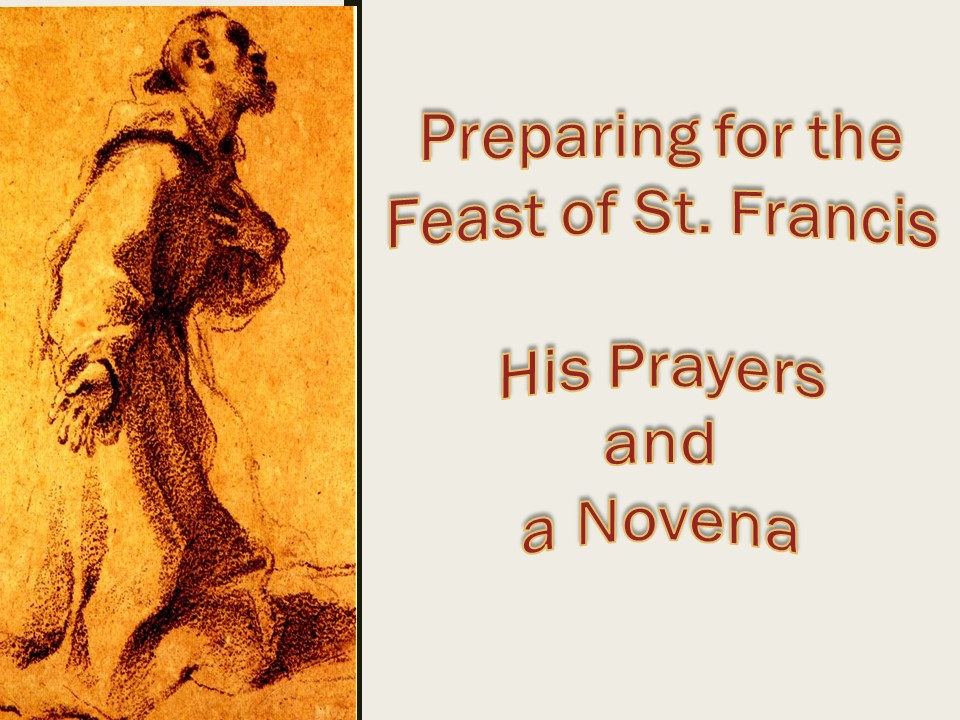
FORMATION FRIDAY – Preparing for the Feast of St. Francis – His Prayers & a Novena – Sept, 27, 2024
(en español abajo) Links in blue. Full links in the attached files.
(Korean translation attached in a separate PDF.)Preparing for the Feast of St. Francis–His Prayers and a Novena
Please share with your local fraternityAs the feast day of St. Francis approaches, we share a link to the Novena to St. Francis which started on September 25th. (If you have not started the novena yet, you can certainly catch up!)
Also, this week we provide links to the special prayers of St. Francis with some general questions for meditation.Novena on the St. Anthony Shrine website started on 9/25: ST. FRANCIS NOVENA
Links to some of the prayers of St. Francis with which we should all be familiar: (Over the next few days, read the complete prayer and some background material on the Franciscan Intellectual Tradition website.)
THE TESTAMENT PRAYER
“We adore you, Lord Jesus Christ, in all your churches throughout the whole world, and we bless you, because by your holy cross you have redeemed the world.” TESTAMENT PRAYER
PRAYER BEFORE THE CRUCIFIX
“Most high, glorious God, enlighten the darkness of my heart. And give me true faith, certain hope, and perfect charity…” PRAYER BEFORE THE CRUCIFIXPRAYER FROM THE LETTER TO THE ENTIRE ORDER
A PRAYER INSPIRED BY THE OUR FATHER
THE PRAISES TO BE SAID AT ALL THE HOURS
“Holy, holy, holy Lord God Almighty, Who is, and Who was, and Who is to come: And let us praise and glorify Him forever…”
THE PRAISES OF GOD AND THE BLESSING
“You are the holy Lord God Who does wonderful things. You are strong. You are great. You are the most high….”
THE CANTICLE OF BROTHER SUN
“Most High, all-powerful, good Lord, Yours are the praises, the glory, the honor, and all blessing,”PRAYER AND THANKSGIVING (Chapter XXIII of the EarlierRule—Regula non Bullata)
“All-powerful, most holy, Almighty and supreme God,…”
SALUTATION OF THE BLESSED VIRGIN MARY
“Hail, O Lady, Holy Queen, Mary, holy Mother of God, Who are the Virgin made Church, chosen by the most Holy Father in heaven whom he consecrated with His most holy beloved Son and with the Holy Spirit the Paraclete, 3in whom there was and is all fullness of grace and every good….”
Some questions to think about, discuss, or to answer in your journal.
If you cannot read all of the prayers listed above in one sitting, choose 2 or 3 at a time. As you read and then pray, please think about the following:
+What are the common themes in all of Francis’s prayers?
+Where can these prayers fit into our prayer lives as Franciscans?
+As you consider the words of these prayers, what stands out as being important to St. Francis? How do these ideas and feelings affect us as Franciscans?++++++++++++++++++++++
Formación 27 de septiembre, 2024 (LOS ENLACES APARECEN EN AZUL. EL ENLACE COMPLETO APARECE EN EL PDF)
Preparándonos para la fiesta de San Francisco: sus oraciones y una novena (Compartir con su fraternidad local.)A medida que se acerca el día de la fiesta de San Francisco, compartimos un enlace a la Novena a San Francisco que comenzó el 25 de septiembre. Además, esta semana proporcionamos enlaces a las oraciones especiales de San Francisco con algunas preguntas generales para la meditación durante estos días tan importantes.
NOVENA ASAN FRANCISCO en español (Comenzó el 25 de septiembre. Si no ha comenzado una novena, es posible recuperar los días perdidos.)
Enlaces a algunas de las oraciones de San Francisco con las que todos deberíamos estar familiarizados: (Lea la oración completa en http://franciscanos.org/ ).
LA ORACIÓN DEL TESTAMENTO
5”Te adoramos, Señor Jesucristo, también en todas tus iglesias que hay en el mundo entero, y te bendecimos, porque por tu santa cruz redimiste al mundo.”LA ORACIÓN ANTE EL CRUCIFIJO DE SAN DAMIÁN
“Sumo, glorioso Dios, ilumina las tinieblas de mi corazón y dame fe recta, esperanza cierta y caridad perfecta,
sentido y conocimiento, Señor, para que cumpla tu santo y verdadero mandamiento.”ORACIÓN DE LA CARTA A TODA LA ORDEN
ALABANZAS QUE SE HAN DE DECIR EN TODAS LAS HORAS
1”Santo, santo, santo Señor Dios omnipotente, el que es y el que era y el que ha de venir (cf. Ap 4,8):
Y alabémoslo y ensalcémoslo por los siglos.”
ALABANZAS DEL DIOS ALTÍSIMO
“1Tú eres santo, Señor Dios único, que haces maravillas (Sal 76,15). 2Tú eres fuerte, tú eres grande (cf. Sal 85,10), tú eres altísimo, …”CÁNTICO DEL HERMANO SOL o ALABANZAS DE LAS CRIATURAS
“Altísimo, omnipotente, buen Señor, tuyas son las alabanzas, la gloria y el honor y toda bendición.”
REGLA NO BULADA Cap. XXIII: Oración y acción de gracias
“Omnipotente, santísimo, altísimo y sumo Dios,…”SALUDO A LA BIENAVENTURADA VIRGEN MARÍA
“Salve, Señora, santa Reina, santa Madre de Dios, María, que eres virgen hecha iglesia 2y elegida por el santísimo Padre del cielo, a la cual consagró Él con su santísimo amado Hijo y el Espíritu Santo Paráclito, 3en la cual estuvo y está toda la plenitud de la gracia y todo bien….”Algunas preguntas para pensar, platicar, o responder en su diario.
Si no puede leer todas las oraciones enumeradas anteriormente de una sola vez, elija 2 o 3 a la vez. Mientras lee y luego ora, piense en lo siguiente:
+ ¿Cuáles son los temas comunes en todas las oraciones de Francisco?
+ ¿Dónde pueden encajar estas oraciones en nuestra vida de oración como franciscanos?
+ Al considerar las palabras de estas oraciones, ¿qué se destaca como importante para San Francisco? ¿Cómo nos afectan estas ideas y sentimientos como franciscanos?Diane F. Menditto, OFSVice Minister, National Fraternity, Secular Franciscan Order USAListen – Discern – Go Forth National Theme 2022-2025
FORMATION FRIDAY – Frequently Asked Questions #7 – Sept. 20, 2024
Please share with your local fraternity (en español abajo)
Frequently Asked Questions answered by our General Constitutions (GC): For the next several weeks we will take a look at some questions given in the 2010 edition of the Handbook for Servant Leadership. The same questions often arise on our councils and in our fraternities. Becoming familiar with the Constitutions is very helpful in addressing issues that arise in fraternities at all levels. For the complete, latest translation of the entire document, visit: https://ciofs.info/library/official-documents/ or https://www.secularfranciscansusa.org/the-general-constitutions-of-the-secular-franciscan-order-2000/
+ What provisions for life in fraternity should be made by the fraternity? [GC Article 53]
Please read each section and discuss the questions that follow. Also, read the article of the Rule mentioned.
1. OFS Rule Article 24. The Fraternity must offer to its members opportunities for coming together and collaborating through meetings to be held with as great a frequency as allowed by the situation and, with the involvement of all its members.
+ How often does your fraternity gather? How long are the gatherings? Do you wish you gathered more or less? Why?
+ Each time you meet, what is the pattern of the gatherings? (Prayer, announcements, ongoing formation, etc.) + What would you change about the gathering? (Your discussion group might want to share this with the council.)
+ How would you describe the environment of your fraternity gatherings? What suggestions would you make to the council?
2. OFS Rule Articles 6; 8. The fraternity should come together periodically, also as a Church community to celebrate the Eucharist in a climate which strengthens the fraternal bond and characterizes the identity of the Franciscan family. Where, for whatever reason, this particular celebration may not be possible, they should participate in the celebration of the larger Church community.
+ On what occasions does your fraternity attend mass together?
3. To belong to the OFS, it is essential to be attached to a local Fraternity and be actively involved in the life of that Fraternity. Appropriate initiatives should be adopted according to the directives of the National Statutes, to keep those brothers and sisters united to the Fraternity who — for valid reasons of health, family, work, or distance — cannot actively participate in community life.
+ Does your fraternity have members who only attend occasionally? How can you encourage them to participate?
+ Does you fraternity have members who are excused from gatherings for good reason? How does the fraternity maintain contact with them? How do you personally maintain contact with one or more of these members?
4. The Fraternity remembers with gratitude its brothers and sisters who have passed away and continues its communion with them by prayer and in the Eucharist.
+ How does your fraternity remember those who have passed away?
+ Is there anything special that you do as a fraternity when someone passes?
+ What is done for those who have died in past years as part of fraternity life?
5. The National Statutes can provide special ways of associating with the Fraternity for those who, without becoming a member of the OFS, want to participate in its life and activities.
You can read the National Statutes at this link: https://www.secularfranciscansusa.org/statutes-of-the-national-fraternity-of-the-secular-franciscan-order-in-the-united-states-of-america-2/
Formación 20 de septiembre, 2024 (Compartir con su fraternidad local.) Preguntas frecuentes #7
Preguntas Frecuentes Respondidas por nuestras Constituciones Generales (CG): Durante las próximas semanas echaremos un vistazo a algunas preguntas dadas en la edición 2010 del Manual para el Liderazgo de Servicio. Las mismas preguntas surgen a menudo en nuestros consejos y en nuestras fraternidades. Familiarizarse con las Constituciones es muy útil para abordar los problemas que surgen en las fraternidades a todos los niveles. Para obtener la traducción completa y más reciente del documento completo, visite: https://ciofs.info/wp-content/uploads/2021/01/ES-Constituciones-generales-OFS-s.pdf
+ ¿Qué disposiciones para la vida en fraternidad debe hacer la fraternidad? [CCGG Artículo 53]
Por favor, lea cada sección y discuta las preguntas que siguen. Además, lea el artículo de la Regla mencionado.
Constituciones Artículo 53
1. Regla Artículo 24. La Fraternidad debe ofrecer a sus miembros ocasiones de encuentro y de colaboración a través de reuniones, que se han de tener con la mayor frecuencia que permitan las situaciones ambientales, y con la participación de todos.
+ ¿Con qué frecuencia se reúne su fraternidad? ¿Cuánto tiempo duran las reuniones? ¿Le gustaría reunirse más o menos? ¿Por qué?
+ Cada vez que se reúnen, ¿cuál es el patrón de las reuniones? (Oración, anuncios, formación permanente, etcétera.)
+ ¿Qué cambiaría de la reunión? (Es posible que su grupo de discusión desee compartir esto con el consejo).
+ ¿Cómo describiría el ambiente de las reuniones de su fraternidad? ¿Qué sugerencias le haría al consejo?
2. Regla Artículos 6; 8. La Fraternidad se reúna periódicamente, como comunidad eclesial, para celebrar la Eucaristía en un clima que consolide el vínculo fraterno y exprese la identidad de la Familia Franciscana. Donde no sea posible la celebración particular, particípese en la de una más amplia comunidad eclesial.
+ ¿En qué ocasiones su fraternidad asiste a misa junta?
3. La inserción en una Fraternidad local y la participación en la vida de la Fraternidad es indispensable para la pertenencia a la OFS. Se han de adoptar las iniciativas oportunas, según las orientaciones de los Estatutos nacionales, para mantener la unión entre la Fraternidad y los hermanos que – por motivos válidos de salud, familia, trabajo o distancia – estén impedidos para participar activamente en la vida comunitaria.
+ Su fraternidad tiene miembros que solo asisten ocasionalmente? ¿Cómo puede usted animarlos a participar?
+ ¿Su fraternidad tiene miembros que están exentos de las reuniones por una buena razón? ¿Cómo mantiene la fraternidad el contacto con ellos? ¿Cómo mantiene usted personalmente el contacto con uno o más de estos miembros?
4. La Fraternidad recuerda con gratitud a los hermanos difuntos y continúa la comunión con ellos en la oración y en la Eucaristía.
+ ¿Cómo recuerda su fraternidad a los que han fallecido?
+ ¿Hay algo especial que hagan como fraternidad cuando alguien fallece?
+ ¿Qué se hace por los que han muerto en los últimos años como parte de la vida de fraternidad?
5. Los Estatutos nacionales pueden prever formas particulares de adhesión a la Fraternidad para quienes, sin pertenecer a la OFS, deseen compartir su vida y actividades.
Diane F. Menditto, OFSVice Minister, National Fraternity, Secular Franciscan Order USAListen – Discern – Go Forth National Theme 2022-2025