Please share with your local fraternity
Thank you to Anne Mulqueen, OFS
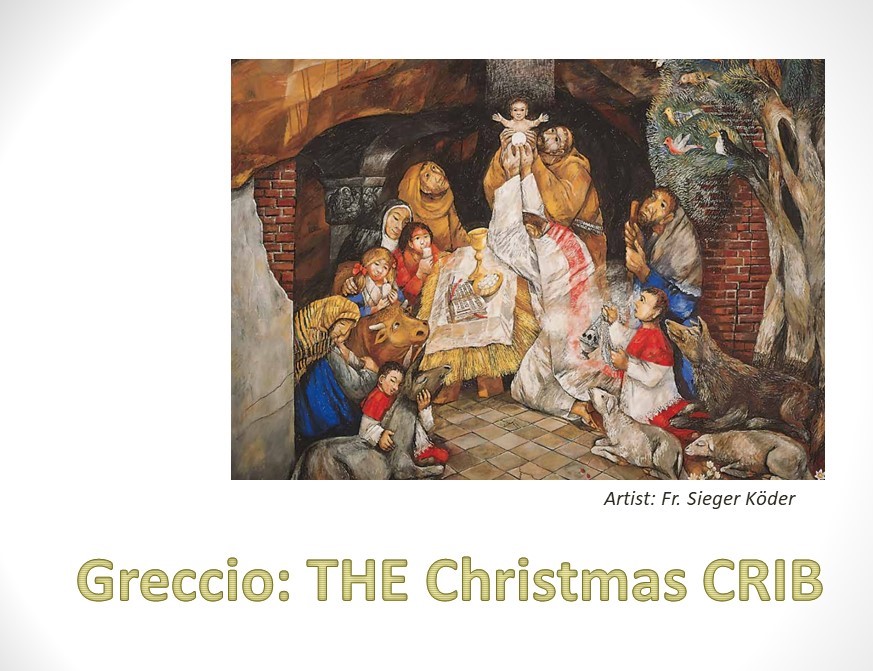
It is said that Christmas is a time for children, but I say Christmas is a time for all who have not lost the wonder, joy and delight in celebrating the gift of the birth of a baby, human and divine, who came to earth to be one of us. On Christmas eve, 1223, our Father Francis made his ardent love for the Incarnation of God tangible through the reenactment of Bethlehem in a cave in Greccio.
In the First Life of St. Francis, Thomas of Celano writes that Francis wanted the birth of Christ to come alive, presenting anew the birth of the baby Jesus in a cave in Greccio. Francis wanted this event to be, noted and recalled with reverent memory. It is almost eight hundred years later, and we continue to display the Christmas creche in our homes and in our churches. And so during this Christmastide, let us set aside time to recall with reverent memory the wonder of the Incarnation as we gaze on the crib that holds Mary’s baby.
What prompted St. Francis to create this scene? St. Bonaventure would say he wanted to rouse the hearts of those weak in the faith. Thomas of Celano would say the child had been forgotten in the hearts of many; but by grace he was brought to life again through St. Francis.
St. Francis was a man of action. So what did he do? He invited his brothers and the people in the village to a cave, filled with animals, straw and a feeding trough, that served as a crib for the infant savior. Francis wanted everyone to experience the humility and poverty of a tender God who was born into the world as a poor and helpless baby. He wanted everyone to experience the love of God poured out in the Incarnation. At the appointed time the people arrived, carrying torches and candles. And their hearts were no longer cold, but filled with love. Everyone gathered in joy around this divine baby, lying in a manger.
While gazing at the crib of the infant Jesus, ponder this quote from Pope Francis. “When, at Christmas, we place the statue of the Infant Jesus in the manger, the nativity scene suddenly comes alive. God appears as a child, for us to take into our arms. Beneath weakness and frailty, he conceals his power that creates and transforms all things. It seems impossible, yet it is true: in Jesus, God was a child, and in this way he wished to reveal the greatness of his love: by smiling and opening his arms to all.” [Admirabile Signum 8]
It is always best to read the original sources on a subject in addition to a reflection or commentary. Therefore, please go to https://www.franciscantradition.org., pray first, then read and meditate on the following accounts of Francis’ reenactment of the nativity at Greccio. For those without access to the Internet, please read the account of the first Nativity in any biography of St. Francis you have or in the printed resource Volume 1 The Saint.
· The Life of Saint Francis by Thomas of Celano, Chapter XXX, [FA:ED, vol. 1, 254-257]
· The Life of Blessed Francis, Legenda Maior, by St. Bonaventure, Chapter 10, [FA:ED, vol. 2, 610-611]
Just one question to discuss or to comment on in your journal:
Has anything you read or meditated upon reawakened your imagination about the WORD made flesh—the invisible God made visible in a baby and has it changed your understanding of the nature of God?Por favor comparta con su fraternidad local
+++++++++++++++++++++++++++
Formación 20 de diciembre, 2024
Gracias a Anne Mulqueen, OFS
Se dice que la Navidad es una época de niños, pero yo digo que la Navidad es una época de todos los que no han perdido el asombro, la alegría y el deleite de celebrar el don del nacimiento de un bebé, humano y divino, que vino a la tierra para ser uno de nosotros. En la víspera de Navidad de 1223, nuestro Padre Francisco hizo tangible su ardiente amor por la Encarnación de Dios a través de la recreación de Belén en una cueva en Greccio.
En la Primera Vida de San Francisco, Tomás de Celano escribe que Francisco quiso que el nacimiento de Cristo cobrara vida, presentando de nuevo el nacimiento del niño Jesús en una cueva de Greccio. Francisco quiso que se tomara nota de este evento y que fuera recordado con memoria reverente. Han pasado casi ochocientos años y seguimos exhibiendo el pesebre navideño en nuestros hogares y en nuestras iglesias. Así que durante esta Navidad, dediquemos tiempo para recordar con reverencia la maravilla de la Encarnación mientras contemplamos el pesebre que sostiene al bebé de María.
¿Qué impulsó a San Francisco a crear esta escena? San Buenaventura dijo que quiso despertar los corazones de los débiles en la fe. Tomás de Celano dijo que el niño había quedado olvidado en el corazón de muchos; pero por gracia fue devuelto a la vida a través de San Francisco.
San Francisco fue un hombre de acción. Entonces, ¿qué hizo? Invitó a sus hermanos y a la gente del pueblo a una cueva llena de animales, paja y un comedero, que serviría de cuna al niño salvador. Francisco quería que todos experimentaran la humildad y la pobreza de un Dios tierno que nació en el mundo como un bebé pobre e indefenso. Quería que todos experimentaran el amor de Dios derramado en la Encarnación. A la hora señalada llegó el pueblo portando antorchas y velas. Y sus corazones ya no estaban fríos, sino llenos de amor. Todos se reunieron en alegría alrededor de este divino bebé, acostado en un pesebre.
Mientras contempla el pesebre del niño Jesús, reflexione sobre esta cita del Papa Francisco. “Cuando, en Navidad, colocamos la estatua del Niño Jesús en el pesebre, el pesebre de repente cobra vida. Dios se nos aparece como un niño, para que lo tomemos en nuestros brazos. Debajo de la debilidad y la fragilidad, esconde su poder que crea y transforma todas las cosas. Parece imposible, pero es verdad: en Jesús, Dios era niño, y así quiso revelar la grandeza de su amor: sonriendo y abriendo sus brazos a todos.” [Admirable Signum 8]
Siempre es mejor leer las fuentes originales sobre un tema además de una reflexión o comentario. Por lo tanto, visite http://franciscanos.org/frandp/menup.html , ore primero, luego lea y medite en los siguientes relatos de la recreación de la natividad de Francisco en Greccio.
- La Vida de San Francisco de Tomás de Celano , Capítulo XXX
http://franciscanos.org/fuentes/1Cel03.html
- La vida del Beato Francisco, Legenda Maior, de San Buenaventura, Capítulo 10
http://franciscanos.org/fuentes/lma04.html
Solo una pregunta para discutir o comentar en su diario :
¿Algo que leyó o meditó ha vuelto a despertar su imaginación acerca de la PALABRA hecha carne, el Dios invisible hecho visible en un bebé y ha cambiado su comprensión de la naturaleza de Dios?
Diane F. Menditto, OFSVice Minister, National Fraternity, Secular Franciscan Order USAListen – Discern – Go Forth National Theme 2022-2025
Category: Formation Friday
FORMATION FRIDAY – Part Three: Living the Charism – December 13, 2024
During Advent we wait for the coming of our Lord Jesus Christ. We know that he walked on this earth. We know that he is always with us in the Eucharist. But now, we wait for Him to come again.
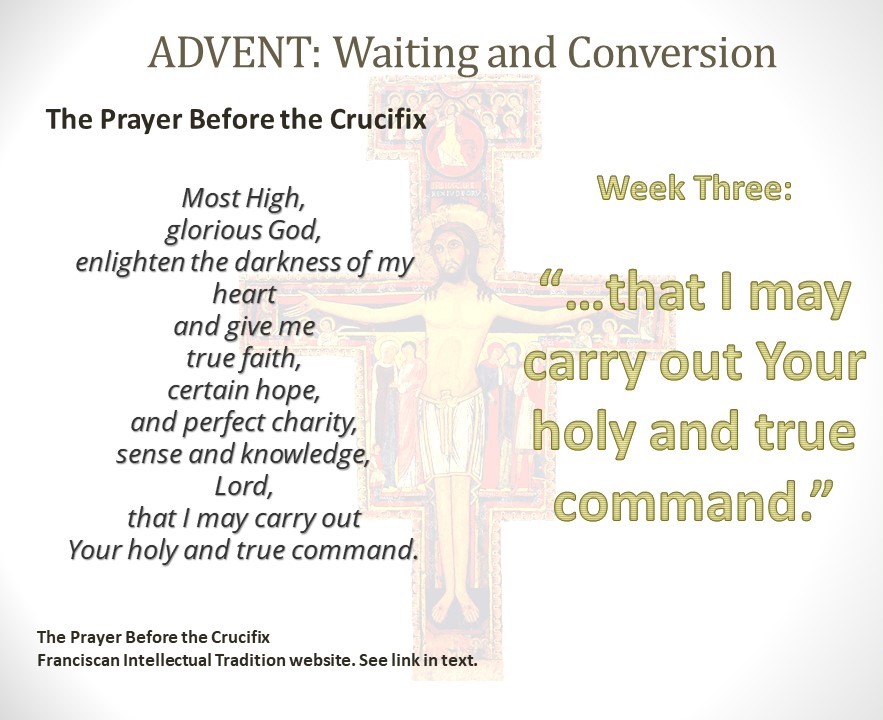
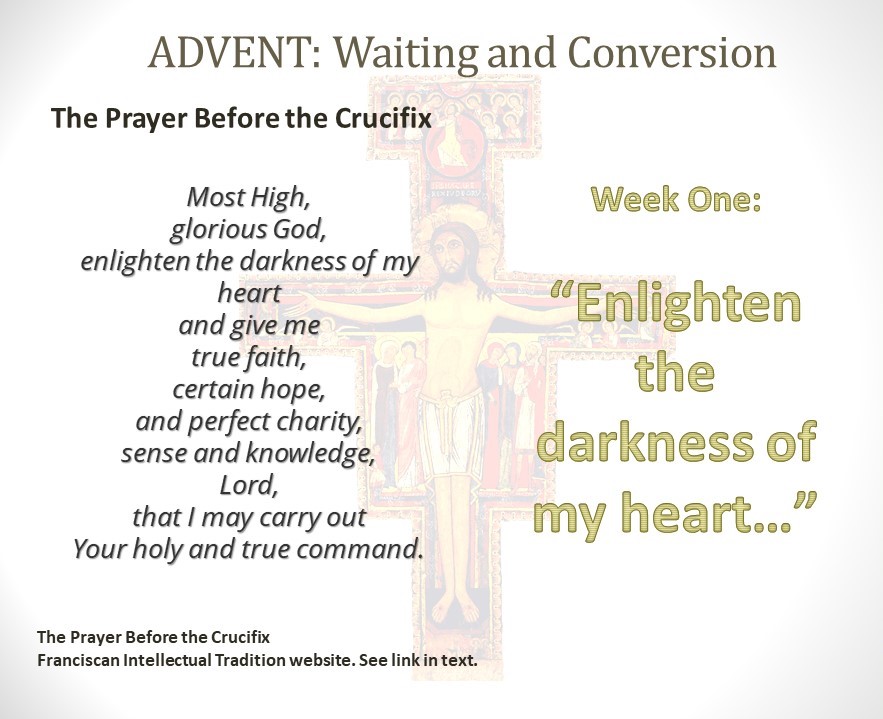
For three weeks we will focus on the prayer that St. Francis prayed as he knelt before the Crucifix of San Damiano. Each part of it has significance during this time of waiting and conversion.
Most High,
glorious God,
enlighten the darkness of my heart
and give me
true faith,
certain hope,
and perfect charity,
sense and knowledge,
Lord,
that I may carry out
Your holy and true command.Part Three: Living the Charism
“…that I may carry out Your holy and true command.”
CONSIDER:
+Our Rule: Article 2—”The Secular Franciscan Order holds a special place in this family circle. It is an organic union of all Catholic fraternities scattered throughout the world and open to every group of the faithful. In these fraternities the brothers and sisters, led by the Spirit, strive for perfect charity in their own secular state. By their profession they pledge themselves to live the gospel in the manner of St. Francis by means of this rule approved by the Church.”
+Our Rule: Article 10— “Uniting themselves to the redemptive obedience of Jesus, who placed his will into the Father’s hands, let them faithfully fulfil the duties proper to their various circumstances of life17. Let them also follow the poor and crucified Christ, witness to him even in difficulties and persecutions18.”
+Our Rule: Article 14—”Secular Franciscans, together with all people of good will, are called to build a more fraternal and evangelical world so that the kingdom of God may be brought about more effectively. Mindful that anyone “who follows Christ, the perfect man, becomes more of a man himself”, let them exercise their responsibilities competently in Christian spirit of service25”
+Admonition XVII: The Humble Servant of God
“1Blessed is that servant Mt 24:46 who no more exalts himself over the good the Lord says or does through him than over what He says or does through another.
2A person sins who wishes to receive more from his neighbor than what he wishes to give of himself to the Lord God.”+ During Advent, we focus on how well we carry out what we are called to do in our lives as Secular Franciscans. Now is the time to ask ourselves how familiar we are with our Rule and with what we promised at Profession.
Questions for discussion or to answer in your journal
+As Franciscans, we are called to intensify our baptismal promises through our profession.
–What were the promises made for us at our Baptism?
–Which articles of our Rule present the greatest challenge to me?
–Do I read and pray some portion of Scripture each day? How do I carry out what I am being asked to do by Jesus in the Gospel?++++++++++++++++++++
Formación 13 de diciembre, 2024
Durante el Adviento esperamos la venida de nuestro Señor Jesucristo. Sabemos que caminó sobre esta tierra. Sabemos que él está siempre con nosotros en la Eucaristía. Pero ahora, esperamos que Él regrese.
Durante tres semanas nos centraremos en la oración que rezó San Francisco mientras se arrodillaba ante el Crucifijo de San Damián. Cada parte tiene un significado durante este tiempo de espera y conversión.
Tercera parte: Vivir el carisma
“…para que cumpla tu santo y verdadero mandamiento.”
Sumo, glorioso Dios,
ilumina las tinieblas de mi corazón
y dame fe recta,
esperanza cierta
y caridad perfecta,
sentido y conocimiento, Señor,
para que cumpla tu santo y verdadero mandamiento.CONSIDERE:
+Nuestra regla: Artículo 2—”En el seno de dicha familia, tiene un puesto peculiar la Orden Franciscana Seglar, la cual se configura como una unión orgánica de todas las fraternidades católicas esparcidas por el mundo entero y abiertas a todo grupo de fieles, en las cuales los hermanos y las hermanas, impulsados por el Espíritu a alcanzar la perfección de la caridad en su estado seglar, se comprometen con la Profesión a vivir el Evangelio a la manera de San Francisco con la ayuda de la presente Regla confirmada por la Iglesia5.”
+Nuestra regla: Artículo 10— “Asociándose a la obediencia redentora de Jesús, que sometió su voluntad a la del Padre, cumplan fielmente las obligaciones propias de la condición de cada uno en las diversas circunstancias de la vida17, y sigan a Cristo, pobre y crucificado, testimoniándolo aún en las dificultades y persecuciones18.“
+Nuestra regla: Artículo 14— “Llamados, juntamente con todos los hombres de buena voluntad, a construir un mundo más fraterno y evangélico para la edificación del reino de Dios, conscientes de que “quien sigue a Cristo, Hombre perfecto, se hace a sí mismo más hombre”, cumplan con competencia las propias responsabilidades con espíritu cristiano de servicio25.”
[Cap. XVII: Del humilde siervo de Dios]
+ Admonición XVII: “1Bienaventurado aquel siervo (Mt 24,46) que no se exalta más del bien que el Señor dice y obra por medio de él, que del que dice y obra por medio de otro. 2Peca el hombre que quiere recibir de su prójimo más de lo que él no quiere dar de sí al Señor Dios.”http://franciscanos.org/esfa/adm-ae.html
+ Durante el Adviento, nos enfocamos en qué tan bien llevamos a cabo lo que estamos llamados a hacer en nuestras vidas como franciscanos seglares. Ahora es el momento de preguntarnos qué tan familiarizados estamos con nuestra Regla y con lo que prometimos en Profesión.
Preguntas para platicar o para responder en su diario
+ Como franciscanos, estamos llamados a intensificar nuestras promesas bautismales a través de nuestra profesión.
— ¿Cuáles fueron las promesas que nos hicieron en nuestro bautismo?
–¿Qué artículos de nuestra Regla me presentan el mayor desafío?
— ¿Leo y oro alguna porción de las Escrituras todos los días? ¿Cómo llevo a cabo lo que Jesús me pide que haga en el Evangelio.
Diane F. Menditto, OFSVice Minister, National Fraternity, Secular Franciscan Order USAListen – Discern – Go Forth National Theme 2022-2025
Formation Friday – ADVENT – December 6, 2024
(en español abajo) Korean translation attached in a separate PDF.
Please share with your local fraternity (All three parts together will work well for fraternity ongoing formation at any time of year.)During Advent we wait for the coming of our Lord Jesus Christ. We know that he walked on this earth. We know that he is always with us in the Eucharist. But now, we wait for Him to come again.
For three weeks we will focus on the prayer that St. Francis prayed as he knelt before the Crucifix of San Damiano. Each part of it has significance during this time of waiting and conversion.
Most High,
glorious God,
enlighten the darkness of my heart
and give me
true faith,
certain hope,
and perfect charity,
sense and knowledge,
Lord,
that I may carry out
Your holy and true command.Part Two: Faith and Hope
“…and give me true faith, certain hope, and perfect charity, sense and knowledge, Lord,”
CONSIDER:
+ Our Rule: Article 19—”Mindful that they are bearers of peace which must be built up unceasingly, they should seek out ways of unity and fraternal harmony through dialogue, trusting in the presence of the divine seed in everyone and in the transforming power of love and pardon.
Messengers of perfect joy in every circumstance, they should strive to bring joy and hope to others.”
+ Our Rule: Article 9—”The Virgin Mary, humble servant of the Lord, was open to his every word and call. She was embraced by Francis with indescribable love and declared the protectress and advocate of his family15. The Secular Franciscans should express their ardent love for her by imitating her complete self-giving and by praying earnestly and confidently16.”
+Admonition XXVII: Virtue Puts Vice to Flight
1Where there is charity and wisdom, there is neither fear nor ignorance.
2Where there is patience and humility, there is neither anger nor disturbance.
3Where there is poverty with joy, there is neither greed nor avarice.a
4Where there is restb and meditation, there is neither anxiety nor restlessness.
5Where there is fear of the Lord to guard an entrance, Lk 11:21 there the enemy cannot have a place to enter.
6Where there is a heart full of mercyc and discernment, there is neither excess nor hardness of heart.+ During Advent, we strive to imitate our Blessed Mother who brought joy and hope to the world through her “YES.” Now is the time to ask ourselves if we are saying yes to what the Lord is asking of us and to what we promised at our Profession.
Questions for discussion or to answer in your journal+ How do you build peace in your fraternity and in your family? What are the most challenging times/topics that you encounter during family or fraternity gatherings, and how do you handle them?
+Which characteristics of the Blessed Mother do you strive to imitate? Consider Mary’s role in the Incarnation. What does it take to say YES to God?
+The Prayer Before the Crucifix occurred before the Admonitions were written. According to Admonition XXVII, how did God answer Francis’s prayer?
Thank you to Anne Mulqueen, OFS, for her inspiration.
++++++++++++++++++
Formación 6 de diciembre, 2024
Durante el Adviento esperamos la venida de nuestro Señor Jesucristo. Sabemos que caminó sobre esta tierra. Sabemos que él está siempre con nosotros en la Eucaristía. Pero ahora, esperamos que Él regrese.
Durante tres semanas nos centraremos en la oración que rezó San Francisco mientras se arrodillaba ante el Crucifijo de San Damián. Cada parte tiene un significado durante este tiempo de espera y conversión.
Segunda parte: fe y esperanza
“…y dame fe recta, esperanza cierta y caridad perfecta, sentido y conocimiento, Señor,…”
Sumo, glorioso Dios,
ilumina las tinieblas de mi corazón
y dame fe recta,
esperanza cierta
y caridad perfecta,
sentido y conocimiento, Señor,
para que cumpla tu santo y verdadero mandamiento.CONSIDERE:
+Nuestra Regla: Artículo 19—“Como portadores de paz y conscientes de que ésta ha de construirse incesantemente, indaguen los caminos de la unidad y del entendimiento fraterno, mediante el diálogo, confiando en la presencia del germen divino que hay en el hombre y en la fuerza transformadora del amor y del perdón31.
Mensajeros de la perfecta alegría, esfuércense permanentemente en llevar a los demás el gozo y la esperanza32.”
+Nuestra Regla: Artículo 9—”La Virgen María, humilde sierva del Señor, siempre atenta a su palabra y a todas sus mociones, fue para San Francisco centro de indecible amor, y declarada Protectora y Abogada de su familia15. Los Franciscanos seglares den testimonio de su ardiente amor hacia Ella con la imitación de su disponibilidad incondicional, y en la efusión de una confiada y consciente oración16.”
+Admonición XXVII: De la virtud que ahuyenta al vicio
“1Donde hay caridad y sabiduría, allí no hay temor ni ignorancia.
2Donde hay paciencia y humildad, allí no hay ira ni perturbación.
3Donde hay pobreza con alegría, allí no hay codicia ni avaricia.
4Donde hay quietud y meditación, allí no hay preocupación ni vagancia.
5Donde está el temor de Dios para custodiar su atrio (cf. Lc 11,21), allí el enemigo no puede tener un lugar para entrar.
6Donde hay misericordia y discreción, allí no hay superfluidad ni endurecimiento.”http://franciscanos.org/esfa/adm-ae.html
+ Durante el Adviento, nos esforzamos por imitar a nuestra Santísima Madre que trajo alegría y esperanza al mundo a través de su “SÍ.” Ahora es el momento de preguntarnos si estamos diciendo SÍ a lo que el Señor nos pide y a lo que prometimos en nuestra Profesión.
Preguntas para platicar o para responder en su diario
+ ¿Cómo fomenta la paz en su fraternidad y en su familia? ¿Cuáles son los momentos / temas más desafiantes que encuentra durante las reuniones familiares o de fraternidad, y cómo los maneja?
+ ¿Qué características de la Santísima Virgen se esfuerza por imitar? Considere el papel de María en la Encarnación. ¿Qué se necesita para decirle que SÍ a Dios?
+ La oración ante el crucifijo ocurrió antes de que se escribieran las Admoniciones. Según la Admonición XXVII, ¿cómo respondió Dios a la oración de Francisco?
Gracias a Anne Mulqueen, OFS, por su inspiración.
Diane F. Menditto, OFSVice Minister, National Fraternity, Secular Franciscan Order USAListen – Discern – Go Forth National Theme 2022-2025
Formation Friday –Advent—Waiting and Conversion (Part 1)- November 29, 2024
(en español abajo) Korean translation attached in a separate PDF.
Please share with your local fraternity (All three parts, this week and the next two weeks, together will work well for fraternity ongoing formation at any time of year.)Advent—Waiting and Conversion (Part 1)
During Advent we wait for the coming of our Lord Jesus Christ. We know that he walked on this earth. We know that he is always with us in the Eucharist. But now, we wait for Him to come again.
For three weeks we will focus on the prayer that St. Francis prayed as he knelt before the Crucifix of San Damiano. Each part of it has significance during this time of waiting and conversion.
Most High,
glorious God,
enlighten the darkness of my heart
and give me
true faith,
certain hope,
and perfect charity,
sense and knowledge,
Lord,
that I may carry out
Your holy and true command.Part one: Daily Conversion
“Most High, glorious God, enlighten the darkness of my heart”
CONSIDER:
+Our Rule: Article 7— “United by their vocation as “brothers and sisters of penance”11, and motivated by the dynamic power of the gospel, let them conform their thoughts and deeds to those of Christ by means of that radical interior change which the gospel itself calls “conversion.” Human frailty makes it necessary that this conversion be carried out daily12.
On this road to renewal the sacrament of reconciliation is the privileged sign of the Father’s mercy and the source of grace13.”+Admonition 22: Correction
1Blessed is the servant who endures discipline, accusation, and reprimand from another as patiently as he would from himself.
2Blessed is the servant who, after being reprimanded, agrees courteously, submits respectfully, admits humbly, and makes amends willingly.
3Blessed is the servant who is not quick to excuse himself, and endures with humility, shame, and reprimand for a sin, when he did not commit the fault.+During Advent, we examine our lives to prepare for the coming of Jesus. Now is a good time to see if we are living up to the call for daily conversion in our lives.
Questions for discussion or to answer in your journal
+ How do you live up to our call to daily conversion? During Advent, what spiritual improvements would you like to make in your life—even if they are little ones?
+ What were some of the key points of Francis’s conversion? How did he follow through? What can those moments teach us?Thank you to Anne Mulqueen, OFS, for her inspiration.
+++++++++++++++++++++
Formación 29 de noviembre, 2024
Adviento: espera y conversiónDurante el Adviento esperamos la venida de nuestro Señor Jesucristo. Sabemos que caminó sobre esta tierra. Sabemos que él está siempre con nosotros en la Eucaristía. Pero ahora, esperamos que Él regrese.
Durante tres semanas nos enfocaremos en la oración que rezó San Francisco mientras se arrodillaba ante el Crucifijo de San Damián. Cada parte tiene un significado durante este tiempo de espera y conversión.
Sumo, glorioso Dios,
ilumina las tinieblas de mi corazón
y dame fe recta,
esperanza cierta
y caridad perfecta,
sentido y conocimiento, Señor,
para que cumpla tu santo y verdadero mandamiento.http://franciscanos.org/esfa/orsd.html
Primera Parte: La conversión diaria
“Sumo, glorioso Dios, ilumina las tinieblas de mi corazón…”
CONSIDERE:
+Nuestra Regla: Artículo 7—Como “hermanos y hermanas de penitencia”11, en virtud de su vocación, impulsados por la dinámica del Evangelio, conformen su modo de pensar y de obrar al de Cristo, mediante un radical cambio interior, que el mismo Evangelio denomina con el nombre de “conversión”; la cual, debido a la fragilidad humana, debe actualizarse cada día.
En este camino de renovación, el Sacramento de la Reconciliación es signo privilegiado de la misericordia del Padre y fuente de gracia.+Admoniciones [Cap. XXII: De la corrección]
1Bienaventurado el siervo que soporta tan pacientemente la advertencia, acusación y reprensión que procede de otro, como si procediera de sí mismo. 2Bienaventurado el siervo que, reprendido, benignamente asiente, con vergüenza se somete, humildemente confiesa y gozosamente satisface. 3Bienaventurado el siervo que no es ligero para excusarse, sino que humildemente soporta la vergüenza y la reprensión de un pecado, cuando no incurrió en culpa.
http://franciscanos.org/esfa/adm-ae.html
+ Durante el Adviento, examinamos nuestras vidas para prepararnos para la venida de Jesús. Ahora es un buen momento para ver si estamos a la altura del llamado a la conversión diaria en nuestras vidas.
Preguntas para platicar o para responder en su diario
+ ¿Cómo está a la altura de nuestro llamado a la conversión diaria? Durante el Adviento, ¿qué mejoras espirituales le gustaría hacer en su vida, incluso si son pequeñas?
+ ¿Cuáles fueron algunos de los puntos clave de la conversión de Francisco? ¿Cómo cumplió? ¿Qué nos pueden enseñar esos momentos?
Gracias a Anne Mulqueen, OFS, por su inspiración.
Diane F. Menditto, OFSVice Minister, National Fraternity, Secular Franciscan Order USAListen – Discern – Go Forth National Theme 2022-2025
Formation Friday – Frequently Asked Questions #13 – November 22, 2024
Please share with your local fraternity (en español abajo) Korean translation attached in separate PDF.
Frequently Asked Questions answered by our General Constitutions (GC): This week, and for several more, we continue to spotlight the questions given in the 2010 edition of the Handbook for Servant Leadership. Becoming familiar with the Constitutions is very helpful in addressing these questions and others that arise in fraternities at all levels. For the complete, latest translation of the entire document, visit: https://ciofs.info/library/official-documents/ or https://www.secularfranciscansusa.org/the-general-constitutions-of-the-secular-franciscan-order-2000/
What is the spiritual and pastoral relationship between the First Order, TOR, and the OFS?
+Vital Reciprocity and role of the Spiritual Assistant [Articles 89-90] (For further and more complete information, please also see articles 85-88; the National Statutes, International Statutes, and the Handbook for Spiritual Assistance)
Articles 89-90 Role of the Spiritual Assistant
Article 89
1. By virtue of the vital reciprocity between the religious and the secular members of the Franciscan Family and the responsibilities of Major Superiors, spiritual assistance to the Fraternities of the OFS at all levels must be assured as a fundamental element of communion.
2. The Spiritual Assistant is the person designated by the competent Major Superior to carry out this service for a specific Fraternity of the OFS.
3. To be a witness of Franciscan spirituality and of the fraternal affection of the religious towards the Secular Franciscans, and to be a bond of communion between his Order and the OFS, the Spiritual Assistant should be a Franciscan religious, member of the First Order or the TOR.
4. When it is not possible to give such a Spiritual Assistant to the Fraternity, the competent Major Superior can entrust the service of spiritual assistance to: a) religious brothers or sisters of other Franciscan institutes;
b) diocesan clerics or other persons, specially prepared for such service who are members of the OFS;
c) other diocesan clerics or religious who are not Franciscan.
5. Prior authorization of the Superior or the local Ordinary, when needed, does not exempt the Franciscan Major Superior of the responsibility for the quality of pastoral service and of spiritual assistance given.
Article 90
1. The principal task of the Assistant is to communicate Franciscan spirituality and to co-operate in the initial and continuing formation of the brothers and sisters.
2. The Spiritual Assistant is by right, a voting member of the Council of the Fraternity to which he or she gives assistance and collaborates with it in all activities. However, the Spiritual Assistant does not exercise the right to vote in financial questions*. (also See 90.3) [*or in elections see Statutes for Spiritual and Pastoral Assistance]
After reading Articles 89 and 90, please discuss the following with a partner or in your fraternity
+Does your local fraternity have a Spiritual Assistant? Is he/she a member of a religious order, diocesan clergy, or OFS?
+What role does the Spiritual Assistant play in your fraternity?
+How does your fraternity’s Spiritual Assistant fulfill Article 90.1 above? How does this help you in your vocation as a Secular Franciscan?
Formación 22 de noviembre, 2024 Preguntas frecuentes #13 (Por favor compartir con su fraternidad local.)
Preguntas Frecuentes Respondidas por nuestras Constituciones Generales (CG): Esta semana, y por varias más, volvemos a las preguntas dadas en la edición 2010 del Manual para el Liderazgo de Servicio. Las mismas preguntas surgen a menudo en nuestros consejos y en nuestras fraternidades. Familiarizarse con las Constituciones es muy útil para abordar los problemas que surgen en las fraternidades a todos los niveles. Para obtener la traducción completa y más reciente del documento completo, visite: https://ciofs.info/wp-content/uploads/2021/01/ES-Constituciones-generales-OFS-s.pdf
¿Cuál es la relación espiritual y pastoral entre la Primera Orden, la TOR y la OFS?
+Reciprocidad vital y papel del Asistente Espiritual [Artículos 89-90] (Para una información más completa y más completa, ver también los artículos 85-88; los Estatutos Nacionales, los Estatutos Internacionales y el Manual de Asistencia Espiritual)
Artículos 89-90 Papel del Asistente Espiritual
Artículo 89
1. En virtud de la reciprocidad vital entre los religiosos y los seglares de la Familia Franciscana y de las responsabilidades de los Superiores mayores, debe garantizarse a las Fraternidades de la OFS, en todos sus niveles, la asistencia espiritual como un elemento fundamental de comunión.
2. El Asistente espiritual es la persona designada por el Superior mayor competente para prestar este servicio a una Fraternidad concreta de la OFS.
3. Para ser testigo de la espiritualidad franciscana y del afecto fraterno de los religiosos hacia los franciscanos seglares y vínculo de comunión entre su Orden y la OFS, el Asistente espiritual sea un religioso franciscano, perteneciente a la Primera Orden o a la TOR.
4. Cuando no es posible asignar a la Fraternidad tal Asistente espiritual, el Superior mayor competente puede confiar el servicio de la Asistencia espiritual a:
a) religiosos o religiosas pertenecientes a otros Institutos franciscanos;
b) clérigos diocesanos u otras personas, específicamente preparadas para este servicio, pertenecientes a la OFS;
c) otros clérigos diocesanos, o religiosos no franciscanos.
5. La autorización previa del Superior o del Ordinario del lugar, necesaria en estos casos, no exime al Superior mayor franciscano de su responsabilidad respecto a la calidad del servicio pastoral y de la asistencia espiritual.
Artículo 90
1. Es cometido principal del Asistente comunicar la espiritualidad franciscana y cooperar en la formación inicial y permanente de los hermanos.
2. El Asistente espiritual es miembro de derecho, con voto, del Consejo de la Fraternidad al que presta su asistencia y colabora con él en todas sus actividades. No ejerce el derecho de voto en las cuestiones económicas*
(Véase también 90.3) [*o en las elecciones ver Estatutos para la Asistencia Espiritual y Pastoral]
Después de leer los artículos 89 y 90, por favor discuta lo siguiente con un compañero o en su fraternidad.
+¿Su fraternidad local tiene un Asistente Espiritual? ¿Es miembro de una orden religiosa, del clero diocesano o de la OFS?
+¿Qué papel desempeña el Asistente Espiritual en su fraternidad?
+¿Cómo cumple el Asistente Espiritual de su fraternidad el Artículo 90.1 anterior? ¿Cómo le ayuda esto en su vocación de franciscano seglar?
Diane F. Menditto, OFSVice Minister, National Fraternity, Secular Franciscan Order USAListen – Discern – Go Forth National Theme 2022-2025