God’s Joy Makes Us Evangelizers
(This article originally appeared in the TAU-USA Winter 2026 Issue #118)
By Francine Gikow, OFS
Patrick Mendes, former U.S. National Minister of the OFS (2006-2009), said in an interview, “It is not what we do but what we bring to what we do. What we bring is our charism – our charism of our peace and joy and love for God’s creation.” The next question then becomes, “How can I bring this to others? I’m shy. I can’t speak in a group. I’m not educated in apologetics. I’m just a layperson!”
 If I say, “I’m just a layperson,” I am not living what God has made me to be. I am a person called by God to be His arms, His eyes, and reflect His love toward others in the present. We should not underestimate the value of our lives in God’s hands. Allow Him to take charge in your life and He will change it. There is nothing more credible than a life alive with the Holy Spirit and the Father’s love! When we allow God to take over our life, the overflow of joy from His Presence can be contagious. Nothing evangelizes more powerfully than a life filled with the joy of God!
As we open our lives to God, we become more aware of His Presence each day. We ask God for the grace to become more sensitive, mindful, and intentional so we can become aware of how God interacts within our world and through our relationships. I describe this as my “treasure hunt” for God.
Historically, those on the spiritual path looked up toward heaven and the majesty of God. Franciscans, however, look down toward our created world and the relationships within it. We find God through a helpless baby born poor and dependent upon parents. We, like Francis, find God in the leper, the forgotten, the hurting, and the “lesser ones.” We are relationship people!
We may have initially been attracted to God through nature – the vestiges of God’s love which he made as “good.” We may also have found God’s presence in the Eucharist, Scripture, the sacraments, or in relationships with our spouse, fraternity, the church, and in society. However, this grace looks for God in everything and every-where and we need to heed this call.
The Irish talk about the “thin places” where heaven seems to touch the earth and where God seems to “leak” through. “Thin places” are where God shows Himself to us. He is present in all things and all times, but we miss Him and how He interacts in this world. It is hard for us to detect His presence in the everyday.
This is when we ask for the grace to “see” God active in our relationships, our suffering, and in our joys. We ask to see with God’s eyes and not our own. As we are filled with gratitude for our loving God, we become more aware of Him working through us. Our relationships and conversations become more intentional as we mindfully hold His presence within us. We become more joyful and thankful since we have personally known God’s love. This resulting joy from experiencing God makes us evangelizers. Love and joy attract! We become evangelists!
In The Presence You Are, Jan Novotka sings, “It’s not what you do, but how you do it. It’s not what you see – but how you see. It’s not what you say, what you know or achieve. But it’s the presence, the presence you are!
https://www.secularfranciscansusa.org/2026/04/gods-joy-makes-us-evangelizers/
Welcoming Fr. Cid Joseph to the CNSA
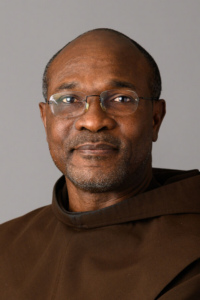 Fr. Cidouane Joseph, OFM (Fr. Cid) is the new National Spiritual Assistant and Provincial Animator for Our Lady of Guadalupe Province, OFM. He succeeds Fr. Jerome Wolbert, OFM, in this ministry and begins his service with a spirit of humility and fraternity.
In May, Fr. Jerome will move to Rome to study Italian and begin a new ministry there with the Dicastery for the Eastern Churches. We are very grateful for Fr. Jerome’s service to the OFS, and wish him the best in his new assignment.
Fr. Cid was born and raised in Haiti and arrived in the United States in 2002. He entered the Order of Friars Minor shortly thereafter, making his first profession of vows in Wilmington, Delaware, in 2006, and his solemn profession at St. Francis of Assisi Church in New York in 2009.
He was ordained a deacon at the Basilica of the National Shrine of the Immaculate Conception in Washington, D.C., in 2010, and to the priesthood at Holy Name of Jesus Church in New York in 2011.
His relationship with the Secular Franciscan Order began prior to his ordination at Holy Name of Jesus Church, where he first encountered Secular Franciscans and developed an appreciation for their vocation.
He has since served as a Spiritual Assistant at multiple levels, including local, regional, and provincial fraternities. Notably, he served as Regional Spiritual Assistant to the Solanus Casey Region. Through these experiences, he has cultivated a deep respect for the Secular Franciscan vocation and the shared charism that unites the Franciscan family.
In accepting this appointment, Fr. Cid has expressed both gratitude and a strong commitment to supporting the fraternities entrusted to his care. He recognizes the breadth of the responsibility of accompanying Secular Franciscans across the United States and emphasizes the importance of collaboration, fraternity, and mutual support in fulfilling this mission effectively.
Fr. Cid has affirmed his readiness to assist Regional Ministers and local fraternities, particularly those within Our Lady of Guadalupe Province, while also serving the broader national fraternity. He encourages ongoing cooperation between the First Order and the Secular Franciscan Order, underscoring the importance of maintaining and strengthening this vital relationship.
Reflecting on his experience, Fr. Cid notes that working with Secular Franciscans has enriched his own vocation as a friar and has deepened his appreciation for the vitality and witness of the Secular Franciscan life.
Members are invited to read his full introductory letter and to welcome him in the spirit of Franciscan fraternity.
 Fr. Cid’s Introduction Letter to Regional Ministers
https://www.secularfranciscansusa.org/2026/04/welcoming-fr-cid-to-the-cnsa/