Franciscan Living – Why After You?
(This article originally appeared in the TAU-USA Summer Issue 2022 #106)
by Francine Gikow, OFS
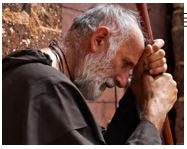 “Brother Masseo, wanting to test how humble he [Francis] was, went up to him and, as if joking, said, ‘Why after you, why after you, why after you?’ Masseo goes on to say in clarification: ‘I’m saying why does the whole world come after you, and everyone seems to desire to see you and hear you? You aren’t a handsome man in body, you aren’t someone of great learning, you’re not noble; so why does the whole world come after you?’”[1]
Francis’ response to Masseo may not seem to shed much light on this question, however. In fact, Francis states that God has chosen him because of his vileness and insufficiency. Francis expands this thought when he continues, saying: “…so that it may be known that every virtue and every good is from Him, and not from the creature, and no person may boast in his sight. But whoever boasts must boast in the Lord to whom is every honor and glory forever.”
God gave Francis great gifts. He gave Francis, an ordinary person born in the Middle Ages, great gifts of preaching, humility, and courage, not only because Francis made use of them, but also because Francis became a conduit for God’s love for us: The Lord and Creator shone through his creation of Francis. Truly, Francis became an “instrument” for God to work through so He could reach out and touch others through the human face of Francis.
God can work through us as well when he gives us “gifts” to use so that we can attract others to Christ. Thaddée Matura, OFM, warns us, however, “What one must beware of above all is the temptation to appropriate for oneself the good that belongs to God… one must acknowledge the origin of these gifts, rejoice over them, promote them; but once this is done, one must ‘render’ them, restore them to the One to whom they belong in an act of praise and thanksgiving.” [2]
Perhaps one of us has been given the grace to actually “see” God working through us, but detachment from personal ownership of our gifts is needed. We must be fully aware that we have been given everything by our loving God. We cannot appropriate that which is God’s, and we “own” nothing apart from Him.
We can still rejoice over these gifts we have used for God’s benefit, mindful that their Source is our loving God and not ourselves. These gifts are reminders of the intimate care and love of the Father who gives us all good things. He loves us!
We should also promote and use the gifts God has given and not “hide them under a bushel basket,” because it is by these gifts that people can come to know Christ through us. Like Francis, we can become a conduit to God, since these gifts are really God’s gifts, not our own. We can become the “face” of God to others and evangelize by our actions.
Acknowledging the true Source of any of the gifts we “appear” to own, we should return all praise and thanksgiving to the One who is GIFT Himself and the Source of any gift He has given us to use. Instead of accepting accolades for ourselves, we refer to the true Giver of Gifts in rejoicing and praise! Franciscan joy!
People were attracted to Francis because they were attracted to God’s gifts that they saw in Francis. Francis was well aware that he was not the owner of the gifts, but “He [God] has chosen me to confound the nobility and the greatness and the strength and beauty and wisdom of the world…”[3] Do likewise with joy!
[1] LFl:10 in FA:ED II, p. 583
[2] Thaddée Matura, OFM. Francis of Assisi: Writer and Spiritual Master. transl. Paul Lachance, OFM. (Cincinatti OH: St. Anthony Messenger Press, 2005), 49
[3] LFl:10 in FA:ED II, 0.583.
https://www.secularfranciscansusa.org/2022/10/31/franciscan-living-why-after-you/
Francis And Clare And Peace
(This article originally appeared in the Summer TAU-USA Issue #106)
by Bret Thoman, OFS
Blessed are the peacemakers, for they will be called children of God. (Matthew 5:9)
 As the war in Eastern Europe continues, Secular Franciscans – like everyone else – are looking for answers. Perhaps we can turn to Sts. Francis and Clare, as their lives were also affected by the tragedies of war and violence.
In 1215, Pope Innocent III launched the Fourth Lateran Council, at which he called for a fifth crusade. St. Francis was likely present at the council, and he heard the call. After two failed attempts, in 1219, he arrived in the Holy Land. However, he was there as a different sort of crusader. He did not arrive with arms; he had a different plan.
The earliest account of this well-known encounter comes from the first biography of St. Francis by Thomas of Celano. Written in 1228, just two years after the saint’s death, it was commissioned by the pope as the first official life story of St. Francis.
According to Thomas, Francis “would not rest from carrying out fervently the holy impulse of his spirit” – that is, martyrdom. Therefore, in the “thirteenth year of his conversion” (1219), he journeyed to Syria by ship and walked courageously with an unnamed companion across the battle lines to confront the “Sultan of the Saracens.”
While details of the exchange are not recorded, Thomas indicates that the sultan was struck by Francis’s witness, demeanor, and disdain for wealth, and he recognized that there was something unique about him. The account concludes with a statement that Francis did not receive his sought-after martyrdom, though he suggests that God was saving the moment for his later reception of the stigmata.
St. Bonaventure, a Franciscan theologian, and later Minister General of the order, also wrote a biography of St. Francis, in 1263. Bonaventure’s account mirrors Thomas’s almost verbatim but differs primarily in the addition of Francis challenging the sultan’s priests to a trial by fire: “so that [the sultan] will recognize which faith deserves to be held as the holier and more certain.”
While Frances’s desire f or martyrdom may strike some today as antiquated, it is consistent with the historic person of St. Francis. St. Francis was so devoted to Christ crucified on the cross that he sought to imitate him in every way – even going to the “cross” of martyrdom.
When Francis converted to the life of a penitent and signed his tunic with a cross, he became a “cross bearer” like the crusaders, who also wore a cross over their armor. He had laid down his own arms, but he was still a warrior at heart, though he was fighting a spiritual crusade. His arms were now the Word and the cross, his armor the penitential tunic.
It is not likely that Francis supported the crusades, as he never mentioned them in any of his writings. Moreover, his own experience in battle before his conversion and his renunciation of arms is telling. His life trajectory makes it clear that he had rejected every form of violence. He had become fully nonviolent.
Though the sultan did not convert, and Francis was not martyred, the encounter led to a significant breakthrough. According to Thomas, Francis was received “very graciously” by the sultan, who “honored him as much as he could, offering him many gifts.” Two of those gifts – an ivory horn and an Islamic prayer mat – are preserved in the Basilica of St. Francis in Assisi to this day.
More importantly, after the encounter, the witness of Francis led the sultan to turn over the administration of the Christian sites in his territory to Francis and his order. This was an extraordinary gesture, in that safe passage for Christians in the Holy Land was one of the primary motives the crusades had been launched in the first place.
St. Clare of Assisi also came of age in a milieu marked by violence. After an uprising in 1199, Clare, just eight years old, was exiled to Perugia with the other noble families of Assisi. Her father, uncles, and cousins were all knights. It is likely they had experience in battle. When they went out, they would have been armed with swords and scabbards on their hips. Weaponry including lances, shields, and battle axes would have been fixtures within the castle where Clare grew up.
When she was 18 years old, Clare had an experience with Jesus Christ. She, too, posed the same question to the Lord as the rich young man who inquired how to inherit eternal life. But she listened and did what He said, “Go, sell what you have, give the money to the poor, and come and follow me” (see Matthew 19:16-30; Mark 10:17-31; Luke 18:18-30).
Throughout her life, Clare reflected and meditated on the crucifixion and what her Lord had sacrificed for her. She yearned to imitate the crucified Christ and to offer herself, like Him, as a sacrifice to save others. In the Process of Canonization, three sisters testified that Clare had a desire to be a martyr in the Holy Land.
Clare had her opportunity toward the end of her life, in Assisi, when an army of Saracen soldiers tried to attack San Damiano.
The year was 1240, the hour tierce (9:00 AM), when they appeared suddenly “swarming like bees.” Though the sisters were terrified, Clare told them not to fear and to have confidence in Christ, because he would defend them.
Taking to heart the words of Jesus, “Greater love has no man than this, that a man lay down his life for his friends” (John 15:13), she said to her sisters, “I wish to be your ransom; if it should happen that the enemies come into [San Damiano], place me before them.”
Clare did not know what would happen to her as she asked the friars to bring to her the Holy Eucharist reposed in a silver pyx inside an ivory box. Before the door to the refectory, Clare lay prostrate before the Lord in the Eucharist while awaiting what she believed would be her martyrdom.
When the Saracens broke through the gate and entered the enclosure, they stopped in their tracks. They were disarmed by this mysterious, veiled woman. She was not afraid of them. Clare possessed a strength infinitely more powerful than they with their weapons and physical force.
St. Clare was practicing perhaps the most challenging imperative of the Gospel: “Love your enemies, do good to those who hate you, bless those who curse you, pray for those who abuse you. To him who strikes you on the cheek, offer the other also; and from him who takes away your coat do not withhold even your shirt” (Luke 6:27-29.
The Saracens were so disoriented that they fled. There was no violence that day.
In their approach to peacemaking and peace, Sts. Francis and Clare did not counter violence with more violence. Instead, they sought to imitate Christ.
When Christ was being arrested, he rebuked Peter, who sought to defend him, saying, “Put your sword back into its place; for all who take the sword will perish by the sword” (Matthew 26:52).
Later, during his interrogation with Pontius Pilate, he said, “My kingship is not of this world; if my kingship were of this world, my servants would fight, that I might not be handed over to the Jews; but my kingship is not from the world” (John 18:36).
Christ makes it clear that his Kingdom is heavenly, beyond the world. Though the Catholic Church allows legitimate defense (see CCC 2263-2267) and “just war” under some circumstances (see CCC 2307-2317), the way Saints Francis and Clare sought to imitate Christ shows a radical way of confronting war.
In Bret Thoman’s book, A Knight and a Lady: A Journey into the Spirituality of Saints Francis and Clare, he writes about peace and peacemaking and other elements of Franciscan spirituality.
https://www.secularfranciscansusa.org/2022/10/24/francis-and-clare-and-peace/