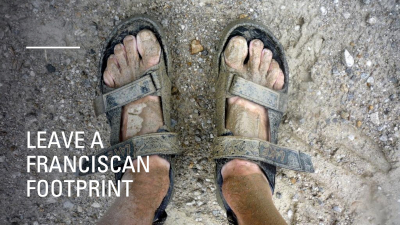
(a pdf copy is attached for printing)
Five Important Spiritual Thoughts from the Liturgy of the Word
…and follow up for the Secular Franciscan
December 1 – December 7
1
— “Everyone who listens to these words of mine and acts on them will be like a wise man
who built his house on rock.”(Mt 7:24)**
2
— “The harvest is abundant but the laborers are few.”(Mt 9:37)**
3 – “Prepare the way of the Lord, make straight his paths.”
(Mt 3:3)**
…Am I preparing for the Lord in the way I live?
4 — “What
are you thinking in your hearts?” (Lk 5:22)**Extended meditation:
Most sinfulness begins in our mind, our thinking. We think about things, and then we act it
out, or more often speak it out. And
often that acting or speaking is sinful.
So, Jesus’s question of the Pharisees or the people he is preaching to
is often: “What are you thinking?”Jesus
makes a powerful statement to Peter in the Gospel (Matthew 16:23):You are thinking not as God does, but as
human beings do.It leads to the questions of what is God thinking,
and what is human thinking?First, we ask the question about “human thinking.” I think that the best way to answer
is to study commercials, especially television commercials because commercials,
according to those who make them, are what we desire. If we desire it, we will
buy the product. What is “human thinking”, according to our advertisements?I
come up with five things—think of some commercials on the television shows that
you watch and see if you agree with me. According to advertisements, the way I
see it, we should want these things:– 1
– beauty is a significant
desire, usually a thin, young and athletic body with the right kind of figure,
and therefore, the right food, the right razor, and the like, and all kinds of
clothing, pills and creams are necessary;– 2
– pleasure is a desire, pleasure
from eating or drinking or feeling comfort, better convenience in our lives,
and feeling good about our pets; it includes the whole area of enjoyment from
sex (which is much more explicit in today’s world than it ever has been);– 3
– money is very much part of
human being thinking—making more of it, saving it better, or especially getting
something cheaper;– 4
– health, and in particular no pain
is a guideline in human thinking—so that life can always be happy, with no
suffering, and again, pills are necessary for it to happen, with a denial as
much as possible of the pain of growing older;– 5
– a sense of being superior or
having power is important—to be more intelligent, more powerful, more
clever than someone else, and so we need the right car, the right bank, the
right broker, more money, and so forth.Those ideas especially and probably many others make up part of “human thinking.”
In sharp contrast, Jesus speaks of God’s thinking in the Gospel. What is “God thinking”? As described by Jesus, “God
thinking” would consist of:– 1
– denying oneself—selfishness has no part of God’s way; there must be very
little concern for how much we ourselves will get out of any venture:What profit would there be for one to gain the whole world and forfeit his life?
– 2
– the cross is part of “God thinking”—there will be pain and suffering,
driving that point home to Peter, calling him Satan when he misunderstood it;– 3
– we must have a religious guide: he says specifically:Follow me.
It implies knowing Jesus well enough so that his
thoughts, words and actions become our thoughts, words and actions.Therefore, we have given to us two different points of view. Practically everything in our
lives can be considered in the light of the contrast of “human thinking” or
“God thinking.” For example, living in a family, in a community, going to
college, working to make money and so forth. Or take for example our spiritual lives: growing
spiritually takes time, time spent in things like reading Scripture and
reflecting on it or spiritual reading or time spent in prayer by ourselves. It
involves the thought that we really must improve our lives. “Human thinking”
about that is that it is a waste of our valuable time.If we learn to “purify” our thinking, we will learn to become truly “God-thinking.”
5
– “Come to me, all you who labor and are burdened, and I will give you rest.
Take my yoke upon you and learn from me,for I am meek and humble of heart; and you will find rest for yourselves. For my yoke is easy, and my burden light.” (Mt
11:28-30)**…Have I?
Category: Franciscan Footprint
Shaping the Franciscan Footprint
SHAPING THE FRANCISCAN FOOTPRINT – November 24 – November 30 2022
(pdf copy of this article attached for printing)
Five Important Spiritual Thoughts from the Liturgy of the Word
…and follow up for the Secular Franciscan
November 24 – November 30
1 — “By your perseverance, you will secure your lives.”
(Lk 21:19)**
…By our patient endurance of living well, we will deserve eternal life. How consistent am I in my spiritual life?
2 – “Be vigilant at all times.” (Lk 21:36)**
…Extended meditation:
What would people do if they discovered the exact time when the earth as we know it would be destroyed? Would people simply be resigned to their fate, and prepare by not preparing, simply letting it happen, and dying when the time came? Or would they turn to their belief, a Supreme Being, allowing the divine to help them prepare themselves to accept the inevitable?
It is not a happy thought to think of our deaths. In fact, sometimes thinking about death can be downright frightening. We do not relish final moments in a hospital fighting the pain of whatever is killing us; nor do we want the feeling of disease that eats us up into earthly death; nor do we like to think about the possibility of a sudden accident. But no matter what we want, we know that we must die. Earthly death is not optional.
Jesus knew the feeling of the possibility of death. As with everything that has a deep effect on human beings, Jesus spoke about it. And when he spoke about death, it was always with a certain degree of hope rather than fear. He tells us to think of an eternal life with God by being prepared for our deaths. In fact, that moment is so full of hope that our God will “wait” on us, presumably giving us the very thing that we want which is nothing less than eternal life with our God. The image that Jesus uses in the story is an unbelievably consoling one: our God loves us so much that at the moment of our deaths, he will be there to take care of us personally.
The condition that Jesus gives is that we be “prepared for our deaths.” What exactly is the meaning of the condition? The answer is given to us constantly in the Scriptures. Jesus tells us, in effect, that if we live the Christian life, that is, if we honestly strive to make the Christian virtues our own, then we will understand what being “prepared” means. If we live the virtues of love, forgiveness, peace and the other characteristics that Jesus showed us, we will be ready no matter when the Lord comes.
There is an obvious urgency to Jesus’s message because we do not know the hour of our earthly passing. But we are blessed to know what we must do to be prepared for that moment when it does come.
3 — “Amen, I say to you, in no one in Israel have I found such faith.” (Mt 8:10)**
…Am I recognized in my community to have great faith?
4 – “You have revealed [the wise and learned things] to the childlike.” (Lk 10:21)**
…Am I developing the traits of a “child” in my life: humility, honesty, acceptance of God?
5 — “Come after me, and I will make you fishers of men.”
(Mt 4:19)**
…Have I truly come to the Lord in a Franciscan way?
SHAPING THE FRANCISCAN FOOTPRINT – November 17 – November 23 2022
(pdf copy attached for printing)
Five Important Spiritual Thoughts from the Liturgy of the Word
…and follow up for the Secular Franciscan
November 17 – November 23
1 — “If this day
you only knew what makes for peace.” (Lk 19:42)**…Do others consider me a peaceful person?
2 – “He said to me,
‘Take and swallow it.’” (Rev 10:9)Extended meditation:
Why are Jesus’s words so important?
Before we even answer that question, we have to clarify “Jesus’s words.” First of all, we must be certain that they
are his words. The Gospels give us the
words, and although sometimes there must be scholarly study with regard to the
words, most of the time they can easily be understood. Mark Twain famously said, “Most people are bothered by those passages of
Scripture they do not understand, but the passages that bother me are those I
do understand.”Secondly, Jesus’s words come through
others. For example, we must listen to
the words that come from the Hebrew Scriptures, words often spoken as a
foundation for Jesus’s words in the Gospel.
Also, we must hear the words of preachers of Jesus’s words who were
speaking of what Jesus said and their application to our lives, namely the
words of the New Testament Scriptures.The General Instruction on the Roman
Liturgy says this about the first part of the Mass called the Liturgy of the
Word:The
Liturgy of the Word is to be celebrated in such a way as to promote meditation,
and so any sort of haste that hinders recollection must clearly be avoided.
During the Liturgy of the Word, it is also appropriate to include brief periods
of silence, accommodated to the gathered assembly, in which, at the prompting
of the Holy Spirit, the word of God may be grasped by the heart and a response
through prayer may be prepared. It may be appropriate to observe such periods
of silence, for example, before the Liturgy of the Word itself begins, after
the first and second reading, and lastly at the conclusion of the homily.Periods of silence in which “at the prompting of the Holy Spirit, the word of God may
be grasped by the heart” is suggested by the document. The words of Jesus and about Jesus must be
the guide that the Christian accepts in order to live in our world. That is, the beginning of a good life comes
from words, words that we think about in “the heart.”Of course, thinking about those words is only the beginning. “The heart” must direct those words to
“living,” in action. Francis of Assisi famously spoke that fact at one time: “It is no use
walking anywhere to preach unless our walking is our preaching,” which has been
roughly translated: “Preach the Gospel at all times; and if necessary, use words.”
3 – “My house shall be a house of prayer.” (Lk 19:46)**
…Can I make my prayer schedule/life a little better than it is?
4 — “Jesus,
remember me when you come into your kingdom.” (Lk 23:42)**…This should be a daily prayer, and a daily challenge to deserve the kingdom.
5 — “I tell you truly, this poor widow put in
more than all the rest. (Lk 21:3)**…Do we give of ourselves completely to the Lord?
SHAPING THE FRANCISCAN FOOTPRINT – November 10 – November 16 2022
(PDF copy is attached for printing)
Five Important Spiritual Thoughts from the Liturgy of the Word
…and follow up for the Secular Franciscan
November 10 – November 16
1 — “Behold, the Kingdom of God is among you.” (Lk 17:21)**
Extended meditation:
When Christian people are asked about
the most important thing that Jesus said while on earth, they usually refer to
virtues such as love, peace, forgiveness, etc.
But upon study of Jesus’s words, the most important image that Jesus
used was the image of the Kingdom of God.It seems that what Jesus wanted most of
all during his ministry here on earth is to establish this Kingdom of God. According to the Catechism, that Kingdom
refers to what will happen with we cooperate with the grace of the Spirit to
make everything holy in our society and culture, culminating in the eternal
life that Jesus promised.It did not work out that way, of
course, because of the opposition that Jesus faced during his ministry. But he did begin the process, and it has
continued over the ages to be known as the Church. It should be the Church’s goal to bring everyone
to cooperate with the Spirit, and consequently enjoy both a holy life here and
eternal life hereafter.But has the Church done that? And in particular have we cooperated in
bringing about such an end.This allegory about the Church should
lead us to understand our role a little more.On a dangerous seacoast where shipwrecks
often occur there was once a crude little lifesaving station. The building was
just a hut, and there was only one boat, but the few devoted members kept a
constant watch over the sea, and with no thought for themselves, went out day
and night tirelessly searching for the lost. This wonderful little station
saved many lives, so that it became famous.Some of those who were saved, and
various others in the surrounding area, wanted to become associated with the
station and give of their time and money for the support of its work. New boats
were bought and new crews trained. The little lifesaving station grew.Presently, some members became unhappy
that the building was so crude, so simple. Gradually, beds replaced cots and
good furniture appeared in the enlarged building.The station itself came to be decorated
beautifully, and was used as a club. The members became less interested in
going to sea on lifesaving missions, so lifeboat crews were hired to do that
work, especially when the people whose lives were saved were people who were
different from the people of the station.Soon, there was a split in the club
membership. Those members who wanted lifesaving to be its primary purpose were
voted down by the others. They were told that if they wanted to save lives,
they could begin their own station down the coast—which they did.As the years went by, the new station
experienced the same changes that had occurred in the old. It evolved into a
club, and yet another lifesaving station was founded.History continued to repeat itself, and if
you visit the seacoast today, you will find a number of exclusive clubs along
the shore.Shipwrecks are still frequent in those waters, but
most of the people drown.We are part of the Kingdom of God, the “life-saving station”
that Jesus established. Perhaps we should be better “life-savers” than we are.
2
– “When the Son of Man comes, will he find faith on earth?” (Lk 18:8)**…How strong is my faith?
3
— “Lord, please let me see.” (Lk 18:41)**…What should I see in the sense of what the Lord wants for me to understand in my life?
4 – “Day and night they do not stop exclaiming: ‘Holy, holy, holy is the Lord God
almighty.’” (Rev 4:8)…Do I spend time of praise to God, for example, for creation, for my living, for the great things in my life?
5 – “‘Well done, good servant! You have been faithful in this very
small matter.’” (Lk 19:17)…Am I as faithful as I should be in my spiritual activities?
SHAPING THE FRANCISCAN FOOTPRINT – November 3 – November 9 2022
(PDF copy is attached for printing)
Five Important Spiritual Thoughts from the Liturgy of the Word
…and follow up for the Secular Franciscan
November 3 – November 9
1 — “You justify yourselves in the sight of others, but God knows your hearts; for what is of human esteem is an abomination in the sight of God.” (Lk 16:15)**
…God knows my heart;
what is the general direction of my life right now?
2 — “Things that cause sin will inevitably occur, but woe to the one through whom they occur.” (Lk 17:1)**
…What kind of an example am I showing?
3
– “When you have done all you have been commanded, say, ‘We are unprofitable servants; we have done what we were obliged to do.’” (Lk 17;10)**…Extended Meditation
Hypocrisy
is an interesting phenomenon to talk about. It is an automatic trap or problem
area for anyone who gives direction to others: priests, ministers, teachers,
parents, legislators, anyone showing leadership of others. In our case, it is
anyone who chooses to do something good that others see, and therefore anyone understands
the importance of God in our lives. For whatever reason, we say to the world:
“I believe in God through Jesus Christ.” We must listen to Jesus in the Gospel.
It is possible to say ‘I believe’, and not put it into practice.We should be very interested in what we say in Church. We say strong words during
the service, words like, we believe, we will, we do. We
must truly listen to what we say and do. We receive the Lord in the words of
the Gospel and in the Eucharist. How can someone receive the Lord and with the
same mouth tear down someone else or allow foul language to come out of it? How
can someone receive the Lord and continue a life-style that makes a shambles of
a marriage or parenting? How can we miss the sacredness of life itself by being
bitter and angry most of the time? Or refusing to see the good in life?How?—according to Jesus, we have allowed religion to be nothing more than something to be seen
or performed.What’s the antidote to hypocrisy, how do we stay away from it? The Gospel gives us
that as well. Jesus says:The greatest among you must be your servant.
Service—we have heard that before from Jesus, in
fact a number of times. The way to keep ourselves from the hypocrisy of saying
one thing and doing another is to work on behalf of others. Serve people, give
to them without expecting anything in return, make others feel important
because they are—really.By the very fact that we say we believe in God, we are making a statement to the world
outside. We must realize that we could be hypocrites… or if we carry through,
we could be people who are helping this world.
4 – “You are God’s building.” (1 Cor 3:9)
…Do my thoughts, words and actions prove this?
5 – “Stop making my Father’s house a marketplace.” (Jn 2:16)**
…Prayer is not bargaining with God; it is giving our very selves to God.