Open post

SHAPING THE FRANCISCAN FOOTPRINT – May 25 – May 31 2023

Shaping the Franciscan Footprint

Five Important Spiritual Thoughts from the Liturgy of the Word

…and follow up for the Secular Franciscan

May 25 – May 31


1 – “There are also many other things that Jesus did, but if these were to be described individually, I do not think the whole world would contain the books that would be written.” (Jn 21:25)

…Have I developed a truly spiritual life based on Jesus?

2 – “And they were all filled with the Holy Spirit and began to speak in different tongues, as the Spirit enabled them to proclaim.” (Acts 2:4)

…Do I “proclaim” the presence of God in the way I act?

3 – He said to his mother, “Woman, behold, your son.” Then he said to the disciple, “Behold, your mother.” (Jn 19:26-27)

   Do I have a devotion to the Blessed Virgin Mary?

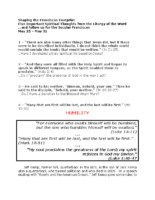
4 – “Many that are first will be last, and the last will be first.” (Mk 10:31)

HUMILITY

 “For everyone who exalts himself will be humbled,

but the one who humbles himself will be exalted.”

(Luke 14:11)

+++

“Many that are first will be last, and the last will be first.”

(Mark 10:31)

    +++

“My soul proclaims the greatness of the Lord; my spirit rejoices in God my Savior.”

(Luke 1:46-47


        Jeff Kemp, former NFL quarterback in the 80’s, is the son of Jack Kemp also a quarterback who turned politician and who died in 2009.  In a speech dealing with “Sports and the American Dream,” Jeff Kemp gave some rules to live by on and off the playing field. His first rule was incredible for a sports professional. His first rule: humility.

        He tells a story on himself. He was drafted by the Los Angeles Rams (in those days) in 1981, designated fifth-string quarterback. Actually he became a rather successful quarterback in the NFL, but he did not think he would survive training camp. The rookies were called in first and after about two days, a young boy came to him, and asked if he could carry his helmet to the locker room. Jeff felt rather honored, and liked being an idol for the ten-year-old. During that first week of practice and survival, the young man carried his helmet to the locker room every day. A couple of days before the practice actually started for everyone, the young boy said to him: “Jeff, can I ask you a question?” Jeff thought: this is my first fan; he’s going to ask me for my autograph. He felt good, pleased that he had impressed someone, even if it was a ten-year-old. “Absolutely,” he said. The ten-year-old said: “When do the good football players come to camp?

        ”Humility,” Jeff Kemp goes on to say, “was a good thing. It helped me appreciate what I had and avoid dwelling on what I did not have. It prevented complaining, which drains the spirit and unity of any group. It also led me to persevere and be ready whenever opportunity presented itself.” 
        One might not expect humility to be a quality that a former professional player would espouse, but it is one that you might expect from a religious leader. Jesus did exactly that in the Gospels.

        Most of us realize that humility is defined to be nothing more or less than the truth, that is, looking at something from an objective point of view. It is very difficult, because we have a tendency to look at everything through our own eyes, with our own agenda, and our own agenda “colors” everything that we see or consider.

        In the Gospels, the Pharisees felt that they had the truth, a truth that made them feel more important than anyone else, that they were worthy of respect and admiration. Jesus knew what they were thinking. He explained it to them saying that they must learn humility, that is, the truth, and the truth when it concerns others is that everyone is important.

        Lack of humility was a fault that even the Apostles fell into.

        The application for us is that we are called to be humble people, people who are dedicated to the truth, and when it concerns others, to realize that they are all equally important. We have a tendency to judge that we are better than others for whatever reason. Maybe we think we have more knowledge, more talent, more age, more money, more maturity, more whatever, and consequently, we place ourselves above others in some sense. We do it in a subtle way, of course. We will never say, “I am more important than you,” but we do it in our thoughts, or in our passing conversations. The objective truth is that everyone is important and we may be distorting that truth by our own jealousy or our own selfishness.

        Jesus teaches us a very practical lesson: we must be humble people, that is, we must honor the truth at all times. The Christian will be humble in his/her approach to others not only because he/she is modest and respectful, but because he/she seeks the truth of who they are.

5 – “Blessed are you who believed that what was spoken to you by the Lord would be fulfilled.” (Lk 1:45)

…Mary’s faith was real.  Is my faith what it should be?
Open post

SHAPING THE FRANCISCAN FOOTPRINT – May 18 – May 24 2023

Shaping the Franciscan Footprint

Five Important Spiritual Thoughts from the Liturgy of the Word

…and follow up for the Secular Franciscan

May 18 – May 24

  1 –- “For the Father himself loves you, because you have loved me
and have come to believe that I came from God.”
(Jn 16:27)

…You are loved with a divine love. What should that do for me?

2 –- “When they saw him, they worshiped, but they doubted.” (Mt 28:17)

…Is my faith as strong as it should be?

3 — He entered the synagogue, and for three months debated boldly
with persuasive arguments about the Kingdom of God. 
(Acts 19:8)

…Paul had tremendous courage to do this.  Do I have the courage to be a good Franciscan?

4 — Now this is eternal life, that they should know you, the only true God, and the one whom you sent, Jesus Christ. (Jn17:3)

…This is my spiritual task.  Am I following through?

5 — “Holy Father, keep them in your name.” (Jn 17:11)

…The Lord is praying for me.  Have I responded well in my life?

Special meditation

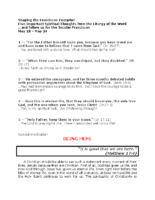
BEING HERE

 “It is good that we are here.”

(Matthew 17:4)


        A Christian should be able to say such a statement every moment of their lives, simply because they are Christian. First of all, God has given us life, and now God through Jesus has given us eternal life. Even right now before the bliss of eternal life, even in the worst of all scenarios, at least we have life and the Holy Spirit continues to work for us. The spirituality of Christianity is thoroughly positive even as negatives happen. We can say the words that were found on one of the walls of the Dachau concentration camp: “I believe in the sun even when it isn’t shining.”  It is with true conviction that we should be able to say, “Lord, it is good for us to be here.”

        But there are some things that block our acceptance of that statement.  One of those major blocks is what may be named the “IF ONLYS”:

        – if only I had been born into money, or in Southern California or Florida;

        – if only I had more time;

        – if only I had been a little smarter;

        – if only I had just a couple more breaks;

        – if only I could win the lottery;

        – if only I could have a better job;

        – if only things had not worked out the way they did;

        – if only I were younger;

        – if only I weren’t as old as I am;

        – if only my health could be a little better.

Many people keep saying “if only” and never see what they have right now, and therefore their approach to life becomes essentially negative.

        If we truly believe in God, we believe that it is good for us to be here—right here: this place, this time, this life, this situation, these circumstances. Yes, we can try to make it better, and indeed we should, but we have LIFE and we can live it to the fullest.

Open post

SHAPING THE FRANCISCAN FOOTPRINT – May 11 – May 17 2023

Shaping the Franciscan Footprint

Five Important Spiritual Thoughts from the Liturgy of the Word

…and follow up for the Secular Franciscan

May 11 – May 17

  1 — “This is my commandment: love one another as I love you.” (Jn 15:12)

           The chaplain told this true story: it was the story of one of the patients he once had in long-term care in the VA hospital where he worked. The veteran went by the name of “Vet” because he always referred to himself as “the veteran of the war.” The war was Vietnam and he was angry about it. It had ruined him—he was physically wounded although not that badly—but his real problem was: he had come home, he thought, to a world that did not receive him well. He felt his country was unkind; he felt his family was part of the problem. He began to abuse them, verbally mainly, but sometimes physically. Eventually his wife and child left, refusing even to talk with him. He had tried to explain, but they never came back and he became even more bitter than he was.

           The chaplain explained that “Vet” began to change a little when he received a series of anonymous one-line notes on postcards in the mail. The line read “You are responsible for what you do” with the word you underlined. The post cards were mailed from different cities on Monday or Tuesday of each week and always the same—sometimes printed, sometimes written, sometimes typed. They kept coming for over a year and he finally began to understand some things in his life and began to change not completely, but a little. He finally found out that his wife was responsible for the postcards; they did get back together briefly before she died. But he finally began to understand that he could not blame a place or a war for his anger. He ultimately was responsible for who he was and what he did, but before he understood it, he had to have it placed bluntly in front of him.

                 “Vet” needed a blunt statement from his wife before he began to understand. Only then could he change his ways. You and I often need blunt statements that shake us out of our complacency to make us see what we are doing. For example, arguably the primary directive that Jesus gave us while he was here on earth was to love one another. It is a relatively blunt statement that should make us understand this idea of love of others:

           Love one another as I love you.

Think of that: “as I love you” is a divine love, therefore much deeper than a human love and that is the love we should have for one another.

           We have all heard that plea to love from Jesus and the Scripture hundreds of times, but, let’s face it, people are still not as loving as they should be. In fact, there continue to be situations where there is a lack of love. That is certainly true on a national / international level: Christian people who are not loving. But perhaps on our own level, we are not loving the way we should: in our work place, our family, our home, our lives, and these words should apply to us. But often they do nothing—we just listen to them, and say “I wish so and so would listen” or “I’m doing this already” or “My circumstances are different.” It seems that the Lord can do nothing to get us to understand that he is talking to us.

           One rather negative spiritual author says simply that Christian people in America have lost their spark; that we are just going through the motions without any hope that their spiritual lives will catch fire. We need a shock to our system so that we can catch fire.

           The question becomes then: what will it take to make us understand that we have to love others? We will not have anyone like “Vet’s” wife because probably no one will take the time to do it. And so basically, Christians have to rely on the power of Jesus’ words—and that should be enough for a Christian. We must really hear Jesus’ directive maybe for the first time: if you are a Christian, you must love everyone, no exceptions.

           There was a popular song a couple of years ago that was a normal love song, but the title was a good one. The title was “Let Love In.” Perhaps we should look at love of others and then allow ourselves to be shocked. Imagine that Jesus comes up to us right now, points his finger at us, and says: there is love lacking in your life—you are the man / woman. Now is the time to let love in.


2 — “When the Advocate comes whom I will send you from the Father, the Spirit of truth who proceeds from the Father, he will testify to me. (Jn 15:26)

…The Holy Spirit is the Spirit of truth.  Do I consider myself to be a person who always tells the truth?


3 –- “And when he comes he will convict the world.”  (Jn 16:8)

…Have I allowed the world to have too much of a hold in my life?


4 – “I will not leave you orphans; I will come to you.” (Jn 14:18)

…When I am lonely, I must understand that the Lord through the Spirit is with me.


5 — But when he comes, the Spirit of truth, he will guide you to all truth. (Jn 16:13)

…Again, Jesus has us think about the truth.  I might take the opportunity to ask forgiveness for the times when I have not been truthful.


www.frmikescully.com

www.thegospelandme.com


Open post

SHAPING THE FRANCISCAN FOOTPRINT – May 4 – May10 2023

Shaping the Franciscan Footprint

Five Important Spiritual Thoughts from the Liturgy of the Word

…and follow up for the Secular Franciscan

May 4 – May 10

1 — “Do not let your hearts be troubled. You have faith in God; have faith also in me.” (Jn 14:1)

…Do I show my faith the way I should?

2 — Jesus said to him, “I am the way and the truth and the life. No one comes to the Father except through me.”  (Jn 14:6)

…THE reason why we follow the Lord. Is it clear from my life?

3 — The Advocate, the Holy Spirit whom the Father will send in my name–he will teach you everything and remind you of all that I told you.” (Jn 14:26)

…Go through the gifts of the Holy Spirit (Wisdom, Understanding, Right Judgement, Knowledge, Courage, Awe [Fear of the Lord], Reverence) and determine which virtue I should work on more in the next couple days.

4 — “Peace I leave with you; my peace I give to you.” (Jn 14:27)

…Am I a truly “peaceful person,” that is, trying to bring about harmony in whatever situation?

5 – “Remain in me, as I remain in you.” (Jn 15:4)

…An obligation…and a promise. 

Extra meditation

BAPTISM

 “Amen, I say to you, unless one is born of water and Spirit
he[/she] cannot enter the Kingdom of God.”

(John 3:5)

+++

It happened in those days that Jesus came from Nazareth

of Galilee and was baptized in the Jordan by John.

(Mark 1:9)

        You have probably met a couple of saints in your life.  They may not be formally canonized, but they should be.  Two of them lived in the same town that the pastor lived in.

        One was in her 90’s and a little hard of hearing and could not walk long distances. It was too risky for her to go to Church, which she wanted to do in the worst way. She was one of the well-known people in her small town simply because of her holiness.  The pastor celebrated home Masses for her, and one particular time, he gave a little homily on whatever. After Mass, she told her granddaughter, in a pretty loud voice as many hard-of-hearing older people do, “I didn’t understand one thing that priest said!” The fact is: she did not need to because she was what can be called a practical theologian. She had put her faith into everything that she did.

        The other practical theologian in that same town helped the pastor of the town provide a temporary home for someone who really needed help and she literally saved that young person’s life. She also was a practical theologian. A little later as she neared the end of her life, she was involved in a very bad accident. She had to wear one of those braces that, in effect, molded a steel cage around her head to keep her from moving her neck. The medical field has something a little more user-friendly now, but she looked awful, and people felt awful for her. But she lived out her life with an attitude that she put into words at one time.  She said: “This is good. God still wants me to do something with my life.” There is little doubt that she did it. It is a statement of a practical theologian.

        A practical theologian is one who has put Baptism into practice. It makes our Baptism something that is a true guide for living well. We celebrate that thought on the feast of the Baptism of Jesus. Jesus used the Baptism of John to say to us that every one of us must begin using our Baptism as a guide just as Jesus did in a most human way. Baptism becomes a guide when we put into practice the characteristics of Jesus.

        All Christians are baptized, most of them very young. We are Christians, and almost immediately, we have to wonder why with so many baptized Christians, there are still so many problems in the Christian world, and in our own little worlds. If we were better practical theologians, that would change.

        A Methodist minister a couple of years ago put it this way. The minister stated that the problem with most Christians is that they have not fully embraced the call of Christianity. Using strong accusatory language, he said: “If ministers and their flocks would worry more about listening to the call of Jesus, and less about money and whose religion is right or wrong, we wouldn’t have the mire and misery that we have now.” He is a little negative, but there is a lot of truth there.

        Listening to the call of Christianity means being practical theologians, and how do we do that? We know the answer. We take the time to address the mire and misery in our own homes and in the situations that we can do something about. We can do things like: regulate TV and movies, make sure young people get the Christian education they need, pray more, go to the sacrament of Reconciliation more, volunteer more, and so forth.

        We need practical theologians in our Church today. They should be us.

www.frmikescully.com

www.thegospelandme.com

Open post

SHAPING THE FRANCISCAN FOOTPRINT – April 27 – May 3 2023

Shaping the Franciscan Footprint

Five Important Spiritual Thoughts from the Liturgy of the Word

…and follow up for the Secular Franciscan

April 27 – May 3

 1 – “Your ancestors ate the manna in the desert, but they died; this is the bread that comes down from heaven so that one may eat it and not die.” (Jn 6:49-50)

…The Eucharist was central to Francis’s life.  Is it in mine?

 2 – “[Paul] began at once to proclaim Jesus in the synagogues,
that he is the Son of God.”
(Acts 9:20)

…Do my thoughts, words and actions proclaim the message of Jesus?

3 – “I am the gate. Whoever enters through me will be saved, and will come in and go out and find pasture.” (Jn 10:9)

…Are the actions and words of Jesus the means I use to pattern my life?

4 — “I am the good shepherd. A good shepherd lays down his life for the sheep.” (Jn 10:11)

…I should spend some time in thanksgiving for the Lord’s redemption.

5 – “I am the way and the truth and the life. No one comes to the Father except through me.” (Jn 14:6)

…Have I made Jesus the pattern and measure of my life?


Further meditation:

A SERVANT

 “The greatest among you must be your servant.

(Matthew 23:11-12)

+++

When you have done all you have been commanded, say,

‘We are unprofitable servants; we have done what we were obliged to do.’”

(Luke 17:10)

+++

“Do you realize what I have done for you?

If I, therefore, the master and teacher,

have washed your feet,

you ought to wash one another’s feet.

I have given you a model to follow,

so that as I have done for you, you should also do.”

(John 13:12-15)

         It is always interesting to study the way some people look at religion. Two of the Apostles had a pretty specific idea of what it meant for them. For them, it led to power:

        Grant that in your glory we may sit one at your right and the other at your left.

That remark made the other Apostles angry because they wanted the same thing, and they felt that they were not getting it.

        We are often inclined to think of religion the same way the Apostles looked at the kingdom. Why do we go to Church? Why worship God? To feel good, have happiness, eternal life, good graces from God, obtaining what we pray for? That is, to obtain some type of reward for going to Church on a weekend? In fact, we often look at religion and going to Church as insurance, that is, so I can earn my way into heaven, doing things to get me to heaven.

        Jesus says that that is the wrong stress. That is not what religion / kingdom / God is all about. He told his disciples that the kingdom he was preaching had nothing to do with what they were going to get out of it: not—sitting on my right or left; not—being able to lord it over anyone. In fact, he says, quite pointedly:

        It shall not be so among you!

It is not a matter of getting anything; it is rather a matter of service:

        Whoever wishes to be great among you will be your servant.

        And at the Last Supper, the Lord made it crystal clear by giving a direct statement: if you are going to be a Christian, a follower of Christ, you must serve others

        If I, the master and teacher, have washed your feet, you ought to wash one another’s feet.  I have given you a model to follow, so that as I have done for you, you should also do.

        One of the people that comes up when we try to serious consider ourselves is the prophet Jonah. He is a perfect example of us in our negative moments. He was in the category of “a headstrong (= stubborn), / opinionated, / somewhat good person / with talents.” God tried to become active in his life, but his selfishness would not allow it. God told him to preach to the city of Nineveh, a traditional enemy of Israel. Jonah not only said “no,” but tried to run away from God. God got his attention again through a violent storm and a large fish. A second time, the Lord said: now, will you go and preach? Which he finally did. He was a good preacher, he had talents. The people listened and reformed themselves. God rejected the evil that he planned to send (Jesus refers to this in one of his sermons). Jonah then became angry at God because he did not think that God should have been so good to them. God said “too bad, I am.” Then Jonah said: “let me die,” went out to sulk, felt protected by means of a plant which God then destroyed. Jonah complained about that: “let me die.” God said basically “grow up” and get over your selfishness. We are led to question whether he ever did: the book ends.

Religion can be defined as letting go of our selfishness, letting go of our “Jonah-ness.” Jesus today calls it the whole idea of being a servant. It is the thought of letting go of our selfishness in order to work on behalf of others.

Our problem is that our selfishness is pretty strong. We want what we want. We like the idea of “lording it over” others, to have authority over others. We do not particularly like the idea of service of others. We really want to make religion a personal thing. We like to think that going to Church is enough and it does not really involve others and their problems. Certainly we are into religion with the whole idea of personal salvation—that is an automatic—we are working to have eternal life, but Jesus says that everything connected with religion / God / Kingdom must always consider other people as well—because we enter into religion as “servants” of others.

If we want to be a follower of Jesus Christ, we must listen closely to him:

        Whoever wishes to be first among you will be the slave of all.

A slave” is even stronger than a “servant.” He is describing an attitude that every one of us should have.

        And Jesus looks at you and me and says, “Do you realize what I have done for you?”

www.frmikescully.com

www.thegospelandme.com


Scroll to top
Juan de Padilla