Open post

FORMATION FRIDAY – Our Identity Part 1 of 3 – October 15, 2021


Dear Brothers and Sisters, 

Today’s lesson discusses our identity as Catholics and Franciscans.  This is the first of a three-part series that can be used for personal reflection.  You may use it for Ongoing Formation along with parts 2 and 3 which will come in the coming weeks.  As always, discussion questions are included with these lessons so that you will be able to quickly use them at your next Gathering.
Peace, Dona
 
++++++++++++++++++++++++++++++++++++++++++++++++++++++++++++++++++++++++++++++++++++++++++++++++++++++++++++++++++++++++++++++++++++++


Our Identity as Catholics and as Secular Franciscans (Part 1 of 3)

[For personal formation take each part separately. For ongoing formation, all three parts will be useful when presented together and discussed.]

Refer to Anne Mulqueen, OFS-FUN Manual-Our Identity as a Secular Franciscan

 “Identity as a person is impossible to define definitively because each one that God creates is unique and unrepeatable. God calls us by name, and one of the sweetest sounds to anyone’s ears is the sound of their name.”


Faith, values, passions, what we do, whom we are related to, our associations, and many other things make up our identity. Here are some questions Anne offers us about identity in general. We can ask ourselves:


·        “Who am I?” God has a purpose for us.

·        “Who are we?” Church—we use our gifts for the good of all.

·        “What is my purpose?” We are to proclaim that Christ is present among us through our behavior and our words.

·        “To whom do I belong?” We belong to God; we belong to the Franciscan family; we belong to those we love and those we serve.

As Catholic Christians—through Baptism:

·        We are members of the community of believers

·        We have the responsibility to listen to and implement the word of God

·        We receive the gifts of the Holy Spirit

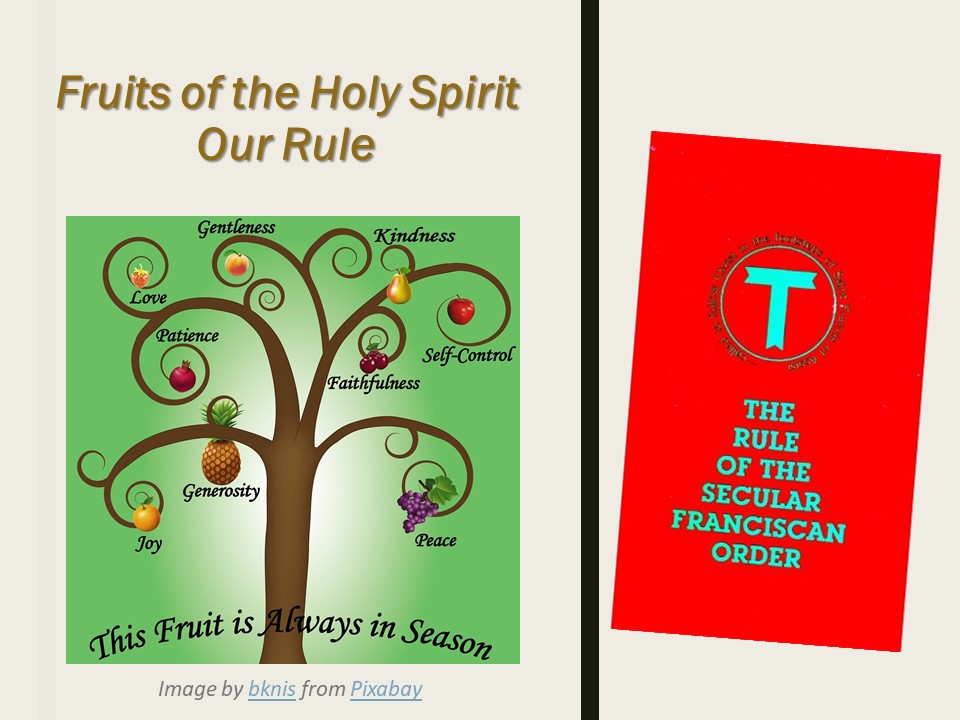
·        We receive the fruits of the Holy Spirit

·        We go forth as witnesses and instruments of the Church’s mission.

·        We offer ourselves and our activities to God as a spiritual sacrifice.  

·        We are invited to prophetic service

·        We accept the word of God

·        We are faithful in living the Gospel

·        We bear witness to the world to God’s way of achieving peace, joy, love, and justice.

·        We are given a place in the Kingdom of God and its mission


Within our identity as Catholic Christians, we will find the makings of a Secular Franciscan.
(To be continued)


For discussion or to be answered in your journal:

+Look at the first section above. Think about, then answer the four questions listed.

+What are the gifts of the Holy Spirit? (Look them up if you’re not sure.) Which gifts are strong in you?

+What are the fruits of the Holy Spirit? Which of these fruits are most evident in you?

+According to the bullets presented above, how are you living out your commitment as a Catholic? Give some examples.

++++++++++++++++++

Nuestra identidad como católicos y franciscanos seglares (Parte 1 de 3)
Por favor, compartir con su fraternidad.

[Para la formación personal tomar cada parte por separado. Para la formación permanente, las tres partes serán útiles cuando se presenten juntas y se discutan.]

Consulte Anne Mulqueen, OFS-FUN Manual-Our Identity as a Secular Franciscan

“La identidad como persona es imposible de definir definitivamente porque cada uno que Dios crea es único e irrepetible. Dios nos llama por nuestro nombre, y uno de los sonidos más dulces para los oídos de cualquiera es el sonido de su nombre “.

La fe, los valores, las pasiones, lo que hacemos, con quién nos relacionamos, nuestras asociaciones y muchas otras cosas conforman nuestra identidad. Aquí hay algunas preguntas que Anne nos ofrece sobre la identidad en general. Podemos preguntarnos:


•”¿Quién soy?” Dios tiene un propósito para nosotros.

•”¿Quienes somos?” Iglesia: utilizamos nuestros dones individuales para el bien de todos.

• “¿Cuál es mi propósito?” Debemos proclamar que Cristo está presente entre nosotros a través de nuestro comportamiento y nuestras palabras.

• “¿A quién pertenezco?” Pertenecemos a Dios; pertenecemos a la familia franciscana; pertenecemos a aquellos a quienes amamos y a quienes servimos.


Como cristianos católicos, a través del bautismo:

• Somos miembros de la comunidad de creyentes

• Tenemos la responsabilidad de escuchar e implementar la palabra de Dios.

• Recibimos los dones del Espíritu Santo

• Recibimos los frutos del Espíritu Santo

• Salimos como testigos e instrumentos de la misión de la Iglesia.

• Nos ofrecemos a nosotros mismos y nuestras actividades a Dios como sacrificio espiritual.

• Estamos invitados al servicio profético

• Aceptamos la palabra de Dios

• Somos fieles en vivir el Evangelio

• Damos testimonio al mundo de la manera en que Dios logra la paz, la alegría, el amor y la justicia.

• Se nos da un lugar en el Reino de Dios y su misión.


Dentro de nuestra identidad personal como cristianos católicos encontraremos los ingredientes de un franciscano seglar.

(Continuará la semana próxima)

Para discusión o para ser respondido en su diario:

+ Mire la primera sección de arriba. Piense y luego responda las cuatro preguntas enumeradas.

+ ¿Cuáles son los dones del Espíritu Santo? (Búsquelos si no está seguro). ¿Qué dones son fuertes en usted?

+ ¿Cuáles son los frutos del Espíritu Santo? ¿Cuáles de estos frutos son más evidentes en usted?

+ Según las viñetas presentadas anteriormente, ¿cómo está viviendo su compromiso como católico? Dé algunos ejemplos.


Diane F. Menditto, OFS

Chair, National Formation Commission

Formation Director, Our Lady of the Angels Region
Formation Director, St. Francis Fraternity, Hackensack, NJ


Open post

FORMATION FRIDAY – Catholic Social Teaching From St. Francis to Secular Franciscan Rule – October 8, 2021

Dear Brothers and Sisters, 

Today’s lesson is about St. Francis’ direction to his brothers from the Legend of the Three Companions, the OFS Rule, and how this aligns with the teaching of the Catholic Church.  It is always important to review our RULE with any formation we present to our fraternities so that all have a good understanding of the Rule and we profess to follow.  Peace, Dona

+++++++++++++++++++++++++++++++++++++++++++++++++++++++++++++++++++++++++
In the Legend of the Three Companions we read:
For his great desire was that he, as well as his brothers, would abound in such good deeds for which the Lord would be praised. He used to tell them: “As you announce peace with your mouth, make sure that greater peace is in your hearts. Let no one be provoked to anger or scandal through you, but may everyone be drawn to peace, kindness, and harmony through your gentleness. For we have been called to this: to heal the wounded, bind up the broken, and recall the erring. In fact, many who seem to us to be members of the devil will yet be disciples of Christ.”
 
The Catholic Church has given us the Seven Themes of Catholic Social Teaching. The Secular Franciscan Rule of 1978 helps us to make them part of our daily lives.
 
1- CST: LIFE AND DIGNITY OF THE HUMAN PERSON—The Catholic Church proclaims that human life is sacred and that the dignity of the human person is the foundation of a moral vision for society.
+OFS RULE: Articles 15 and 17: Promote justice and peace and respect for life
 
2- CST: CALL TO FAMILY, COMMUNITY, AND PARTICIPATION—We are both sacred and social; part of society.
+OFS RULE: Articles 13 and 17: A sense of community—ready to place themselves on an equal basis with all people; Cultivate a spirit of peace, fidelity, and respect for life in the family. Husbands and wives should bear witness in the world of the love of Christ for his Church.
 
3- CST: RIGHTS AND RESPONSIBILITIES—The Catholic tradition teaches that human dignity can be protected and a healthy community can be achieved only if human rights are protected, and responsibilities are met.
+OFS RULE: Article 14: [We] are called to build a more fraternal and evangelical world; exercise our responsibilities competently.
 
4- CST: OPTION FOR THE POOR AND VULNERABLE—How are the most vulnerable faring?
+OFS RULE: Articles 13 and 15: Accept all people as a gift of the Lord. Place ourselves on an equal basis with the lowly…; Be in the forefront of promoting justice…
 
5- CST: THE DIGNITY OF WORK AND THE RIGHTS OF WORKERS—The economy should serve people not vice versa.
+OFS RULE: Article 16: Let them esteem work both as a gift and as a sharing in the creation, redemption, and service of the human community.
 
6- CST: SOLIDARITY—We are one human family.
+OFS RULE: Articles 13 and 19: …place themselves on an equal basis with all people, especially the lowly. …trusting in the presence of the divine seed in everyone and in the transforming power of love and pardon.
 
7- CST: CARE FOR GOD’S CREATION—We show respect for the Creator by taking care of His creation.
+OFS RULE: Article 18: They should respect all creatures which bear the imprint of the Most High,…
 
 
For discussion or to answer in your journal
 
+How does Catholic Social Teaching (CST) apply to us as Secular Franciscans? Give “daily life” examples.
+In what ways do you live out the articles of the Rule mentioned above?
+How can our fraternities live out Catholic Social Teaching through our
 
 
postolates? Give examples of what you are already doing? What more can you do?
 
++++++++++
Comparta con su fraternidad local.
 
Doctrina social católica: De San Francisco a la regla franciscana seglar
 
En la leyenda de los tres compañeros leemos:
Todo su afán era que así él como los hermanos estuvieran tan enriquecidos de buenas obras, que el Señor fuera alabado por ellas. Y les decía: «Que la paz que anunciáis de palabra, la tengáis, y en mayor medida, en vuestros corazones Que ninguno se vea provocado por vosotros a ira o escándalo, sino que por vuestra mansedumbre todos sean inducidos a la paz, a la benignidad y a la concordia. Pues para esto hemos sido llamados: para curar a los heridos, para vendar a los quebrados y para corregir a los equivocados. Pues muchos que parecen ser miembros del diablo, llegarán todavía a ser discípulos de Cristo».
 
La Iglesia Católica nos ha dado los Siete Temas de la Doctrina Social Católica. La Regla Franciscana Seglar de 1978 nos ayuda a hacerlos parte de nuestra vida diaria.
 
1- DSC: VIDA Y DIGNIDAD DE LA PERSONA HUMANA — La Iglesia Católica proclama que la vida humana es sagrada y que la dignidad de la persona humana es el fundamento de una visión moral para la sociedad.
+ REGLA OFS: Artículos 15 y 17: Promover la justicia y la paz y el respeto a la vida
 
2- DSC: LLAMADO A LA FAMILIA, LA COMUNIDAD Y LA PARTICIPACIÓN: somos tanto sagrados como sociales; parte de la sociedad.
+ REGLA OFS: Artículos 13 y 17: Un sentido de comunidad — listo para colocarse en igualdad de condiciones con todas las personas; Cultive un espíritu de paz, fidelidad y respeto por la vida en familia. Los esposos y las esposas deben dar testimonio en el mundo del amor de Cristo por su Iglesia.
 
3-DSC: DERECHOS Y RESPONSABILIDADES — La tradición católica enseña que se puede proteger la dignidad humana y que se puede lograr una comunidad saludable solo si se protegen los derechos humanos y se cumplen las responsabilidades.
+ REGLA OFS: Artículo 14: [Estamos] llamados a construir un mundo más fraterno y evangélico; ejercer nuestras responsabilidades de manera competente.
 
4- DSC: OPCIÓN PARA LOS POBRES Y VULNERABLES: ¿Cómo les va a los más vulnerables?
+ REGLA OFS: Artículos 13 y 15: Acepta a todas las personas como un regalo del Señor. Situarnos en pie de igualdad con los humildes…; Estar a la vanguardia de la promoción de la justicia …
 
5- DSC: LA DIGNIDAD DEL TRABAJO Y LOS DERECHOS DE LOS TRABAJADORES — La economía debe servir a las personas y no al revés.
+ REGLA OFS: Artículo 16: Que estimen el trabajo como don y como participación en la creación, redención y servicio de la comunidad humana.
 
6- DSC: SOLIDARIDAD — Somos una sola familia humana.
+ REGLA OFS: Artículos 13 y 19:… colocarse en igualdad de condiciones con todas las personas, especialmente con los humildes. … Confiando en la presencia de la semilla divina en todos y en el poder transformador del amor y del perdón.
 
7- DSC: CUIDADO POR LA CREACIÓN DE DIOS — Mostramos respeto por el Creador al cuidar de Su creación.
+ REGLA OFS: Artículo 18: Deben respetar a todas las criaturas que llevan la huella del Altísimo, …
 
 
Para platicar o responder en su diario
+ ¿Cómo se aplica la Doctrina Social Católica (DSC) a nosotros como franciscanos seglares? Dé ejemplos que proceden de la “vida diaria.”
+ ¿De qué manera vive usted los artículos de la Regla antes mencionados?
+ ¿Cómo pueden nuestras fraternidades vivir la Doctrina Social Católica a través de nuestros apostolados? ¿Dé ejemplos de lo que ya están haciendo. ¿Qué más se puede hacer?


Diane F. Menditto, OFS

Chair, National Formation Commission

Formation Director, Our Lady of the Angels Region
Formation Director, St. Francis Fraternity, Hackensack, NJ


Open post

FORMATION FRIDAY – The Canticle of the Creatures – October 1, 2021

 
Dear Brothers and Sisters, 
Today’s lesson discusses the Canticle of the Creatures, a beautiful hymn created shortly before Francis’ death.   Father Murray Bodo OFM said that the Canticle of the Creatures, for Francis, summed up his whole spirituality and his whole life, because he praises God by being a part of all of the created world.  He singles out the four elements of earth, water, air, and fire. And he calls them his brother and sisters:  Brother Fire, Sister Water, Brother Wind, and Sister Mother Earth.
At the end of the lesson, there are links to YouTube videos on the Transitus of St. Francis – one in English and one in Spanish.  There is also a link to Franciscan Traditions, an important site to find excellent formation materials. (Formation directors, we have referred to this site several times, and is a great site for authentic Franciscan formation materials).   Please share this lesson with your fraternities.  Peace, Dona
+++++++++++++++++++++++++++++++++++++++++++++++++++++++++++++++++++++++++++++++++++++++++++++++++++
 
As we approach the Transitus and Feast Day of our Seraphic Father, we offer his own words as they appear in the Canticle of the Creatures. Composed in 1225 during his last illness, St. Francis gives glory to God through all of creation in the first portion of the canticle. Ever the peacemaker, he added verses 10 and 11 at a time when the political and religious authorities of Assisi conflicted. Then, right before his death, he added two verses praising God for “Sister Bodily Death,” and, as always, calling us to penance and conversion.
 
The Canticle of the Creatures
 
1 Most High, all-powerful, good Lord,
Yours are the praises, the glory, and the honor, and all blessing, Rv 4:9 Rv 4:11
 
2. To You alone, Most High, do they belong,
and no human is worthy to mention Your name..d
 
3 Praised be You, my Lord, with all Your creatures, Tb 8:7
especially Sir Brother Sun,
Who is the day and through whom You give us light.e
 
4 And he is beautiful and radiant with great splendor;
and bears a likeness of You, Most High One.
 
5 Praised be You, my Lord, through Sister Moon and the stars, Ps 148:3
in heaven, You formed them clear and precious and beautiful. a
 
6 Praised be You, my Lord, through Brother Wind,
and through the air, cloudy and serene, and every kind of weather,
through whom You give sustenance to Your creatures.
 
7 Praised be You, my Lord, through Sister Water, Ps 148:4 Ps 148:5
who is very useful and humble and precious and chaste.
 
8 Praised be You, my Lord, through Brother Fire, Dn 3:66
through whom You light the night, Ps 78:14 [Vulgate, Ps 77:14]
and he is beautiful and playful and robust and strong.
 
9 Praised be You, my Lord, through our Sister Mother Earth, Dn 3:74
who sustains and governs us,
and who produces various fruit with colored flowers and herbs. Ps 104:13 [Vulgate, Ps 103:13] Ps 104:14 [Vulgate, Ps 103:14]
 
10 Praised be You, my Lord, through those who give pardon for Your
love, Mt 6:12
and bear infirmity and tribulation.b
 
11 Blessed are those who endure in peace
for by You, Most High, shall they be crowned.
 
12 Praised be You, my Lord, through our Sister Bodily Death,
from whom no one living can escape.c
 
13 Woe to those who die in mortal sin.
Blessed are those whom death will find in Your most holy will,
for the second death Rv 2:11 Rv 20:6 shall do them no harm.d
 
14 Praise and bless my Lord Dn 3:85 and give Him thanks
and serve Him with great humility.
 
 
After reading the Canticle, go back and look at the Scripture sources indicated by the footnotes—read the passages—see how Francis was influenced by his intimate knowledge of Scripture.
 
+What part does Scripture play in your daily life? What does “going from Gospel to life and life to the Gospel” (Article 4 of our Rule) mean to you?
 
Reread verses 10 and 11 of the Canticle.
+How do you serve as a peacemaker in your family, job, or community?
+In what ways is it difficult for you to “forgive” those who don’t agree with you?
+Verse 10 calls to mind the story of Perfect Joy. What is Francis telling us in that story and in this canticle?
 
Verses 12 and 13 talks about the end of life and how we are to prepare.
+Give some thought to the qualities, it takes to accept our eventual death or the death of someone we love.
 
+Reread the Prologue to the Rule of 1978, especially “Concerning Those Who Do Not Do Penance.” Why are penance and conversion so important to us?
 
Here is a short video about the Transitus of St. Francis celebrated on October 3rd.
+++++++++++++
Por favor compartir con sus fraternidades locales
Cántico de las Criaturas
A medida que nos acercamos al Tránsito y la Fiesta de nuestro Seráfico Padre, ofrecemos sus propias palabras tal como aparecen en el Cántico de las Criaturas. Compuesto en 1225 durante su última enfermedad, San Francisco da gloria a Dios a través de toda la creación en la primera parte del cántico. Siempre pacificador, agregó los versículos 10 y 11 en un momento en que las autoridades políticas y religiosas de Asís estaban en conflicto. Luego, justo antes de su muerte, añadió dos versos alabando a Dios por la “Hermana Muerte Corporal” y, como siempre, llamándonos a la penitencia y la conversión.
 
ALABANZAS DE LAS CRIATURAS
1Altísimo, omnipotente, buen Señor,
tuyas son las alabanzas, la gloria y el honor y toda bendición.
 
2A ti solo, Altísimo, corresponden,
y ningún hombre es digno de hacer de ti mención.
 
3Loado seas, mi Señor, con todas tus criaturas,
especialmente el señor hermano sol,
el cual es día, y por el cual nos alumbras.
 
4Y él es bello y radiante con gran esplendor,
de ti, Altísimo, lleva significación.
 
5Loado seas, mi Señor, por la hermana luna y las estrellas,
en el cielo las has formado luminosas y preciosas y bellas.
 
6Loado seas, mi Señor, por el hermano viento,
y por el aire y el nublado y el sereno y todo tiempo,
por el cual a tus criaturas das sustento.
 
7Loado seas, mi Señor, por la hermana agua,
la cual es muy útil y humilde y preciosa y casta.
 
8Loado seas, mi Señor, por el hermano fuego,
por el cual alumbras la noche,
y él es bello y alegre y robusto y fuerte.
 
9Loado seas, mi Señor, por nuestra hermana la madre tierra,
la cual nos sustenta y gobierna,
y produce diversos frutos con coloridas flores y hierba.
 
10Loado seas, mi Señor, por aquellos que perdonan por tu amor,
y soportan enfermedad y tribulación.
 
11Bienaventurados aquellos que las soporten en paz,
porque por ti, Altísimo, coronados serán.
 
12Loado seas, mi Señor, por nuestra hermana la muerte corporal,
de la cual ningún hombre viviente puede escapar.
 
13¡Ay de aquellos que mueran en pecado mortal!:
bienaventurados aquellos a quienes encuentre en tu santísima voluntad,
porque la muerte segunda no les hará mal.
 
14Load y bendecid a mi Señor,
y dadle gracias y servidle con gran humildad.
 
Después de leer el Cántico, regrese y mire las fuentes de las Escrituras indicadas por las notas al pie de página, lea los pasajes y vea cómo Francisco fue influenciado por su conocimiento íntimo de las Escrituras.
 
+ ¿Qué papel juegan las Escrituras en su vida diaria? ¿Qué significa para usted “ir del Evangelio a la vida y de la vida al Evangelio” (artículo 4 de nuestra Regla)?
 
Releer los versículos 10 y 11 del Cántico.
+ ¿Cómo se desempeña como pacificador en su familia, trabajo o comunidad?
+ ¿De qué manera te resulta difícil “perdonar” a los que no están de acuerdo contigo?
+ El versículo 10 recuerda la historia de Perfect Joy. ¿Qué nos dice Francisco en esa historia y en este cántico?
Los versículos 12 y 13 hablan sobre el final de la vida y cómo debemos prepararnos.
+ Piense un poco en las cualidades que se necesitan para aceptar nuestra eventual muerte o la muerte de alguien a quien amamos.
+ Releer el Prólogo de la Regla de 1978, en especial “Sobre los que no hacen penitencia”. ¿Por qué son tan importantes para nosotros la penitencia y la conversión?
 
Un breve video sobre la vida de San Francisco en español
 
Diane F. Menditto, OFS
Chair, National Formation Commission
Formation Director, Our Lady of the Angels Region
Formation Director, St. Francis Fraternity, Hackensack, NJ
 
Open post

FORMATION FRIDAY – Preparing for the feast of St. Francis – His Prayers & Novena – September 24, 2021

 
Dear Brothers and Sisters, 
Today’s lesson is a great resource for Franciscan Prayers.  Though you may be familiar with most of his prayers, have you ever thought about themes in Francis’ prayers? Do you say some of these prayers each day or could you find a way to fit one or more in?  Think about what was important to Francis when you review his prayers.  Novena to St. Francis starts 9/25 – Tomorrow!  Don’t let this prayer opportunity past you by.  Peace, Dona
++++++++++++++++++++++++++++++++++++++++++++++++++++++++++++++++++++++++++++++++++++++++++++++++++++++++++++++++++++++++++++++++++++


PDF document with the full links is attached to this email. Because Gmail will not deliver emails with numerous links to big groups, the links can be accessed by clicking on the titles. In the PDF the links are visible.

As the feast day of St. Francis approaches, we share a link to the Novena to St. Francis which starts on September 25th. Also, this week we provide links to the special prayers of St. Francis with some general questions for meditation.

Novena on the St. Anthony Shrine website starting tomorrow

Links to some of the prayers of St. Francis with which we should all be familiar: (Read the complete prayer and some background material on the Franciscan Intellectual Tradition website.)

THE TESTAMENT PRAYER
“We adore you, Lord Jesus Christ, in all your churches throughout the whole world, and we bless you because by your holy cross you have redeemed the world.”

PRAYER BEFORE THE CRUCIFIX
“Most high, glorious God, enlighten the darkness of my heart. And give me true faith, certain hope, and perfect charity…” 

PRAYER FROM THE LETTER TO THE ENTIRE ORDER

A PRAYER INSPIRED BY THE OUR FATHER

THE PRAISES TO BE SAID AT ALL THE HOURS
“Holy, holy, holy Lord God Almighty, Who is, and Who was, and Who is to come:  And let us praise and glorify Him forever…”

THE PRAISES OF GOD AND THE BLESSING
“You are the holy Lord God Who does wonderful things. You are strong. You are great. You are the most high….”

THE CANTICLE OF BROTHER SUN
“Most High, all-powerful, good Lord, Yours are the praises, the glory, the honor, and all blessing,”

PRAYER AND THANKSGIVING (Chapter XXIII of the EarlierRule—Regula non-Bullata)
“All-powerful, most holy, Almighty and supreme God,…”

 SALUTATION OF THE BLESSED VIRGIN MARY

“Hail, O Lady, Holy Queen, Mary, holy Mother of God, Who are the Virgin made Church, chosen by the most Holy Father in heaven whom he consecrated with His most holy beloved Son and with the Holy Spirit the Paraclete, 3in whom there was and is all fullness of grace and every good….”

Some questions to think about, discuss, or answer in your journal.

If you cannot read all of the prayers listed above in one sitting, choose 2 or 3 at a time. As you read and then pray, please think about the following:


  • What are the common themes in all of Francis’s prayers?
  • Where can these prayers fit into our prayer lives as Franciscans?
  • As you consider the words of these prayers, what stands out as being important to St. Francis? How are these ideas and feelings affect us as Franciscans?


+++++++++++++++++++++++++++++++++++++++++++++++++++++++++++++++++++++++++++++++++

Comparta con su fraternidad local.

Preparándose para la fiesta de San Francisco: sus oraciones y una novena

Se adjunta a este correo electrónico un documento PDF con los enlaces completos. Debido al hecho de que Gmail no entregará correos electrónicos con numerosos enlaces a grupos grandes, se puede acceder a los enlaces haciendo clic en los títulos. En el PDF los enlaces son visibles.

A medida que se acerca el día de la fiesta de San Francisco, compartimos un enlace a la Novena a San Francisco que comienza el 25 de septiembre. Además, esta semana proporcionamos enlaces a las oraciones especiales de San Francisco con algunas preguntas generales para la meditación.

NOVENA A SAN FRANCISCO en español(Comienza mañana, 25 de septiembre.)

Enlaces a algunas de las oraciones de San Francisco con las que todos deberíamos estar familiarizados: (Lea la oración completa en http://franciscanos.org/ ).

LA ORACIÓN DEL TESTAMENTO
5”Te adoramos, Señor Jesucristo, también en todas tus iglesias que hay en el mundo entero, y te bendecimos, porque por tu santa cruz redimiste al mundo.”

LA ORACIÓN ANTE EL CRUCIFIJO DE SAN DAMIÁN
Sumo, glorioso Dios, ilumina las tinieblas de mi corazón y dame fe recta, esperanza cierta y caridad perfecta,
sentido y conocimiento, Señor, para que cumpla tu santo y verdadero mandamiento.”

ORACIÓN DE LA CARTA A TODA LA ORDEN

EXPOSICIÓN DEL PADRE NUESTRO

ALABANZAS QUE SE HAN DE DECIR EN TODAS LAS HORAS
1”Santo, santo, santo Señor Dios omnipotente, el que es y el que era y el que ha de venir (cf. Ap 4,8):
Y alabémoslo y ensalcémoslo por los siglos.”

ALABANZAS DEL DIOS ALTÍSIMO
“1Tú eres santo, Señor Dios único, que haces maravillas (Sal 76,15). 2Tú eres fuerte, tú eres grande (cf. Sal 85,10), tú eres altísimo, …”

CÁNTICO DEL HERMANO SOL   o   ALABANZAS DE LAS CRIATURAS        
“Altísimo, omnipotente, buen Señor, tuyas son las alabanzas, la gloria y el honor y toda bendición.”

REGLA NO BULADA Cap. XXIII: Oración y acción de gracias
“Omnipotente, santísimo, altísimo y sumo Dios,…”

SALUDO A LA BIENAVENTURADA VIRGEN MARÍA
“Salve, Señora, santa Reina, santa Madre de Dios, María, que eres virgen hecha iglesia 2y elegida por el santísimo Padre del cielo, a la cual consagró Él con su santísimo amado Hijo y el Espíritu Santo Paráclito, 3en la cual estuvo y está toda la plenitud de la gracia y todo bien….”

Algunas preguntas para pensar, platicar o responder en su diario.

Si no puede leer todas las oraciones enumeradas anteriormente de una sola vez, elija 2 o 3 a la vez. Mientras lee y luego ora, piense en lo siguiente:

+ ¿Cuáles son los temas comunes en todas las oraciones de Francisco?

+ ¿Dónde pueden encajar estas oraciones en nuestra vida de oración como franciscanos?

+ Al considerar las palabras de estas oraciones, ¿qué se destaca como importante para San Francisco? ¿Cómo nos afectan estas ideas y sentimientos como franciscanos?


Diane F. Menditto, OFS
Chair, National Formation Commission
Minister, Our Lady of the Angels Region
 
Open post

FORMATION FRIDAY – The Stigmata of St. Francis – Sept. 17, 2021


Dear Brothers and Sisters, September is a month we meditate on the Passion of Christ and of Our Lady of Sorrows with special feast days and devotions.  No wonder holy St. Francis received the stigmata in this month.  Be sure to review this formation lesson at least on your own because it contains basic information about St. Francis, our Seraphic Father.

Peace, Dona

image.png
__________________________________________________________________________________________________________________________


The Stigmata of St. Francis

+ St. Francis received the Stigmata around the feast of the Triumph of the Holy Cross in September of 1224–two years before his death.
+He was praying on Mt. La Verna preparing for the feast of St. Michael the Archangel. Brother Leo was nearby.
+While praying He asked God for two things. 


  • One, to let him experience the suffering Christ endured on the Holy Cross 
  • and two, for him to experience the love in which He did it.
+ Shortly thereafter, Francis saw a Seraph with six wings. (Seraphs are angels of the highest order who are closest to God and most passionate in praising Him.) Between the wings was the image of a crucified man. When the vision disappeared, Francis was marked with the wounds of Christ. (St. Francis’s encounter with the Seraph and his passion in praising the Father has caused the Franciscan Order to be called the Seraphic Order and Francis our Seraphic Father.
+ We celebrate the Feast of the Stigmata on September 17th
+ St. Francis is the first person in recorded Christian history to receive the Stigmata.


The Stigmata: Inspiration for our spiritual lives as Franciscans

The marks in our lives:
–What does it mean to be marked?
–What marks us in our lives?
–As Catholics, how are we marked?
–How do the things that mark us, help us to move forward in our spiritual lives?

Now, Gaze at the Cross:
–As we gaze at the wounds of Christ, what comes to mind?
–As we consider what Jesus suffered for us, how do we respond?
–As we contemplate Jesus’s willingness to die for us, what are we willing to do for our brothers and sisters?
–As we imitate Jesus in our lives, how are we willing to use our lives in the service of others?

Prayer to the Five Wounds of the Lord prayed by St. Clare of Assisi
https://www.franciscantradition.org/clare-of-assisi-early-documents/related-documents/franciscan-documents/the-prayer-to-the-five-wounds-of-the-lord/599-ca-ed-1-page-422

Prayer of Pope St. John Paul II (On a visit to Mt. La Verna in 1983)


O St Francis, stigmatized on La Verna, the world longs for you, that icon of the crucified Jesus.


It has need of your heart, open to God and to others; of your bare, wounded feet, of your pierced hands raised in supplication.
It longs for your voice so frail yet forceful with the power of the Gospel.
Francis, help the people of this age to recognize the evil of sin and to seek purification from it in penance.
Help them to become free from the very structures of sin that oppress today’s society.
Rekindle in the consciousness of those in government an urgent need for peace between nations and peoples.
Instil in young people your freshness of life that is capable of withstanding the snares of the many cultures of death.
To those injured by every type of evil teach, O Francis, the joy of being able to forgive.
To all those crucified by suffering, hunger and war, reopen the doors of hope. Amen.


++++++++++++++++++++++++++++++++++++++++++++++++++++++++++++++++++++++++++++++++++++++++++++++++++++++++++++++++++++++++++++++++


Los estigmas de San Francisco

+ San Francisco recibió los estigmas en torno a la fiesta del Triunfo de la Santa Cruz en septiembre de 1224, dos años antes de su muerte.
+ Estaba orando en el monte La Verna preparándose para la fiesta de San Miguel Arcángel. El hermano Leo estaba cerca.
+ Mientras oraba, le pidió a Dios dos cosas. Una, dejarle experimentar el sufrimiento que Cristo soportó en la Santa Cruz y dos, que experimentara el amor en el que lo hizo.
+ Poco después, Francisco vio un Serafín con seis alas. (Los serafines son ángeles del orden más alto que están más cerca de Dios y más apasionados en alabarlo.) Entre las alas estaba la imagen de un hombre crucificado. Cuando la visión desapareció, Francisco quedó marcado con las llagas de Cristo. (El encuentro de San Francisco con el Serafín y su pasión por alabar al Padre ha hecho que la Orden Franciscana sea llamada Orden Seráfica y Francisco nuestro Seráfico Padre.
+ Celebramos la Fiesta de los Estigmas el 17 de septiembre
+ San Francisco es la primera persona en la historia cristiana registrada en recibir los estigmas.

Los estigmas: inspiración para nuestra vida espiritual como franciscanos

Las marcas en nuestras vidas:
-¿Qué significa estar marcado?
-¿Qué nos marca en nuestra vida?
-Como católicos, ¿cómo estamos marcados?
– ¿Cómo nos ayudan las cosas que nos marcan a avanzar en nuestra vida espiritual?

Ahora, mirar la cruz:
– Al contemplar las heridas de Cristo, ¿qué nos viene a la mente?
-Al considerar lo que Jesús sufrió por nosotros, ¿cómo respondemos?
Al contemplar la disposición de Jesús a morir por nosotros, ¿qué estamos dispuestos a hacer por nuestros hermanos y hermanas?
Al imitar a Jesús en nuestra vida, ¿cómo estamos dispuestos a usar nuestra vida al servicio de los demás?

Oración a las cinco llagas del Señor–oración de santa Clara de Asís (en inglés)
https://www.franciscantradition.org/clare-of-assisi-early-documents/related-documents/franciscan-documents/the-prayer-to-the-five-wounds-of-the-lord/599-ca-ed-1-page-422

Oración del Papa San Juan Pablo II (En una visita al Monte La Verna en 1983)
Oh, San Francisco, estigmatizado en La Verna, el mundo te anhela, ese icono de Jesús crucificado.
Necesita tu corazón, abierto a Dios ya los demás; de tus pies descalzos y heridos, de tus manos traspasadas alzadas en súplica.
Anhela tu voz tan frágil pero contundente con el poder del Evangelio.
Francisco, ayuda a la gente de esta época a reconocer la maldad del pecado y a buscar la purificación de él en la penitencia.
Ayúdalos a liberarse de las mismas estructuras del pecado que oprimen a la sociedad actual.
Reavivar en la conciencia de los gobernantes una urgente necesidad de paz entre naciones y pueblos.
Inculca en los jóvenes tu frescura de vida que es capaz de resistir las trampas de las muchas culturas de la muerte.
A los heridos por todo tipo de mal, enséñales, oh Francisco, la alegría de poder perdonar.
A todos los crucificados por el sufrimiento, el hambre y la guerra, reabre las puertas de la esperanza. Amén.


Diane F. Menditto, OFS
Chair, National Formation Commission
Minister, Our Lady of the Angels Region
 
Scroll to top
Juan de Padilla