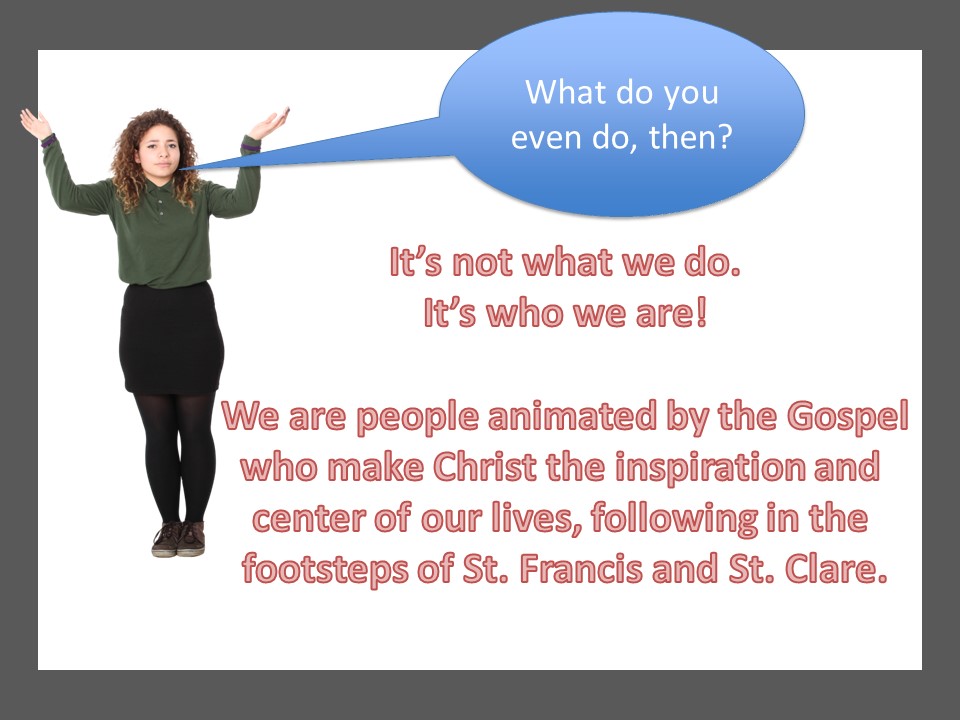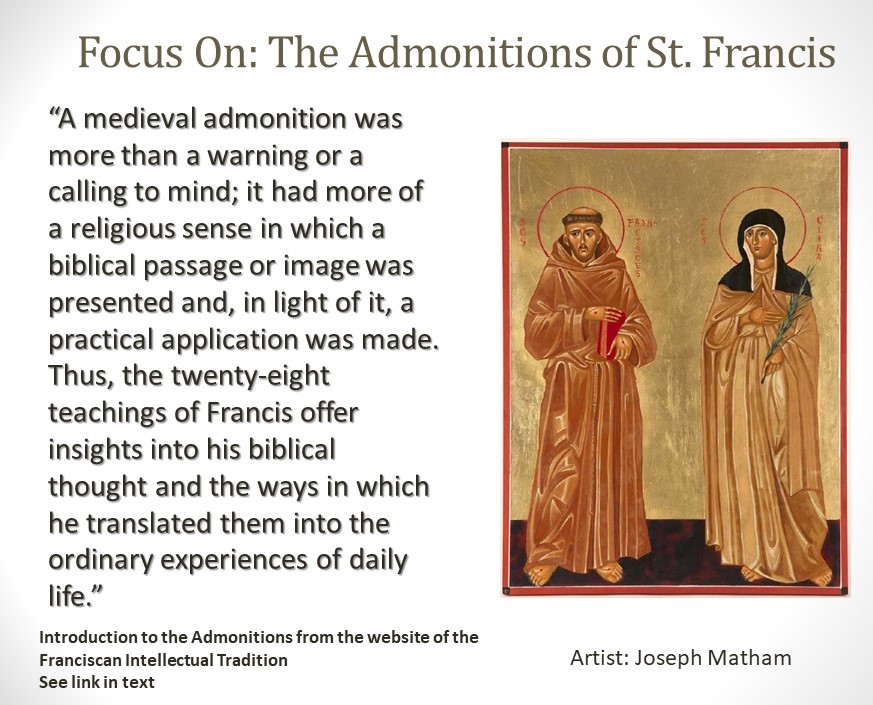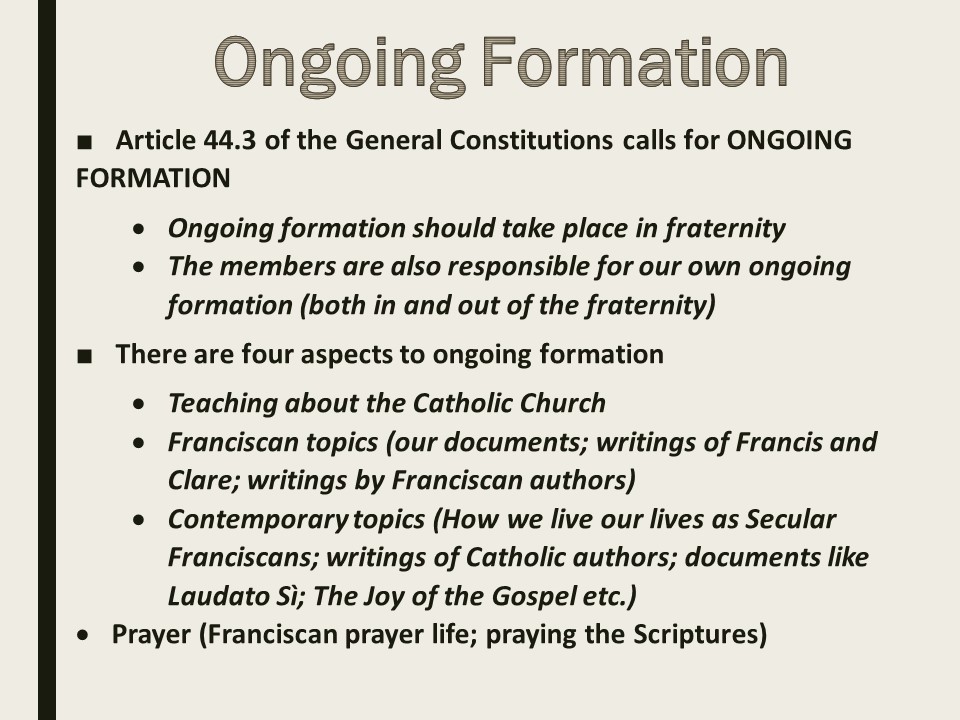
This week we look at Our Franciscan SpiritualityOur Franciscan Spirituality—comes from the spirituality of our founder, St. Francis of Assisi. Franciscan spirituality is incarnational, intensely Eucharistic, and penitential. We often hear the words “crib, cross, and Eucharist” when learning about St. Francis’s spirituality. Francis was in awe of the Incarnation, the Kénosis (self-emptying) shown by God in becoming one of us. His devotion to the Incarnation is most obvious in the recreation at Greccio of the birth of Christ. But it goes much deeper. Francis wanted to imitate Jesus perfectly in all things so that he too would become a son of the Father, so much so that he became known as the “mirror of Christ.”St. Francis’s constant contemplation of the cross is part of his devotion to the Incarnation. Here is God, who was not only born in a lowly manger, but God who was willing to die the worst, most humiliating death possible so that we could spend eternity with him. In order to imitate this death to self, Francis knew that penance and daily conversion (metanoia) were the only way to the Father. As he prayed on Mount La Verna, he asked two things: one, to let him experience the suffering Christ endured on the Holy Cross and two, for him to experience the love in which He did it. Francis’s prayer was granted as he was imprinted with the wounds of Christ in the Stigmata 8.And then, the Eucharist. Jesus is physically present with us every day under the appearances of bread and wine. We hear directly from Francis in the First Letter to the Custodians, “With all that is in me and more I beg you that, when it is fitting and you judge it expedient, you humbly beg the clergy to revere above all else the most holy Body and Blood of our Lord Jesus Christ and His holy names and the written words that sanctify His Body. 3They should hold as precious the chalices, corporals, appointments of the altar, and everything that pertains to the sacrifice. 4If the most holy Body of the Lord is very poorly reserved in any place, let It be placed and locked up in a precious place according to the command of the Church. Let It be carried about with great reverence and administered to others with discernment.”All of this is wrapped in Sacred Scripture. Francis gives us our spiritual focus. He lived by the words of the Gospel, and we imitate him in our reading and praying of and living out the gospel.Rule Article 4. “The rule and life of the Secular Franciscans is this: to observe the gospel of our Lord Jesus Christ by following the example of Saint Francis of Assisi, who made Christ the inspiration and the center of his life with God and people6. Christ, the gift of the Father’s love, is the way to him, the truth into which the Holy Spirit leads us, and the life which he has come to give abundantly7. Secular Franciscans should devote themselves, especially to careful reading of the gospel, going from gospel to life and life to the gospel.”Article 5. “Secular Franciscans, therefore, should seek to encounter the living and active person of Christ in their brothers and sisters, . The faith of Saint Francis, who often said “I see nothing bodily of the Most High Son of God in this world except his most holy body and blood”9, should be the inspiration and pattern of their eucharistic life.“Article 8. “As Jesus was the true worshipper of the Father, so let prayer and contemplation be the soul of all they are and do14. Let them participate in the sacramental life of the Church, above all the Eucharist. Let them join in liturgical prayer in one of the forms proposed by the Church, reliving the mysteries of the life of Christ.”For discussion or to answer in your journal.+What is the center of your Franciscan prayer life? How does this compare to Francis’s example?+After reading the articles of our Rule that talk of our Franciscan spirituality, what might you want to work toward changing or improving how you pray each day?+The Mass, the Gospel, the Liturgy of the Hours—reflect on how each of these fits into your prayer life. Share (or make note) of how they affect your relationship with Jesus and with others.+++++++++++++++++++++++++++++++++++++++++++Formation Friday 20 de mayo de 2022 Comparta con su fraternidad local¿Qué hace que los franciscanos seglares sean diferentes de otros católicos? (Cuarta parte)Esta semana nos fijamos en Nuestra Espiritualidad FranciscanaNuestra Espiritualidad Franciscana —viene de la espiritualidad de nuestro fundador, San Francisco de Asís. La espiritualidad franciscana es encarnacional, intensamente eucarística y penitencial. A menudo escuchamos las palabras “pesebre, cruz, y eucaristía” cuando aprendemos sobre la espiritualidad de San Francisco. Francisco estaba asombrado por la Encarnación, la Kénosis (desprendimiento de sí mismo) mostrada por Dios al convertirse en uno de nosotros. Su devoción a la Encarnación es más evidente en la recreación en Greccio del nacimiento de Cristo. Pero va mucho más profundo. Francisco quiso imitar perfectamente a Jesús en todas las cosas para que él también se convirtiera en hijo del Padre, tanto que llegó a ser conocido como el “espejo de Cristo.”La constante contemplación de la cruz de San Francisco es parte de su devoción a la Encarnación. Aquí está Dios, que no solo nació en un pesebre humilde, sino que estuvo dispuesto a morir de la peor y más humillante muerte posible para que pudiéramos pasar la eternidad con él. Para imitar esta muerte a sí mismo, Francisco sabía que la penitencia y la conversión diaria (metanoia) eran el único camino hacia el Padre. Mientras oraba en el monte La Verna, pidió dos cosas: una, que le permitiera experimentar el sufrimiento que Cristo soportó en la Santa Cruz y dos, que experimentara el amor con el que lo hizo. La oración de Francisco fue concedida ya que estaba impreso con las heridas de Cristo en los Estigmas.Y luego, la Eucaristía. Jesús está físicamente presente con nosotros todos los días bajo las apariencias de pan y vino. Escuchamos directamente de Francisco en la Primera Carta a los Custodios: “Con todo lo que hay en mí y más os ruego que, cuando os convenga y lo juzguéis conveniente, supliquéis humildemente al clero que reverencie sobre todas las cosas al santísimo Cuerpo y Sangre de nuestro Señor Jesucristo y Sus santos nombres y las palabras escritas que santifican Su Cuerpo. 3 Deben tener como preciosos los cálices, los corporales, los arreglos del altar y todo lo que pertenece al sacrificio. 4 Si el santísimo Cuerpo del Señor está muy pobremente reservado en algún lugar, que sea colocado y encerrado en un lugar precioso según el mandato de la Iglesia. Que se lleve con gran reverencia y se administre a otros con discernimiento.”Todo esto está envuelto en la Sagrada Escritura. Francisco nos da nuestro enfoque espiritual. Vivió de acuerdo con las palabras del Evangelio, y nosotros lo imitamos en nuestra lectura, oración, y vivencia del evangelio.Regla Artículo 4. “La Regla y la vida de los Franciscanos seglares es ésta: guardar el santo Evangelio de nuestro Señor Jesucristo siguiendo el ejemplo de San Francisco de Asís, que hizo de Cristo el inspirador y centro de su vida con Dios y con los hombres6.Cristo, don del amor del Padre, es el camino hacia Él, es la verdad en la cual nos introduce el Espíritu Santo, es la vida que Él ha venido a dar abundantemente7.Los Franciscanos seglares dedíquense asiduamente a la lectura del Evangelio, pasando del Evangelio a la vida y de la vida al Evangelio8.”Artículo 5. “Los Franciscanos seglares, pues, busquen la persona viviente y operante de Cristo en los hermanos, en la Sagrada Escritura, en la Iglesia y en las acciones litúrgicas. La fe de San Francisco que dictó estas palabras: “En este mundo nada veo corporalmente del mismo Altísimo Hijo de Dios sino su santísimo cuerpo y sangre”9, sea para ellos inspiración y guía de su vida eucarística.”Artículo 8. “Como Jesucristo fue el verdadero adorador del Padre, del mismo modo los Franciscanos seglares hagan de la oración y de la contemplación el alma del propio ser y del propio obrar14.Participen de la vida sacramental de la Iglesia, especialmente de la Eucaristía, y asóciense a la oración litúrgica en alguna de las formas propuestas por la misma Iglesia, reviviendo así los misterios de la vida de Cristo.”Para platicar o para responder en su diario.+¿Cuál es el centro de su vida de oración franciscana? ¿Cómo se compara esto con el ejemplo de Francisco?+Después de leer los artículos de nuestra Regla que hablan de nuestra espiritualidad franciscana, ¿en qué le gustaría trabajar para cambiar o mejorar su forma de orar cada día?+La Misa, el Evangelio, la Liturgia de las Horas: Reflexione sobre cómo cada uno de estos encaja en su vida de oración. Comparta (o tome nota) de cómo afectan su relación con Jesús y con los demás.Diane F. Menditto, OFSChair, National Formation Commission
Formation Director, Our Lady of the Angels Region
Formation Director, St. Francis Fraternity, Hackensack, NJ
Category: Formation Friday
FORMATION FRIDAY – What Makes OFS Different from Other Catholics? (Part 3) May 13, 2022
What Makes Secular Franciscans Different from Other Catholics? (Part Three)This week we look at Our RULE OF LIFE AND GENERAL CONSTITUTIONS.Our Rule and Constitutions—We Secular Franciscans are blessed to have a Rule of Life and Constitutions approved by the Church. These documents guide us in living out the Franciscan charism. We need to take the time to read the Rule frequently and pray about what the Prologue and each article tell us about our lives as Catholics and Franciscans. This is one of the big advantages we have over other Catholics. For example, since our prologue is taken from the First Letter to the Faithful, St. Francis himself is speaking directly to us when he reminds us that we are a people of penance and conversion.Chapter One of the Rule has only three articles, but it plants us firmly in the Franciscan family. It tells us that our Rule is approved by the Holy See and that we are linked down through the centuries to all those who have formed part of the three orders founded by St. Francis in the 13th century.Chapter Two contains articles four through nineteen. Here we find the plan of life set out for us as Secular Franciscans. We learn how we are to pray; how we are to we are to strive for daily conversion; how we are to follow in the footsteps of St. Francis in showing that the gospel can be lived; how we are to live in simplicity and humility; and how we are to reach out to all of our brothers and sisters and to all of creation. Having this portion of the Rule is especially valuable to us on our daily journey to the Father. It is an advantage that other Catholics just do not have.Chapter Three guides us in our fraternity life and tells us about the structure of our world-wide order and the purpose of our fraternity life.The General Constitutions form a much longer document because they interpret the Rule and tell us how we are to carry out what is asked in the Rule. This document is also approved by the Holy See, and in promising to follow the Rule, we also promise to follow what is laid out in the Constitutions.Here are the 17 essential elements of our Rule. The questions are to answer in your journal or to discuss with a partner.To live the gospel according to the spirit of St. FrancisTo be converted continually (metanoia)To live as brothers and sisters to all people and all creationTo live in communion with ChristTo follow the poor and crucified ChristTo share in the life and mission of the ChurchTo share in the love of the FatherTo be instruments of peaceTo have a life of prayer that is personal, communal and liturgicalTo live in joyTo have a spirituality of a secular characterTo be pilgrims on the way to the fatherTo participate in the Apostolate of the LaityTo be at the service of the less fortunateTo be loyal to the Church in an attitude of dialogue and collaboration with her ministersTo be open to the action of the SpiritTo live in simplicity, humility, and minority+Which of the elements of our Rule have helped you in your daily life as a Franciscan? Please explain how.+ Which of the elements are challenging for you? Why? How can you work to make them part of your life?+See if you can pinpoint which articles address each of the elements.++++++++++++++++++++++++++++++++++++Formation Friday 13 de mayo de 2022 Comparta con su fraternidad local.¿Qué hace que los franciscanos seglares sean diferentes de otros católicos? (Parte tres)Esta semana nos fijamos en nuestra REGLA DE VIDA Y CONSTITUCIONES GENERALES.Nuestra Regla y Constituciones— Nosotros, los Franciscanos Seglares, tenemos la bendición de tener una Regla de Vida y Constituciones aprobadas por la Iglesia . Estos documentos nos guían en la vivencia del carisma franciscano. Necesitamos tomarnos el tiempo para leer la Regla con frecuencia y orar sobre lo que el Prólogo y cada artículo nos dicen sobre nuestras vidas como católicos y franciscanos. Esta es una de las grandes ventajas que tenemos sobre otros católicos. Por ejemplo, dado que nuestro prólogo está tomado de la Primera Carta a los Fieles , el mismo San Francisco nos habla directamente cuando nos recuerda que somos un pueblo de penitencia y conversión.El Capítulo Primero de la Regla tiene sólo tres artículos, pero nos sitúa firmemente en la familia franciscana . Nos dice que nuestra Regla está aprobada por la Santa Sede y que estamos vinculados a lo largo de los siglos a todos los que han formado parte de las tres órdenes fundadas por San Francisco en el siglo XIII.El Capítulo Segundo contiene los artículos cuatro al diecinueve. Aquí encontramos el proyecto de vida trazado para nosotros como franciscanos seglares. Aprendemos cómo debemos orar; cómo debemos luchar por la conversión diaria; cómo hemos de seguir los pasos de San Francisco mostrando que el evangelio se puede vivir; cómo debemos vivir en sencillez y humildad; y cómo vamos a llegar a todos nuestros hermanos y hermanas ya toda la creación . Tener esta porción de la Regla es especialmente valioso para nosotros en nuestro camino diario hacia el Padre. Es una ventaja que otros católicos simplemente no tienen.El Capítulo Tres nos guía en nuestra vida de fraternidad y nos habla sobre la estructura de nuestro orden mundial y el propósito de nuestra vida de fraternidad.Las Constituciones Generales forman un documento mucho más largo porque interpretan la Regla y nos dicen cómo debemos llevar a cabo lo que se pide en la Regla. Este documento también está aprobado por la Santa Sede , y al prometer seguir la Regla, prometemos también seguir lo dispuesto en las Constituciones.Aquí están los 17 elementos esenciales de nuestra Regla. Las preguntas son para platicar o responder en su diario.Vivir el evangelio según el espíritu de san FranciscoSer convertido continuamente (metanoia)Vivir como hermanos y hermanas de todas las personas y de toda la creación.Vivir en comunión con CristoSeguir a Cristo pobre y crucificadoParticipar en la vida y misión de la IglesiaPara compartir el amor del PadreSer instrumentos de pazTener una vida de oración personal, comunitaria y litúrgicaVivir en la alegríaTener una espiritualidad de carácter secular.Ser peregrinos en el camino hacia el padrePara participar en el Apostolado de los LaicosEstar al servicio de los menos afortunadosSer fieles a la Iglesia en actitud de diálogo y colaboración con sus ministrosEstar abiertos a la acción del Espíritu Vivir en la sencillez, la humildad y la minoridad+¿Cuáles de los elementos de nuestra Regla te han ayudado en tu vida diaria como franciscano? Explique cómo.+ ¿Cuál de los elementos es un desafío para usted? ¿Por qué? ¿Cómo puede trabajar para que formen parte de su vida?+Vea si puede identificar qué artículos abordan cada uno de los elementos.Diane F. Menditto, OFSChair, National Formation Commission
Formation Director, Our Lady of the Angels Region
Formation Director, St. Francis Fraternity, Hackensack, NJ
FORMATION FRIDAY – What Makes Us Different? (Part 2) – May 6, 2022
What Makes Secular Franciscans Different from Other Catholics? (Part Two)Over the next few weeks, we will look at five things about Secular Franciscans that set us apart. This week we look at FRATERNITY.Our Fraternity Life—How can anyone be a Franciscan without fraternity? As much as St. Francis loved to find solitary places to pray, he always had friars nearby, and he always returned to fraternity life. He tells us, “The Lord gave me brothers…” (Testament)Article 24 of our OFS Rule speaks of fraternity: “To foster communion among members, the council should organize regular and frequent meetings of the community as well as meeting with other Franciscan groups, especially with youth groups. It should adopt appropriate means for growth in Franciscan and ecclesial life and encourage everyone to a life of fraternity. This communion continues with deceased brothers and sisters through prayer for them.”“Fraternity is…a call to build a community of love in harmony with all of God’s children and all of God’s creation to reflect Love back to the God of Love: Father, Son and Holy Spirit.” (FUN Manual “Fraternity and Francis” by Tom Bello, OFS—former National Minister)For most of us, our experience of fraternity comes at the local level. Although we find fraternity at the regional, national, and international levels, the local fraternity is the heartbeat of the Order. It is where we find mutual support in our faith. It is where we learn to carry out the promises we made at profession. Fraternity is like a workshop where we practice universal kinship; patience; humility; simplicity; and acceptance of others. It is where we keep our vocation alive. If fraternity life is well-lived, we will learn how to pray together and to work together to move the fraternity and the Church forward. We learn what it is to be a Franciscan by how we listen to one another, accept those who are different than we are, and by how we learn about the Franciscan charism together. Fraternity nourishes our vocation and helps us to bring the joy of knowing Christ to others both inside the fraternity and outside in our daily lives.The structure and flow of our gatherings can help us to achieve what is outlined above. Belonging to a club or attending a business meeting is (or should be) a very different experience from participating in a fraternity gathering. In fraternity, we pray together with one another and with the whole church. We strengthen our vocation by learning about the Franciscan charism and the gospel during our ongoing formation sessions; and we experience conversion of heart as we interact with our brothers and sisters and reach out to others through our apostolates. Fraternity life is a gift!For discussion or to answer in your journal+What is your favorite part of your local fraternity gathering? How does it strengthen your life as a Franciscan?+ What suggestions would you make to your local council to make your monthly gatherings even better? Be sure to tell why this would be valuable and how you would get it done.+Thinking about positive experiences you have had of fraternity (remember, fraternity is not only the monthly gathering, but it is found wherever Franciscans gather), list two or three and try to say why they had a special impact on you.+++++++++++++++++++Comparta con su fraternidad local¿Qué diferencia a los franciscanos seglares de otros católicos? (Segunda parte)Durante las próximas semanas, veremos cinco cosas sobre los franciscanos seglares que nos distinguen. Esta semana nos fijamos en la FRATERNIDAD .Nuestra vida de fraternidad: ¿Cómo se puede ser franciscano sin fraternidad? Por mucho que a San Francisco le encantaba encontrar lugares solitarios para orar, siempre tenía frailes cerca y siempre volvía a la vida de fraternidad . Nos dice: “El Señor me dio hermanos…” (Testamento )El artículo 24 de nuestra Regla OFS habla de fraternidad: “Para incrementar la comunión entre los miembros, el Consejo organice reuniones periódicas y encuentros frecuentes, incluso con otros grupos franciscanos, especialmente de jóvenes, adoptando los medios más adecuados para el crecimiento en la vida franciscana y eclesial, estimulando a todos a la vida de Fraternidad.Esta comunión se prolonga con los hermanos difuntos, ofreciendo sufragios por sus almas.”“ Fraternidad es… un llamado a construir una comunidad de amor en armonía con todos los hijos de Dios y toda la creación de Dios para reflejar el Amor hacia el Dios del Amor: Padre, Hijo y Espíritu Santo .” (Manual FUN “Fraternidad y Francisco” por Tom Bello, OFS—ex Ministro Nacional)Para la mayoría de nosotros, nuestra experiencia de fraternidad llega a nivel local. Aunque encontramos fraternidad a nivel regional, nacional e internacional, la fraternidad local es el latido del corazón de la Orden. Es donde encontramos apoyo mutuo en nuestra fe. Es donde aprendemos a cumplir las promesas que hicimos en la profesión. La fraternidad es como un taller donde practicamos el parentesco universal; paciencia; humildad; sencillez ; y aceptación de los demás. Es donde mantenemos viva nuestra vocación. Si la vida de fraternidad se vive bien, aprenderemos a orar juntos y a trabajar juntos para hacer avanzar la fraternidad y la Iglesia. Aprendemos lo que es ser franciscano por cómo nos escuchamos unos a otros, aceptamos a los que son diferentes a nosotros y por cómo aprendemos juntos sobre el carisma franciscano. La fraternidad alimenta nuestra vocación y nos ayuda a llevar la alegría de conocer a Cristo a los demás, tanto dentro como fuera de la fraternidad en nuestra vida cotidiana.La estructura y el flujo de nuestros encuentros pueden ayudarnos a lograr lo descrito anteriormente. Pertenecer a un club o asistir a una reunión de negocios es (o debería ser) una experiencia muy diferente a participar en una reunión de fraternidad. En fraternidad, rezamos juntos unos con otros y con toda la iglesia. Fortalecemos nuestra vocación aprendiendo sobre el carisma franciscano y el evangelio durante nuestras sesiones de formación continua; y experimentamos la conversión del corazón cuando interactuamos con nuestros hermanos y hermanas y nos acercamos a otros a través de nuestros apostolados. ¡La vida de fraternidad es un don de Dios!Para platicar o para responder en su diario+¿Cuál es su parte preferida del encuentro de su fraternidad local? ¿Cómo fortalece su vida como franciscano?+ ¿Qué sugerencias le haría a su consejo local para que sus encuentros mensuales sean aún mejores? Asegúrese de decir por qué esto sería valioso y cómo lo haría.+Pensando en experiencias positivas que haya tenido de fraternidad (recuerde, la fraternidad no es sólo el encuentro mensual, sino que se encuentra dondequiera que se reúnan los franciscanos), enumere dos o tres y trate de decir por qué tuvieron un impacto especial en usted.Diane F. Menditto, OFSChair, National Formation Commission
Formation Director, Our Lady of the Angels Region
Formation Director, St. Francis Fraternity, Hackensack, NJ
FORMATION FRIDAY – What Makes a Secular Franciscan Different from Other Catholics? (Part 1) – April 29, 2022
What Makes Secular Franciscans Different from Other Catholics? (Part One)All of us who are Catholics have many things in common. Most of us grew up attending Mass every Sunday. We go to confession every so often. We pray many of the same prayers: the Rosary, the Divine Mercy Chaplet, the Memorare, the Angelus, and prayers asking for the intercession of our favorite saints. Some Catholics read a bit of Scripture every day and attend bible study and some may even pray the Liturgy of the Hours.So, what makes Secular Franciscans different? Over the next few weeks, we will look at five things about Secular Franciscans that set us apart. (There may even be more than five, but we will tackle five.)1-OUR PROFESSION—At Baptism we receive the gifts of the Holy Spirit and become part of the Church. At Confirmation, the Holy Spirit prepares us to participate fully in the mission of the Church. Profession, then, is our special opportunity. It is the further strengthening of the promises that were made for us (or that we made) at Baptism. Through the Spirit, we “bind ourselves more closely to the Church and work intently to rebuild the ecclesial community and fulfill its mission among all people.” (See Rite of Profession, Ritual p. 22)If you read the Rite of Profession (Ritual pp. 18-26), you will see that at Profession, we make a commitment to live the Gospel by following in the footsteps of St. Francis. The special charism given to us by St. Francis is that he showed that the Gospel can be lived. We, as Secular Franciscans, strive to do this in our daily lives. Therefore, we need to be thoroughly familiar with Scripture—especially the Gospels. At the Rite of Profession, we are presented with the book of the Gospels. At the Ceremony of Introduction and Welcoming, we are given a biography of St. Francis, and at the Rite of Admission, we are given a copy of the Rule of Life. All three of these gifts remind us that we are to internalize how St. Francis lived; how Jesus lived and taught; and how we are to live as Secular Franciscans.At Profession, we promise to build a more fraternal and evangelical world based on the Gospel. We promise to be faithful to our vocation and to practice the spirit of service. We promise to bind ourselves more closely to the Church and to participate more fully in her mission. And, we pledge to make fraternity a visible sign of the Church, a community of faith and love. During the Rite of Profession, the candidates answer, “Yes, this is what I want,” in response to questions asked regarding these promises.Read and consider the following words taken from the Rite of Profession:+ The candidates say: “We ask to be admitted to profession of the Rule of the Secular Franciscan Order and to make a permanent commitment to the gospel life. [Our formation] has strengthened us in the conviction that the Lord is calling us to observe the holy gospel of Our Lord Jesus Christ by following the footsteps of St. Francis of Assisi.” (Ritual p. 20)+ Finally, the WORDS OF PROFESSION are pronounced by the candidates:“I, __ , by the grace of God, renew my baptismal promises and consecrate myself to the service of his Kingdom. Therefore, in my secular state, (or as a member of the diocesan clergy), I promise to live all the days of my life the gospel of our Lord Jesus Christ in the /secular Franciscan Order by observing its rule of life. May the grace of the Holy Spirit, the intercession of the Blesses Virgin Mary and our holy father St. Francis, and the fraternal bonds of community always be my help, so that I may reach the goal of perfect Christian love.”For discussion or to answer in your journal:+After reading the promises of profession outlined above, discuss the ways in which you (if you are professed) are living them out in your daily life. (It would also be helpful to read the entire Rite on pp. 18-26 of the brown ritual.)+Which of these promises have proved to be challenging to you?+If you are in initial formation, 1-How do you see these promises lived out by the members of your fraternity? 2-Can you picture yourself living out these promises? 3-Please offer a few examples of what you would do both now and after Profession.++++++++++++++++++++++Formation Friday 29 de abril de 2022Comparta con su fraternidad local¿Qué diferencia a los franciscanos seglares de otros católicos?Todos los que somos católicos tenemos muchas cosas en común. La mayoría de nosotros crecimos asistiendo a misa todos los domingos. Nos confesamos de vez en cuando. Rezamos muchas de las mismas oraciones: el Rosario, la Coronilla de la Divina Misericordia, el Memorare (Acordaos), el Ángelus y oraciones pidiendo la intercesión de nuestros santos favoritos. Algunos católicos leen un poco de las Escrituras todos los días y asisten a estudios bíblicos y algunos incluso pueden rezar la Liturgia de las Horas.Entonces, ¿qué hace que los franciscanos seglares sean diferentes? Durante las próximas semanas, veremos cinco cosas sobre los franciscanos seglares que nos distinguen. (Incluso puede haber más de cinco, pero abordaremos cinco).1- NUESTRA PROFESIÓN —En el Bautismo recibimos los dones del Espíritu Santo y nos hacemos parte de la Iglesia. En la Confirmación, el Espíritu Santo nos prepara para participar plenamente en la misión de la Iglesia. La profesión, entonces, es nuestra oportunidad especial. Es el fortalecimiento adicional de las promesas que se nos hicieron (o que hicimos) en el Bautismo. A través del Espíritu, “nos vinculamos más estrechamente a la Iglesia y trabajamos intensamente para reconstruir la comunidad eclesial y cumplir su misión entre todos los pueblos.” (Ver Rito de Profesión, Ritual p. 22 )Si lee el Rito de la Profesión ( Ritual pp. 18-26 ), verá que en la Profesión nos comprometemos a vivir el Evangelio siguiendo los pasos de San Francisco . El carisma especial que nos dio San Francisco es que mostró que el Evangelio se puede vivir. Nosotros, como franciscanos seglares, nos esforzamos por hacer esto en nuestra vida diaria. Por lo tanto, debemos estar completamente familiarizados con las Escrituras, especialmente con los Evangelios. En el Rito de Profesión, se nos presenta el libro de los Evangelios. En la Ceremonia de Introducción y Bienvenida se nos entrega una biografía de San Francisco, y en el Rito de Admisión se nos entrega una copia de la Regla de Vida. Estos tres obsequios nos recuerdan que debemos internalizar cómo vivió San Francisco; cómo Jesús vivió y enseñó; y cómo debemos vivir como franciscanos seglares.En la Profesión nos comprometemos a construir un mundo más fraterno y evangélico basado en el Evangelio. Prometemos ser fieles a nuestra vocación y practicar el espíritu de servicio . Prometemos vincularnos más estrechamente a la Iglesia y participar más plenamente en su misión. Y nos comprometemos a hacer la fraternidad signo visible de la Iglesia , comunidad de fe y de amor. Durante el Rito de Profesión, los candidatos responden: “Sí, esto es lo que quiero,” en respuesta a las preguntas formuladas con respecto a estas promesas.Lea y considere las siguientes palabras tomadas del Rito de Profesión:+ Los candidatos dicen : “Pedimos ser admitidos a la profesión de la Regla de la Orden Franciscana Seglar y hacer un compromiso permanente con la vida evangélica. [Nuestra formación] nos ha fortalecido en la convicción de que el Señor nos está llamando a observar el santo evangelio de Nuestro Señor Jesucristo siguiendo los pasos de San Francisco de Asís”. (Ritual pág. 20)+ Finalmente, las PALABRAS DE PROFESIÓN son pronunciadas por los candidatos :“Yo, _ _ , por la gracia de Dios, renuevo mis promesas bautismales y me consagro al servicio de su Reino. Por lo tanto, en mi estado seglar (o como miembro del clero diocesano), prometo vivir todos los días de mi vida el evangelio de nuestro Señor Jesucristo en la Orden Franciscana seglar observando su regla de vida. Que la gracia del Espíritu Santo, la intercesión de la Santísima Virgen María y de nuestro santo padre San Francisco, y los lazos fraternales de comunidad sean siempre mi ayuda, para que pueda alcanzar la meta del perfecto amor cristiano”.Para discusión o para responder en su diario:+ Después de leer las promesas de profesión descritas anteriormente, discuta las formas en que usted (si es profeso) las está viviendo en su vida diaria. (También sería útil leer todo el Rito en las páginas 18-26 del ritual marrón).+ ¿Cuál de estas promesas ha resultado ser un desafío para usted?+ Si está en formación inicial , 1-¿Cómo ve estas promesas vividas por los miembros de su fraternidad? 2-¿Puede imaginarse viviendo estas promesas? 3-Por favor, ofrezca algunos ejemplos de lo que haría tanto ahora como después de la Profesión.Diane F. Menditto, OFSChair, National Formation Commission
Formation Director, Our Lady of the Angels Region
Formation Director, St. Francis Fraternity, Hackensack, NJ
FORMATION FRIDAY – WRITINGS OF FRANCIS & CLARE – April 22, 2022
On Friday, April 22nd, 2022 at 8:11 PM, Juan dePadilla <juandepadillaregion.ofs@gmail.com> wrote:
Formation Friday April 22, 2020Please share with your local fraternity (en español abajo)It is important that we get to know the many writings left to us by our founder. Franciscans are blessed to have many of St. Francis’s and St. Clare’s writings. By reading what they wrote, and praying as they prayed, we allow the Holy Spirit to strengthen our vocation and how we live the Franciscan Charism.In 1224, after St. Francis had received the Sacred Stigmata on Mt. La Verna, he wrote the Praises of God. These are in his own handwriting. On the other side of that parchment, Francis wrote the Blessing for Bro. Leo who was with him on Mt. Laverna. (See graphic). You can read further background on this writing and read all the early documents at the link below.The Praises of God1You are the holy Lord God Who does wonderful things. Ps 77:15 [Vulgate, Ps 76:15] a2You are strong. You are great. Ps 86:10 [Vulgate, Ps 85:10] You are the most high.You are the almighty king. You holy Father, Jn 17:11King of heaven and earth. Mt 11:253You are three and one, the Lord God of gods; Ps 136:2 [Vulgate, Ps 135:2]You are the good, all good, the highest good,Lord God living and true. 1 Thes 1:94You are love, charity; You are wisdom, You are humility,You are patience, You are beauty, You are meekness, Ps 71:5 [Vulgate, Ps 70:5]You are security, You are rest,You are gladness and joy, You are our hope, You are justice,You are moderation, You are all our riches to sufficiency.5You are beauty, You are meekness,You are the protector, Ps 31:5 [Vulgate, Ps 30:5] You are our custodian and defender,You are strength, Ps 43:2 [Vulgate, Ps 42:2] You are refreshment. 6You are our hope,You are our faith, You are our charity,You are all our sweetness, You are our eternal life:Great and wonderful Lord, Almighty God, Merciful Savior.Please read the praises above. Read through once. Then prayerfully consider each word and sentence a second time.• What do the words and phrases that St. Francis wrote about God tell you about his relationship with Him?• Choose four words or phrases that touch you deeply. Spend some time thinking about why you chose those words.• How do these ideas about God reflect your personal relationship with Him?• How do these ideas inspire you to make changes in your own life in order to strengthen your relationship with God?• Personal challenge: In this season of rejoicing, choose a particular way you can strengthen your relationship with God. See if you can carry it out this week.+++++++++++++++++Formation Friday 22 de abril, 2022Por favor compartir con su fraternidad localEs importante que conozcamos los muchos escritos que nos dejó nuestro fundador. Los franciscanos tienen la bendición de tener muchos de los escritos de San Francisco y Santa Clara. Al leer lo que escribieron y orar como ellos oraron, permitimos que el Espíritu Santo fortalezca nuestra vocación y cómo vivimos el carisma franciscano.En 1224, después de que San Francisco recibió los Sagrados Estigmas en el Monte La Verna, escribió las ALABANZAS DEL DIOS ALTÍSIMO. Estos son de su puño y letra. En el otro lado de ese pergamino, Francisco escribió la Bendición para el Hno. Leo que estaba con él en el monte Laverna. Puede leer más antecedentes sobre este escrito y leer todos los primeros documentos en el siguiente enlace:Alabanzas del dios altísimoTú eres santo, Señor Dios único, que haces maravillas.Tú eres fuerte, tú eres grande, tú eres altísimo, tú eres rey omnipotente, tú, Padre santo, rey del cielo y de la tierra.Tú eres trino y uno, Señor Dios de dioses, tú eres el bien, todo el bien, el sumo bien, Señor Dios vivo y verdadero.Tú eres amor, caridad; tú eres sabiduría, tú eres humildad, tú eres paciencia, tú eres belleza, tú eres mansedumbre, tú eres seguridad, tú eres quietud, tú eres gozo, tú eres nuestra esperanza y alegría, tú eres justicia, tú eres templanza, tú eres toda nuestra riqueza a satisfacción.Tú eres belleza, tú eres mansedumbre; tú eres protector, tú eres custodio y defensor nuestro; tú eres fortaleza, tú eres refrigerio.Tú eres esperanza nuestra, tú eres fe nuestra, tú eres caridad nuestra, tú eres toda dulzura nuestra, tú eres vida eterna nuestra: Grande y admirable Señor, Dios omnipotente, misericordioso Salvador.Por favor, lea las alabanzas de arriba. Léalas una vez. Luego, en oración, considere cada palabra y oración por segunda vez.• ¿Qué le dicen las palabras y frases que San Francisco escribió sobre Dios acerca de su relación con Él?• Elija cuatro palabras o frases que te conmuevan profundamente. Dedique algo de tiempo a pensar por qué eligió esas palabras.• ¿Cómo reflejan estas ideas acerca de Dios su relación personal con Él?• ¿Cómo le inspiran estas ideas a hacer cambios en su propia vida para fortalecer su relación con Dios?• Desafío personal: En esta temporada de regocijo, elija una manera particular en la que pueda fortalecer su relación con Dios. A ver si puede llevarlo a cabo esta semana.Diane F. Menditto, OFSChair, National Formation Commission
Formation Director, Our Lady of the Angels Region
Formation Director, St. Francis Fraternity, Hackensack, NJ