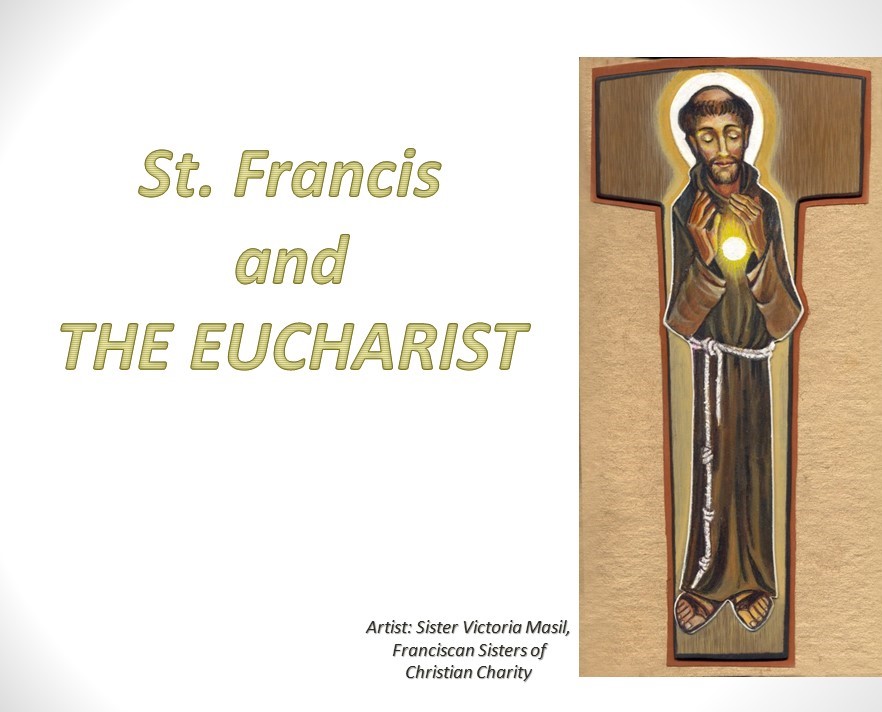
Since July is the month of the Precious Blood, and we are also celebrating the three-year Eucharistic Revival, we repeat some of our previous posts on the Eucharist this month.
St. Francis centered his life and spirituality on the Incarnation, the humanity of Christ. He was in awe that God “bent down” to be with us through his birth; through his suffering and death on the cross; and through the Eucharist by which he remains with us for all time.
“26Let everyone be struck with fear, let the whole world tremble, and let the heavens exult when Christ, the Son of the living God, is present on the altar in the hands of a priest. 27O wonderful loftiness and stupendous dignity! O sublime humility! O humble sublimity! The Lord of the universe, God and the Son of God, so humbles Himself that for our salvation He hides Himself under an ordinary piece of bread! 28Brothers, look at the humility of God, and pour out your hearts before Him! Ps 62:9 [Vulgate, Ps 61:9] Humble yourselves that you may be exalted by Him! 1 Pt 5:6 Jas 4:10 29Hold back nothing of yourselves for yourselves, that He Who gives Himself totally to you may receive you totally!” (A Letter to the Entire Order: FA:ED, vol. 1, p. 118)
“10And I act in this way because, in this world, I see nothing corporally of the most high Son of God except His most holy Body and Blood which they receive and they alone administer to others. 11I want to have these most holy mysteries honored and venerated above all things and I want to reserve them in precious places.” (The Testament: FA:ED, vol. 1, p. 125)
“ 2With all that is in me and more I beg you that, when it is fitting and you judge it expedient, you humbly beg the clergy to revere above all else the most holy Body and Blood of our Lord Jesus Christ…” (The First Letter to the Custodians (1220): FA:ED, vol. 1, p. 56)
“I implore all of you brothers to show all possible reverence and honor to the most holy Body and Blood of our Lord Jesus Christ 13in Whom that which is in heaven and on earth has been brought to peace and reconciled to almighty God.” Col 1:20
(A Letter to the Entire Order: FA:ED, vol. 1, p. 117)“This is my Body and the Blood of my new covenant [which will be shed for many] ;{snippet Mk 14:22} 11 and Whoever eats my flesh and drinks my blood has eternal life .{snippet Mk 14:24} 12 It is the Spirit of the Lord,{snippet Jn 6:55} therefore, That lives in Its faithful, That receives the Body and Blood of the Lord. 13 All others who do not share in this same Spirit and presume to receive Him eat and drink judgment on themselves .{snippet 1 Cor 11:29}”(The Admonitions: FA:ED, vol. 1, p. 129)
“We must, of course, confess all our sins to a priest and receive the Body and Blood of our Lord Jesus Christ from him. b 23 Whoever does not eat His flesh and drink His blood cannot enter the kingdom of God .{snippet Jn 6:54} {snippet J… (Later Admonition and Exhortation: FA:ED, vol. 1, p. 47)
“Francis speaks most often about the Eucharist, even more than about poverty. For him, the Eucharist is not only a mystery, a sacrament, it is a living person: it is Christ completely given into the hands of a man, fragile and defenseless, just as he was in Bethlehem. From this come his tender feelings for everything to do with the Sacrament of the altar, and his preoccupation with the dignity and cleanliness of the church and sacred vessels.” (Raniero Cantalamessa, O.F.M. Cap “It Is Not Good For Man to Be Alone”: Clare and Francis: CA:ED, p. 11)
A good video by Bishop Barron on the Eucharist:
https://www.youtube.com/watch?v=sgy_TFeIyiM&t=126s (Real Presence)
Visit the Eucharistic Revival website: https://www.eucharisticrevival.org/
Questions for discussion or to answer in your journal.
Read and think about the quotes above. As you think about what St. Francis said (and what was said about his devotion to the Eucharist) consider your own feelings about the Eucharist.
+Why is the Eucharist important to you as a Catholic? As a Franciscan?
+How do you prepare to receive the Body and Blood of Christ?
+How is the Eucharist tied to our Franciscan spirituality?
+Where is the Eucharist mentioned in the OFS Rule? (Also refer to the Prologue)+++++++++++++++++++++
San Francisco y la Eucaristía
Dado que julio es el mes de la Preciosa Sangre, y también estamos celebrando el Avivamiento Eucarístico de tres años, repetimos algunas de nuestras publicaciones anteriores sobre la Eucaristía este mes.
San Francisco centró su vida y espiritualidad en la Encarnación, la humanidad de Cristo. Estaba asombrado de que Dios “se inclinara” para estar con nosotros por su nacimiento; por su sufrimiento y muerte en la cruz; y a través de la Eucaristía por la que permanece con nosotros para siempre.
http://franciscanos.org/esfa/menud2.html
26¡Tiemble el hombre entero, que se estremezca el mundo entero, y que el cielo exulte, cuando sobre el altar, en las manos del sacerdote, está Cristo, el Hijo del Dios vivo (Jn 11,27)! 27¡Oh admirable celsitud y asombrosa condescendencia! ¡Oh humildad sublime! ¡Oh sublimidad humilde, pues el Señor del universo, Dios e Hijo de Dios, de tal manera se humilla, que por nuestra salvación se esconde bajo una pequeña forma de pan! 28Ved, hermanos, la humildad de Dios y derramad ante él vuestros corazones (Sal 61,9); humillaos también vosotros para que seáis ensalzados por él (cf. 1 Pe 5,6; Sant 4,10). 29Por consiguiente, nada de vosotros retengáis para vosotros, a fin de que os reciba todo enteros el que se os ofrece todo entero. (Carta a toda la Orden http://franciscanos.org/esfa/ctao.html )
10Y lo hago por esto, porque nada veo corporalmente en este siglo del mismo altísimo Hijo de Dios, sino su santísimo cuerpo y su santísima sangre, que ellos reciben y ellos solos administran a los otros. 11Y quiero que estos santísimos misterios sean sobre todas las cosas honrados, venerados y colocados en lugares preciosos. 1 (El Testamento http://franciscanos.org/esfa/teste.html )
2Os ruego, más que si se tratara de mí mismo, que, cuando os parezca bien y veáis que conviene, supliquéis humildemente a los clérigos que veneren sobre todas las cosas el santísimo cuerpo y sangre de nuestro Señor Jesucristo…
(Carta a los Custodios http://franciscanos.org/esfa/ctacus.html )10…como lo atestigua el mismo Altísimo, que dice: Esto es mi cuerpo y mi sangre del nuevo testamento, [que será derramada por muchos] (cf. Mc 14,22.24); 11y: Quien come mi carne y bebe mi sangre, tiene vida eterna (cf. Jn 6,55). 12De donde el espíritu del Señor, que habita en sus fieles, es el que recibe el santísimo cuerpo y sangre del Señor. 13Todos los otros que no participan del mismo espíritu y se atreven a recibirlo, comen y beben su condenación (cf. 1 Cor 11,29).
(Admoniciones http://franciscanos.org/esfa/adm-ae.html )22Ciertamente debemos confesar al sacerdote todos nuestros pecados; y recibamos de él el cuerpo y la sangre de nuestro Señor Jesucristo. 23Quien no come su carne y no bebe su sangre (cf. Jn 6,55. 57), no puede entrar en el reino de Dios (Jn 3,5). (Carta a los fieles II http://franciscanos.org/esfa/ctaf2.html )
“Francisco habla más a menudo de la Eucaristía, incluso más que de la pobreza. Para él, la Eucaristía no es solo un misterio, un sacramento, es una persona viva: es Cristo entregado por completo en manos de un hombre, frágil e indefenso, como lo fue en Belén. De ahí su ternura por todo lo que tiene que ver con el sacramento del altar, y su preocupación por la dignidad y limpieza de la iglesia y los vasos sagrados ”. (Raniero Cantalamessa, O.F.M. Cap “It Is Not Good For Man to Be Alone”: Clare and Francis: CA:ED, p. 11)
Un buen video (en inglés) del obispo Barron sobre la Eucaristía:
https://www.youtube.com/watch?v=sgy_TFeIyiM&t=126s (Presencia real)
Visite el sitio del Avivamiento Eucarístico: https://es.eucharisticrevival.org/Preguntas para platicar o para responder en su diario
Lea y piense en las citas anteriores. Al pensar en lo que dijo San Francisco (y lo que se dijo sobre su devoción a la Eucaristía), considere sus propios sentimientos sobre la Eucaristía.
+ ¿Por qué la Eucaristía es importante para usted como católico? ¿Como franciscano?
+ ¿Cómo se prepara para recibir el Cuerpo y la Sangre de Cristo?
+ ¿Cómo está ligada la Eucaristía a nuestra espiritualidad franciscana?
+ ¿Dónde se menciona la Eucaristía en la Regla OFS? (consulte también el Prólogo)
Diane F. Menditto, OFSVice Minister, National Fraternity, Secular Franciscan Order USAListen – Discern – Go Forth National Theme 2022-2025
Category: Formation Friday

Formation Friday July 7, 2023 – Admonition #1 The Body of Christ–St. Francis of Assisi
Since July is the month of the Precious Blood, and we are also celebrating the three-year Eucharistic Revival, we repeat some of our previous posts on the Eucharist this month.
[I. The Body of Christ]1The Lord Jesus says to his disciples: I am the way, the truth and the life; no one comes to the Father except through me. 2If you knew me, you would also know my Father; and from now on, you do know him and have seen him. 3Philip says to him: Lord, show us the Father and it will be enough for us. 4Jesus says to him: Have I been with you for so long a time and you have not known me? Philip, whoever sees me sees my Father as well. Jn 14:6-9
5The Father dwells in inaccessible light, 1 Tm 6:16 and God is spirit, Jn 4:24 and no one has ever seen God. Jn 1:18 6Therefore He cannot be seen except in the Spirit because it is the Spirit that gives life; the flesh has nothing to offer. Jn 6:63 7But because He is equal to the Father, the Son is not seen by anyone other than the Father or other than the Holy Spirit.
8All those who saw the Lord Jesus according to the humanity, therefore, and did not see and believe according to the Spirit and the Divinity that He is the true Son of God were condemned. 9Now in the same way, all those who see the sacrament sanctified by the words of the Lord upon the altar at the hands of the priest in the form of bread and wine, and who do not see and believe according to the Spirit and the Divinity that it is truly the Body and Blood of our Lord Jesus Christ, are condemned.10[This] is affirmed by the Most High Himself Who says:
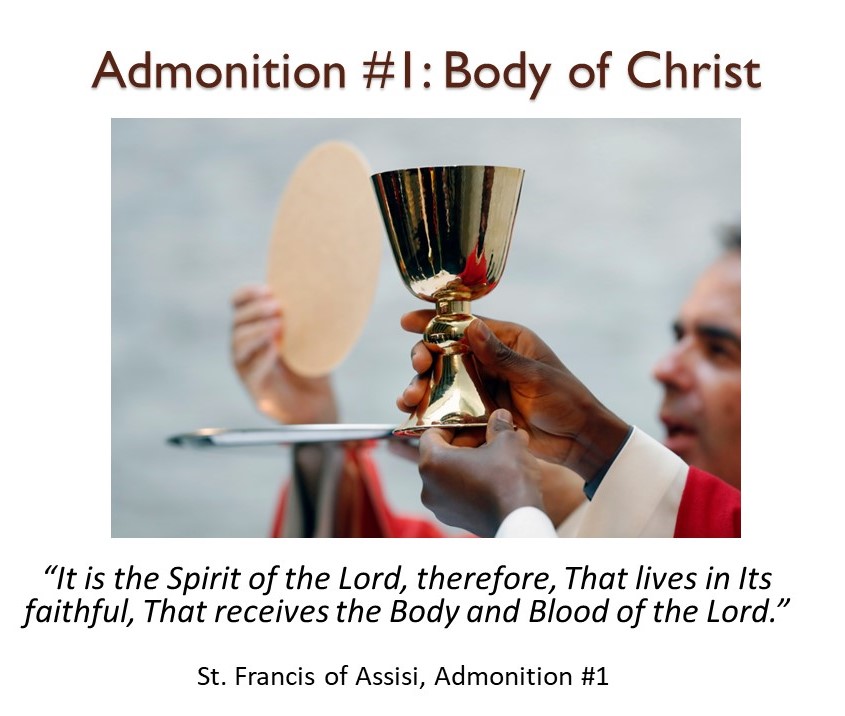
This is my Body and the Blood of my new covenant [which will be shed for many]; Mk 14:22 11and Whoever eats my flesh and drinks my blood has eternal life. Mk 14:24 12It is the Spirit of the Lord, Jn 6:55 therefore, That lives in Its faithful, That receives the Body and Blood of the Lord. 13All others who do not share in this same Spirit and presume to receive Him eat and drink judgment on themselves. 1 Cor 11:29
14Therefore: children, how long will you be hard of heart? Ps 4:3 15Why do you not know the truth and believe in the Son of God? Jn 9:35 16Behold, each day He humbles Himself as when He came from the royal throne Phil 2:8 into the Virgin’s womb; Wis 18:15 17each day He Himself comes to us, appearing humbly; 18each day He comes down from the bosom of the Father Jn 1:18 upon the altar in the hands of a priest.a
19As He revealed Himself to the holy apostles in true flesh, so He reveals Himself to us now in sacred bread. 20And as they saw only His flesh by an insight of their flesh, yet believed that He was God as they contemplated Him with their spiritual eyes, 21let us, as we see bread and wine with our bodily eyes, see and firmly believe that they are His most holy Body and Blood living and true. 22And in this way the Lord is always with His faithful, as He Himself says: Behold I am with you until the end of the age.
Questions to discuss or to answer in your journal
+ After reading this admonition carefully, note what Francis’s feelings are about the Eucharist.
+What do you believe about the Eucharist? What part does receiving the Eucharist play in your spiritual life?
https://www.franciscantradition.org/francis-of-assisi-early-documents/the-saint/writings-of-francis/the-undated-writings/the-admonitions/144-fa-ed-1-page-128
A good video by Bishop Barron on the Eucharist:
https://www.youtube.com/watch?v=sgy_TFeIyiM&t=126s (Real Presence)
Visit the Eucharistic Revival website: https://www.eucharisticrevival.org/
Julio es el mes de la Preciosa Sangre de Cristo—Admonición #1 de San Francisco
Dado que julio es el mes de la Preciosa Sangre, y también estamos celebrando el Avivamiento Eucarístico de tres años, repetimos algunas de nuestras publicaciones anteriores sobre la Eucaristía este mes.
Cap. I: Del cuerpo del Señor
1Dice el Señor Jesús a sus discípulos: Yo soy el camino, la verdad y la vida; nadie va al Padre sino por mí. 2Si me conocierais a mí, ciertamente conoceríais también a mi Padre; y desde ahora lo conoceréis y lo habéis visto. 3Le dice Felipe: Señor, muéstranos al Padre y nos basta. 4Le dice Jesús: ¿Tanto tiempo hace que estoy con vosotros y no me habéis conocido? Felipe, el que me ve a mí, ve también a mi Padre (Jn 14,6-9).
5El Padre habita en una luz inaccesible (cf. 1 Tim 6,16), y Dios es espíritu (Jn 4,24), y a Dios nadie lo ha visto jamás (Jn 1,18). 6Por eso no puede ser visto sino en el espíritu, porque el espíritu es el que vivifica; la carne no aprovecha para nada (Jn 6,64). 7Pero ni el Hijo, en lo que es igual al Padre, es visto por nadie de otra manera que el Padre, de otra manera que el Espíritu Santo.
8De donde todos los que vieron al Señor Jesús según la humanidad, y no vieron y creyeron según el espíritu y la divinidad que él era el verdadero Hijo de Dios, se condenaron. 9Así también ahora, todos los que ven el sacramento, que se consagra por las palabras del Señor sobre el altar por mano del sacerdote en forma de pan y vino, y no ven y creen, según el espíritu y la divinidad, que sea verdaderamente el santísimo cuerpo y sangre de nuestro Señor Jesucristo, se condenan, 10como lo atestigua el mismo Altísimo, que dice: Esto es mi cuerpo y mi sangre del nuevo testamento, [que será derramada por muchos] (cf. Mc 14,22.24); 11y: Quien come mi carne y bebe mi sangre, tiene vida eterna (cf. Jn 6,55). 12De donde el espíritu del Señor, que habita en sus fieles, es el que recibe el santísimo cuerpo y sangre del Señor. 13Todos los otros que no participan del mismo espíritu y se atreven a recibirlo, comen y beben su condenación (cf. 1 Cor 11,29).
14De donde: Hijos de los hombres, ¿hasta cuándo seréis de pesado corazón? (Sal 4,3). 15¿Por qué no reconocéis la verdad y creéis en el Hijo de Dios? (cf. Jn 9,35). 16Ved que diariamente se humilla (cf. Fil 2,8), como cuando desde el trono real (Sab 18,15) vino al útero de la Virgen; 17diariamente viene a nosotros él mismo apareciendo humilde; 18diariamente desciende del seno del Padre (cf. Jn 1,18) sobre el altar en las manos del sacerdote.
19Y como se mostró a los santos apóstoles en carne verdadera, así también ahora se nos muestra a nosotros en el pan sagrado. 20Y como ellos, con la mirada de su carne, sólo veían la carne de él, pero, contemplándolo con ojos espirituales, creían que él era Dios, 21así también nosotros, viendo el pan y el vino con los ojos corporales, veamos y creamos firmemente que es su santísimo cuerpo y sangre vivo y verdadero. 22Y de este modo siempre está el Señor con sus fieles, como él mismo dice: Ved que yo estoy con vosotros hasta la consumación del siglo (cf. Mt 28,20).
https://www.franciscanos.org/esfa/escritossf.html#adm
Preguntas para discutir o responder en su diario
+ Después de leer esta Admonición con atención, apunte cuáles son los sentimientos de Francisco sobre la Eucaristía.
+ ¿Qué cree usted sobre la Eucaristía? ¿Qué papel juega el recibir la Eucaristía en su vida espiritual?
Un buen video (en inglés) del obispo Barron sobre la Eucaristía:
https://www.youtube.com/watch?v=sgy_TFeIyiM&t=126s (Presencia real)
Visite el sitio del Avivamiento Eucarístico: https://es.eucharisticrevival.org/Diane F. Menditto, OFSVice Minister, National Fraternity, Secular Franciscan Order USAListen – Discern – Go Forth National Theme 2022-2025
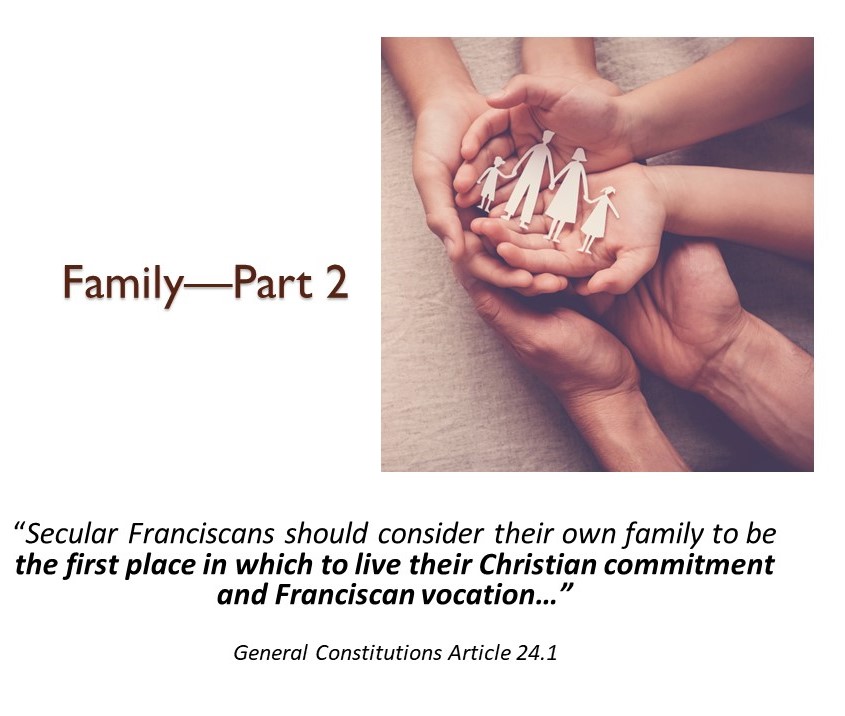
Formation Friday June 30, 2023 – JPIC for Secular Franciscans: Family—Part 2
Prepared by Francine Gikow, OFS, member National Formation Commission, OFS USA
Last week we began our exploration about the place of Family–a part of JPIC in our Secular Franciscan life. We began by defining some characteristics of “family” and our unique role in Christ’s mission for the family, since we are secular and lay. We will further explore our Rule and Constitutions as we consider our own families and apply what we have learned in our everyday life.
To recap, our Rule states: “In their family, they should cultivate the Franciscan spirit of peace, fidelity, and respect for life, striving to make it a sign of a world already renewed. By living the grace of matrimony, husbands and wives in particular should bear witness in the world to the love of Christ for His Church. They should joyfully accompany their children on their human and spiritual journey by providing a simple and open Christian education and being attentive to the vocation of each child.”
Our General Constitutions expand this idea in Article 24.1 which states: Secular Franciscans should consider their own family to be the first place in which to live their Christian commitment and Franciscan vocation. The Constitutions then expand this idea by stating:
· “They should make space within it for prayer; for the Word of God, and for Christian catechesis.
· They should concern themselves with respect for life in every situation from conception until death.
· Married couples find in the Rule…an effective aid in their own journey of Christian life, that, in the sacrament of matrimony, their love shares in the love that Christ has for His Church
· The way spouses love each other and affirm the value of fidelity is a profound witness for their own family, the Church, and the world.”
The Constitutions (Art. 24.2 and 3) continue on to point out ways that in fraternity we might want to:
· explore the spirituality of the family, marriage and the Christian attitude toward dialog, sharing experiences and family problems.
· share important moments of family life with each other and by giving special attentions to widows, singles, single parents, separated, divorced and those living in difficult situations.
· dialog between generations
· form groups for single and married families to support each other in Catholic living.
All this should be done in collaboration with the Church to affirm the value of fidelity and respect for life and offer solutions to family social problems. (GC: Art. 24.3) Finally, children should be educated and formed into living, active People of God, and with the help of organizations (such as YOU-FRA), and they should be given knowledge and a love of Franciscan life. (GC. Art.25)
To summarize, since we are secular and lay, married or single, we all have families and it is in our families that we have a special responsibility to witness and support the mission of the Church and to make Jesus known. We must never forget that a family is holy, not because it is perfect, but because God’s grace is at work in it. (USCC/Adults. 376.)
Reflection Questions:
1. Prayerfully read and meditate on Art. 24.1 of the General Constitutions. Do you think that you are living your Christian commitment and Franciscan vocation in your family well? In what areas do you think you can improve?
2. Article 24.2-3 identifies how our fraternity life could impact our family experience with discussions of a spirituality of the family, how to dialog among family members, intergenerational sharing (especially with children) and support for those in difficult situations. Identify one way that your fraternity could help with family life and discuss it with a member of the Council.
3. Identify some needs for young people and ask your fraternity members for ideas of what the fraternity could do to engage with youth/young adults.
23 de junio de 2023
JPIC para franciscanos seglares: Familia—Parte 2 (Comparta con su fraternidad local)
Preparado por Francine Gikow, OFS, miembro de la Comisión Nacional de Formación, OFS USA.
La semana pasada comenzamos nuestra exploración sobre el lugar de la Familia, una parte de JPIC en nuestra vida franciscana seglar. Comenzamos definiendo algunas características de “familia” y nuestro rol único en la misión de Cristo para la familia, ya que somos seculares y laicos. Exploraremos más a fondo nuestra Regla y Constituciones al considerar a nuestras propias familias y aplicar lo que hemos aprendido en nuestra vida cotidiana.
En resumen, nuestra Regla dice: “Cultiven en su familia el espíritu franciscano de paz, fidelidad y respeto por la vida, esforzándose por hacer de ella signo de un mundo ya renovado. Al vivir la gracia del matrimonio, los esposos y las esposas en particular deben dar testimonio en el mundo del amor de Cristo por su Iglesia. Acompañen con alegría a sus hijos en su camino humano y espiritual, brindándoles una educación cristiana sencilla y abierta y estando atentos a la vocación de cada niño”.
Nuestras Constituciones Generales amplían esta idea en el artículo 24.1 que dice : Los franciscanos seglares consideren a su familia como el ámbito prioritario en el que viven su compromiso cristiano y la vocación franciscana
Las Constituciones luego amplían esta idea al afirmar:
· “en ella concédanle tiempo a la oración, a la Palabra de Dios y a la catequesis cristiana,
· defiendan el respeto a la vida desde su concepción y en toda circunstancia, hasta la muerte.
· Los casados encuentren en la Regla de la OFS una valiosa ayuda para recorrer el camino de la vida cristiana, conscientes de que, en el sacramento del Matrimonio, su amor participa del amor que Cristo tiene a su Iglesia.
· El amor de los esposos y la afirmación del valor de la fidelidad son un profundo testimonio para la propia familia, la Iglesia y el mundo.”.
Las Constituciones (art. 24.2 y 3) continúan señalando caminos que en fraternidad podemos querer:
· explorar la espiritualidad de la familia, el matrimonio y la actitud cristiana hacia el diálogo, compartiendo experiencias y problemas familiares.
· compartir momentos importantes de la vida familiar entre sí y dando especial atención a las viudas, solteros, monoparentales, separados, divorciados y aquellos que viven en situaciones difíciles.
· diálogo entre generaciones
· formar grupos de familias solteras y casadas para apoyarse mutuamente en la vida católica.
Todo esto debe hacerse en colaboración con la Iglesia para afirmar el valor de la fidelidad y el respeto a la vida y ofrecer soluciones a los problemas sociales familiares. (CG: Art. 24.3) Finalmente, los niños deben ser educados y formados como Pueblo de Dios vivo y activo, y con la ayuda de organizaciones (como YOU-FRA), y deben recibir conocimiento y amor por la vida franciscana. (CG. Art. 25)
En resumen, ya que somos seglares y laicos, casados o solteros, todos tenemos familias y es en nuestras familias donde tenemos una responsabilidad especial de testimoniar y apoyar la misión de la Iglesia y dar a conocer a Jesús. Nunca debemos olvidar que una familia es santa, no porque sea perfecta, sino porque en ella obra la gracia de Dios. (USCC/Adultos. 376.)
Preguntas de reflexión:
1. Lea y medite en oración el art. 24.1 de las Constituciones Generales. ¿Crees que estás viviendo bien tu compromiso cristiano y tu vocación franciscana en tu familia? ¿En qué áreas crees que puedes mejorar?
2. El artículo 24.2-3 identifique cómo nuestra vida de fraternidad podría impactar nuestra experiencia familiar con discusiones sobre una espiritualidad de la familia, cómo dialogar entre los miembros de la familia, el compartir intergeneracional (especialmente con los niños) y el apoyo a aquellos en situaciones difíciles. Identifique una forma en que su fraternidad podría ayudar con la vida familiar y discútala con un miembro del Consejo.
3. Identifique algunas necesidades de los jóvenes y pídales a los miembros de su fraternidad ideas sobre lo que la fraternidad podría hacer para comprometerse con los jóvenes/jóvenes adultos.
Diane F. Menditto, OFSVice Minister, National Fraternity, Secular Franciscan Order USAListen – Discern – Go Forth National Theme 2022-2025
Formation Friday – JPIC for Secular Franciscans: Family—Part 1 – June 23, 2023
Prepared by Francine Gikow, OFS, member National Formation Commission, OFS USA
Family and work are often times the most undervalued areas of Justice, Peace and Integrity of Creation(JPIC ) in our Order. Perhaps it is because our Franciscan religious brothers and sisters have shared such a bounty of valuable insight, information, formation, and service in the other areas of JPIC that our own JPIC area of “family” has been underdeveloped.
Because we are secular, not religious, however, does not mean that we should ignore the areas which are in our own areas of expertise–one of which is family life. For us, as Secular Franciscans living in the trenches of society, our witness and active participation in the discussion and formation of social questions, mores, and choices, lends credibility because we are living out our Franciscan Catholic life in society. Our witness and influence can be immense! As Pope Paul VI observed, “contemporary man listens more willingly to witnesses than to teachers, and if he listens to teachers it is because they are witnesses.”( Pope Paul VI, Address to the “Consilium de Laicis” (October 2, 1974.)
Our family is where we live our lives as Secular Franciscans. We are married, widowed or single–but we are fully entrenched in our families. For some, family may not necessarily mean “married” (although it can) but it may also include close relationships for those without biological ties–adoption, foster relationships, guardianships, parent figures, supportive mothering, or long term friends that have close emotional ties. Families are not necessarily defined by blood ties, but are from the heart.
The family has been called the first natural, and most vital cell of the society. John Paul II called it the “primary place of humanization for the person.” Lumen Gentium calls it “a school of love and a domestic church.” Pope John Paul II also says that It is a place where a communion of persons develops and grows and how we reveal our commitment to the Fourth Commandment: Honor Your Father and your Mother. The Incarnation is how the Son of God entered into human history through the family so therefore, the Holy Family should be the model for our own families in which the divine bridegroom brings about the redemption of all families as Jesus proclaims the “gospel of the family.” (John Paul II)
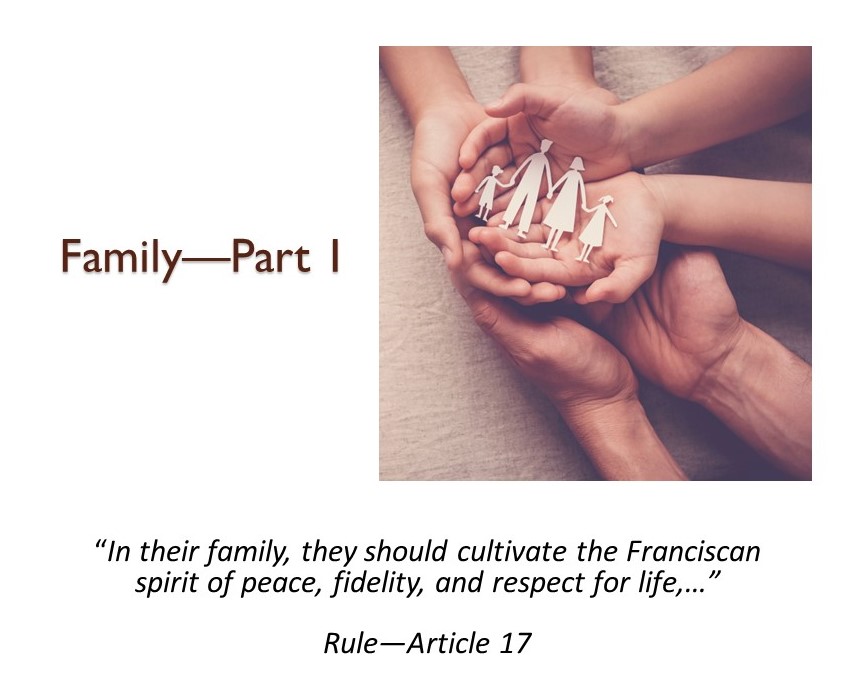
Article 17 of our Rule states: “In their family, they should cultivate the Franciscan spirit of peace, fidelity, and respect for life, striving to make it a sign of a world already renewed. By living the grace of matrimony, husbands and wives in particular should bear witness in the world to the love of Christ for His Church. They should joyfully accompany their children on their human and spiritual journey by providing a simple and open Christian education and being attentive to the vocation of each child.”
Our Constitutions expand this idea in Article 24 which states: “Secular Franciscans should consider their own family to be the first place in which to live their Christian commitment and Franciscan vocation.”
Further exploration of the Family will continue next week.
For discussion with your fraternity, a prayer partner, or to comment on in your journal.
1. Pray, meditate on and discuss the phrase: “contemporary man listens more willingly to witnesses than to teachers, and if he listens to teachers it is because they are witnesses.” What are your thoughts about this statement?
2. Look at how the family is described above in the quoted phrases from Lumen Gentium and John Paul II. Identify those elements in your family and assess where you can do better.
3. What are your “take aways” from this discussion? How will it change what you do?
4. Challenge: What are some ways that you can “cultivate the Franciscan spirit of peace” in your family?
++++++++++++++++++++++++++++++++++++++
JPIC para Franciscanos Seglares: Familia—Parte 1 (Por favor, comparta con su fraternidad local)
Preparado por Francine Gikow, OFS, miembro de la Comisión Nacional de Formación, OFS USA.
La familia y el trabajo son a menudo las áreas más infravaloradas de Justicia, Paz e Integridad de la Creación (JPIC) en nuestra Orden. Tal vez sea porque nuestros hermanos y hermanas religiosos franciscanos han compartido una gran cantidad de conocimientos, información, formación y servicio valiosos en las otras áreas de JPIC que nuestra propia área de JPIC de “familia” ha estado subdesarrollada.
Sin embargo, el hecho de que seamos seglares, no religiosos, no significa que debamos ignorar las áreas que están en nuestras propias áreas de especialización, una de las cuales es la vida familiar. Para nosotros, como franciscanos seglares que vivimos en las trincheras de la sociedad, nuestro testimonio y participación activa en la discusión y formación de cuestiones, costumbres y opciones sociales, da credibilidad porque estamos viviendo nuestra vida católica franciscana en la sociedad. ¡Nuestro testimonio e influencia pueden ser inmensos! Como observó el Papa Pablo VI, “el hombre contemporáneo escucha con más gusto a los testigos que a los maestros, y si escucha a los maestros es porque son testigos.” (Papa Pablo VI, Discurso al “Consilium de Laicis” (2 de octubre de 1974))
Nuestra familia es donde vivimos nuestras vidas como franciscanos seglares. Estamos casados, viudos o solteros, pero estamos totalmente arraigados en nuestras familias. Para algunos, la familia puede no significar necesariamente “casado”, pero también puede incluir relaciones cercanas para aquellos sin vínculos biológicos: adopción, relaciones de acogida, tutelas, figuras paternas, maternidad solidaria o amigos a largo plazo que tienen vínculos cercanos, vínculos emocionales. Las familias no necesariamente se definen por lazos de sangre, sino que son de corazón.
La familia ha sido llamada la primera célula natural y más vital de la sociedad. Juan Pablo II lo llamó el “primer lugar de humanización de la persona”. Lumen Gentium la llama “una escuela de amor y una iglesia doméstica”. El Papa Juan Pablo II también dice que es un lugar donde se desarrolla y crece una comunión de personas, y cómo revelamos nuestro compromiso con el Cuarto Mandamiento: Honra a tu Padre y a tu Madre. La Encarnación es cómo el Hijo de Dios entró en la historia humana a través de la familia, por lo tanto, la Sagrada Familia debe ser el modelo para nuestras propias familias en las que el Esposo divino realiza la redención de todas las familias como Jesús proclama el “evangelio de la familia”. .” (Juan Pablo II)
El artículo 17 de nuestra Regla dice: “Vivan en la propia familia el espíritu franciscano de paz, fidelidad y respeto a la vida, esforzándose en convertirlo en el signo de un mundo ya renovado en Cristo. Los casados, particularmente, viviendo la gracia del matrimonio, den testimonio en el mundo del amor de Cristo a su Iglesia. Con una educación cristiana, sencilla y abierta, atentos a la vocación de cada uno, recorran gozosamente con sus hijos su itinerario espiritual y humano”.
Nuestras Constituciones amplían esta idea en el artículo 24 que dice: “Los franciscanos seglares consideren a su familia como el ámbito prioritario en el que viven su compromiso cristiano y la vocación franciscana”.
La exploración adicional de la Familia continuará la próxima semana.
Para platicar con su fraternidad, un compañero de oración, o para comentar en su diario.
- Oren, mediten y comenten la frase: “el hombre contemporáneo escucha con más gusto a los testigos que a los maestros, y si escucha a los maestros es porque son testigos”. ¿Cuáles son sus pensamientos acerca de esta declaración?
- Mire cómo se describe a la familia arriba en las frases citadas de Lumen Gentium y Juan Pablo II. Identifique esos elementos en su familia y evalúe dónde puede hacerlo mejor.
- ¿Cuáles son sus “resultados” de esta discusión? ¿Cómo cambiará usted lo que hace?
- Desafío: ¿Cuáles son algunas formas en las que puede “Vivir en la propia familia el espíritu franciscano de paz”?
Diane F. Menditto, OFSVice Minister, National Fraternity, Secular Franciscan Order USAListen – Discern – Go Forth National Theme 2022-2025
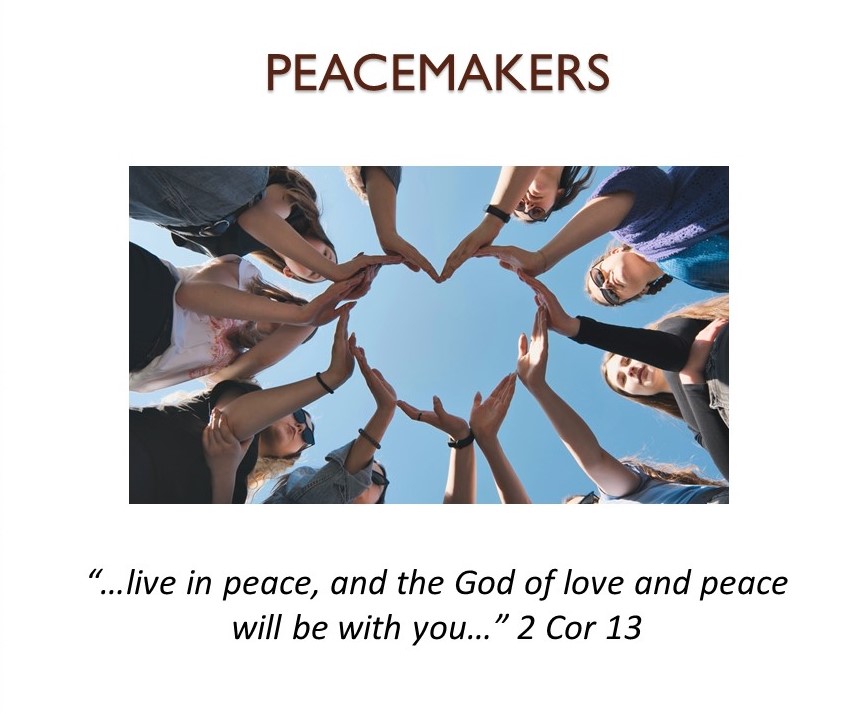
NAFRA-FORM Formation Friday June 16, 2023 Peacemaking
Peacemaking
“Brothers and sisters, rejoice. Mend your ways, encourage one another, agree with one another, live in peace, and the God of love and peace will be with you. Greet one another with a holy kiss. All the holy ones greet you. The grace of the Lord Jesus Christ and the love of God and the fellowship of the Holy Spirit be with all of you.”
Last week we looked at the idea of “welcoming.” But, how can we feel welcome in our fraternities, in our families, or in our workplaces if there is conflict? The Second Letter to the Corinthians points us in the right direction.
Please read the passage again and then see the points and questions below for discussion.
+ “Mend your ways.” St. Paul tells us that we are to look at ourselves first! How might we be contributing to the conflict? Are we saying too little or too much? We need to discern if the conflict stems from something we have said or done. Do we always have to be right? Are we humble enough to “mend our ways” if we have contributed to the difficulty?
+ “Encourage one another.” Do we, personally and as a council, acknowledge the efforts of others? If there needs to be fraternal correction, are we gentle, pointing out the good as well as the not so good?
+ “Agree with one another.” That’s not always easy, but if we don’t agree with what someone is saying, can we at least stop to listen to what they have to say and see if there is any point of agreement before we reject what they are saying? If we still don’t agree, be gentle.
+ “Live in peace.” (See our Rule below)
OFS Rule Article 19
“Mindful that they are bearers of peace which must be built up unceasingly, they should seek out ways of unity and fraternal harmony through dialogue, trusting in the presence of the divine seed in everyone and in the transforming power of love and pardon. Messengers of perfect joy in every circumstance, they should strive to bring joy and hope to others…”
+ Give some examples of how Secular Franciscans can be bearers of peace in all situations.
+ What would be a good way to enter into dialogue with someone with whom we do not agree?
+ If, in fact, the divine seed is in everyone, what respect do we owe others? (Even those we don’t particularly like.)
+ If we try to bring “joy and hope” to others, how can we improve how we deal with our brothers and sisters?
+ What role do good communication, listening, and thoughtful responses (both verbally and in emails) have in bringing peace to the fraternity, family, or workplace?
+ Give serious thought to how bringing partisanship into a fraternity can be disruptive. How can this be handled well if the fraternity wants to discuss opposing points of view?
Fraternity challenge: After discussing all of the above, have a roll-playing session to see how members handle disagreements. (Please have a good moderator to facilitate the discussion.)
+++++++++++++++++++++++++++++
Por favor comparta con su fraternidad local
PACIFICADORES
“Hermanos: Estén alegres, trabajen por su perfección, anímense mutuamente, vivan en paz y armonía. Y el Dios del amor y de la paz estará con ustedes. Salúdense los unos a los otros con el saludo de paz. Los saludan todos los fieles.
La gracia de nuestro Señor Jesucristo, el amor del Padre y la comunión del Espíritu Santo estén siempre con ustedes.”La semana pasada analizamos la idea de ser acogedores. Pero ¿cómo podemos sentirnos bienvenidos en nuestras fraternidades, en nuestras familias o en nuestros lugares de trabajo si hay conflicto? La Segunda Carta a los Corintios nos señala la dirección correcta.
Lea el pasaje nuevamente y luego vea los puntos y preguntas a continuación para su discusión.
+ “Trabajen por su perfección.” ¡San Pablo nos dice que primero debemos mirarnos a nosotros mismos! ¿Cómo podríamos estar contribuyendo al conflicto? ¿Estamos diciendo muy poco o demasiado? Necesitamos discernir si el conflicto proviene de algo que hemos dicho o hecho. ¿Siempre debemos tener la razón? ¿Somos lo suficientemente humildes como para “enmendarnos” si hemos contribuido a la dificultad?
+ “Anímense mutuamente”. ¿Reconocemos personalmente y como consejo local los esfuerzos de los demás? Si es necesaria una corrección fraterna, ¿somos amables, señalando tanto lo bueno como lo no tan bueno?
+ “Vivan en paz y armonía.” Eso no siempre es fácil, pero si no estamos de acuerdo con lo que alguien dice, ¿podemos al menos detenernos a escuchar lo que quiere decir y ver si hay algún punto de acuerdo antes de rechazar lo que dice? Si aún no estamos de acuerdo, sea amable.
+ “Vivir en paz.” (Vea nuestra regla a continuación)
Regla OFS Artículo 19
“Como portadores de paz y conscientes de que ésta ha de construirse incesantemente, indaguen los caminos de la unidad y del entendimiento fraterno, mediante el diálogo, confiando en la presencia del germen divino que hay en el hombre y en la fuerza transformadora del amor y del perdón.” Mensajeros de la perfecta alegría, esfuércense permanentemente en llevar a los demás el gozo y la esperanza…”
+ Dar algunos ejemplos de cómo los franciscanos seglares pueden ser portadores de paz en todas las situaciones.
+ ¿Cuál sería una buena manera de entrar en diálogo con alguien con quien no estamos de acuerdo?
+ Si, de hecho, la semilla divina está en todos, ¿qué respeto debemos a los demás? (Incluso aquellos que no nos gustan particularmente).
+ Si tratamos de llevar “gozo y esperanza” a los demás, ¿cómo podemos mejorar la forma en que tratamos a nuestros hermanos y hermanas?
+ ¿Qué papel tienen la buena comunicación, la escucha y las respuestas reflexivas (tanto verbalmente como por correo electrónico) para traer paz a la fraternidad, la familia o el lugar de trabajo?
+ Piense seriamente en cómo traer el partidismo a una fraternidad puede ser disruptivo. ¿Cómo se puede manejar esto bien si la fraternidad quiere discutir puntos de vista opuestos?
Desafío de fraternidad: Después de discutir todo lo anterior, tenga una sesión de juego de roles para ver cómo los miembros manejan los desacuerdos. (Tengan un buen moderador para facilitar la discusión).
Diane F. Menditto, OFSVice Minister, National Fraternity, Secular Franciscan Order USAListen – Discern – Go Forth National Theme 2022-2025
