Formation Friday August 18, 2023 (En español abajo)
When We Gather in Chapter for the Fraternal and Pastoral Visitation Please share with your local fraternity
Next week the National Fraternity Council (all Regional
Ministers and members of the National Executive Council and Commission Chairs)
will meet in in St. Louis for our National Chapter. This year we will host two
international visitors who will carry out the Fraternal and Pastoral visitation
which is held every six years.In the USA, the National (and Regional) Chapters are held
each year and have a profound effect on every Secular Franciscan. On the
regional level, elections and visitations take place every three years. On the
national level, elections take place every three years, but the visitation by
the higher level (CIOFS) takes place every six years.General Constitutions Article 68.1:” The National
Chapter is the representative organ of the Fraternities existing within the
confines of a National Fraternity. It has legislative, deliberative, and
elective powers. In conformity with the Rule and the Constitutions, it may make
legislative decisions and give norms valid within its national confines. The National
Statutes determine the composition of the National Chapter, its frequency, its
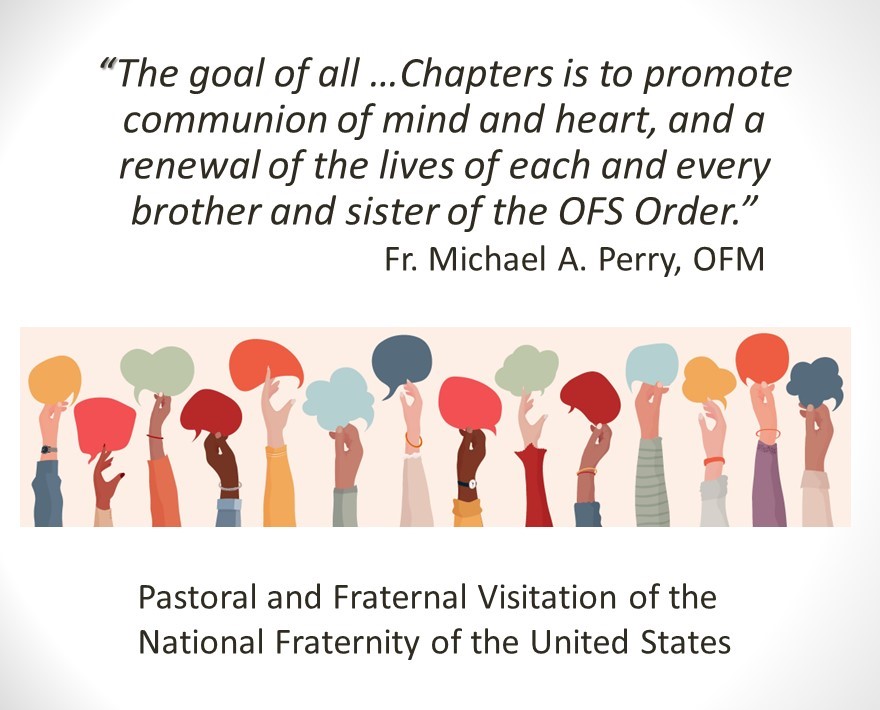
powers, and how to convoke it.”“The goal of all
…Chapters is to promote communion of mind and heart, and a renewal of the lives
of each and every brother and sister of the OFS Order. Speaking about renewal,
it is a long and difficult process that makes serious demands of us: the demand to return to the source of our
vocation, the priorities and essential elements of ourgospel way of
life that, over the course of time can become less clear and, in the extreme, no
longer serve to animate and set direction for our Franciscan lives.” (Br.
Michael A. Perry, OFM, former General Minister of the Order of Friars Minor, at
the General Chapter of the Secular Franciscan Order in 2021.)As you can see
in what Br. Michael said, the Chapter is not only for business, although that
is also important. But, probably the most important part of the gathering is
fraternity and ongoing formation. National Chapters (and Regional Chapters) occur
on a three-year cycle. On the regional level, the Elective Chapter is held
every three years. A visitation by the higher fraternity is carried out in the
year following elections and a general business chapter is held during the
third year. On the national level, this schedule varies slightly. Elective
chapters and business chapters are held on the three-year cycle, but the
Chapter of Visitation is held nationally only every six years.In the United
States, all three types of national chapters are held over a 5-day period with
the National Executive Council and Commission Chairs arriving two or three days
early for preparatory meetings. Even if there is to be an election or
visitation, National Chapters follow a certain pattern. We open with a special
Mass; then, each day there are many opportunities for prayer: Daily Mass,
Morning Prayer, Adoration, a Holy Hour, and a Rite of Remembrance for all those
who have died in the past year.Although the
National Executive Council carries out the day-to-day business of the National
Fraternity, when the National Fraternity Council gathers, it is their
responsibility to carry out national business. (See Article 2.1 of the National
Statutes: “The governing body of NAFRA is the National Fraternity Council.
The National Executive Council acts on behalf of the National Fraternity
Council when the members of the entire Council are not in session [cf. General
Constitutions, article #66.1]”. Therefore, during each day of Chapter there
is business: Updates on what our various commissions and committees are doing;
presentation of and approval of the budget for the following year; motions to
approve points brought forward by the Regional Ministers who form the National
Fraternity Council. The National Minister also informs the National Fraternity
Council of the “State of the Order.”This year, the
National Chapter falls in the sixth year of the visitation cycle. Our last
visitation by the International Fraternity was in 2017. So this year our
National Fraternity will be visited by one of the International Councilors and
one of the General Spiritual Assistants. The International Statutes describe
the process:Article 13 1)
Fraternal and pastoral visitations are carried out according to the spirit of
the Rule, the provisions of the General Constitutions (Art. 87.2; 94; 95), the
present Statutes, and the Statutes for Spiritual and Pastoral Assistance to the
OFS. 2) The CIOFS Presidency and the Conference of General Spiritual Assistants
(CSA) carry out the fraternal and pastoral visitations to the National
Councils. 3) To help ensure better fraternal and pastoral visitations, the
visitors prepare for them in advance by taking the following steps: a)
acquiring from their Secretariat copies of the reports of previous visitations
and any other significant information; b) communicating the program and the
purpose of the visitation with the Councils concerned; c) soliciting from the
National Fraternity Council a report in advance on the updated situation of the
Fraternity itself; d) being open to the suggestions of the Fraternity
concerned. 4) The National and Regional Councils undertake to ensure that the
Visitors have the opportunity to meet the local Ordinary. 5) The Visitor will
write a report of the visitation, as a rule, within three months of the
visitation, with his or her recommendations, addressing it to the Council
concerned and to the Council of the higher level. These reports, if not made
jointly, are to be exchanged between the fraternal and pastoral visitors and
properly saved in the archives of the Secretariat.Please keep
your National Fraternity Council and National Executive Council in your prayers
for safe travel and productive meetings.For discussion
or to answer in your journal:
+Have you
attended a National Chapter? What was your impression?+Talk to
someone who has attended and ask them their impressions.+Have you
attended your Regional Chapter? What was your impression?+If you could attend the National Chapter this year, what questions would you
ask the International visitors? What questions would you ask the National
Executive Council?+++++++++++++++++++++++++++++++++
18 agosto, 2023—La visita fraterna y
pastoral
Cuando nos reunimos en Capítulo para la
Visita Fraternal y Pastoral Por favor comparta con su fraternidad localLa próxima semana, el Consejo de la Fraternidad
Nacional (todos los Ministros Regionales y miembros del Consejo Ejecutivo
Nacional y los Presidentes de las Comisiones) se reunirán en St. Louis para
nuestro Capítulo Nacional. Este año recibiremos a dos visitantes
internacionales que realizarán la Visita Fraterna y Pastoral que se realiza
cada seis años.En los Estados Unidos, los Capítulos Nacionales
(y Regionales) se llevan a cabo cada año y tienen un profundo efecto en cada
Franciscano Seglar. A nivel regional, las elecciones y visitas tienen lugar
cada tres años. A nivel nacional, las elecciones se realizan cada tres años,
pero la visita del nivel superior ( CIOFS ) se realiza cada seis años.Constituciones Generales Artículo 68. 1: “El Capítulo nacional es el órgano
representativo de las Fraternidades existentes en el ámbito de una Fraternidad
nacional, con potestad legislativa, deliberativa y electiva. Puede tomar
decisiones legislativas y emanar normas, de conformidad con la Regla y las
Constituciones, válidas en el ámbito nacional. El Estatuto nacional determina
la composición, periodicidad, competencias y modo de convocar el Capítulo nacional.”“El objetivo de todos… los Capítulos es
promover la comunión de mente y corazón, y la renovación de la vida de todos y
cada uno de los hermanos y hermanas de la Orden OFS. Hablando de renovación, es
un proceso largo y difícil que nos plantea serias exigencias: la exigencia de
volver a la fuente de nuestra vocación, a las prioridades y elementos
esenciales de nuestra forma de vida evangélica que, con el paso del tiempo,
puede volverse menos clara y, en el extremo, dejar de servir para animar y
orientar nuestra vida franciscana”. ( Fr. Michael A. Perry, OFM, ex Ministro
General de la Orden de los Frailes Menores, en el Capítulo General de la Orden
Franciscana Seglar en 2021. )
Como se puede ver en lo que el Hno. Michael
dijo, el Capítulo no es solo para negocios, aunque eso también es importante.
Pero, probablemente, la parte más importante del encuentro es la fraternidad y
la formación permanente. Los Capítulos Nacionales (y los Capítulos Regionales)
ocurren en un ciclo de tres años. A nivel regional, el Capítulo electivo se
realiza cada tres años. La visita de la fraternidad mayor se lleva a cabo en el
año siguiente a las elecciones y el capítulo general de negocios se lleva a
cabo durante el tercer año. A nivel nacional, este horario varía ligeramente.
Los capítulos electivos y los capítulos de negocios se llevan a cabo en el
ciclo de tres años, pero el Capítulo de la Visitación se lleva a cabo a nivel
nacional solo cada seis años.
En los Estados Unidos, los tres tipos de
capítulos nacionales se llevan a cabo durante un período de 5 días y los miembros
del Consejo Ejecutivo Nacional y los presidentes de las Comisiones llegan dos o
tres días antes para las reuniones preparatorias. Incluso si va a haber una
elección o visita, los Capítulos Nacionales siguen un cierto patrón. Abrimos
con una Misa especial; luego, cada día hay muchas oportunidades para la
oración: Misa diaria, Oración de la mañana, Adoración, Hora santa y Rito de
recuerdo para todos aquellos que han muerto en el último año.
Aunque el Consejo Ejecutivo Nacional lleva a
cabo los asuntos cotidianos de la Fraternidad Nacional, cuando se reúne el
Consejo de la Fraternidad Nacional, es su responsabilidad llevar a cabo los
asuntos nacionales. (Véase el Artículo 2.1 de los Estatutos Nacionales: “ El
órgano rector de NAFRA es el Consejo de la Fraternidad Nacional. El Consejo
Ejecutivo Nacional actúa en nombre del Consejo de la Fraternidad Nacional
cuando los miembros del Consejo en su totalidad no están en sesión [cf.
Constituciones Generales, artículo #66.1]”. Por lo tanto, durante cada
día del Capítulo hay asuntos que discutir: Actualización de lo que están
haciendo nuestras distintas comisiones y comités; presentación y aprobación del
presupuesto para el año siguiente; mociones de aprobación de puntos presentadas
por los Consejeros Regionales que forman el Consejo de la Fraternidad Nacional.
El Ministro Nacional también informa al Consejo de la Fraternidad Nacional del
“Estado de la Orden”.
Este año, el Capítulo Nacional cae en el sexto
año del ciclo de visitas. Nuestra última visita de la Fraternidad Internacional
fue en 2017. Así que este año nuestra Fraternidad Nacional será visitada por
uno de los Consejeros Internacionales y uno de los Asistentes Espirituales
Generales. Los Estatutos Internacionales describen el proceso:
Artículo 13 1) Las visitas fraterna y pastoral
se realizan según el espíritu de la Regla, las disposiciones de las
Constituciones generales (Art. 87.2; 94; 95), el presente Estatuto y el
Estatuto para la Asistencia Espiritual y Pastoral a la OFS. 2) La Presidencia
del CIOFS y la Conferencia de Asistentes Espirituales Generales (CAS) realizan
las visitas fraternales y pastorales a los Consejos Nacionales. 3) Para un
mejor desarrollo de las visitas, tanto fraterna como pastoral, los visitantes
las preparan con antelación procediendo a: a) adquirir de su Secretariado copia
de los informes de las visitas precedentes y cualquier otro elemento
significativo; b) comunicar el programa y el objeto de la visita a los Consejos
interesados; c) solicitar al Consejo de la Fraternidad nacional un informe
previo sobre la situación actualizada de la Fraternidad misma; d) estar abierto
a las sugerencias de la Fraternidad interesada. 4) El Consejo Nacional y el
Regional se empeñan en procurar que los Visitantes tengan la oportunidad de
conocer al Ordinario del lugar. 5) El Visitador redacta, normalmente en los
tres meses siguientes, un informe de la visita, con sus recomendaciones,
dirigiéndolo al Consejo interesado y al Consejo de nivel superior. Dichos
informes, si no se hacen conjuntamente, deben ser intercambiados entre los
visitantes fraterno y pastoral y debidamente conservados en los archivos del
Secretariado.
Por favor mantenga a su Consejo Nacional de
Fraternidad y Consejo Ejecutivo Nacional en sus oraciones para un viaje seguro
y reuniones productivas.
Para discusión o para responder en su diario:
+¿Ha asistido a un Capítulo Nacional? ¿Cuál fue
su impresión?+Hable con alguien que haya asistido y pídale
sus impresiones.+¿Ha asistido a su Capítulo Regional? ¿Cuál fue
su impresión?+Si usted pudiera asistir al Capítulo Nacional este año, ¿Qué preguntas les
haría a los visitantes internacionales? ¿A los miembros del Consejo Ejecutivo
Nacional?
++++++++++++++++++++++++++++++++++++
Diane F. Menditto, OFSVice Minister, National Fraternity, Secular Franciscan Order USAListen – Discern – Go Forth National Theme 2022-2025—
Category: Formation Friday
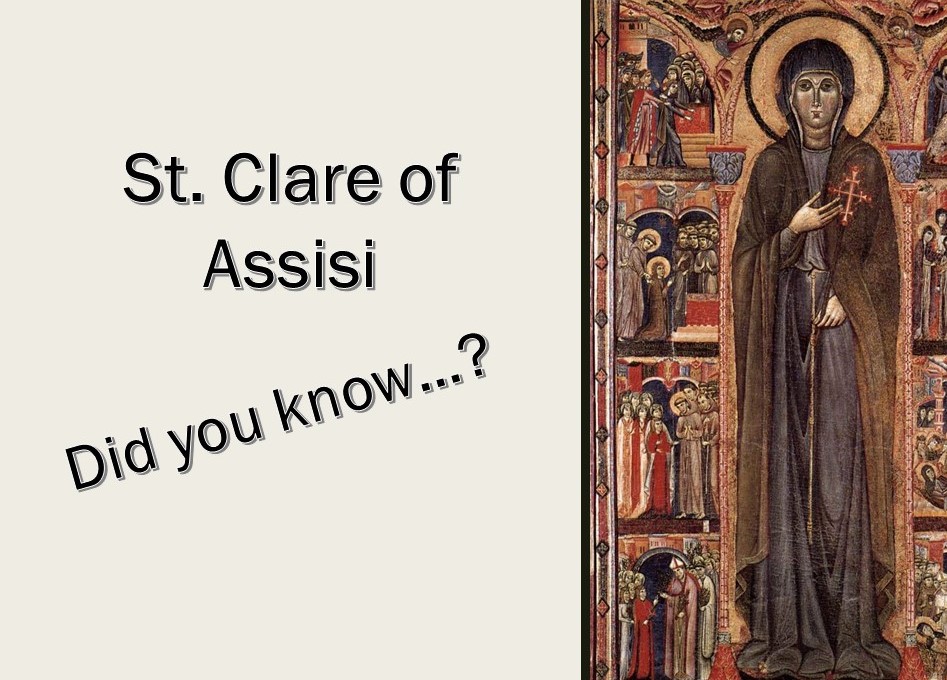
Formation Friday August 11, 2023 (Feast of St. Clare of Assisi) (En español abajo) What do you know about St. Clare of Assisi?
Prepared by Francine Gikow, OFS, member, National Formation Commission, OFS-USA
Did you know that…?
· St. Clare’s family was part of the class known as the Maiores—the upper class (nobility) of society in Assisi.
· Clare’s mother, Ortulana, was a strong, deeply religious woman who made a number of pilgrimages, notably one to the Holy Land. Later, she and Clare’s sister entered the monastery.
· One of the earliest followers of St. Francis was Clare’s cousin Rufino.
· When St. Clare left her family home, she gave away all her considerable worldly goods, dowry and family connections.
· At first she lived in the Benedictine monastery of San Paolo delle Abbadesse.
· She entered penniless, without status, and was considered a servant.
· The “choir nuns” usually came from wealthy families. The lay sisters (“converse”) did all the menial tasks.
· Clare accepted the lowliest status willingly. She wanted no preference given to her.
· San Paolo delle Abbadesse monastery enjoyed a privilege of excommunication for anyone interfering or maltreating its residents thereby protecting St. Clare from her family’s wrath.
· St. Clare outlived St. Francis of Assisi by 27 years and during that time helped to maintain the integrity of the Franciscan charism by contact with St. Francis’ early followers who came to her for advice.
Rule of Life:
· In 1219, Cardinal Ugolino wrote his own Constitutions for the followers of St. Clare and established it following the Rule of St. Benedict. It allowed endowments and property, etc. This order was originally called “the Poor Ladies of the Order of Valley of the Spoleto or of Tuscany.” He tried to have St. Clare accept this Benedictine rule and his own constitutions for her order but she refused since it did not include the “Privilege of Poverty.” However, Cardinal Ugolino was able to convince many monasteries following St. Clare of Assisi, in San Damiano, to accept it. In spite of this, there were still some monasteries loyal to St. Clare who truly lived the “Privilege of Poverty” such as Agnes of Prague’s monastery.
· After Cardinal Ugolino was elected pope (as Gregory IX) In 1228, Cardinal Reinaldo dei Conti di Segni, was appointed the new Cardinal protector for Cardinal Ugolino’s order with its 24 female monasteries,but it was now called the “Order of St. Damian.” St. Clare’s monastery was listed as a member monastery although St. Clare did not approve of Ugolino’s Constitutions. However, it was during this time that St. Clare’s monastery was allowed an exemption for the “Privilege of Poverty,” but it remained the only monastery given this privilege. St. Clare and her sisters were then brought under the Benedictine rule proposed by now pope, Gregory IX.
· Beginning on November 13, 1245, Pope Innocent IV issued a bull that reaffirmed that all monasteries of the Order of St. Damian were to follow the Rule of St. Benedict and Ugolino’s “Form of Life” which required endowments for the monastery.
· Clare was a very strong woman never compromising on her core belief of living only on what God provided (without dowries, property, or regular income) which she called, the Privilege of Poverty..
· St. Clare’s Rule of Life for her sisters was the first canonical “Form of Life” (Rule) written by a woman approved on her deathbed by Pope Innocent IV which at first still included only St. Clare’s monastery in San Damiano, but eventually St. Agnes of Prague’s monastery and a few other monasteries would be allowed to follow it.
· St. Clare’s “Form of Life” for her sisters was very democratic and visionary for the time. Some
of her innovations were:
· election of the abbess by all the sisters with the abbess having term limits rather than a lifelong appointment.
· voting for admission and profession candidates by all of the sisters.
· all sisters would perform menial work and there would be no demarcation between servants and choir nuns. All sisters would be expected to serve. Moreover, serving was seen as a privilege and St. Clare was a model for serving.
Questions for reflection or to answer in your journal
+What did you learn about St. Clare today that you did not know before?
+What about St. Clare’s life inspires you as a Secular Franciscan?
+ Personal Challenge: St. Clare’s love of poverty allowed her to be a collaborative servant leader. This week, examine any leadership positions you hold. How are you collaborative? If collaboration is difficult for you, what is holding you back?For more information:
WIlliam Hugo, OFM Cap. and Joanne Schatzlein, OFS, Studying the Life of Saint Clare of Assisi: A Beginner’s Workbook. Hyde Park N.Y.: New City Press. 2019.
Bret Thoman, OFS, St. Clare of Assisi: Light from the Cloister, Tan Books, Charlotte, North Carolina. 2017.
+++++++++++++++++++
11 de agosto de 2023 (Fiesta de Santa Clara de Asís)
¿Qué sabe usted de Santa Clara de Asís? ( Por favor, comparta con su fraternidad local.)Preparada por Francine Gikow, OFS, miembro, Comisión Nacional de Formación, OFS-USA
Sabía usted que…?
- La familia de Sta. Clara era parte de la clase conocida como Mayores, la clase alta (nobleza) de la sociedad en Asís.
- La madre de Clara, Ortulana, era una mujer fuerte y profundamente religiosa que hizo varias peregrinaciones, en particular una a Tierra Santa. Más tarde, ella y la hermana de Clara entraron en el monasterio.
- Uno de los primeros seguidores de San Francisco fue el primo de Clara, Rufino.
- Cuando Santa Clara dejó el hogar de su familia, regaló todos sus considerables bienes mundanos, dote y conexiones familiares.
- Al principio vivió en el monasterio benedictino de San Paolo delle Abbadesse.
- Entró sin dinero, sin estatus, y fue considerada una sirvienta.
- Las “monjas del coro” solían provenir de familias adineradas. Las hermanas laicas (“converse”) hacían todas las tareas domésticas.
- Clara aceptó de buena gana el estatus más bajo. No quería que se le diera preferencia.
- El monasterio de San Paolo delle Abbadesse disfrutó del privilegio de la excomunión para cualquiera que interfiriera o maltratara a sus residentes, protegiendo así a Santa Clara de la ira de su familia.
- Santa Clara sobrevivió a San Francisco de Asís por 27 años y durante ese tiempo ayudó a mantener la integridad del carisma franciscano mediante el contacto con los primeros seguidores de San Francisco que acudieron a ella en busca de consejo.
Regla de vida:
- En 1219, el Cardenal Ugolino escribió sus propias Constituciones para los seguidores de Santa Clara y las estableció siguiendo la Regla de San Benito. Permitía dotaciones y propiedades, etc. Esta orden se llamaba originalmente “las Damas Pobres de la Orden del Valle de Spoleto o de Toscana”. Trató de que Santa Clara aceptara esta regla benedictina y sus propias constituciones para su orden, pero ella se negó porque no incluía el “Privilegio de la Pobreza”. Sin embargo, el cardenal Ugolino pudo convencer a muchos monasterios que seguían a Santa Clara de Asís, que la aceptaran. A pesar de esto, todavía quedaban algunos monasterios fieles a Santa Clara que verdaderamente vivían el “Privilegio de la Pobreza” como el monasterio de Inés de Praga.
- Después de que el cardenal Ugolino fue elegido papa (como Gregorio IX) en 1228, el cardenal Reinaldo dei Conti di Segni, fue nombrado el nuevo cardenal protector de la orden del cardenal Ugolino con sus 24 monasterios femeninos, pero ahora se llamaba la “Orden de San Damián”. ” El monasterio de Santa Clara figuraba como monasterio miembro, aunque Santa Clara no estaba de acuerdo con las Constituciones de Ugolino. Sin embargo, fue durante este tiempo que al monasterio de Santa Clara se le permitió una exención por el “Privilegio de la Pobreza”, pero siguió siendo el único monasterio que recibió este privilegio. Santa Clara y sus hermanas quedaron bajo la regla benedictina propuesta por el ahora Papa Gregorio IX.
- A partir del 13 de noviembre de 1245, el Papa Inocencio IV emitió una bula que reafirmaba que todos los monasterios de la Orden de San Damián debían seguir la Regla de San Benito y la “Forma de vida” de Ugolino, que requería dotaciones para el monasterio.
- Clare era una mujer muy fuerte que nunca se comprometió con su creencia central de vivir solo con lo que Dios proveyó (sin dotes, propiedades o ingresos regulares), lo que ella llamó el Privilegio de la Pobreza.
- La Regla de Vida de Santa Clara para sus hermanas fue la primera “Forma de Vida” canónica (Regla) escrita por una mujer aprobada en su lecho de muerte por el Papa Inocencio IV, que al principio solo incluía el monasterio de Santa Clara en San Damián, pero eventualmente la Santa Sede permitiría que el monasterio de Inés de Praga y algunos otros monasterios lo siguieran.
- La “Forma de vida” de Santa Clara para sus hermanas fue muy democrática y visionaria para la época. Algunas de sus innovaciones fueron:
· elección de la abadesa por todas las hermanas y la abadesa tenía límites de mandato en lugar de un nombramiento de por vida.
· votación de candidatas de admisión y profesión por parte de todas las hermanas.
· todas las hermanas realizarían trabajos de baja categoría y no habría demarcación entre sirvientas y monjas del coro. Se esperaría que todas las hermanas sirvieran. Además, servir era visto como un privilegio y Sta. Clara era un modelo de servicio.
Preguntas para reflexionar o para responder en su diario
+¿Qué aprendió sobre Santa Clara hoy que no sabía antes?
+¿Cómo le inspira la vida de Santa Clara como franciscano seglar?
+ Desafío personal: El amor de Santa Clara por la pobreza le permitió ser una líder de servicio colaborativa. Esta semana, examine cualquier posición de liderazgo que tenga. ¿Cómo colabora? Si colaborar le es difícil, ¿qué le detiene?Para más información: (en inglés)
William Hugo, OFM Cap. y Joanne Schatzlein, OFS, Studying the Life of Saint Clare of Assisi: A Beginner’s Workbook. Hyde Park New York: New City Press. 2019.
Bret Thoman, OFS, St. Clare of Assisi: Light from the Cloister, Tan Books, Charlotte, NC. 2017.
Diane F. Menditto, OFSVice Minister, National Fraternity, Secular Franciscan Order USAListen – Discern – Go Forth National Theme 2022-2025
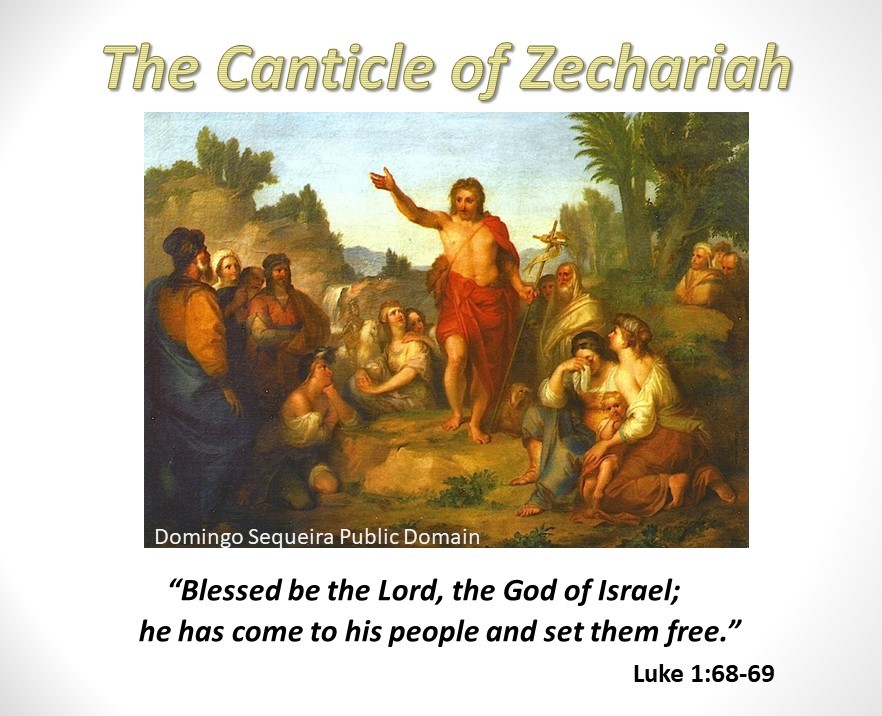
Formation Friday – Canticle of Zechariah (Benedictus) Luke 1:68-69 – August 4, 2023
Prepared by Layna Maher, OFS, Chair, National Formation Commission, OFS-USA
Each morning, the Canticle (song) of Zechariah, the Benedictus, is prayed in the Liturgy of the Hours as part of our Morning Prayer. As we pray the Benedictus, the Church remembers John the Baptist, the “forerunner of Jesus” at the beginning of every day.
The opening words of this Canticle, “Blessed be the Lord, the God of Israel” give us the name Benedictus, a Latin word for Blessed.
· Why do we start each day with this Canticle?
· What does it mean for us as Catholics and as Franciscans?
As we awaken in the tender compassion of our God the dawn from on high shall break upon us and one of the first things we do, is to sing this blessing of God.
Pray the Benedictus—read to yourself or out loud with a prayer partner
Benedictus: The Canticle of Zechariah
Blessed be the Lord, the God of Israel;
he has come to his people and set them free.
He has raised up for us a mighty savior,
born of the house of his servant David.Through his holy prophets he promised of old
that he would save us from our enemies,
from the hands of all who hate us.
He promised to show mercy to our fathers
and to remember his holy covenant.This was the oath he swore to our father Abraham:
to set us free from the hands of our enemies,
free to worship him without fear,
holy and righteous in his sight all the days of our life.You, my child, shall be called the prophet of the Most High;
for you will go before the Lord to prepare his way,
to give his people knowledge of salvation
by the forgiveness of their sins.In the tender compassion of our God
the dawn from on high shall break upon us,
to shine on those who dwell in darkness and the shadow of death,
and to guide our feet into the way of peace.Glory to the Father, and to the Son,
and to the Holy Spirit:
as it was in the beginning, is now,
and will be for ever. Amen.In the Benedictus, we join ourselves to the mission of St John the Baptist, who came to prepare a way for the Lord by being a witness of God’s love and salvation. It calls us to do the same.
It calls us to:
· Show mercy (Matthew 25: 35-40, The Corporal Works of Mercy)
· Be a prophet of the Most High (share our faith by how we live our lives)
· Give His people knowledge of salvation by the forgiveness of their sins
· Shine on those who dwell in darkness and the shadow of death
· Guide our feet into the way of peace.
Our work each day is to use our voice and our lives as a personal witness – like John the Baptist –where we live, where we work, and wherever we go, to make God’s presence known to each person we encounter.
OFS Rule Art. 14 “Secular Franciscans, together with all people of good will, are called to build a more fraternal and evangelical world so that the kingdom of God may be brought about more effectively…”
Reflection Questions:
· How have you shown or experienced mercy or compassion?
· What opportunities did you miss to show mercy and compassion?
· How have you experienced forgiveness
· How have you shined the Light of Christ into the world?
· How have you brought peace into the world?
· Personal Challenge: Think of opportunities that you missed to forgive or to show mercy. Resolve to carry this out for a particular situation that comes to mind.
++++++++++++++++++++++++++++
4 de agosto de 2023 Comparta con su fraternidad local
Cántico de Zacarías (Benedictus) Lucas 1:68-69
Preparada por Layna Maher, OFS, Presidenta, National Formation Commission, OFS-USA
Cada mañana, el Cántico (canción) de Zacarías, el Benedictus, se reza en la Liturgia de las Horas como parte de Laudes. Mientras rezamos el Benedictus, la Iglesia recuerda a Juan el Bautista, el “precursor de Jesús” al comienzo de cada día.
Las palabras iniciales de este Cántico, “Bendito sea el Señor, Dios de Israel”, nos dan el nombre Benedictus, una palabra latina para Bendito.
- ¿Por qué comenzamos cada día con este Cántico?
- ¿Qué significa para nosotros como católicos y franciscanos?
Mientras despertamos Por la entrañable misericordia de nuestro Dios, nos visitará el sol que nace de lo alto,
y una de las primeras cosas que haremos, es cantar esta bendición de Dios.Reza el Benedictus: Solo o en voz alta con un compañero de oración
Benedictus: Cántico de Zacarías
Bendito sea el Señor, Dios de Israel,
porque ha visitado y redimido a su pueblo,
suscitándonos una fuerza de salvación
en la casa de David, su siervo,
según lo había predicho desde antiguo,
por boca de sus santos profetas.Es la salvación que nos libra de nuestros enemigos
y de la mano de todos los que nos odian;
realizando la misericordia
que tuvo con nuestros padres,
recordando su santa alianza
y el juramento que juró a nuestro padre Abrahán.Para concedernos que, libres de temor,
arrancados de la mano de los enemigos,
le sirvamos con santidad y justicia,
en su presencia, todos nuestros días.Y a ti, niño, te llamarán profeta del Altísimo,
porque irás delante del Señor
a preparar sus caminos,
anunciando a su pueblo la salvación,
el perdón de sus pecados.Por la entrañable misericordia de nuestro Dios,
nos visitará el sol que nace de lo alto,
para iluminar a los que viven en tinieblas
y en sombra de muerte,
para guiar nuestros pasos
por el camino de la paz.Gloria al Padre, y al Hijo, y al Espíritu Santo.
Como era en el principio, ahora y siempre,
por los siglos de los siglos. Amén.En el Benedictus nos unimos a la misión de san Juan Bautista, que vino a preparar el camino del Señor siendo testigo del amor y de la salvación de Dios. Nos llama a hacer lo mismo.
Nos llama a:
- Mostrar misericordia (Mateo 25: 35-40, Las Obras de Misericordia Corporales)
- Ser profeta del Altísimo (compartir nuestra fe por cómo vivimos nuestras vidas)
- Dar a su pueblo conocimiento de la salvación por el perdón de sus pecados
- Brillar sobre los que habitan en la oscuridad y la sombra de la muerte
- Guíar nuestros pasos por el camino de la paz.
Nuestro trabajo cada día es usar nuestra voz y nuestra vida como un testimonio personal, como Juan el Bautista, donde vivimos, donde trabajamos y dondequiera que vayamos, para dar a conocer la presencia de Dios a cada persona que encontramos.
Regla OFS Art. 14 “Llamados, juntamente con todos los hombres de buena voluntad, a construir un mundo más fraterno y evangélico para la edificación del reino de Dios,…”
Preguntas de reflexión:
- ¿Cómo ha mostrado o experimentado la misericordia o compasión?
- ¿Qué oportunidades perdió de mostrar misericordia y compasión?
- ¿Cómo ha experimentado el perdón?
- ¿Cómo ha hecho brillar la Luz de Cristo en el mundo?
- ¿Cómo ha traído la paz al mundo?
- Desafío personal : Piense en las oportunidades que perdió para perdonar o mostrar misericordia. Resuelva llevar a cabo esto para una situación particular que le venga a la mente.
++++++++++++++++++++++++++++++
Diane F. Menditto, OFSVice Minister, National Fraternity, Secular Franciscan Order USAListen – Discern – Go Forth National Theme 2022-2025

Formation Friday – The Pardon of Assisi – The Porziuncola Indulgence – Celebrated on Aug 2 – July 28, 2023
The Pardon of Assisi – The Porziuncola Indulgence—Celebrated on August 2 (en español abajo)
Please share with your local fraternity
+ The sixteenth century Basilica of St. Mary of the Angels envelops the tiny chapel known as the Porziuncola.
+ This chapel was one of the churches restored by St. Francis.
+ This is the spot where, while listening to the Gospel, Francis understood what he was called by God to do.
+ Here he founded the Order in 1209.
+ St. Clare received her religious habit from the hands of Francis here in 1211.
+ In 1216 as Francis prayed that everyone could be brought to heaven, he obtained from Jesus in a vision the PARDON OF ASSISI—a plenary indulgence, which was later ratified by Pope Honorius III.
+ This is where the friars’ early general chapters were held—the Chapter of Mats of 1221 was attended by 5,000 friars.
+ Here, on October 3, 1226, St. Francis welcomed Sister Death lying naked on the ground just outside the chapel.
“See to it, my sons, that you never abandon this place. If you are driven out from one side, go back in at the other. For this place is truly holy and is the dwelling place of God. Here, when we were but a few, the Most High gave us increase; here he enlightened the hearts of his poor ones by the light of his wisdom; here he set our wills on afire with the flame of his love. Here he who prays with a devout heart will obtain what he prays for and he who offends will be punished more severely. Wherefore, my sons, consider this dwelling place of God to be worthy of all honour, and with all your, with voice of joy, and praise, give glory to the Lord in this place.” (Words of the dying St. Francis, Celano 1, n. 106)
The Conditions for Receiving the Pardon
+ Each year from vespers on August 1 through August 2 (Feast of Our Lady of the Angels) you should visit either a Franciscan church or your own church. (At first the indulgence was only given for the Porziuncola, but it has been widened over the years.)
+ You may obtain the indulgence any day of the year upon visiting the Porziuncola itself.
CONDITIONS TO OBTAIN THE PARDON OF ASSISI
Plenary Indulgence–(for oneself or for a departed soul)
- Sacramental Confession to be in God’s sanctifying grace *(to be received within eight days before or after initiate “appeal” for the Plenary Indulgence);
- *Participation in the Holy Mass with reception of the Holy Eucharist.
- Visit to a Catholic Church, followed by the Profession of FAITH (Nicene Creed or Apostles Creed),
- Recite the OUR FATHER, in order to reaffirm and give witness to one’s Christian dignity, as a child of God, that one received in Baptism;
- Pray for the Pope’s intentions: as Vicar of Christ, Shepherd of the Universal Church, and visible sign of unity among the Faithful
Excellent reference on this topic: http://www.shrinesf.org/pardon-of-assisi.html
Also, if you are able to read Spanish, the link below has a very interesting article about the Porziuncola.
For discussion and reflection
+ Read Matthew 10: 9-15. This is the gospel that Francis heard read at the Porziuncola. Reflect on its meaning to all Franciscans and to us as Secular Franciscans.
+ On August 1-2, visit a Franciscan or other church and follow the conditions to receive the indulgence.
+ While you are there, spend time with the Blessed Sacrament. Consider your vocation and what God is asking of you.
+++++++++++++++++++++++++
Formation Friday – 28 de julio, 2023
El perdón de Asís – La indulgencia de la porciúncula 2 de agosto
Comparta con su fraternidad local.
+ La Basílica de Santa María de los Ángeles del siglo XVI envuelve la pequeña capilla conocida como la Porciúncula.
+ Esta capilla fue una de las iglesias restauradas por San Francisco.
+ Este es el lugar donde, mientras escuchaba el Evangelio, Francisco comprendió lo que Dios le había llamado a hacer.
+ Aquí fundó la Orden en 1209.
+ Santa Clara recibió su hábito religioso de manos de Francisco aquí en 1211.
+ En 1216, mientras Francisco oraba para que todos pudieran ser llevados al cielo, obtuvo de Jesús en una visión el PERDÓN DE ASÍS, una indulgencia plenaria, que luego fue ratificada por el Papa Honorio III.
+ Aquí es donde se llevaron a cabo los primeros capítulos generales de los frailes; al Capítulo de las Esteras de 1221 asistieron 5.000 frailes.
+ Aquí, el 3 de octubre de 1226, San Francisco recibió desnudo a la Hermana Muerte en el suelo a las afueras de la capilla.
“Ocúpense, hijos míos, de que nunca abandonen este lugar. Si son expulsados de un lado, regresen por el otro. Porque este lugar es verdaderamente santo y es la morada de Dios. Aquí, cuando éramos sólo unos pocos, el Altísimo nos dio crecimiento; aquí iluminó el corazón de sus pobres con la luz de su sabiduría; aquí prendió nuestras voluntades con la llama de su amor. Aquí el que ora con corazón devoto obtenga lo que pide y el que ofende será castigado más severamente. Por tanto, hijos míos, consideren esta morada de Dios digna de toda honra, y con toda su voz, con voz de gozo y alabanza, den gloria al Señor en este luga .” (Palabras de San Francisco agonizante, Celano 1, n. 106)
Las condiciones para recibir la indulgencia
+ Cada año, desde las vísperas del 10 de agosto al 20 de agosto (Fiesta de Nuestra Señora de los Ángeles), debe visitar una iglesia franciscana o su propia iglesia. (Al principio, la indulgencia solo se otorgó a la Porciúncula, pero se ha ampliado con los años).
+ Puede obtener la indulgencia cualquier día del año al visitar la propia Porziuncola.
CONDICIONES PARA OBTENER EL PERDÓN DE ASÍS
Indulgencia plenaria – (para uno mismo o para un alma difunta)
• Confesión sacramental para estar en la gracia santificante de Dios * (para ser recibida dentro de los ocho días antes o después de iniciada la “apelación” para la Indulgencia Plenaria);
• * Participación en la Santa Misa con recepción de la Sagrada Eucaristía.
• Visita a una Iglesia Católica, seguida de la Profesión de FE (Credo de Nicea o Credo de los Apóstoles),
• Recitar el PADRE NUESTRO, para reafirmar y dar testimonio de la propia dignidad cristiana, como hijo de Dios, que se recibió en el Bautismo;
• Ore por las intenciones del Papa: como Vicario de Cristo, Pastor de la Iglesia Universal y signo visible de unidad entre los Fieles.
Excelente recurso en español http://franciscanos.org/santuarios/bellucci.htm
Para platicar y reflexionar
+ Lea Mateo 10: 9-15. Este es el evangelio que Francisco escuchó en la Porciúncula. Reflexione sobre su significado para todos los franciscanos y para nosotros como franciscanos seglares.
+ El 10 o el 20 de agosto, visite una iglesia franciscana u otra iglesia; siga las condiciones para recibir la indulgencia.
+ Mientras esté allí, pase tiempo con el Santísimo Sacramento. Considere su vocación y lo que Dios le está pidiendo.
Diane F. Menditto, OFSVice Minister, National Fraternity, Secular Franciscan Order USAListen – Discern – Go Forth National Theme 2022-2025
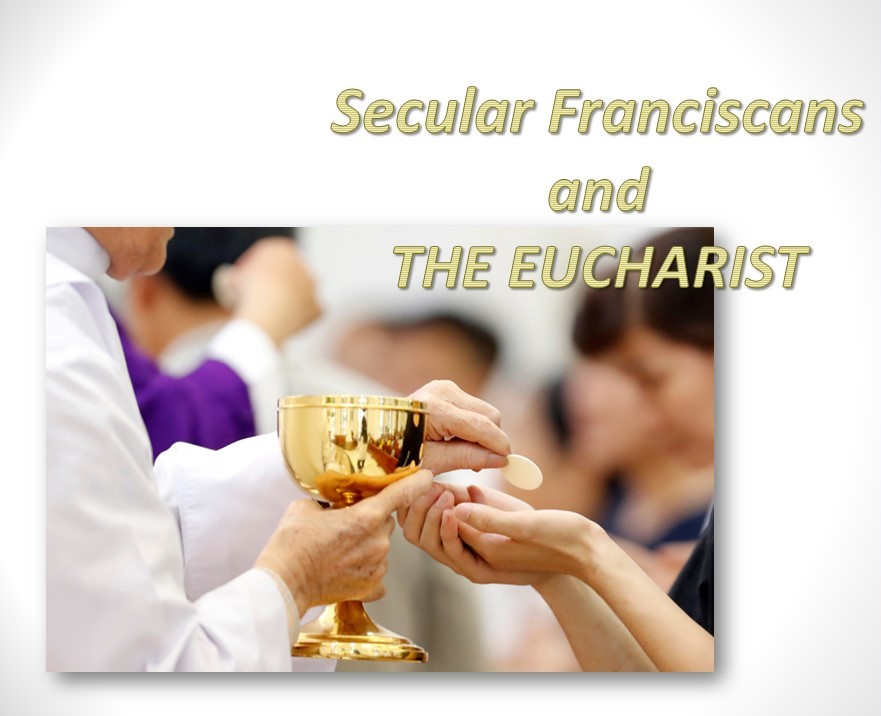
Formation Friday – Secular Franciscans and the Eucharist – July 21, 2023
Since July is the month of the Precious Blood, and we are also celebrating the three-year Eucharistic Revival, we repeat some of our previous posts on the Eucharist this month.
St. Francis was devoted to the Eucharist. In the first Admonition, he says. “This is my Body and the Blood of my new covenant [which will be shed for many] ;{snippet Mk 14:22} 11 and Whoever eats my flesh and drinks my blood has eternal life .{snippet Mk 14:24} 12 It is the Spirit of the Lord,{snippet Jn 6:55} therefore, That lives in Its faithful, That receives the Body and Blood of the Lord. 13 All others who do not share in this same Spirit and presume to receive Him eat and drink judgment on themselves .{snippet 1 Cor 11:29}”(The Admonitions: FA:ED, vol. 1, p. 129)
As we follow in the footsteps of our Seraphic Father, we, too, are devoted to the most precious Body and Blood of our Lord Jesus in the Eucharist. Let’s take a look at our Rule and Constitutions.
Rule Article 8: … “Let them participate in the sacramental life of the Church, above all the Eucharist….”
General Constitutions Article 14.2: (Refers to Art. 8 of the Rule) “The Eucharist is the center of the life of the Church. Christ unites us to himself and to one another as a single body in it. Therefore, the Eucharist should be the center of the life of the fraternity. The brothers and sisters should participate in the Eucharist as frequently as possible, being mindful of the respect and love shown by Francis, who, in the Eucharist, lived all the mysteries of the life of Christ.”
“The Holy Spirit builds up, animates, and sanctifies the Church. He prepares us to go out and bring others to Christ. He opens our minds to understand Christ’s death and Resurrection. He makes present for us the mystery of Christ, especially in the Eucharist, and brings us to communion with God that we may bear much fruit. (Cf. CCC
– no. 737) United States Catholic Catechism for Adults – USCCB – Page 109
GC Article 53.2 & 4 (Refers to Articles 6 & 8 of the Rule) 2.”The fraternity should come together periodically, also as a Church community to celebrate the Eucharist in a climate which strengthens the fraternal bond and characterizes the identity of the Franciscan family. Where, for whatever reason, this particular celebration may not be possible, they should participate in the celebration of the larger Church community.”
N.B. “The Eucharist, celebrated with parish members, draws us to the Church. It keeps us in touch with the local
parish and diocesan community. The fraternity may periodically celebrate Eucharist at their fraternity gatherings.
This celebration is recommended for special occasions – e.g. Professions, jubilees of profession, a memorial Eucharist for the deceased of the SFO or other important occasions.” Cf. Benedict XVI’s quote from Sacramentum
Caritatis on page 184-185 (Franciscan Journey p. 177)
“Within the Church the Eucharist is the center of our lives. Attending a parish Eucharist is highly encouraged. We need to be consistently present at the gathering of the People of God. It reminds us of our union with the Church.”
(Franciscan Journey p. 178)
A good video by Bishop Barron on the Eucharist:
https://www.youtube.com/watch?v=sgy_TFeIyiM&t=126s (Real Presence)
Visit the Eucharistic Revival website: https://www.eucharisticrevival.org/
Through our example, we help others to realize that Jesus is truly present in the Eucharist under the appearance of bread and wine. Please think about your relationship with Jesus in the Eucharist as you answer the questions below.
+Why is the Eucharist important to you as a Catholic? As a Franciscan?
+How do you prepare to receive the Body and Blood of Christ?
+How is the Eucharist tied to our Franciscan spirituality?
+Think about what our Rule and Constitutions say about the Eucharist. How are you opened up by these words to allow the Holy Spirit to transform you?+In what ways can you show special reverence for the Eucharist?
++++++++++++++++++++++++++
Los Franciscanos Seglares y la Eucaristía – Por favor, comparta con su fraternidad local.
Dado que julio es el mes de la Preciosa Sangre, y también estamos celebrando el Avivamiento Eucarístico de tres años, repetimos algunas de nuestras publicaciones anteriores sobre la Eucaristía este mes.
San Francisco era devoto de la Eucaristía. En la primera Admonición, dice.”…como lo atestigua el mismo Altísimo, que dice: Esto es mi cuerpo y mi sangre del nuevo testamento, [que será derramada por muchos] (cf. Mc 14,22.24); 11y: Quien come mi carne y bebe mi sangre, tiene vida eterna (cf. Jn 6,55). 12De donde el espíritu del Señor, que habita en sus fieles, es el que recibe el santísimo cuerpo y sangre del Señor. 13Todos los otros que no participan del mismo espíritu y se atreven a recibirlo, comen y beben su condenación (cf. 1 Cor 11,29). (Admoniciones http://franciscanos.org/esfa/adm-ae.html )
Mientras seguimos los pasos de nuestro Seráfico Padre, nosotros también somos devotos del Cuerpo y la Sangre más preciados de nuestro Señor Jesús en la Eucaristía. Echemos un vistazo a nuestra Regla y Constituciones.
Regla Artículo 8: … “Participen de la vida sacramental de la Iglesia, epecialmente la Eucaristía… ”.
Constituciones Generales Artículo 14.2: (Véase Regla Art. 8.) “ La Eucaristía es el centro de la vida de la Iglesia. En ella Cristo nos une a Él y entre nosotros como un único cuerpo. Por lo tanto, la Eucaristía sea el centro de la vida de la Fraternidad; los hermanos participen en la Eucaristía con la mayor frecuencia posible, conscientes del respeto y amor de San Francisco, que en la Eucaristía vivió todos los misterios de la vida de Cristo.”
“El Espíritu Santo edifica, anima y santifica a la Iglesia. Él nos prepara para salir y llevar a otros a Cristo. Él abre nuestras mentes para comprender la muerte y resurrección de Cristo. Nos hace presente el misterio de Cristo, especialmente en la Eucaristía, y nos lleva a la comunión con Dios para que demos mucho fruto. (Cf. CCC
– no. 737) Catecismo Católico de los Estados Unidos para Adultos – USCCB – Página 109
CCGG, artículo 53.2 y 4 (Se refiere a los artículos 6 y 8 de la Regla) 2. (Regla 6; 8). “La Fraternidad se reúna periódicamente, como comunidad eclesial, para celebrar la Eucaristía en un clima que consolide el vínculo fraterno y exprese la identidad de la Familia Franciscana. Donde no sea posible la celebración particular, particípese en la de una más amplia comunidad eclesial.”
NB “La Eucaristía, celebrada con los feligreses, nos acerca a la Iglesia. Nos mantiene en contacto con la
comunidad local parroquial y diocesana. La fraternidad podrá celebrar periódicamente la Eucaristía en sus reuniones de fraternidad. Esta celebración se recomienda para ocasiones especiales, por ejemplo, profesiones, jubileos de profesión, una eucaristía en memoria de los difuntos de la OFS u otras ocasiones importantes”. Cf. Cita de Benedicto XVI de Sacramentum Caritatis en la página 184-185 (Jornada franciscana p. 177)
“Dentro de la Iglesia la Eucaristía es el centro de nuestra vida. Se recomienda encarecidamente asistir a una Eucaristía parroquial. Necesitamos estar constantemente presentes en la reunión del Pueblo de Dios. Nos recuerda nuestra unión con la Iglesia”. (Jornada franciscana p. 178)
Un buen video (en inglés) del obispo Barron sobre la Eucaristía:
https://www.youtube.com/watch?v=sgy_TFeIyiM&t=126s (Presencia real)
Visite el sitio del Avivamiento Eucarístico: https://es.eucharisticrevival.org/
A través de nuestro ejemplo, ayudamos a otros a darse cuenta de que Jesús está realmente presente en la Eucaristía bajo la apariencia del pan y el vino. Piense en su relación con Jesús en la Eucaristía mientras responda las siguientes preguntas.
+¿Por qué la Eucaristía es importante para usted como católico? ¿Como franciscano?
+¿Cómo se prepara para recibir el Cuerpo y la Sangre de Cristo?+¿Cómo se vincula la Eucaristía a nuestra espiritualidad franciscana?
+ Piense en lo que dicen nuestra Regla y Constituciones sobre la Eucaristía. ¿Cómo estas palabras le abren para permitir que el Espíritu Santo lo transforme?
+¿De qué maneras puede mostrar reverencia especial por la Eucaristía?
Diane F. Menditto, OFSVice Minister, National Fraternity, Secular Franciscan Order USAListen – Discern – Go Forth National Theme 2022-2025