Korean translation attached in a separate PDF.
Please share with your local fraternity.The OFS-USA National Fraternity has recently published “From Gospel to Life,” the OFS Rule with Commentary. This occasional series highlights the Prologue (See November 17th and 24th) and the articles of the Rule, the commentary, and questions based on this publication for fraternity discussion. You may order “Gospel to Life” at this link: https://www.secularfranciscansusa.org/wp-content/uploads/Order-Form_October_2023rev.pdf
Rule of the Secular Franciscan Order
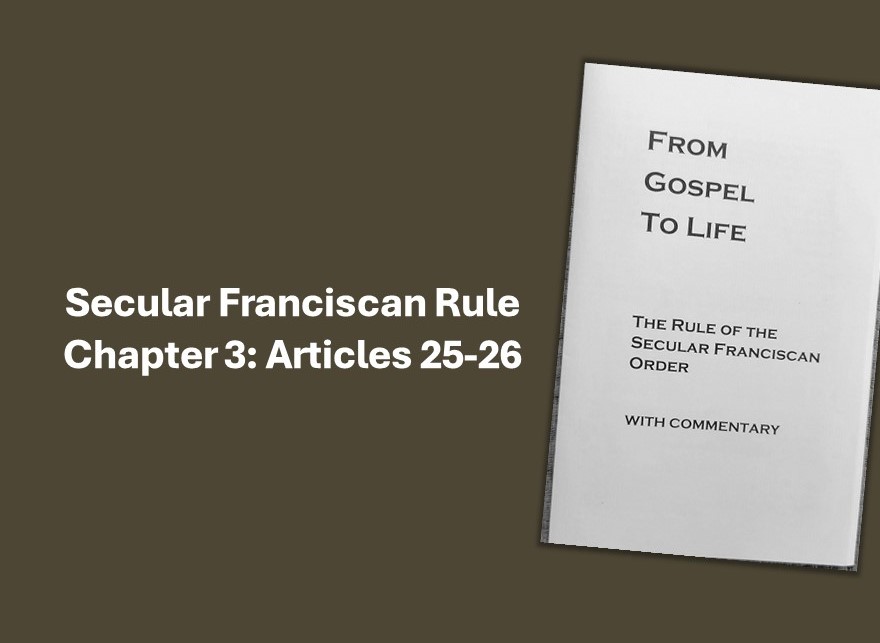
Chapter 3 Articles 25-26Article 25: Regarding expenses necessary for the life of the fraternity and the needs of worship, of the apostolate, and of charity, all the brothers and sisters should offer a contribution according to their means. Local fraternities should contribute toward the expenses of the higher fraternity councils.44
Article 26: As a concrete sign of communion and co-responsibility, the councils on various levels, in keeping with the constitutions, shall ask for suitable and well-prepared religious for spiritual assistance. They should make this request to the superiors of the four religious Franciscan families, to whom the Secular Fraternity has been united for centuries.
To promote fidelity to the charism as well as observance of the Rule and to receive greater support in the life of the fraternity, the minister or president, with the consent of the council, should take care to ask for a regular pastoral visit by the competent religious superiors as well as for a fraternal visit from those of the higher fraternities, according to the norm of the Constitutions.45
“And whoever observes these things let him be blessed in Heaven with the blessing of the Most High Father, and on earth with the blessing of His Beloved Son with the Most Holy Spirit the Paraclete.”
(Blessing of St. Francis found in The Testament of Francis)
Commentary
Article 25: Paragraph 25 points out that the voluntary contributions of the members finance the fraternity’s spiritual and temporal needs and activities. The fraternity, according to its means and agreed-upon arrangements, also contributes to the support of regional, national, and international fraternities. This paragraph is a contemporary application of the traditional Secular Franciscan values outlined in the very first rule, that the members are responsible for taking care of their own in whatever way is necessary.
Article 26: Finally, the rule speaks of the spiritual assistance of the clergy; it also refers to the need of the friars to share fellowship and their Franciscan vocation with the Secular Franciscans (26). Three important implications are drawn from this paragraph: First of all, since the Secular Franciscan Order is basically a lay order, the laity themselves are primarily responsible for their own spiritual growth and have the duty to get the proper assistance to achieve this end. Secondly, spiritual assistants should have a good background in Franciscanism and Vatican Council II (especially the role of the laity) and a willingness to share their own vocation with the Secular Franciscan community. Thirdly, the official visit to the fraternity is given a dual role; spiritual growth is ensured through pastoral visitation by a Franciscan friar. Organizational development is provided by the fraternal visitation of a higher lay leader.
For discussion with a partner, in a group, or to comment on in your journal:
+Re-read articles 25-26 and the commentary:
— Sharing in expenses
· What do you understand the monthly contribution to the fraternity to be?
· How would you explain this to a new member?
—Spiritual Assistance
· Does your fraternity have a spiritual assistant? If yes, is it a friar, sister, or a Secular Franciscan? If no, who takes care of the spiritual needs of your fraternity?
· In what ways does your spiritual assistant serve your fraternity? If you know your regional spiritual assistant, tell how he serves your region.
+++++++++++++++++++++++++++++++
Formación 17 de mayo, 2024 Por favor, comparta con su fraternidad local
La Fraternidad Nacional OFS-USA ha publicado recientemente “Del Evangelio a la Vida”, la Regla de la OFS con comentario. (Publicada en inglés y español) Esta serie ocasional que destacará el Prólogo (véase 17 y 24 de noviembre) y varios artículos de la Regla, el comentario y las preguntas para la discusión de la fraternidad. Se puede pedir “Evangelio a la vida” en español en este enlace:
https://www.secularfranciscansusa.org/wp-content/uploads/Order-Form_October_2023rev.pdf
Regla de la Orden Franciscana Seglar
Capítulo 3 Artículos 25-26
Artículo 25: Todos los hermanos y hermanas ofrezcan una contribución proporcionada a las propias posibilidades, para sufragar los gastos necesarios de la vida de la Fraternidad o para obras de culto, de apostolado y de caridad.Las Fraternidades locales contribuyan al pago de los gastos de los Consejos de las Fraternidades de nivel superior.44
Artículo 26: Como signo concreto de comunión y de corresponsabilidad, los Consejos de los diferentes niveles, de acuerdo con las Constituciones, pedirán religiosos idóneos y preparados para la asistencia espiritual a los Superiores de las cuatro Familias religiosas franciscanas, a las cuales, desde siglos, está unida la Fraternidad Seglar.
Para fomentar la fidelidad al carisma y la observancia de la Regla, y para recibir mayor ayuda en la vida de fraternidad, el Ministro o Presidente, de acuerdo con el Consejo, sea solícito en pedir periódicamente a los Superiores religiosos competentes la visita pastoral y a los responsables del nivel superior la visita fraterna, según las Constituciones.
“Y todo el que guarde estas cosas, sea colmado en el cielo de la bendición del altísimo Padre, y sea colmado en la tierra de la bendición del amado Hijo con el Espíritu Paráclito…” (Bendición de San Francisco, del Testamento)
Comentario
Artículo 25: El párrafo 25 señala que las contribuciones voluntarias de los miembros financian las necesidades y actividades espirituales y temporales de la fraternidad. La fraternidad, según sus medios y arreglos convenidos, contribuye también al sostenimiento de las fraternidades regionales, provinciales, nacionales e internacionales. Este párrafo es una aplicación contemporánea de los valores franciscanos seglares tradicionales descritos en la primera regla, que los miembros son responsables de cuidar de sí mismos en cualquier forma que sea necesaria.
Artículo 26: Finalmente, la regla habla de la asistencia espiritual del clero; se refiere también a la necesidad de los frailes de compartir la fraternidad y la vocación franciscana con los franciscanos seglares (26). De este párrafo se extraen tres implicaciones importantes: En primer lugar, dado que la Orden Franciscana Seglar es básicamente una orden laica, los laicos mismos son los principales responsables de su propio crecimiento espiritual y tienen el deber de obtener la asistencia adecuada para lograr este fin. En segundo lugar, los asistentes espirituales deben tener una buena formación en franciscanismo y el Concilio Vaticano II (especialmente el papel de los laicos) y la voluntad de compartir su propia vocación con la comunidad franciscana seglar. En tercer lugar, se da un doble papel a la visita oficial a la fraternidad; el crecimiento espiritual se asegura a través de la visita pastoral de un fraile franciscano. El desarrollo organizacional es proporcionado por la visita fraterna de un líder laico superior.
Para hablar con un compañero, en grupo o para comentar en su diario:
+Leer otra vez los artículos 25-26 y el comentario:
–Compartir los gastos
· ¿Cuál entiende que es la contribución mensual a la fraternidad?
· ¿Cómo le explicaría esto a un nuevo miembro?
–La asistencia espiritual
· ¿Su fraternidad tiene un asistente espiritual? En caso afirmativo, ¿es un fraile, una hermana o un franciscano seglar? Si no es así, ¿quién se ocupa de las necesidades espirituales de su fraternidad?
· ¿De qué manera su asistente espiritual sirve a su fraternidad? Si conoce a su asistente espiritual regional, describa cómo sirve a su región.
Diane F. Menditto, OFSVice Minister, National Fraternity, Secular Franciscan Order USAListen – Discern – Go Forth National Theme 2022-2025
Category: Formation Friday
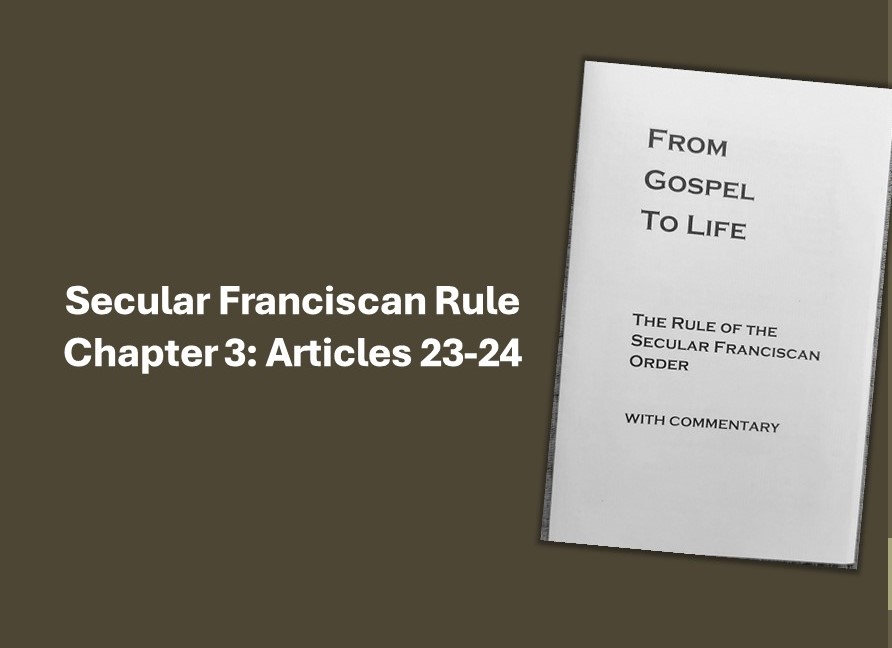
FORMATION FRIDAY – RULE, Chpt 3, Art.23-24 – May 17, 2024
(En español abajo) The Korean translation is also attached in a separate PDF.
Please share with your local fraternity.The OFS-USA National Fraternity has recently published “From Gospel to Life,” the OFS Rule with Commentary. This occasional series highlights the Prologue (See November 17th and 24th) and the articles of the Rule, the commentary, and questions based on this publication for fraternity discussion. You may order “Gospel to Life” at this link: https://www.secularfranciscansusa.org/wp-content/uploads/Order-Form_October_2023rev.pdf
Rule of the Secular Franciscan Order
Chapter 3 Article 23-24Article 23: Requests for admission to the Secular Franciscan Order must be presented to the local fraternity, whose council decides upon the acceptance of new brothers and sisters.
Admission into the Order is gradually attained through a time of initiation, a period of formation of at least one year, and profession of the Rule. The entire community is engaged in this process of growth by its own manner of living. The age for profession and the distinctive Franciscan sign are regulated by the statutes.
Profession by its nature is a permanent commitment.Members who find themselves in particular difficulties should discuss their problems with the council in fraternal dialogue. Withdrawal or permanent dismissal from the Order, if necessary, is an act of the fraternity council according to the norm of the constitutions.
Article 24: To foster communion among members, the council should organize regular and frequent meetings of the community as well as meeting with other Franciscan groups, especially with youth groups. It should adopt appropriate means for growth in Franciscan and ecclesial life and encourage everyone to a life of fraternity. This communion continues with deceased brothers and sisters through prayer for them.
Commentary
Article 23: Paragraph 23 points out the importance of the initial orientation, with elements of both instruction and experience directed toward a lifetime commitment in the Order. It also stresses the role of the council in the development of community, especially for new members and for errant members. A number of important implications develop from this paragraph: It is the responsibility of primarily the council (not just the president or the spiritual assistant) to lead new members to commitment and to exercise charity in particular difficulties. The life of the whole fraternity contributes to the growth of the new members and consolidates it. Furthermore, profession is highlighted as a mature and enduring decision to participate as fully as possible in the Church’s life and mission according to the manner of Francis.
Article 24: Paragraph 24 discusses the means to express a strong and lasting fraternity spirit. The regular and frequent meeting (ordinarily once a month) is the way to build fraternity with prayer, education, apostolic activity, dialogue, and leisure. Continuing education in Franciscanism and Church life is also stressed as a means of spiritual growth and community building.
For discussion with a partner, in a group, or to comment on in your journal:
+Re-read articles 23-24 and the commentary:
— Initial formation and entry into the order
· For professed members: Describe your experience during your time of discernment and initial formation.
· For those who have been admitted to initial formation: What is your experience with your fraternity’s formation program? How are you being prepared for fraternity life?
· What role has your fraternity played in helping you to discern or to maintain your vocation?
–The responsibility of the local fraternity
· Does your fraternity meet regularly in person?
· Describe a typical gathering. How does it help to strengthen you as a Secular Franciscan?
+++++++++++++++
Formación 17 de mayo, 2024 Por favor, comparta con su fraternidad local
La Fraternidad Nacional OFS-USA ha publicado recientemente “Del Evangelio a la Vida”, la Regla de la OFS con comentario. (Publicada en inglés y español) Esta serie ocasional que destacará el Prólogo (véase 17 y 24 de noviembre) y varios artículos de la Regla, el comentario y las preguntas para la discusión de la fraternidad. Se puede pedir “Evangelio a la vida” en español en este enlace:
https://www.secularfranciscansusa.org/wp-content/uploads/Order-Form_October_2023rev.pdf
Regla de la Orden Franciscana Seglar
Capítulo 3 Artículos 23-24
Artículo 23: Las peticiones de admisión en la Orden Franciscana Seglar se presentan a una Fraternidad local, cuyo Consejo decide la aceptación de los nuevos hermanos37.
La inserción se realiza mediante un tiempo de iniciación, un tiempo de formación de al menos, un año y la Profesión de la Regla38. En este itinerario gradual está comprometida toda la Fraternidad en su estilo de vida. Por lo que se refiere a la edad para la Profesión, y al signo distintivo franciscano39, procédase según los Estatutos.
La Profesión es, de por sí, un compromiso perpetuo40.
Los hermanos que se encuentren en dificultades particulares tratarán sus problemas en fraterno diálogo con el Consejo. La separación o definitiva dimisión de la Orden, si fuere necesaria, es un acto que compete al Consejo de la Fraternidad, en conformidad con las Constituciones. 41
Artículo 24: Para incrementar la comunión entre los miembros, el Consejo organice reuniones periódicas y encuentros frecuentes, incluso con otros grupos franciscanos, especialmente de jóvenes, adoptando los medios más adecuados para el crecimiento en la vida franciscana y eclesial, estimulando a todos a la vida de Fraternidad42.
Esta comunión se prolonga con los hermanos difuntos, ofreciendo sufragios por sus almas.43
Comentario
Artículo 23: El párrafo 23 señala la importancia de la orientación inicial, con elementos tanto de instrucción como de experiencia dirigidos hacia un compromiso de por vida en la Orden. También enfatiza el papel del consejo en el desarrollo de la comunidad, especialmente para los nuevos miembros y para los miembros errantes. A partir de este párrafo se desarrollan una serie de implicaciones importantes: Es responsabilidad primordial del consejo (no sólo del presidente o del asistente espiritual) llevar a los nuevos miembros al compromiso y ejercer la caridad en las dificultades particulares. La vida de toda la fraternidad contribuye al crecimiento de los nuevos miembros y lo consolida. Además, la profesión se destaca como una decisión madura y duradera de participar lo más plenamente posible en la vida y misión de la Iglesia a la manera de Francisco.
Artículo 24: El párrafo 24 trata sobre los medios para expresar un espíritu de fraternidad fuerte y duradero. El encuentro regular y frecuente (de ordinario una vez al mes) es el camino para fortalecer la fraternidad con la oración, la educación, la actividad apostólica, el diálogo y el ocio. También se enfatiza la educación continua en el franciscanismo y la vida de la Iglesia como un medio de crecimiento espiritual y desarrollo comunitario. Nuevamente, se enfatiza que la fraternidad deriva gran parte de su vida de un consejo vigoroso; por lo tanto, el consejo debe reunirse con regularidad para ocuparse de los asuntos ordinarios, fomentar la vivencia del Evangelio y mostrar interés por el crecimiento de todos sus miembros
Para hablar con un compañero, en grupo o para comentar en su diario:
+Leer otra vez los artículos 23-24 y el comentario:
— La Formación inicial y la entrada en la orden
· Para los miembros profesos: Describa su experiencia durante su tiempo de discernimiento y formación inicial.
· Para aquellos que han sido admitidos a la formación inicial: ¿Cuál es su experiencia con el programa de formación de su fraternidad? ¿Cómo le está preparando para la vida de fraternidad?
· ¿Qué papel ha desempeñado su fraternidad para ayudarle a discernir o a mantener su vocación?
–La responsabilidad de la fraternidad local
· ¿Su fraternidad se reúne regularmente en persona?
· Describa un encuentro típico. ¿Cómo le ayuda a fortalecerse como franciscano seglar?
Diane F. Menditto, OFSVice Minister, National Fraternity, Secular Franciscan Order USAListen – Discern – Go Forth National Theme 2022-2025
FORMATION FRIDAY – RULE – Chapter 3, Articles 21-22 – May 10, 2024
Korean translation attached as a separate PDF.
Please share with your local fraternity.The OFS-USA National Fraternity has recently published “From Gospel to Life,” the OFS Rule with Commentary. This occasional series highlights the Prologue (See November 17th and 24th) and the articles of the Rule, the commentary, and based on this publication for fraternity discussion. You may order “Gospel to Life” at this link: https://www.secularfranciscansusa.org/wp-content/uploads/Order-Form_October_2023rev.pdf
Rule of the Secular Franciscan Order
Chapter 3 Article 21-22Article 21: On various levels, each fraternity is animated and guided by a council and minister (or president) who are elected by the professed according to the Constitutions.
Their service, which lasts for a definite period, is marked by a ready and willing spirit and is a duty of responsibility to each member and to the community.
Within themselves the fraternities are structured in different ways according to the norm of the Constitutions, according to the various needs of their members and their regions, and under the guidance of their respective council.
Article 22: The local fraternity is to be established canonically. It becomes the basic unit of the whole Order and a visible sign of the Church, the community of love. This should be the privileged place for developing a sense of Church and the Franciscan vocation and for enlivening the apostolic life of its members.
Commentary
Article 21: This fraternity is bound together with the leadership of a president and a council who are ready and willing to serve, and it is expressed in diversified ways according to the needs of the area. Two implications ensue from the first part of this paragraph: the importance of choosing available and competent and willing leaders and, secondly, the responsibility of Secular Franciscans themselves to exercise complete control in administrative and temporal matters. The stress of diversified fraternity styles implies that the structure of the community must be tailored to the needs of those who form it.
Article 22: The local fraternity is the basic living organism of the whole Secular Franciscan Order and a visible sign of the whole Church in miniature. Hence, its beginning and development is guided by Church authority, for it is the center for spiritual growth, apostolic outreach, and loving union among its members. This paragraph calls the members to relate with one another more personally and intensely and stresses the ties with the local bishop.
For discussion with a partner, in a group, or to comment on in your journal:
+Re-read article 21 and the commentary:
— Each level of fraternity in our order is animated and guided by a council.
· How does your local council guide your fraternity? Can you name the members and tell what they do?
· What do you know about the regional executive council?
· Can you share anything you know about the national or international councils?
· If you are not sure about any of the above questions, where can you find out more?
+Re-read article 22 and the commentary:
–The local fraternity is the visible sign of the Church…
· Have you ever seen your local fraternity’s document of establishment?
· Why do you think the local fraternity is established by the Church?
+++++++++++++++
Formación 10 de mayo, 2024 Por favor, comparta con su fraternidad local
La Fraternidad Nacional OFS-USA ha publicado recientemente “Del Evangelio a la Vida”, la Regla de la OFS con comentario. (Publicada en inglés y español) Esta serie ocasional que destacará el Prólogo (véase 17 y 24 de noviembre) y varios artículos de la Regla, el comentario y las preguntas para la discusión de la fraternidad. Se puede pedir “Evangelio a la vida” en español en este enlace:
https://www.secularfranciscansusa.org/wp-content/uploads/Order-Form_October_2023rev.pdf
Regla de la Orden Franciscana Seglar
Capítulo 3 Artículos 21-22
Artículo 21: En los diferentes niveles, cada Fraternidad es animada y guiada por un Consejo y un Ministro (o Presidente), elegidos por los profesos en conformidad con las Constituciones.
Su servicio, que dura un tiempo limitado, es un compromiso de disponibilidad y de responsabilidad para con cada uno y para con el grupo.
Las Fraternidades, según lo establecido en las Constituciones, se estructuran internamente de manera diversa, conforme a las necesidades de sus miembros y de las regiones, bajo la dirección del Consejo respectivo.
Artículo 22: La Fraternidad local necesita ser canónicamente erigida, y se convierte así en la primera célula de toda la Orden y en signo visible de la Iglesia, comunidad de amor. Ésta deberá ser el lugar privilegiado para desarrollar el sentido eclesial y la vocación franciscana, y, además, para animar la vida apostólica de sus miembros.
Comentario
Artículo 21: Esta fraternidad está ligada al liderazgo de un presidente y un consejo listos y dispuestos a servir, y se expresa de formas diversas según las necesidades del área (21). Dos implicaciones se derivan de la primera parte de este párrafo: la importancia de elegir líderes disponibles, competentes y dispuestos y, en segundo lugar, la responsabilidad de los franciscanos seglares mismos de ejercer un control completo en asuntos administrativos y temporales. El énfasis en los estilos de fraternidad diversificados implica que la estructura de la comunidad debe adaptarse a las necesidades de quienes la forman.
Artículo 22: La fraternidad local es el organismo vivo básico de toda la Orden Franciscana Seglar y un signo visible de toda la Iglesia en miniatura (22). Por lo tanto, su inicio y desarrollo está guiado por la autoridad de la Iglesia, pues es el centro del crecimiento espiritual, la extensión apostólica y la unión cariñosa entre sus miembros. Este párrafo llama a los miembros a relacionarse más personal e intensamente y subraya los vínculos con el obispo local.
Para hablar con un compañero, en grupo o para comentar en tu diario:
+Vuelva a leer el artículo 21 y el comentario:
–Cada nivel de fraternidad en nuestra orden está animado y guiado por un consejo.
· ¿Cómo orienta su consejo local su fraternidad? ¿Puedes nombrar a los miembros y decir lo que hacen?
· ¿Qué sabe del consejo ejecutivo regional?
· ¿Puede compartir algo que sepas sobre los consejos nacionales o internacionales?
· Si no está seguro de alguna de las preguntas anteriores, ¿dónde puede encontrar más información?
+Vuelve a leer el artículo 22 y el comentario:
–La fraternidad local es el signo visible de la Iglesia…
· ¿Ha visto alguna vez el documento de fundación de su fraternidad local?
· ¿Por qué cree que la fraternidad local es fundada por la Iglesia?
Diane F. Menditto, OFSVice Minister, National Fraternity, Secular Franciscan Order USAListen – Discern – Go Forth National Theme 2022-2025
FORMATION FRIDAY – RULE, Chapter 3 – May 3, 2024
En español abajo) KOREAN TRANSLATION IS ATTACHED IN PDF FORMAT. Please share with your local fraternity.
The OFS-USA National Fraternity has recently published “From Gospel to Life,” the OFS Rule with Commentary. This occasional series highlights the Prologue (See November 17th and 24th) and the articles of the Rule, the commentary, and questions based on this publication for fraternity discussion. You may order “Gospel to Life” at this link: https://www.secularfranciscansusa.org/wp-content/uploads/Order-Form_October_2023rev.pdf
Rule of the Secular Franciscan Order
Chapter 3 Article 20Article 20: The Secular Franciscan Order is divided into fraternities of various levels—local, regional, national, and international. Each one has its own moral personality in the Church. These various fraternities are coordinated and united according to the norm of this Rule and of the Constitutions.
Commentary
Article 20: Ordinarily, the gospel life of Secular Franciscans outlined in the second chapter is developed and sustained within the framework of an organized community, called a fraternity, in each locality. Hence, “fraternity” is the topic of chapter three (20–26). These fraternities are living and active communities. They serve as expressions of loving and trusting relationships between members and as a legal unit of government. They exist on various levels and have their own special character (20). They are given life and direction by their lay leadership and particular characteristics by their local needs (21). They exist with the approval of the Church (22) and are nurtured by new members who have been prepared for commitment (23). Their meetings and contributions express their will to and sense of community (24–25). Their spiritual growth is developed through the assistance of clergy and religious (26).
(Articles 21 through 26 will be covered in subsequent weeks and will complete our series.)
The chapter (Chapter 3) begins with outlining the fraternity as the characteristic of all Secular Franciscan groupings, whether local, regional, provincial, national, or international (20). A new dimension given to Secular Franciscan life because of this paragraph is awareness of (and, hence, a mandate to achieve) a fraternity spirit and style operating on levels beyond that of the local fraternity. Regional, provincial, national, or international groupings are not just a federation of independent, semiautonomous fraternities or a forum for exchange but actually a fully operating community with its own character, interactivity, and authority as defined by the statutes.
For discussion with a partner, in a group, or to comment on in your journal:
+Re-read article 20 and the commentary:
—The local fraternity is the heartbeat of the Order.
· Share some observations about your local fraternity.
· Why is fraternity important to you?
· How does your local fraternity add to or shape your life as a Secular Franciscan?
–The other levels of fraternity have their own special character…
· What do you know about the regional, national, and international fraternities?
· What is the name of your region? Who is your regional minister? How does your region enhance your life as a Secular Franciscan?
· What is the name of your national minister? What services does the national fraternity (NAFRA) provide for you?
· What is the name of our general minister? What do you know about the services the international fraternity (CIOFS) provides for you?
· What would you like to know about the other levels of fraternity?
+++++++++++++++
Formación 3 de mayo, 2024 Por favor, comparta con su fraternidad local
La Fraternidad Nacional OFS-USA ha publicado recientemente “Del Evangelio a la Vida”, la Regla de la OFS con comentario. (Publicada en inglés y español) Esta serie ocasional que destacará el Prólogo (véase 17 y 24 de noviembre) y varios artículos de la Regla, el comentario y las preguntas para la discusión de la fraternidad. Se puede pedir “Evangelio a la vida” en español en este enlace:
https://www.secularfranciscansusa.org/wp-content/uploads/Order-Form_October_2023rev.pdf
Regla de la Orden Franciscana Seglar
Capítulo 3 Artículo 20
Artículo 20: La Orden Franciscana Seglar se articula en Fraternidades, de diversos niveles: local, regional, nacional e internacional. Cada una de estas Fraternidades tiene su propia personalidad moral en la Iglesia34. Las Fraternidades de los diversos niveles se coordinan y unen entre sí, de acuerdo con lo que se establece en esta Regla y en las Constituciones.
Comentario
Artículo 20: De ordinario, la vida evangélica de los franciscanos seglares esbozada en el segundo capítulo se desarrolla y se sostiene en el marco de una comunidad organizada, llamada fraternidad, en cada localidad. Por lo tanto, la «fraternidad» es el tema del capítulo tres (20–26). Estas fraternidades son comunidades vivas y activas. Sirven como expresiones de la relación cariñosa y confiada entre los miembros y como unidad legal de gobierno. Existen en varios niveles y tienen su propio carácter especial (20). Sus necesidades locales les dan vida y características particulares (21). Existen con la aprobación de la Iglesia (22) y son nutridos por nuevos miembros que han sido preparados para hacer el compromiso. (23). Sus reuniones y contribuciones monetarias expresan su voluntad y sentido de comunidad (24-25). Su crecimiento espiritual se desarrolla a través de la asistencia del clero y de los religiosos (26).
(Los artículos 21 a 26 se tratarán en las semanas siguientes y completarán nuestra serie).El capítulo 3 comienza perfilando la fraternidad como característica de todas las agrupaciones franciscanas seglares, ya sean locales, regionales, provinciales, nacionales o internacionales (20). Una nueva dimensión dada a la vida franciscana seglar debido a este párrafo es la conciencia de (y, por lo tanto, un mandato para lograr) un espíritu y estilo de fraternidad que opera en niveles más allá de la fraternidad local. Las agrupaciones regionales, provinciales, nacionales o internacionales no son simplemente una federación de fraternidades independientes y semiautónomas o un foro de intercambio, sino una comunidad en pleno funcionamiento con su propio carácter, interactividad y autoridad como se define en los estatutos.
Para platicar con un compañero, en un grupo o para comentar en su diario:
+Vuelva a leer el artículo 20 y el comentario:
—La fraternidad local es el latido del corazón de la Orden.
· Comparta algunas observaciones sobre su fraternidad local.
· ¿Por qué es importante para usted la fraternidad?
· ¿De qué manera su fraternidad local contribuye o da forma a su vida como franciscano seglar?
–Los otros niveles de fraternidad tienen su propio carácter especial…
· ¿Qué sabe de la fraternidad regional, nacional e internacional?
· ¿Cuál es el nombre de su región? ¿Quién es su ministro regional? ¿Cómo mejora su región su vida como franciscano seglar?
· ¿Cómo se llama su ministro nacional? ¿Qué servicios le ofrece la fraternidad nacional (NAFRA)?
· ¿Cómo se llama nuestro ministro general? ¿Qué sabe de los servicios que le presta la fraternidad internacional (CIOFS)?
· ¿Qué le gustaría saber sobre los otros niveles de fraternidad?
Diane F. Menditto, OFSVice Minister, National Fraternity, Secular Franciscan Order USAListen – Discern – Go Forth National Theme 2022-2025
FORMATION FRIDAY – JPIC #3 – April 26, 2024
(En español abajo) THE KOREAN TRANSLATION IS ALSO ATTACHED IN A SEPARATE PDF
Justice, Peace, and the Integrity of Creation #3 (Our series on the Rule will continue next month.)
Thank you to Joe Makely, OFS, National JPIC Animator for contributing this piece.
What does it mean that our Rule is influenced by Vatican II? It means we experienced a renewal.
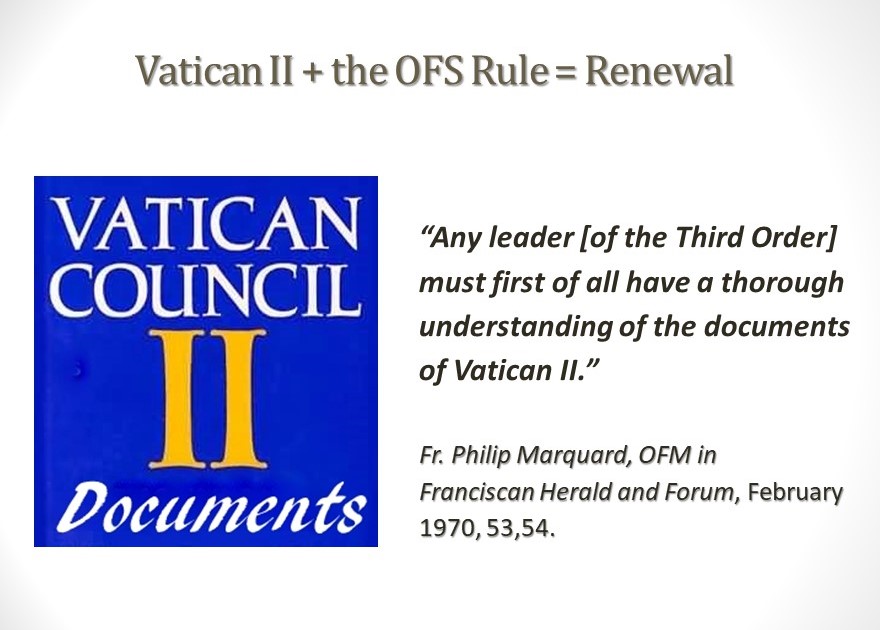
At the close of Vatican II, the friars led the tertiaries to follow long sought after reforms. Their guidelines included the major documents of Vatican II about the laity. It was a very exciting time for the Third Order, when we finally gained our autonomy and an affirmation of the lay charism. One of the luminaries was Fr. Philip Marquard, OFM, who wrote in 1970: “Any leader [of the Third Order] must first of all have a thorough understanding of the documents of Vatican II. They must be read and reread so that one understands their true direction. The Church is not looking for mere adaptation, but renewal. There was nothing Pope John stressed more strongly than this point.” (See note 1)
The process of renewal included a very serious study of the early penitents, as described by Mrs. Pamona Pefanis, a Third Order participant from Canada who attended the gatherings in Assisi: “The strongest impression I received from the entire historians’ congress was that the 13th Century Penitenti were deeply involved in the social and political problems of their period, and that we must emerge from our cocoon of pious devotions and embroil ourselves in the problems of our day, bringing to them the same evangelical fervor that motivated the 13th Century members of our order.” (See note 2)
So that’s a partial picture of how we got those lively apostolic phrases in our Rule, like “promoting justice [with] courageous initiatives” and how we eventually got the Apostolic Commissions, which became (in accord with the 1st Order) Justice, Peace and the Integrity of Creation. The “how” of JPIC, our emphasis on loving dialogue and obedience, is central to what we do and that goes back to Francis himself, who said of his friars: “… they should be gentle, peaceful, and unassuming, courteous and humble, speaking respectfully to everyone, as is expected of them.” (See note 3) It did not mean departure from the vision of the founder, but was a call to restudy, reembrace that vision and adapt it to the needs of the current generation.
For discussion or to answer in your journal:
Question 1. In what ways is my fraternity bringing evangelical fervor to the problems of society?
Question 2. Have I read the documents of Vatican II myself, more than once? After reading them again, write down any questions you have and see if your group (or an outside source) will answer them for you.
Question 3. Does my region/fraternity have a JPIC animator? Discuss with the group who might be gifted in this area.
Challenge: Consider initiating a fraternity formation or workshop based on Article 14.1 of the General Constitutions: “They should commit themselves to a faith-inspired reflection on the Church, its mission in today’s world and the role of the Franciscan laity within it. They should take up the challenges and accept the responsibilities that this reflection will lead them to discover.” (See note 4)
Notes
1-Franciscan Herald and Forum, February 1970, 53,54.
2-A History of the Secular Franciscan Order in the United States, Volume IIA, p 409
3-ST. Francis of Assisi, Rule of 1223, Chapter 3, Omnibus of Sources, P.60
4-OFS General Constitutions, Article 14.1
Formación (Por favor, comparta con su fraternidad local)
La justicia, la paz y la integridad de la creación #3 (Nuestra serie sobre la Regla continuará el mes próximo.)
Le agradecemos a Joe Makely, OFS, Animador nacional de JPIC por contribuir esta materia.
¿Qué significa que nuestra Regla está influenciada por el Vaticano II? Significa que experimentamos una renovación.
Al final del Concilio Vaticano II, los frailes condujeron a los terciarios a seguir las reformas largamente buscadas. Sus directrices incluían los principales documentos del Vaticano II sobre los laicos. Fue un tiempo muy emocionante para la Tercera Orden, cuando finalmente obtuvimos nuestra autonomía y una afirmación del carisma laical. Una de las luminarias fue el P. Philip Marquard, OFM, quien escribió en 1970: “Cualquier líder [de la Tercera Orden] debe, en primer lugar, tener un conocimiento profundo de los documentos del Vaticano II. Hay que leerlos y releerlos para que uno entienda su verdadera dirección. La Iglesia no busca una mera adaptación, sino una renovación. No había nada que el Papa Juan enfatizara con más fuerza que este punto. (Vea la nota 1)
El proceso de renovación incluyó un estudio muy serio de los primeros penitentes, como lo describe la Sra. Pamona Pefanis, una participante de la Tercera Orden de Canadá que asistió a las reuniones en Asís: “La impresión más fuerte que recibí de todo el congreso de historiadores fue que los penitenti del siglo XIII estaban profundamente involucrados en los problemas sociales y políticos de su época, y que debíamos salir de nuestro capullo de devociones piadosas y enredarnos en los problemas de nuestro tiempo, llevándoles el mismo fervor evangélico que motivó a los 13ésimo Centenarias miembros de nuestra orden”. (Vea la nota 2)
Así que esa es una imagen parcial de cómo obtuvimos esas frases apostólicas vivas en nuestra Regla, como “promover la justicia [con] iniciativas valientes” y cómo finalmente obtuvimos las Comisiones Apostólicas, que se convirtieron (de acuerdo con la 1ª Orden) la justicia, la paz y la integridad de la creación. El “cómo” de JPIC, nuestro énfasis en Diálogo amoroso y obediencia, es central en lo que hacemos y que se remonta al mismo Francisco, que dijo de sus frailes: “… Deben ser gentiles, pacíficos y modestos, corteses y humildes, hablando con respeto a todos, como se espera de ellos. (Vea la nota 3) El Concilio Vaticano II no significó apartarse de la visión del fundador, sino que fue un llamado a reestudiar, retomar esa visión y adaptarla a las necesidades de la generación actual.
Para platicar o contestar en su diario:
Pregunta 1. ¿Cómo está mi fraternidad llevando fervor evangélico a los problemas de la sociedad?
Pregunta 2. ¿He leído yo mismo los documentos del Vaticano II, más de una vez? Después de leerlos otra vez, apunte las preguntas que tenga y vea si alguien en su grupo (o un “experto” de afuera) tenga las respuestas.
Pregunta 3. ¿Mi región/fraternidad tiene un animador de JPIC? (Hablen con su grupo para ver si pueden pensar en quién tiene talento en esta área.)
Desafío: Considerar la posibilidad de iniciar una formación o taller de fraternidad basado en el artículo 14, p1 de las Constituciones Generales: “Deben comprometerse a una reflexión inspirada en la fe sobre la Iglesia, su misión en el mundo de hoy y el papel de los laicos franciscanos dentro de ella. Deben asumir los desafíos y aceptar las responsabilidades que esta reflexión les llevará a descubrir”. (Vea la nota 4)
Notas
1-Heraldo y Foro Franciscano, febrero de 1970, 53,54.
2-Una historia de la Orden Franciscana Seglar en los Estados Unidos, Volumen IIA, p 409
3-San Francisco de Asís, Regla de 1223, Capítulo 3, Ómnibus de Fuentes, p.60
4-Constituciones Generales de la OFS, artículo 14, p 1
Diane F. Menditto, OFSVice Minister, National Fraternity, Secular Franciscan Order USAListen – Discern – Go Forth National Theme 2022-2025