Please share with your fraternities (En español abajo) Korean translation attached in a separate PDF.
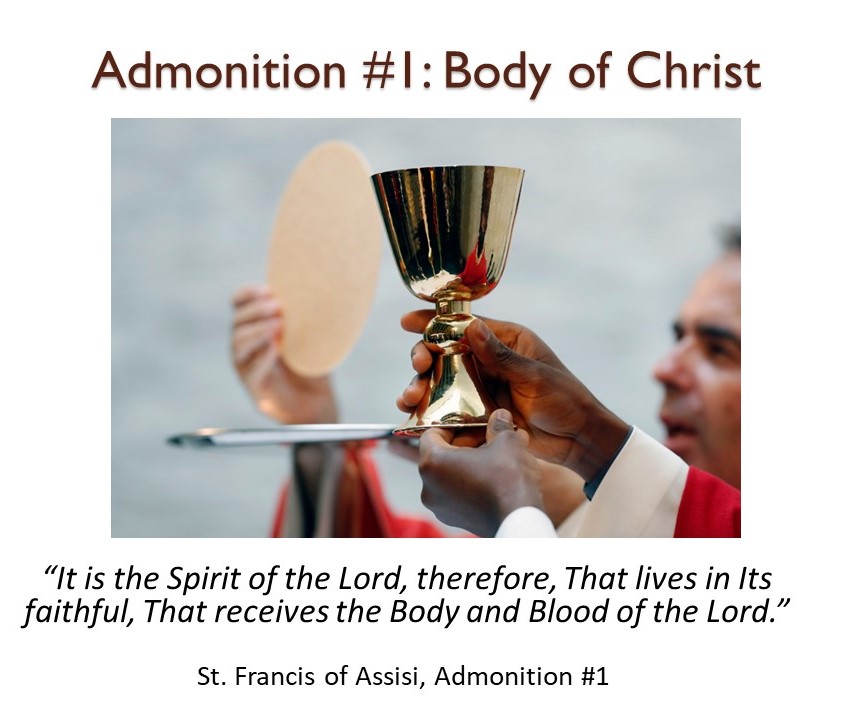
Admonition #1 The Body of Christ By St. Francis
Since July is the month of the Precious Blood, and we are also celebrating the three-year Eucharistic Revival, we repeat some of our previous posts on the Eucharist this month.
[I. The Body of Christ]1The Lord Jesus says to his disciples: I am the way, the truth and the life; no one comes to the Father except through me. 2If you knew me, you would also know my Father; and from now on, you do know him and have seen him. 3Philip says to him: Lord, show us the Father and it will be enough for us. 4Jesus says to him: Have I been with you for so long a time and you have not known me? Philip, whoever sees me sees my Father as well. Jn 14:6-9
5The Father dwells in inaccessible light, 1 Tm 6:16 and God is spirit, Jn 4:24 and no one has ever seen God. Jn 1:18 6Therefore He cannot be seen except in the Spirit because it is the Spirit that gives life; the flesh has nothing to offer. Jn 6:63 7But because He is equal to the Father, the Son is not seen by anyone other than the Father or other than the Holy Spirit.
8All those who saw the Lord Jesus according to the humanity, therefore, and did not see and believe according to the Spirit and the Divinity that He is the true Son of God were condemned. 9Now in the same way, all those who see the sacrament sanctified by the words of the Lord upon the altar at the hands of the priest in the form of bread and wine, and who do not see and believe according to the Spirit and the Divinity that it is truly the Body and Blood of our Lord Jesus Christ, are condemned.10[This] is affirmed by the Most High Himself Who says:
This is my Body and the Blood of my new covenant [which will be shed for many]; Mk 14:22 11and Whoever eats my flesh and drinks my blood has eternal life. Mk 14:24 12It is the Spirit of the Lord, Jn 6:55 therefore, That lives in Its faithful, That receives the Body and Blood of the Lord. 13All others who do not share in this same Spirit and presume to receive Him eat and drink judgment on themselves. 1 Cor 11:29
14Therefore: children, how long will you be hard of heart? Ps 4:3 15Why do you not know the truth and believe in the Son of God? Jn 9:35 16Behold, each day He humbles Himself as when He came from the royal throne Phil 2:8 into the Virgin’s womb; Wis 18:15 17each day He Himself comes to us, appearing humbly; 18each day He comes down from the bosom of the Father Jn 1:18 upon the altar in the hands of a priest.a
19As He revealed Himself to the holy apostles in true flesh, so He reveals Himself to us now in sacred bread. 20And as they saw only His flesh by an insight of their flesh, yet believed that He was God as they contemplated Him with their spiritual eyes, 21let us, as we see bread and wine with our bodily eyes, see and firmly believe that they are His most holy Body and Blood living and true. 22And in this way the Lord is always with His faithful, as He Himself says: Behold I am with you until the end of the age.
Questions to discuss or to answer in your journal
+ After reading this admonition carefully, note what Francis’s feelings are about the Eucharist.
+What do you believe about the Eucharist? What part does receiving the Eucharist play in your spiritual life?
https://www.franciscantradition.org/francis-of-assisi-early-documents/the-saint/writings-of-francis/the-undated-writings/the-admonitions/144-fa-ed-1-page-128A good video by Bishop Barron on the Eucharist:
https://www.youtube.com/watch?v=sgy_TFeIyiM&t=126s (Real Presence)
Visit the Eucharistic Revival website: https://www.eucharisticrevival.org/
Julio es el mes de la Preciosa Sangre de Cristo—Admonición #1 de San Francisco 5 de julio, 2024
Dado que julio es el mes de la Preciosa Sangre, y también estamos celebrando el Avivamiento Eucarístico de tres años, repetimos algunas de nuestras publicaciones anteriores sobre la Eucaristía este mes.
Cap. I: Del cuerpo del Señor
1Dice el Señor Jesús a sus discípulos: Yo soy el camino, la verdad y la vida; nadie va al Padre sino por mí. 2Si me conocierais a mí, ciertamente conoceríais también a mi Padre; y desde ahora lo conoceréis y lo habéis visto. 3Le dice Felipe: Señor, muéstranos al Padre y nos basta. 4Le dice Jesús: ¿Tanto tiempo hace que estoy con vosotros y no me habéis conocido? Felipe, el que me ve a mí, ve también a mi Padre (Jn 14,6-9).
5El Padre habita en una luz inaccesible (cf. 1 Tim 6,16), y Dios es espíritu (Jn 4,24), y a Dios nadie lo ha visto jamás (Jn 1,18). 6Por eso no puede ser visto sino en el espíritu, porque el espíritu es el que vivifica; la carne no aprovecha para nada (Jn 6,64). 7Pero ni el Hijo, en lo que es igual al Padre, es visto por nadie de otra manera que el Padre, de otra manera que el Espíritu Santo.
8De donde todos los que vieron al Señor Jesús según la humanidad, y no vieron y creyeron según el espíritu y la divinidad que él era el verdadero Hijo de Dios, se condenaron. 9Así también ahora, todos los que ven el sacramento, que se consagra por las palabras del Señor sobre el altar por mano del sacerdote en forma de pan y vino, y no ven y creen, según el espíritu y la divinidad, que sea verdaderamente el santísimo cuerpo y sangre de nuestro Señor Jesucristo, se condenan, 10como lo atestigua el mismo Altísimo, que dice: Esto es mi cuerpo y mi sangre del nuevo testamento, [que será derramada por muchos] (cf. Mc 14,22.24); 11y: Quien come mi carne y bebe mi sangre, tiene vida eterna (cf. Jn 6,55). 12De donde el espíritu del Señor, que habita en sus fieles, es el que recibe el santísimo cuerpo y sangre del Señor. 13Todos los otros que no participan del mismo espíritu y se atreven a recibirlo, comen y beben su condenación (cf. 1 Cor 11,29).
14De donde: Hijos de los hombres, ¿hasta cuándo seréis de pesado corazón? (Sal 4,3). 15¿Por qué no reconocéis la verdad y creéis en el Hijo de Dios? (cf. Jn 9,35). 16Ved que diariamente se humilla (cf. Fil 2,8), como cuando desde el trono real (Sab 18,15) vino al útero de la Virgen; 17diariamente viene a nosotros él mismo apareciendo humilde; 18diariamente desciende del seno del Padre (cf. Jn 1,18) sobre el altar en las manos del sacerdote.
19Y como se mostró a los santos apóstoles en carne verdadera, así también ahora se nos muestra a nosotros en el pan sagrado. 20Y como ellos, con la mirada de su carne, sólo veían la carne de él, pero, contemplándolo con ojos espirituales, creían que él era Dios, 21así también nosotros, viendo el pan y el vino con los ojos corporales, veamos y creamos firmemente que es su santísimo cuerpo y sangre vivo y verdadero. 22Y de este modo siempre está el Señor con sus fieles, como él mismo dice: Ved que yo estoy con vosotros hasta la consumación del siglo (cf. Mt 28,20).
https://www.franciscanos.org/esfa/escritossf.html#adm
Preguntas para discutir o responder en su diario
+ Después de leer esta Admonición con atención, apunte cuáles son los sentimientos de Francisco sobre la Eucaristía.
+ ¿Qué cree usted sobre la Eucaristía? ¿Qué papel juega el recibir la Eucaristía en su vida espiritual?
Un buen video (en inglés) del obispo Barron sobre la Eucaristía:
https://www.youtube.com/watch?v=sgy_TFeIyiM&t=126s (Presencia real)
Visite el sitio del Avivamiento Eucarístico: https://es.eucharisticrevival.org/Diane F. Menditto, OFSVice Minister, National Fraternity, Secular Franciscan Order USAListen – Discern – Go Forth National Theme 2022-2025
Category: Formation Friday
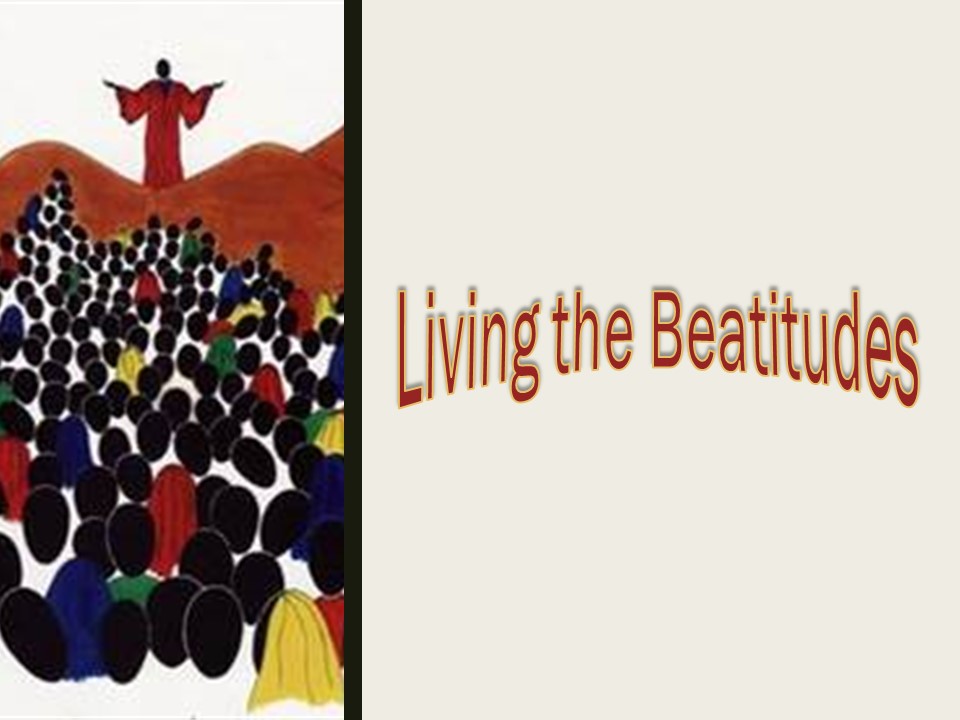
FORMATION FRIDAY -Living the Beatitudes – June 28, 2024
(en español abajo) Korean translation attached in a separate PDF.
Please share with your local fraternity
Living the Beatitudes: Matthew 5: 3-12: Read prayerfully each of the Beatitudes (Matthew 5: 3-12) and think about the comments. Also read the indicated pages in the Franciscan Journey and the articles of the Rule noted below.
“BLESSED are the poor in spirit, for theirs is the kingdom of heaven.”
· Do not cling to material goods or to personal opinions.
· This brings freedom to follow the path of conversion.
+Read Franciscan Journey p. 211 and Article 11 of the OFS Rule
“BLESSED are they who mourn, for they will be comforted.”
· Mourn for personal and societal sinfulness; Discover our mistakes in relationships.
· Conversion brings comfort.
+Read Franciscan Journey pp. 211-212; Read the Prologue to our Rule and Article 7
“ BLESSED are the meek, for they will inherit the land.”
· Those who are meek (gentle) see what needs to be done and do it without arrogance or dominance.
· This spirit shows us what good relationships can accomplish.
+Read Franciscan Journey p. 212; Read Article 13 of our Rule.
“BLESSED are they who hunger and thirst for righteousness, for they will be satisfied.”
· We are faithful to building a world where all people are treated with dignity.
+Read Franciscan Journey p. 212; Refer to article 15 of our Rule.
“BLESSED are the merciful, for they will be shown mercy.”
· This reflects the spirit of Francis and Clare. We offer the hand of mercy because this is what Jesus did.
· “Show mercy and seek reconciliation.”
+Read Franciscan Journey p. 212; Refer to article 12 of our Rule
“BLESSED are the clean of heart, for they will see God.”
· We are willing to deal with reality in a faith-filled way—we are clear-sighted.
· We see the presence of God in all.
+Read Franciscan Journey p. 213; Refer to articles 5, 12, 13 of our Rule
“BLESSED are the peacemakers, for they will be called children of God.”
· We seek “both/and” solutions rather than “either/or.” We listen to one another.
+ Read Franciscan Journey p. 213; Refer to article 19 of our Rule
“BLESSED are they who are persecuted for the sake of righteousness, for theirs is the kingdom of heaven.
BLESSED are you when they insult you and persecute you and utter every kind of evil against you [falsely] because of me. “ “Rejoice and be glad, for your reward will be great in heaven. Thus, they persecuted the prophets who were before you.”
· If we follow the Gospel, we may find that others will persecute us.
· We can rejoice because our reward will be great in heaven.
+ Read Franciscan Journey p. 213; Refer to the Prologue to our Rule
To discuss or to comment on in your journal.
+ Which of the Beatitudes most reflects your personal commitment as a Secular Franciscan?
+ After reading the articles of the Rule mentioned above, how do Franciscans live the Beatitudes in a special way?
++++++++++++++++++
Formación 28 de junio, 2024 Compartir con su fraternidad local.
Vivir las Bienaventuranzas: Mateo 5: 3-12: Lea con espíritu de oración cada una de las Bienaventuranzas (Mateo 5: 3-12) y piense en los comentarios a continuación. Lea también las páginas indicadas en el Camino Franciscano.
“BIENAVENTURADOS los pobres de espíritu, porque de ellos es el reino de los cielos”.
• No se aferre a bienes materiales ni a opiniones personales. Esto trae libertad para seguir el camino de la conversión.
+ Leer La jornada franciscana p. 225 y el Artículo 11 de nuestra regla.
“BIENAVENTURADOS los que lloran, porque ellos recibirán consolación.”
• Llorar por la pecaminosidad personal y social; Descubrir nuestros errores en las relaciones
• La conversión trae consuelo.
+ Leer Jornada franciscana págs. 225-226; Consulte el artículo 7 y el prólogo de nuestra regla.
“BIENAVENTURADOS los mansos, porque ellos heredarán la tierra”.
• Aquellos que son mansos (gentiles) ven lo que hay que hacer y lo hacen sin arrogancia ni dominio.
• Este espíritu nos muestra lo que pueden lograr las buenas relaciones.
+ Leer Jornada franciscana p. 226 y el artículo 13 de nuestra regla.
“BIENAVENTURADOS los que tienen hambre y sed de justicia, porque ellos serán saciados”.
• Somos fieles a la construcción de un mundo donde todas las personas sean tratadas con dignidad.
+ Leer Jornada franciscana p. 226; Consulte el artículo 15 de nuestra Regla.
“BIENAVENTURADOS los misericordiosos, porque se les mostrará misericordia”.
• Esto refleja el espíritu de Francisco y Clara. Ofrecemos la mano de la misericordia porque esto es lo que hizo Jesús.
• “Muestren misericordia y busquen la reconciliación”.
+ Leer Jornada franciscana p. 226; Consulte el artículo 12 de nuestra regla.
“BIENAVENTURADOS los limpios de corazón, porque ellos verán a Dios”.
• Estamos dispuestos a lidiar con la realidad de una manera llena de fe: somos lúcidos.
• Vemos la presencia de Dios en todos.
+ Leer Jornada franciscana p. 227; Consulte los artículos 5, 12, 13 de nuestra Regla.
“BIENAVENTURADOS los pacificadores, porque ellos serán llamados hijos de Dios”.
• Buscamos soluciones de “ambos / y” en lugar de “uno u otro”.
• Nos escuchamos unos a otros.
+ Leer Jornada franciscana p. 226; Consulte el artículo 19 de nuestra regla.
“BIENAVENTURADOS los que padecen persecución por causa de la justicia, porque de ellos es el reino de los cielos.
BIENAVENTURADO eres cuando te insultan, te persiguen y profieren todo tipo de mal contra ti [falsamente] por mi causa. “
“Alégrense y muéstrense contentos, porque su recompensa será grande en los cielos. Así persiguieron a los profetas que fueron antes de ustedes ”.
• Si seguimos el Evangelio, es posible que otros nos persigan.
• Podemos regocijarnos porque nuestra recompensa será grande en el cielo.
+ Leer Jornada franciscana p. 226; Consulte el prólogo de nuestra regla
Para discutir o comentar en su diario.
+ ¿Cuál de las Bienaventuranzas refleja más su compromiso personal como franciscano seglar?
+ Después de leer los artículos de la Regla antes mencionados, ¿cómo viven los franciscanos las Bienaventuranzas de una manera especial?
Diane F. Menditto, OFSVice Minister, National Fraternity, Secular Franciscan Order USAListen – Discern – Go Forth National Theme 2022-2025
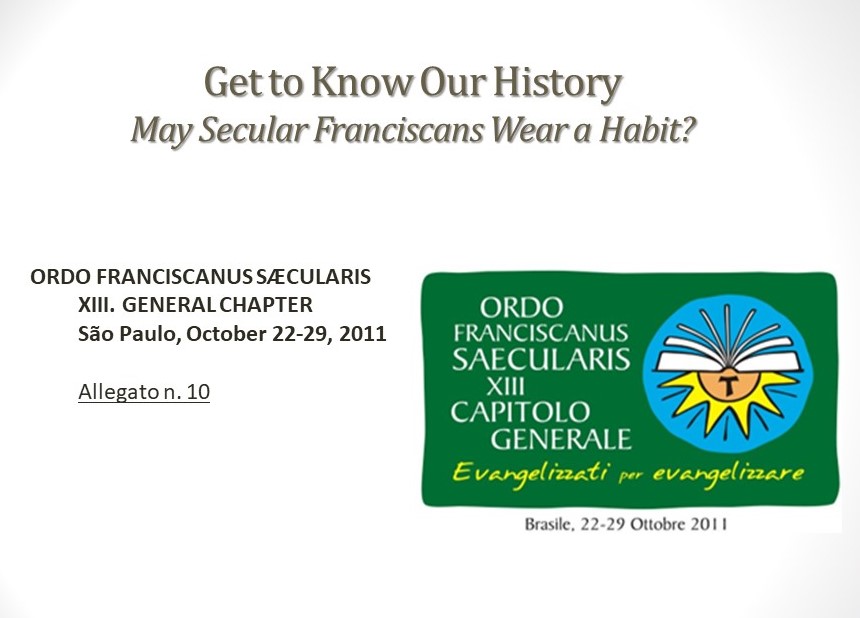
FORMATION FRIDAY – Histry of our Order: Use of the “habit” by Secular Francsicans – June 21, 2024
History of our Order: Use of the “habit” by Secular FranciscansIt is important for us to be aware of the history of our Order and why we do and do not do certain things. Here you can read the official document telling us that it was decided in 2011 that we are not to wear a habit. Many of us know this, some wonder about it, and new members hear about it and might not understand what we are talking about. So, here is a piece of our history.For reference: Article 5.2 of the General Constitutions states, “The practical interpretation of the Constitutions, with the purpose of harmonizing its application in different areas and at the various levels of the Order, belongs to the General Chapter of the OFS.”In the United States (and many other countries) the TAU cross is our distinctive sign of membership in the Order.The General Chapter makes the followingDECISIONThe practice of wearing a “habit” is not in conformity with the Rule and General Constitutions of the OFS, as already established.As a practical interpretation (cf. Art. 5.2 GGCC) of Article 43 of the General Constitutions, the Chapter emphasizes and insists that the distinctive sign of membership in the Order is the “Tau or other Franciscan symbol”. (GGCC 43). A “Franciscan symbol” is a small and simple insignia that is worn on the person (for example, a San Damiano cross).However, an OFS National Fraternity may determine in its National Statutes that the wearing a “uniform” is an acceptable sign of recognition for Secular Franciscans of their own country, providing that the following mandatory criteria is followed:a) the uniform does not replace the TAU or the Franciscan symbol selected by the National Fraternity;b) the nature of the uniform is to be specified in the National Statutes, including a detailed description (preferably graphical) and be of a style that respects the secularity of the members of the Order;c) the style of the uniform should not look like the habit worn by member of a religious Order, so as to avoid bringing confusion between religious and seculars;d) the occasions during which this uniform may be worn must be precisely indicated and specifically excludes its use during the rites of admission and/or profession.The Chapter states that the decision replaces all previous documents in this regard, and becomes in effect now and for the future.d) the occasions during which this uniform may be worn must be precisely indicated and specifically excludes its use during the rites of admission and/or profession.The Chapter states that the decision replaces all previous documents in this regard,and becomes in effect now and for the future.São Paolo, October 29, 2011Encarnación del Pozo, OFS, General Minister+++++++++++++++++++++++++++++++++++Formación 21 de junio, 2024: Por favor, compartir con su fraternidad local.Historia de nuestra Orden: Uso del “hábito” por los franciscanos seglaresEs importante que seamos conscientes de la historia de nuestra Orden y de por qué hacemos y no hacemos ciertas cosas. Aquí puede leer el documento oficial que nos dice que se decidió en 2011 que no debemos usar un hábito. Muchos de nosotros sabemos esto, algunos se preguntan al respecto, y los nuevos miembros se enteran de ello y es posible que no entiendan de qué estamos hablando. Entonces, aquí hay un pedazo de nuestra historia.A modo de referencia: El artículo 5.2 de las Constituciones Generales establece: “La interpretación práctica de las Constituciones, con el fin de armonizar su aplicación en los diversos ámbitos y en las diversas áreas y en los varios niveles de la Orden, corresponde al Capítulo General de la OFS”.En los Estados Unidos (y en muchos otros países) la TAU es nuestro signo distintivo de pertenencia a la Orden.El Capítulo general establece la siguienteDECISIÓNLa práctica de usar un “hábito” no está en conformidad con la Regla y las Constituciones Generales de la OFS, como ya está establecido.Como una interpretación práctica (cfr. Art. 5.2 GGCC) del Artículo 43 de las Constituciones Generales, el Capítulo reitera y confirma que el signo distintivo de pertenencia a la Orden es “la ‘Tau’ u otro símbolo franciscano” (Const. OFS 43). Un “símbolo franciscano” es una insignia pequeña y simple que lleva puesta la persona (por ejemplo, una cruz de San Damián).Sin embargo, una Fraternidad nacional OFS puede determinar en sus Estatutos nacionales que el uso de un “uniforme” puede ser un signo aceptable para distinguir a los franciscanos seglares de su propio país, siempre que los siguientes criterios obligatorios se cumplan:a) el uniforme no sustituye a la TAU ni al símbolo franciscano seleccionado por la Fraternidad Nacional;b) la naturaleza del uniforme se ha de especificar en los Estatutos Nacionales, incluyendo una descripción detallada (preferiblemente gráfica) y debe ser de un estilo que respete la secularidad de los miembros de la Orden;c) el estilo del uniforme no debe verse como el hábito usado por los miembros de una Orden religiosa, con el fin de evitar que se cree confusión entre religiosos y seglares;d) las ocasiones en que se puede usar el uniforme deben indicarse con precisión y excluyendo de modo específico su uso durante los ritos de admisión y / o profesión.El Capítulo establece que esta decisión sustituya todos los documentos anteriores sobre esta cuestión y que entre en vigor desde hoy y para el futuro.São Paolo, 19 de octubre de 2011Encarnación del Pozo, OFSMinistra GeneralDiane F. Menditto, OFSVice Minister, National Fraternity, Secular Franciscan Order USAListen – Discern – Go Forth National Theme 2022-2025
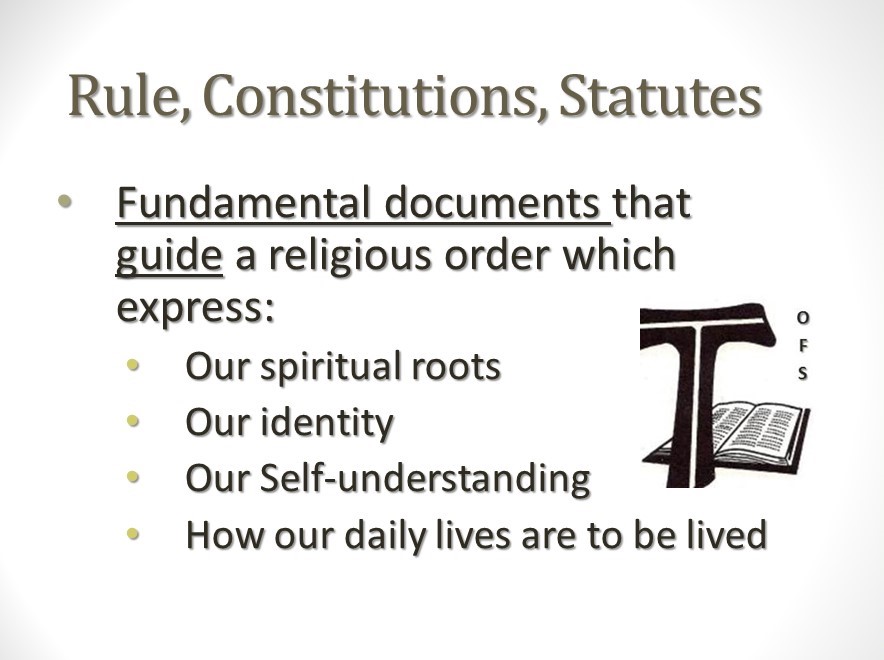
FORMATION FRIDAY – Documents of the Franciscan Order – June 14, 2024
Please share with your local fraternity
Documents of the Secular Franciscan Order
We have recently completed a series of Formation Fridays delineating each section of our Rule and providing commentary. We hope that each local fraternity has been encouraged to use those posts as a basis for ongoing formation on the Rule. It is also very important for each member (especially those serving on Councils) to become familiar with our General Constitutions and National Statutes since they help us to live out the Rule and to navigate most (or many) of the situations (both good and challenging) we encounter in fraternity life.
+ We have one Rule with a Prologue and 26 articles (Calling the articles “rules” implies a restrictive list rather than a way of life!)
Religious orders and institutes follow the charism of their founders. Generally, the founder writes or inspires the Rule of a particular community. The intention of a Rule is that the members of the order will have the inspiration of the founder to live by when he or she is no longer among them. The Rules of religious communities, although requiring approval by the Holy See, are general, most of the time without the specifics that will be necessary to govern a religious community and to live out the Rule authentically.
“The word ‘rule’ (Latin: regula, Greek: kanon) literally means a standard by which something can be tested. In the case of religious or secular institutes it establishes the spiritual foundation and identity of the community. It is the norm which all the other documentation of the institutes – constitutions, statutes, etc. – are measured. Approbation of rules for religious and secular institutes in the Church is reserved to the Holy See.” (See Michael Higgins, TOR, “Importance of Familiarization with the Documents of the Secular Franciscan Order.”)
A Rule is not a list or set of “rules” but the outline of a plan or way of life to help us live out the vision of the founder. In our case the vision for Secular Franciscans is put forth in a Prologue and 26 articles.
+We have General Constitutions which help us to carry out the Rule and govern the Order.
The Constitutions (also approved by the Holy See) are much more specific about the way the Rule should be interpreted and carried out. Here is an explanation by Fr. Lester Bach, OFM Cap., in the Franciscan Journey p. 106:
“The SFO (OFS) Constitutions contain comments on the Rule and insights for understanding the Rule. The Constitutions point out structures to help the Rule come alive in community life. The Constitutions spell out things like canonical procedures and structural developments. They deal with issues of lukewarm members and the role of the servant leaders
of fraternity life (councils). The Constitutions present ways and means to deal with issues that may arise in fraternity life.”
Ministers and Councils should take note that before difficult decisions are made about fraternity life or about individual members, the Constitutions should be consulted. Much confusion can be avoided if this suggestion is always followed.+National Statutes are developed by the National Fraternity to aid in governing all levels of the National Fraternity.
Article 29.3 of the General Constitutions calls for each national fraternity to develop its own statutes. “National Statutes should indicate the criteria for the organization of the OFS in the nation. The application of these criteria is left to the prudent judgement of those responsible for the Fraternities concerned and of the National Council.” National Statutes are not approved by the Holy See but must be approved by the council of the higher level. (CIOFS) The statutes of a particular country take into account the culture and customs of that country and add further particulars to what is laid out in the Constitutions. Statutes may be more restrictive than the Constitutions, but not less restrictive.
Every member should have access to the Rule, Constitutions, and Statutes. You will find our documents in their latest translations on our national website and on the CIOFS website. (Links below)
OFS Governing Documents: https://www.secularfranciscansusa.org/ongoing-formation-resources/#38871d71653d8dcec Official Documents of the OFS https://ciofs.info/library/official-documents/
Questions for discussion or to answer in your journal:
+When was the last time you read our Rule and Constitutions? Please take some time to read them: Choose two or three areas to focus on in the next week. Continue this practice until you have read both documents completely.
+List some of the items that stood out to you as you were completing the above “labor of love.”
+How does your fraternity use the Rule and Constitutions for ongoing formation? Make a list of ideas for their use and submit it to your local council or fraternity formation team.
+Resolve to pray one article of the Rule each day!
+++++++++++++++++++++++++++++++++++++
Formación 14 de junio de 2024 Por favor comparta con su fraternidad local
Documentos de la Orden Franciscana Seglar
Recientemente hemos completado una serie de materiales delineando cada sección de nuestra Regla y proporcionando comentarios. Esperamos que cada fraternidad local se haya animado a utilizar esas materias como base para la formación permanente sobre la Regla. También es muy importante que cada miembro (especialmente los que forman parte de los Consejos) se familiarice con nuestras Constituciones Generales y Estatutos Nacionales, ya que nos ayudan a vivir la Regla y a navegar la mayoría (o muchas) de las situaciones (tanto buenas como desafiantes) que encontramos en la vida de fraternidad.
+ Tenemos una Regla con un Prólogo y 26 artículos (¡Llamar a los artículos “reglas” implica una lista restrictiva en lugar de una forma de vida!)
Las órdenes e institutos religiosos siguen el carisma de sus fundadores. Generalmente, el fundador escribe o inspira la Regla de una determinada comunidad. La intención de una Regla es que los miembros de la orden tengan la inspiración del fundador para vivir cuando él o ella ya no esté entre ellos. Las Reglas de las comunidades religiosas, aunque requieren la aprobación de la Santa Sede, son generales, la mayoría de las veces sin las especificidades que serán necesarias para gobernar una comunidad religiosa y vivir auténticamente la Regla.
“La palabra ‘regla’ (latín: regula , griego: kanon ) literalmente significa un estándar por el cual algo puede ser probado. En el caso de institutos religiosos o seglares establece el fundamento espiritual y la identidad de la comunidad. Es la norma por la que se mide toda la demás documentación de los institutos – constituciones, estatutos, etc. La aprobación de las normas para los institutos religiosos y seglares de la Iglesia está reservada a la Santa Sede”. (Ver Michael Higgins, TOR, “Importancia de la familiarización con los documentos de la Orden Franciscana Seglar”).
Una Regla no es una lista o un conjunto de “reglas,” sino el esquema de un plan o forma de vida para ayudarnos a vivir la visión del fundador. En nuestro caso, la visión para los franciscanos seglares se expone en un prólogo y 26 artículos.
+Tenemos Constituciones Generales que nos ayudan a llevar a cabo la Regla y a gobernar la Orden.
Las Constituciones (también aprobadas por la Santa Sede) son mucho más específicas sobre la forma en que debe interpretarse y llevarse a cabo la Regla. Aquí hay una explicación del P. Lester Bach, OFM Cap., en La jornada franciscana p. 106:
“Las Constituciones OFS (OFS) contienen comentarios sobre la Regla e ideas para comprender la Regla. Las Constituciones señalan estructuras para ayudar a que la Regla cobre vida en la vida comunitaria. Las Constituciones explican cosas como procedimientos canónicos y desarrollos estructurales. Se ocupan de cuestiones de los miembros tibios y el papel de los líderes servidores de la vida de la fraternidad (consejos). Las Constituciones presentan formas y medios para tratar los problemas que pueden surgir en la vida de la fraternidad. En cierto sentido, las Constituciones se convierten en un amplio comentario sobre la vida franciscana seglar. regla y vida.”
Los Ministros y los Consejos deben tomar nota de que antes de tomar decisiones difíciles sobre la vida de la fraternidad o sobre cada uno de los miembros, se deben consultar las Constituciones. Se puede evitar mucha confusión si siempre se sigue esta sugerencia.
+Los Estatutos Nacionales son desarrollados por la Fraternidad Nacional para ayudar a gobernar todos los niveles de la Fraternidad Nacional.
El artículo 29.3 de las Constituciones Generales llama a cada fraternidad nacional a desarrollar sus propios estatutos. “Los Estatutos nacionales deben indicar los criterios de organización de la OFS en la nación. La aplicación de estos criterios se deja al prudente juicio de los Responsables de las Fraternidades interesadas y del Consejo nacional.” Los Estatutos Nacionales no son aprobados por la Santa Sede sino que deben ser aprobados por el consejo del nivel superior. (CIOFS) Los estatutos de un país en particular tienen en cuenta la cultura y las costumbres de ese país y añaden más detalles a lo dispuesto en las Constituciones. Los Estatutos pueden ser más restrictivos que las Constituciones, pero no menos restrictivos.
Cada miembro debe tener acceso a la Regla, a las Constituciones y a los Estatutos. Encontrará nuestros documentos en sus últimas traducciones en nuestro sitio web nacional y en el sitio web del CIOFS. (Enlaces a continuación)
Documentos rectores de la OFS : https://www.secularfranciscansusa.org/ongoing-formation-resources/#38871d71653d8dcec Documentos Oficiales de la OFS: https://ciofs.info/es/library/official-documents/
Preguntas para discutir o responder en tu diario:
+ ¿Cuándo fue la última vez que leyó nuestra Regla y Constituciones? Tómese un tiempo para leerlos: elija dos o tres áreas en las que concentrarse la próxima semana. Continúe con esta práctica hasta que haya leído ambos documentos por completo.
+ Enumere algunos de los elementos que se destacaron para usted mientras completaba el “trabajo de amor” anterior.
+¿Cómo utiliza su fraternidad la Regla y las Constituciones para la formación permanente? Haga una lista de ideas para su uso y envíela a su consejo local o al equipo de formación de la fraternidad.
+ ¡Resuelva rezar un artículo de la Regla cada día!
Diane F. Menditto, OFSVice Minister, National Fraternity, Secular Franciscan Order USAListen – Discern – Go Forth National Theme 2022-2025
FORMATION FRIDAY – Do you ever wondered about Angels? – June 7, 2024 –
Do you ever wonder about angels?
· The existence of the spiritual, non-corporeal beings that Sacred Scripture usually calls “angels” is a truth of faith. The witness of Scripture is as clear as the unanimity of Tradition. (CCC 328 )
· St. Augustine says: “‘Angel’ is the name of their office, not of their nature…..'”188 (CCC 329)
· With their whole beings the angels are servants and messengers of God. Because they “always behold the face of my Father who is in heaven” they are the “mighty ones who do his word, hearkening to the voice of his word”.189 (CCC 329)
· As purely spiritual creatures angels have intelligence and will: they are personal and immortal creatures, surpassing in perfection all visible creatures, as the splendor of their glory bears witness.190 (CCC 330)
· Angels have been present since creation and throughout the history of salvation, announcing this salvation from afar or near and serving the accomplishment of the divine plan: … (CCC 332)
· From its beginning until death, human life is surrounded by their watchful care and intercession.202 “Beside each believer stands an angel as protector and shepherd leading him to life.”203 Already here on earth the Christian life shares by faith in the blessed company of angels and men united in God. (CCC 336)
For complete entries see #s 328-336 in the Catechism of the Catholic Church.
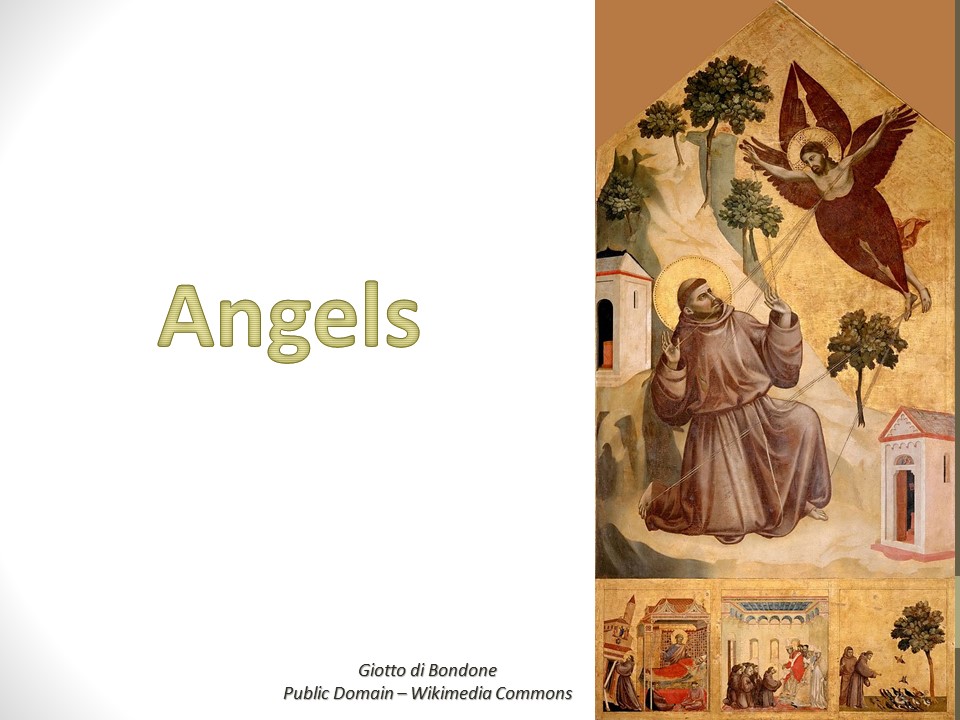
CCC is online at https://www.catholicculture.org/culture/library/catechism/ (searchable)· Traditionally the angels are classified into what are called nine “choirs” or “ranks.” This division is based on nine names of angels found in Sacred Scripture. This is an accepted Catholic belief but is not dogma. The names do not appear in the Catechism. According to these rankings, only Archangels and “regular” angels have contact with humans. Two of the exceptions to this are: a Seraph touched a burning ember to the lips of the Prophet Isaiah, and St. Francis was visited in a vision by a Seraph on Mt. La Verna.
(See Aleteia: https://aleteia.org/2017/09/28/the-9-choirs-of-angels-and-the-roles-given-them-by-god/ )
· St. Thomas Aquinas devotes an entire question to the angels in the Summa Theologiae. (See New Advent: https://www.newadvent.org/summa/1108.htm )
· The names of the nine choirs of angels are: Seraphim, Cherubim, Thrones, Dominions, Virtues, Powers, Archangels, Principalities, Angels. (For a description of each choir see Catholic.org https://www.catholic.org/saints/angels/angelchoir.php )
· In case you were wondering—”The Bible and the Church recognize seven archangels, although just three are known by name, Michael, Gabriel, and Raphael.” Other, non-biblical sources mention four other names, but they are not recognized by the Church.
· The highest order of angels is the SERAPHIM. This is particularly significant for Franciscans.
· The Seraphim are closest to God, and they praise him day and night. Seraphim means “the burning ones.”
· St. Francis was visited by a Seraph in a vision on Mt. La Verna. This is why he is called our Seraphic Father.
· Thomas of Celano mentions the six wings of the Seraph.
· In The Soul’s Journey Into God, St. Bonaventure uses “the imagery of the six wings of the Seraph as indicators and reminders of the comprehensive and full spirituality of St. Francis, and of anyone who would follow his inspiration.” (see link below)
· Read a full description of St. Bonaventure’s explanation of the six wings of the Seraph in an excellent article on “The Seraphic Vision on Mt. La Verna” by Fr. John Sullivan, OFM, (topic #18) on the OFS-USA website here: https://secularfranciscansusa.org/topics-for-keeping-our-focus-on-st-francis-of-assisi/
Questions for discussion or to answer in your journal.
+ Think about angels. What role do they play in your life?
+ Read the article about “The Seraphic Vision on Mt. La Verna.” Think about St. Francis’s vision of the Seraph. What did you learn about this experience? What effect does seeing this event in the life of St. Francis more clearly have on your spiritual life?
++++++++++++++++++++++++
Por favor-compartir con la fraternidad local
¿Alguna vez te has preguntado acerca de los ángeles?
• La existencia de los seres espirituales, incorpóreos, que la Sagrada Escritura suele llamar “ángeles”, es una verdad de fe. El testimonio de la Escritura es tan claro como la unanimidad de la Tradición. (CIC 328 )
• San Agustín dice: “‘Ángel’ es el nombre de su oficio, no de su naturaleza…”188 (CIC 329)
• Con todo su ser, los ángeles son servidores y mensajeros de Dios. Porque ellos “miran siempre el rostro de mi Padre que está en los cielos” son los “poderosos que cumplen su palabra, escuchando la voz de su palabra”.189 (CIC 329)
• Como criaturas puramente espirituales, los ángeles tienen inteligencia y voluntad: son criaturas personales e inmortales, superando en perfección a todas las criaturas visibles, como lo atestigua el esplendor de su gloria.190 (CIC 330)
• Los ángeles han estado presentes desde la creación y a lo largo de la historia de la salvación, anunciando esta salvación de lejos o de cerca y sirviendo a la realización del plan divino: … (CIC 332)
• Desde su comienzo hasta la muerte, la vida humana está rodeada por su cuidado vigilante e intercesión.202 “Al lado de cada creyente está un ángel como protector y pastor que lo lleva a la vida”.203 Ya aquí en la tierra, la vida cristiana comparte por la fe en el bienaventurado compañía de ángeles y hombres unidos en Dios. (CIC 336)
Para las anotaciones completas, vea los números 328-336 en el Catecismo de la Iglesia Católica.
https://www.vatican.va/archive/catechism_sp/index_sp.html
• Tradicionalmente los ángeles se clasifican en lo que se llama nueve “coros” o “rangos.” Esta división se basa en nueve nombres de ángeles que se encuentran en la Sagrada Escritura. Esta es una creencia católica aceptada pero no es un dogma. Los nombres no aparecen en el Catecismo. De acuerdo con estas clasificaciones, solo los Arcángeles y los ángeles “regulares” tienen contacto con los humanos. Dos de las excepciones a esto son: un Serafín tocó una brasa ardiente en los labios del Profeta Isaías, y San Francisco fue visitado en una visión por un Serafín en el Monte La Verna.
(Ver https://es.catholic.net/op/articulos/9763/cat/123/la-jerarquia-angelica.html#modal )
• Santo Tomás de Aquino dedica toda una pregunta a los ángeles en la Summa Theologiae.
(Ver https://hjg.com.ar/sumat/ en particular https://hjg.com.ar/sumat/a/index.html#c50 )• Los nombres de los nueve coros de ángeles son: Serafines, Querubines, Tronos, Dominaciones, Virtudes, Potestades, Arcángeles, Principados, Ángeles. (Para obtener una descripción de cada coro, consulte Catholic.net en español https://es.catholic.net/op/articulos/9763/cat/123/la-jerarquia-angelica.html )
• En caso de que se lo pregunte: “La Biblia y la Iglesia reconocen siete arcángeles, aunque sólo tres son conocidos por su nombre: Miguel, Gabriel y Rafael”. Otras fuentes no bíblicas mencionan otros cuatro nombres, pero no son reconocidos por la Iglesia.”
• El orden más alto de ángeles es el SERAFÍN. Esto es particularmente significativo para los franciscanos.
• Los Serafines son los más cercanos a Dios y lo alaban día y noche. Serafín significa “los ardientes.”
• San Francisco fue visitado por un Serafín en una visión en el Monte La Verna. Por eso se le llama nuestro Seráfico Padre.
• Tomás de Celano menciona las seis alas del Serafín.
• En “El viaje del alma hacia Dios,” San Buenaventura usa “las imágenes de las seis alas del Serafín como indicadores y recordatorios de la espiritualidad integral y plena de San Francisco, ….” (ver enlace abajo)
• Lea una descripción completa de la explicación de San Buenaventura de las seis alas del Serafín en un excelente artículo sobre “La Visión Seráfica en el Monte La Verna” por el Padre. John Sullivan, OFM, (tema 18) en el sitio web de OFS-USA aquí: https://secularfranciscansusa.org/topics-for-keeping-our-focus-on-st-francis-of-assisi/ (en inglés)
Preguntas para platicar o para responder en su diario.
+ Piense en los ángeles. ¿Qué papel juegan en su vida?
+ Piense en la visión de San Francisco del Serafín. ¿Qué efecto tiene el conocimiento de este evento en su vida espiritual?
Diane F. Menditto, OFSVice Minister, National Fraternity, Secular Franciscan Order USAListen – Discern – Go Forth National Theme 2022-2025